LifeWise Academy Lawsuit 2026: Every Active Case Explained and Verified
Quick Answer
- “LifeWise Academy lawsuit” actually refers to at least three separate legal matters, not one case.
- There is no consumer settlement fund or claim process tied to any LifeWise litigation.
- A federal judge partially sided with LifeWise against a Washington school district on April 24, 2026.
If you’re searching for “the LifeWise Academy lawsuit,” here’s the direct answer: there isn’t just one. At least three distinct legal matters involving LifeWise Academy have played out since 2024, and they point in different directions, with LifeWise as both plaintiff and defendant depending on the case.
This matters if you’re a parent in a district considering LifeWise’s religious release-time program, a district official facing a similar dispute, or someone who saw a headline and wants the real story. The most active case right now involves LifeWise suing a Washington school district, not the other way around.
This article walks through each verified legal matter separately, including a federal court’s recent ruling in LifeWise’s favor, a resolved copyright case, and a pending Ohio discrimination claim. One detail most coverage buries: none of these cases involve any settlement fund or payout that parents or students could claim.
The Facts: What’s Verified Across These Cases
| Category | Verified Detail |
|---|---|
| Most Active Case | LifeWise Inc. et al. v. Everett Public School District et al., No. 2:2025cv02604 |
| Court | U.S. District Court, Western District of Washington |
| Judge | Lauren King |
| Status | Preliminary injunction partially granted in LifeWise’s favor on April 24, 2026; case ongoing |
| Resolved Copyright Case | LifeWise Inc. v. Zachary Parrish, U.S. District Court, N.D. Indiana, No. 1:24-cv-00268, settled and dismissed December 2024 |
| Pending Ohio Matter | Rachel Snell v. LifeWise (Stand for Truth), discrimination claim; Ohio Supreme Court cleared the way for Snell to sue in October 2025 |
| Settlement Fund | Not applicable, none of these are consumer class actions |
| Per-Person Payout | Not applicable |
| Claim Deadline for the Public | Not applicable, no consumer claim process exists |
| Organization | LifeWise Inc., Hilliard, Ohio, founded 2019 by Joel Penton |
These are separate legal proceedings with separate parties, timelines, and outcomes. Treating them as one unified “lawsuit” misrepresents what’s actually happening in court.
Is There Really a “LifeWise Academy Lawsuit”? What’s Actually Being Litigated?
No single lawsuit covers everything people mean when they search this term. At least three distinct legal matters have unfolded since 2024, involving different courts, different parties, and different legal theories entirely.
One case has LifeWise as the plaintiff suing a school district over alleged discrimination against its religious program. Another had LifeWise suing a critic for copyright infringement, which has already settled. A third involves a former LifeWise employee pursuing a discrimination claim against the organization itself.
Key Takeaway: Anyone searching “LifeWise Academy lawsuit” needs to specify which case they mean, since LifeWise appears as both plaintiff and defendant across separate, unrelated legal proceedings.
Is LifeWise Academy a Scam or Facing Fraud Charges?
No, none of LifeWise’s current legal matters involve fraud or scam allegations against the organization. LifeWise operates under “released time” religious instruction laws, a legal framework upheld by the U.S. Supreme Court in Zorach v. Clauson in 1952.
LifeWise states its programs are privately funded through donations, with no cost to schools or participating families, and no taxpayer funding involved. The organization’s legal disputes center on First Amendment questions, employment discrimination claims, and copyright issues, not financial fraud against families.
Can Parents or Students File a Claim Against LifeWise Academy?
No, there is currently no consumer claim process, settlement fund, or payout tied to any active LifeWise Academy litigation. This is not a class action lawsuit, and none of the current cases involve compensation available to the general public.
If you have a specific complaint, such as a discrimination concern as a former employee or a dispute over your child’s treatment at school in connection with the program, that would require filing your own individual legal action or complaint with the relevant agency, separate from any of the cases described here.
Key Takeaway: No form, deadline, or claim number exists for LifeWise Academy litigation because none of these cases are structured as consumer settlements.
Reality Check: Anyone contacting you claiming you can “join” a LifeWise Academy lawsuit for a payout is not describing any real, verified case. No official settlement administrator or claims process exists for these matters as of this writing.
What Happened in the LifeWise v. Everett School District Lawsuit?
LifeWise Academy sued the Everett Public School District in Washington state in December 2025, alleging the district discriminated against its religious release-time program. First Liberty Institute and Bryan Cave Leighton Paisner LLP filed the case on LifeWise’s behalf.
The lawsuit followed a December school board meeting where a district board member publicly stated he held “animus” toward LifeWise, calling it an organization of “homophobic bullies” allegedly working toward “an authoritarian theocracy.” That statement became a key piece of evidence in the case.
On April 24, 2026, U.S. District Judge Lauren King partially granted LifeWise’s request for a preliminary injunction. The court found LifeWise and co-plaintiff Sarah Sweeny, a parent and LifeWise staff member, were likely to succeed on key First Amendment claims.
What Did the Court Order in the Everett Case Injunction?
The court’s April 2026 order required Everett Public Schools to make several specific changes, though it stopped short of granting everything LifeWise requested. The judge found the district’s regulations targeted LifeWise specifically in ways that likely violated the First Amendment.
The court’s order required the district to:
- Permit LifeWise to participate in the district’s community resource fairs
- Permit LifeWise to display printed flyers in schools where secular organizations are allowed to do so
- Allow permission slips releasing students to LifeWise programs on a semester-long basis, rather than requiring weekly renewal
- Permit reading of LifeWise materials during school time when students may read other non-scholastic materials
The judge specifically rejected LifeWise’s broader request to block any district requirement not applied to every other organization, finding that request too vague. This means the injunction is narrower than LifeWise originally sought, even though the ruling favored LifeWise overall.
Key Takeaway: The Everett case produced a real, verified court win for LifeWise on specific practices, but the ruling was deliberately narrowed by the judge rather than a total victory.
What Happened to the LifeWise Copyright Lawsuit Against Zachary Parrish?
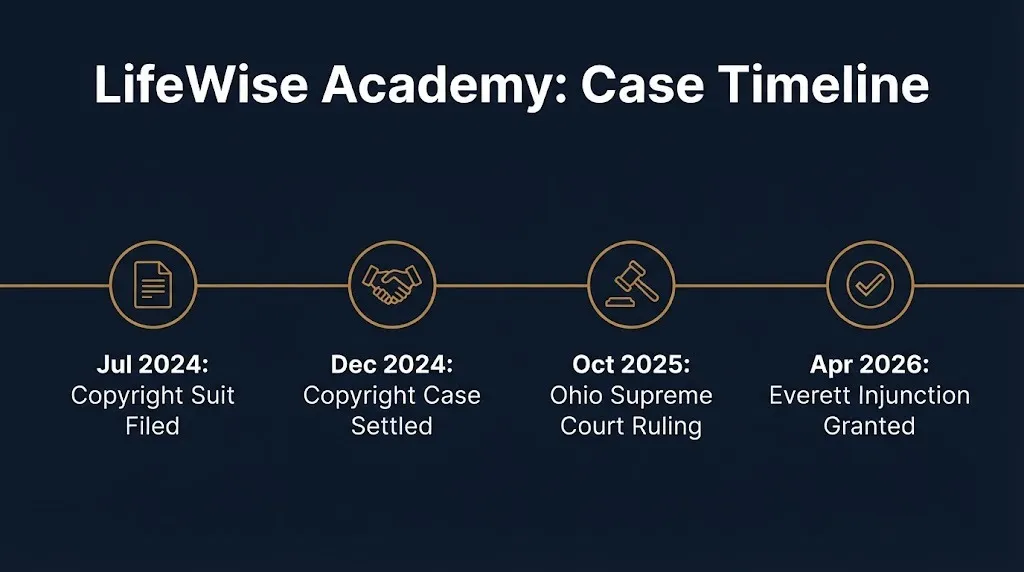
This case is fully resolved. LifeWise sued Zachary Parrish, a parent and co-founder of “Parents Against LifeWise,” for copyright infringement in July 2024 in federal court in Indiana, and the case settled in December 2024.
LifeWise alleged Parrish posed as a volunteer to access its password-protected curriculum, then posted it publicly. Parrish argued his actions were fair use. LifeWise had originally sought up to $150,000 in damages along with an order forcing Parrish to destroy the materials.
| Settlement Term | Verified Detail |
|---|---|
| Money Exchanged | None, neither party paid the other |
| Parrish’s Obligation | Delete his copies of the curriculum and ask others to do the same |
| LifeWise’s Obligation | Make its curriculum available to any requester for 48-hour viewing windows |
| Admission of Guilt | Neither party admitted wrongdoing |
Key Takeaway: This case ended in a mutual settlement with no money changing hands, and it created an ongoing 48-hour curriculum access policy that continues today.
What Is the Rachel Snell Discrimination Case Against LifeWise?
Rachel Snell, a former LifeWise instructor, alleges the organization forced her to resign after she refused to falsify her work hours. She filed a discrimination complaint with the Ohio Civil Rights Commission (OCRC).
LifeWise responded by filing a writ of mandamus asking the Ohio Supreme Court to block the OCRC’s investigation, citing the “ministerial exception,” a legal doctrine limiting government interference in religious organizations’ employment decisions. The OCRC closed its investigation and issued Snell a Notice of Right to Sue on June 26, 2025, before making a final determination.
In October 2025, the Ohio Supreme Court denied LifeWise’s request, allowing Snell’s underlying discrimination claim to proceed. Under Ohio law, Snell generally has two years from the date of the alleged discriminatory practice to file a civil lawsuit, with that period tolled during the OCRC’s investigation.
How Do You Check the Status of These Cases Yourself?
You can verify each case directly rather than relying on secondhand summaries that may conflate separate matters. Here’s how to check.
- For the Everett case, search Case No. 2:25-cv-02604 in the Western District of Washington through PACER or Justia
- For the Parrish case, search Case No. 1:24-cv-00268 in the Northern District of Indiana
- For the Snell matter, check Ohio Supreme Court case filings under the LifeWise mandamus proceeding
- Cross-reference any claim against LifeWise’s own public statements on its official website
- Confirm publication dates on any article you read, since this topic has multiple overlapping timelines
Why Is LifeWise Academy Facing Legal Challenges at All?
LifeWise operates under decades-old legal precedent allowing “released time” religious instruction during school hours, provided it happens off school property, is privately funded, and requires parental permission. Critics argue specific implementation details can still raise constitutional concerns.
Opponents, including some parents and organizations like the Freedom From Religion Foundation, argue that heavy promotion within schools, disruption to non-participating students, or entanglement between school staff and the program can cross constitutional lines even under a technically legal framework.
Think of it like a permitted after-school club that’s legal in principle but can still get challenged if a specific school administers it in a way that favors it over others. That’s the core tension driving the Everett case and similar disputes elsewhere.
Key Takeaway: LifeWise’s legal basis to operate is well established under Supreme Court precedent, but how individual districts implement or restrict the program keeps generating separate, fact-specific legal disputes.
What Recent Safety Concerns Have Been Raised About LifeWise Academy?
In 2026, three Ohio men previously connected to LifeWise Academy as teachers or volunteers were charged with or pleaded guilty to sex crimes against minors, including rape, voyeurism, and sexual battery. These are separate criminal matters, not part of the civil litigation described above.
Christopher Riggs and Kenneth Holycross III previously worked as LifeWise teachers, and William VanSickle previously volunteered with the program. LifeWise stated it received zero reports of misconduct involving LifeWise students in connection with these matters or during LifeWise programming itself.
LifeWise said all staff and volunteers undergo background screenings through a third-party service before serving, and that students are never left one-on-one with a single adult during programming. The organization stated the men passed required background checks that revealed no disqualifying prior offenses.
How Big Is LifeWise Academy and Why Does That Matter Legally?
LifeWise has grown rapidly since its 2019 founding, and that scale is part of why its legal disputes draw national attention. Recent reporting indicates the organization operates in dozens of states and serves tens of thousands of students.
According to Ohio Capital Journal reporting published in February 2026, LifeWise raised more than $39 million in its most recent fiscal year, with profit reported at $11.1 million, down from a higher figure the prior year. The organization has stated its funding comes entirely from private donations, with no taxpayer dollars involved.
This scale matters legally because larger, faster-growing programs create more individual points of friction with specific school districts, increasing the likelihood that some disputes escalate into formal litigation like the Everett case.
What Happens Next: Timeline to Watch
April 24, 2026: Preliminary injunction partially granted in LifeWise’s favor in the Everett Public Schools case.
Ongoing: The Everett case proceeds toward further litigation beyond the preliminary injunction stage.
Ongoing: Rachel Snell’s underlying discrimination claim against LifeWise may proceed in Ohio courts following the state Supreme Court’s October 2025 ruling.
Resolved: The Parrish copyright case remains closed as of its December 2024 settlement, with the curriculum access policy still in effect.
Frequently Asked Questions
Is there one single LifeWise Academy lawsuit?
No, at least three separate legal matters involving LifeWise Academy have been active since 2024.
These include a First Amendment case LifeWise filed against a school district, a resolved copyright case, and an Ohio employment discrimination claim.
Each has its own court, timeline, and outcome.
Did LifeWise Academy win its lawsuit against a school district?
LifeWise won a partial preliminary injunction against Everett Public Schools on April 24, 2026.
The court found LifeWise likely to succeed on key First Amendment claims, but narrowed the relief compared to what LifeWise originally requested.
The underlying case has not fully concluded.
Can I file a claim if I have a complaint about LifeWise Academy?
There is no consumer settlement fund or claim process tied to any current LifeWise litigation.
If you have an individual complaint, you would need to pursue your own separate legal action or agency complaint.
No form or deadline applies broadly to the public in these cases.
What happened to the LifeWise copyright lawsuit?
The copyright case against Zachary Parrish settled in December 2024 with no money exchanged.
Parrish agreed to remove his copies of the curriculum, and LifeWise agreed to make the curriculum available to any requester in 48-hour windows.
Neither party admitted wrongdoing in the settlement.
Is LifeWise Academy legal under the Constitution?
LifeWise operates under “released time” religious instruction laws upheld by the U.S. Supreme Court in Zorach v. Clauson in 1952.
This framework is generally legal when instruction happens off school property, is privately funded, and requires parental consent.
Specific implementation disputes at individual school districts can still lead to separate legal challenges.
What is the Rachel Snell case against LifeWise about?
Rachel Snell, a former LifeWise instructor, alleges she was forced to resign after refusing to falsify her work hours.
The Ohio Supreme Court ruled in October 2025 that she could proceed with her discrimination claim.
LifeWise had argued the “ministerial exception” should block the underlying investigation.
Have there been safety concerns raised about LifeWise Academy programs?
In 2026, three Ohio men previously connected to LifeWise as teachers or volunteers were charged with or pleaded guilty to sex crimes against minors.
LifeWise stated it received no reports connecting these matters to actual LifeWise programming or students.
These are separate criminal proceedings, not part of the civil litigation described in this article.
If you’re trying to track a specific LifeWise Academy legal matter, confirm which case you mean using the court and case numbers listed above rather than treating this as one unified lawsuit. The most active case to watch is the Everett Public Schools dispute, which remains ongoing beyond its April 2026 preliminary injunction ruling.