Texas Ten Commandments Lawsuit 2026: Supreme Court Petition, Fifth Circuit Ruling, and What Comes Next
Quick Answer
- The Texas Ten Commandments lawsuit challenges SB 10, which requires public school classrooms to display a Protestant version of the Ten Commandments.
- The Fifth Circuit upheld the law 9-8 in April 2026, and families filed a Supreme Court petition in August 2026.
- No Supreme Court decision has been issued, and enforcement remains active outside school districts covered by injunctions.
Is the Texas Ten Commandments Lawsuit Real?
The Texas Ten Commandments lawsuit is real, and it has become a national test case over religion in public schools.
The lead case is Rabbi Nathan v. Alamo Heights Independent School District, filed in July 2025 in the U.S. District Court for the Western District of Texas .
A group of multifaith families sued after Texas passed Senate Bill 10, which requires every public school classroom to display a state-approved version of the Ten Commandments .
The plaintiffs include Christian, Jewish, Hindu, Unitarian Universalist, Baha’i, and nonreligious families, plus several clergy members .
Key Takeaway: This is a live constitutional fight, not a settlement case. No one is getting paid, and the outcome will shape what goes on public school walls nationwide.
What Does Texas Senate Bill 10 Actually Require?
Texas Senate Bill 10 requires public schools to display the Ten Commandments in every classroom in a conspicuous location. The display must be at least 16 by 20 inches and readable from anywhere in the room . The required version is the Protestant King James translation . Schools are not required to buy the posters themselves. They must accept donated posters that meet the law’s specifications . This detail matters because some districts argue they cannot be forced to display something they never purchased.
| SB 10 Requirement | Detail |
|---|---|
| Display size | At least 16 by 20 inches |
| Translation | King James Version (Protestant) |
| Location | Conspicuous place in every classroom |
| Purchase rule | Schools not required to buy; must accept donations |
| Effective date | September 1, 2025 |
How Much Does the Texas Ten Commandments Lawsuit Pay?
The Texas Ten Commandments lawsuit does not pay anyone. It is a constitutional challenge, not a settlement or class action payout.
There is no fund, no claim deadline, and no per-person payout. The plaintiffs are asking the courts to strike down the law and block its enforcement .
If you see ads or social posts promising money from this case, they are false. This is a religious freedom dispute, not a consumer claim.
Key Takeaway: There is no settlement money here. The only stakes are whether the law stands or falls.
Who Are the Plaintiffs in the Texas Ten Commandments Lawsuit?
The plaintiffs are more than two dozen Texas families with children in public schools. They come from a wide range of faith backgrounds and none .
The lead case is named for Rabbi Mara Nathan, a Jewish clergy member and parent. The families are represented by the American Civil Liberties Union, ACLU of Texas, Americans United for Separation of Church and State, the Freedom From Religion Foundation, and the law firm Simpson Thacher & Bartlett .
Individual plaintiffs include Nichole Manning, an atheist mother from the Dallas area, and Rabbi Joshua Fixler of Houston . Both have spoken publicly about concerns that the law will make their children feel like outsiders.
Several plaintiffs are clergy members from Christian traditions that oppose government-sponsored religion .
What Did the Fifth Circuit Rule on the Texas Ten Commandments Law?
The Fifth Circuit ruled 9-8 in April 2026 that Texas can enforce Senate Bill 10. The court found the law does not violate the Establishment Clause or the Free Exercise Clause .
Writing for the majority, Judge Stuart Kyle Duncan said the law “looks nothing like a historical religious establishment” . He pointed to recent Supreme Court decisions that replaced the old Lemon test with a focus on historical practices.
The majority also rejected the argument that the law coerces students. “All the law requires is a poster on a classroom wall,” the ruling said .
Eight judges dissented. Judge Irma Carrillo Ramirez wrote that the law clearly violates the First Amendment and that the Supreme Court’s 1980 decision in Stone v. Graham remains binding .
Reality Check: Court rulings are not press releases. The Fifth Circuit’s majority opinion says the law does not coerce anyone, but the dissenting judges say it plainly does. Both sides are reading the same Constitution and reaching opposite conclusions. That is exactly why the Supreme Court is now being asked to step in.
What Happened With the Supreme Court Petition?
Families challenging the law filed a petition with the U.S. Supreme Court on August 17, 2026, asking the justices to review the Fifth Circuit’s ruling .
The petition asks the court to decide two questions. First, whether the Establishment Clause forbids states from mandating permanent displays of a government-selected version of the Ten Commandments in every public school classroom. Second, whether such displays interfere with parents’ free exercise rights to direct their children’s religious education .
The ACLU argues that the Fifth Circuit “flouted this Court’s binding precedents” and that only the Supreme Court can overrule its own prior decisions .
No date has been set for the Supreme Court to decide whether it will take the case. Alamo Heights Independent School District has not filed a public response .
What Is the Difference Between Stone v. Graham and Kennedy v. Bremerton?
Stone v. Graham is a 1980 Supreme Court ruling that struck down a Kentucky law requiring Ten Commandments displays in public schools. The court found the law had no secular purpose .
Kennedy v. Bremerton is a 2022 decision that allowed a football coach to pray at midfield after games. It eliminated the Lemon test, the standard courts had used for decades to judge Establishment Clause cases .
The Fifth Circuit majority said Kennedy effectively overruled Stone by removing the legal basis for it. “With Lemon extracted, there is nothing left of Stone,” Judge Duncan wrote .
The dissenting judges say that is not how it works. Only the Supreme Court can overturn its own precedents, and it has not explicitly done so .
Which Texas School Districts Are Affected by the Injunctions?
As of February 2026, 25 Texas school districts were covered by federal injunctions and not required to display the Ten Commandments .
The first injunction covers Alamo Heights, North East, Lackland, Northside, Austin, Lake Travis, Dripping Springs, Houston, Fort Bend, Cypress-Fairbanks, and Plano ISDs .
The second covers Comal, Georgetown, Conroe, Flour Bluff, Fort Worth, Arlington, McKinney, Frisco, Northwest, Azle, Rockwall, Lovejoy, Mansfield, and McAllen ISDs .
Districts outside those injunctions are subject to SB 10 enforcement. Some have displayed the posters. Others have not, citing the ongoing litigation.
Is the Texas Ten Commandments Law Enforced Right Now?
Yes, the law is enforceable outside the districts covered by injunctions. The Fifth Circuit’s April ruling cleared the way for statewide enforcement .
Texas Attorney General Ken Paxton has opened investigations into districts that have not displayed the posters. His office sent letters demanding proof of compliance or a board vote on prayer policies .
Some districts have pushed back. Conroe ISD said it was following written guidance from the Attorney General’s office not to display the posters while separate litigation is pending .
The Texas Education Agency has not issued uniform enforcement guidance. That means districts are interpreting their obligations differently.
What Is the New State-Level Lawsuit Against the Ten Commandments Law?
Three Houston-area mothers filed a new lawsuit in Harris County in July 2026, arguing that SB 10 violates Texas law, not just the U.S. Constitution .
The plaintiffs, Sanjam Kaur Sohal, Dr. Audrey Rosa Nath, and Emily Roth, are suing the state, Houston ISD, Cy-Fair ISD, and Spring Branch ISD. They argue the law violates the Texas Religious Freedom Restoration Act and a recent state constitutional amendment protecting parents’ rights .
Dr. Nath told Houston Public Media that the Protestant version of the commandments conflicts with her family’s Jain, Hindu, Jewish, and Quaker beliefs .
This state-level challenge is separate from the federal case heading to the Supreme Court. It does not have a hearing scheduled yet.
What Happens Next in the Texas Ten Commandments Lawsuit?
The next major step is whether the Supreme Court agrees to hear the case. If it declines, the Fifth Circuit ruling stands and SB 10 remains enforceable in most Texas districts.
If the court takes the case, a ruling could come in 2027. The outcome would affect not just Texas, but similar laws in Louisiana, Arkansas, and Alabama .
Here is the likely sequence:
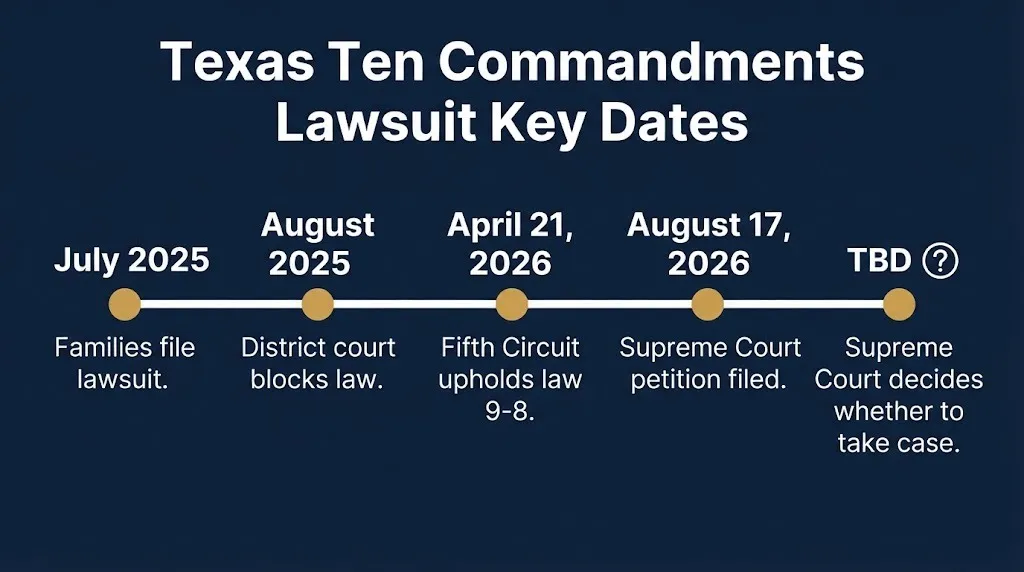
- August 17, 2026: Supreme Court petition filed. Families ask justices to block SB 10 .
- TBD: Supreme Court decides whether to grant certiorari. No date confirmed.
- TBD: If granted, oral arguments and briefing. No timeline confirmed.
- TBD: State-level Harris County case moves through Texas courts. No hearing scheduled .
Frequently Asked Questions
Is the Texas Ten Commandments lawsuit a class action?
No. The lead federal case is a civil rights lawsuit filed by individual families.
A separate class action was filed in December 2025, but it is not the main case before the Supreme Court.
Did the Supreme Court take the Texas Ten Commandments case yet?
No. The petition was filed on August 17, 2026.
The Supreme Court has not announced whether it will hear the case.
What version of the Ten Commandments does SB 10 require?
SB 10 requires the Protestant King James Version.
The law specifies the translation and display size, which some plaintiffs say favors one religious tradition over others.
Can Texas schools opt out of displaying the Ten Commandments?
Schools are not required to purchase the posters themselves.
But they must display donated posters that meet the law’s specifications, unless a court injunction covers their district.
Who is fighting the Texas Ten Commandments law?
The ACLU, ACLU of Texas, Americans United for Separation of Church and State, and Freedom From Religion Foundation are representing the families.
Several clergy members from Christian, Jewish, and other traditions are among the plaintiffs.
What happens if the Supreme Court blocks SB 10?
The law would be unenforceable nationwide.
Similar laws in Louisiana, Arkansas, and Alabama could also be affected.
How many school districts are exempt from SB 10 right now?
Twenty-five Texas school districts are covered by federal injunctions.
They are not required to display the Ten Commandments while those orders remain in effect.
Did any Texas districts refuse to display the Ten Commandments?
Yes. Some districts cited pending litigation or guidance from the Attorney General’s office.
Attorney General Paxton has opened investigations into districts that have not complied.
The Supreme Court has not said whether it will take the Texas Ten Commandments case, and no timeline exists for a decision. If you live in a district not covered by an injunction, check with your school board about current display policies. The single most important date to watch is whenever the Supreme Court announces its next action on the petition filed in August 2026.