Kaiser Permanente DOJ Settlement 2026: $556 Million Medicare Advantage Fraud Resolution, Who Qualifies, and Why Consumers Can’t File a Claim
Quick Answer
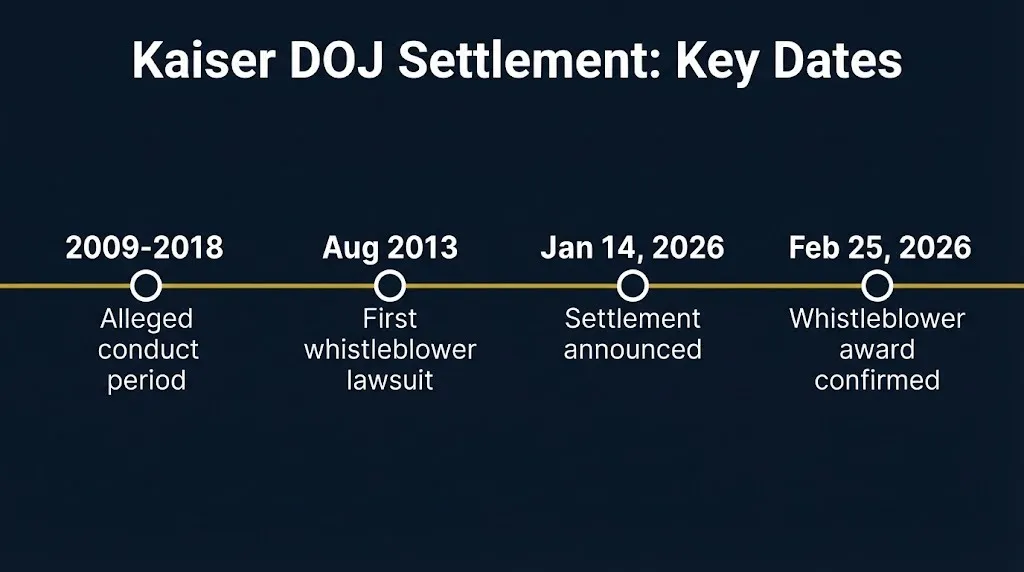
- Kaiser Permanente affiliates paid $556 million to resolve DOJ allegations of Medicare Advantage diagnosis code fraud from 2009 to 2018 .
- The settlement is a False Claims Act resolution, meaning the money goes back to the federal government. There is no consumer claim form or payout process .
- Two former Kaiser employees received roughly $95 million as whistleblower awards for bringing the case .
The Kaiser Permanente DOJ settlement is the largest Medicare Advantage fraud resolution in U.S. history. It resolved allegations that Kaiser pressured physicians to add diagnoses to patient medical records months or years after visits, inflating risk scores and generating roughly $1 billion in improper payments from the federal government .
If you were a Kaiser Medicare Advantage enrollee during that period, you can’t file a claim for money. This was a government enforcement action, not a class action settlement. The money went back to the Medicare program, not to individual members .
This article explains exactly what Kaiser was accused of, why this isn’t a consumer payout case, what it means if you were a Kaiser member during those years, and how whistleblower awards work.
The Facts
| Item | Detail |
|---|---|
| Case Name | U.S. ex rel. Osinek v. Kaiser Permanente, No. 3:13-cv-03891-EMC (N.D. Cal.) |
| Court | U.S. District Court for the Northern District of California |
| Settlement Amount | $556,000,000 |
| Restitution Portion | $278 million |
| Settlement Date | January 14, 2026 |
| Whistleblower Award | Approximately $95 million to relators Ronda Osinek and James M. Taylor, M.D. |
| Consumer Claims Process | None. This was a False Claims Act case, not a class action |
| Alleged Conduct Period | 2009 to 2018 |
| Alleged Improper Payments | Approximately $1 billion |
Is the Kaiser Permanente DOJ Settlement Real or a Scam?
The Kaiser Permanente DOJ settlement is real. The Department of Justice announced it on January 14, 2026, and court records confirm the settlement agreement .
This isn’t a class action where consumers file claims. It’s a False Claims Act case, which means the federal government sued Kaiser for submitting false claims to Medicare. The $556 million goes back to the government, not to individual patients .
If you see a website or social media post claiming you can file a claim for money from the Kaiser DOJ settlement, that’s a scam. There is no consumer claims process. The only people who received money from this case were the two whistleblowers who brought the lawsuit .
Key Takeaway: The Kaiser DOJ settlement is a government enforcement action. If you were a Kaiser Medicare Advantage member, this settlement did not create a payout for you.
What Did Kaiser Permanente Actually Get Accused Of?
Kaiser was accused of systematically pressuring its physicians to add diagnoses to patient medical records that were not considered or addressed during the actual patient visit .
The government alleged that Kaiser:
- Mined patient histories to identify potential diagnoses that had not been submitted to CMS for risk adjustment
- Sent queries to providers urging them to add those diagnoses through “addenda” to medical records, sometimes months or more than a year after the visit
- Set aggressive physician and facility-specific goals for adding risk adjustment diagnoses
- Tied bonuses and financial incentives to meeting risk adjustment diagnosis targets
- Ignored internal warnings from its own compliance department and physicians that the practices violated CMS rules
CMS rules require that diagnoses submitted for risk adjustment be supported by the medical record of a face-to-face visit and, for outpatient visits, must have required or affected patient care, treatment, or management at that visit .
The government claimed Kaiser’s practices generated approximately $1 billion in improper payments based on nearly 500,000 unsupported diagnosis codes .
Why Is There No Consumer Claims Process for the Kaiser Settlement?
There is no consumer claims process because this was a False Claims Act case, not a class action .
In a False Claims Act case, the government sues a company for defrauding federal programs. The money recovered goes back to the government. The only individuals who receive payment are whistleblowers who brought the case under the qui tam provisions of the statute .
A class action, by contrast, is brought by private individuals on behalf of a group who suffered a common injury. Class actions typically result in a settlement fund that class members can claim. This case was not that.
If you were a Kaiser Medicare Advantage member, you were not a party to this lawsuit. You did not suffer a direct financial injury that the government recovered on your behalf. The alleged harm was to the Medicare program, not to individual patients .
Reality Check: No one texts you settlement money from a DOJ enforcement action. The Kaiser DOJ settlement is not a class action. There is no claim form. If someone offers to help you “recover” money from this settlement for a fee, it’s a scam.
Who Were the Whistleblowers and How Much Did They Get?
The whistleblowers were Ronda Osinek and James M. Taylor, M.D., both former Kaiser employees who brought False Claims Act lawsuits against the company .
Osinek filed her lawsuit on August 22, 2013. Taylor filed his on October 22, 2014. The cases were later consolidated in the Northern District of California .
Under the False Claims Act’s qui tam provisions, whistleblowers can receive between 15% and 30% of the government’s recovery. In this case, the relators agreed to a 17% relator’s share out of a potential 25%, resulting in a payment of approximately $95 million to the two whistleblowers .
Taylor, a former Kaiser physician and medical director with billing compliance responsibilities, was represented by Constantine Cannon . The $95 million award is one of the largest whistleblower recoveries in a Medicare Advantage fraud case.
What Does the Kaiser Settlement Mean If You Were a Kaiser Medicare Advantage Member?
If you were a Kaiser Medicare Advantage enrollee between 2009 and 2018, diagnoses may have been added to your medical record that do not reflect your actual health conditions .
That matters because your medical record affects future insurance coverage, treatment decisions, and eligibility for other programs. If you believe your record contains inaccurate diagnoses, you can request a copy of your medical records and ask your current provider to review and correct any errors.
This is not about getting money from the settlement. It’s about making sure your medical history is accurate. Inaccurate diagnoses can affect care decisions and insurance risk scores, even if you never see a direct financial impact .
How Does the Kaiser Settlement Compare to Other Medicare Advantage Fraud Cases?
The Kaiser settlement is the largest Medicare Advantage fraud resolution to date, far exceeding prior settlements .
Medicare Advantage FCA Settlements Comparison:
| Company | Year | Settlement Amount |
|---|---|---|
| Kaiser Permanente | 2026 | $556 million |
| Cigna | 2023 | $172 million |
| Independent Health | 2024 | $100 million |
| Aetna | 2026 | $117.7 million |
Kaiser’s settlement is roughly 3.2 times larger than the next biggest Medicare Advantage FCA settlement. The DOJ has made clear that Medicare Advantage risk adjustment fraud is a top enforcement priority .
Notably, no Corporate Integrity Agreement (CIA) has been publicly announced in the Kaiser settlement, despite CIAs being a common tool in major healthcare fraud resolutions .
What Other Kaiser Settlements Exist in 2026?
Kaiser has two separate class action settlements in 2026 that do involve consumer payouts, unlike the DOJ case .
$46 Million Privacy Data Breach Settlement: Kaiser agreed to a $46 million (potentially increasing to $47.5 million) settlement resolving claims that its websites and mobile apps improperly disclosed members’ information to third parties between November 2017 and May 2024 . The claim deadline was March 12, 2026. The final approval hearing was scheduled for May 7, 2026 .
$10.5 Million TCPA Text Message Settlement: Kaiser Foundation Health Plan agreed to pay $10.5 million to settle claims that it sent marketing texts to people who had already replied “stop” to opt out . The claim deadline was February 12, 2026, and has passed. Claimants could receive $75 for each marketing text sent after opting out .
These are separate from the DOJ settlement. They involve consumer claims and payouts. The DOJ case does not .
Key Takeaway: The Kaiser DOJ settlement has no consumer payout. But Kaiser’s privacy and TCPA settlements do. Make sure you’re looking at the right case before filing any claims.
What Happens Next for Medicare Advantage Enforcement in 2026?
The DOJ has signaled that Medicare Advantage fraud enforcement is a top priority. The Kaiser settlement is part of a broader pattern .
Expected Timeline:
- Ongoing 2026: DOJ continues investigating Medicare Advantage risk adjustment practices across major insurers.
- Ongoing: Other health plans face heightened False Claims Act exposure for coding practices, chart reviews, and incentive structures .
- No scheduled dates: No future court hearings are pending in the Kaiser case. The settlement is final.
The government has relaunched a joint DOJ-HHS False Claims Act Working Group that prioritizes Medicare Advantage enforcement. More settlements and investigations are likely .
Frequently Asked Questions
Can I file a claim for money from the Kaiser DOJ settlement?
No. This was a False Claims Act case, not a class action. The money went back to the federal government. There is no consumer claims process .
How much was the Kaiser Permanente DOJ settlement?
Kaiser affiliates paid $556 million to resolve False Claims Act allegations .
Who received money from the Kaiser settlement?
The federal government received the settlement funds. Two whistleblowers received approximately $95 million under the False Claims Act’s qui tam provisions .
What were the allegations against Kaiser?
The government alleged Kaiser pressured physicians to add unsupported diagnoses to patient medical records to inflate Medicare Advantage risk scores and increase payments .
What is a False Claims Act case?
The False Claims Act allows the government to sue companies that defraud federal programs. Whistleblowers can bring cases on the government’s behalf and receive a share of the recovery .
Were patients harmed by Kaiser’s alleged conduct?
The government’s case focused on harm to the Medicare program, not individual patients. If your medical record contains inaccurate diagnoses, you may want to review it with your provider .
Is there a Kaiser class action settlement I can claim?
Yes, but not from the DOJ case. Kaiser has separate privacy and TCPA settlements. Check the official settlement websites for those cases .
Did Kaiser admit wrongdoing?
No. Kaiser stated that the settlement “has no admission of wrongdoing or liability” and that it chose to settle “to avoid the delay, uncertainty, and cost of prolonged litigation” .
What Should You Do If You Were a Kaiser Medicare Advantage Member?
Review your medical records. If you were a Kaiser Medicare Advantage enrollee between 2009 and 2018, check whether your record contains diagnoses that don’t reflect your actual health conditions .
There is no money to claim from the DOJ settlement. But you can protect yourself by ensuring your medical history is accurate. Request your records from Kaiser or your current provider and ask for corrections if needed.
The most important fact to remember: the $556 million Kaiser DOJ settlement went to the federal government on January 14, 2026. No consumer claim form exists .