Full Sail University Lawsuit 2026: Dismissed, No Settlement, and What That Means for You
Quick Answer
- The Full Sail University lawsuit was dismissed on March 12, 2026, and no settlement was ever reached.
- There is no claim form, no settlement administrator, and no payout for students or the public.
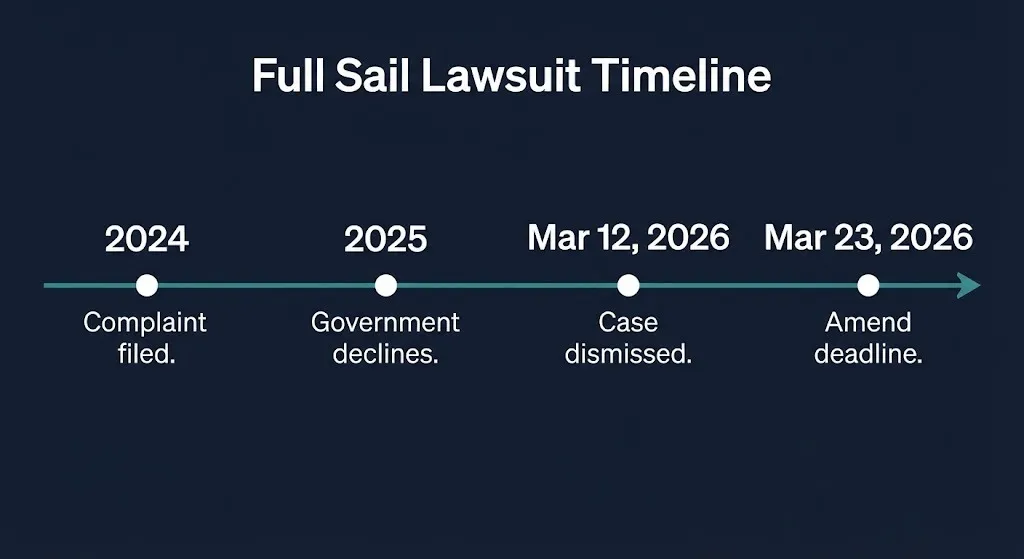
- The judge gave plaintiffs until March 23, 2026, to amend their complaint, and no further public docket activity has been confirmed.
Is the Full Sail University Lawsuit Real or a Scam?
The Full Sail University lawsuit is real, but it is not a consumer settlement you can claim from. It was a False Claims Act case filed by two former Los Angeles Film School executives, not a class action on behalf of students.
David Phillips, former vice president of career development at LAFS, and Ben Chaib, former vice president of admissions, filed the complaint in 2024 in the U.S. District Court for the Central District of California . They accused Full Sail and LAFS of lying to the government about graduate job placement rates for over a decade to keep federal funding flowing .
The case was filed under the False Claims Act, which lets private citizens sue on behalf of the government. The U.S. government reviewed the case and declined to join it . That is a significant signal. When the DOJ declines to intervene in a False Claims Act case, it often means the government does not see enough merit to invest its own resources.
The judge dismissed the entire case on March 12, 2026 . There is no settlement. There is no fund. There is no claim process.
How Much Is the Full Sail University Settlement?
There is no settlement amount because there is no settlement. The case was dismissed, not resolved through a payout.
If you see a website or social media post promising “Full Sail University settlement money” or asking for your information to “check eligibility,” that is not connected to this case. No administrator has been appointed. No fund has been established.
For comparison, the Southwest Airlines Flight 1380 case mentioned in other coverage did involve a voluntary $5,000 payment to passengers. That was a goodwill gesture, not a court-ordered settlement. Full Sail has made no such payment, and no court has ordered one.
The only financial figures publicly tied to this case are the allegations themselves: the plaintiffs claimed Full Sail and LAFS defrauded the government of millions in federal student aid and military benefits . Those are claims, not findings. The judge dismissed them.
Who Was Sued in the Full Sail University Lawsuit?
The defendants named in the lawsuit were James W. “Bill” Heavener, a University of Florida trustee and partial owner of both Full Sail and LAFS; Diana Derycz-Kessler, former president and CEO of LAFS; and her husband, Paul Kessler .
Full Sail University itself was named as a defendant, along with Los Angeles Film School . The plaintiffs alleged the two schools operated as a linked enterprise, sharing executives, accounting systems, and admissions operations .
The complaint claimed LAFS and Full Sail ran a “pay-for-placement scheme,” financing short-term job placements for graduates through nonprofits and vendors to inflate placement rates . It also alleged violations of the incentive compensation ban, claiming sales representatives received promotions and raises based on enrollment quotas .
Full Sail denied all allegations. In a statement, the university said the claims were unfounded and that the plaintiffs never actually worked for Full Sail .
What Did the Judge Decide in the Full Sail Lawsuit?
The judge dismissed the case because the allegations did not meet the legal standard required to move forward. U.S. District Judge Stanley Blumenfeld Jr. found the complaint deficient on multiple grounds.
The most damaging problem for the plaintiffs was group pleading. The judge said the allegations against Full Sail and Paul Kessler “rely largely on group pleading to attribute LAFS’s alleged misconduct to Full Sail” . In plain terms, the plaintiffs treated the two schools as one entity without showing enough specific evidence tying Full Sail to the alleged scheme.
The judge also noted the plaintiffs did not meaningfully oppose arguments that the complaint failed to adequately allege violations of gainful employment rules or the incentive compensation ban . And they did not show that any such violations were material to the disbursement of federal funds.
There was one small win for the plaintiffs. The judge found they “plausibly alleged that the fraud underlying this action was not sufficiently disclosed to the government” before they signed their release agreements . That meant their releases were unenforceable and they had standing to sue. But standing alone was not enough to survive dismissal.
Key Takeaway: The Full Sail lawsuit was dismissed because the plaintiffs could not show with enough specificity that Full Sail itself, as opposed to Los Angeles Film School, engaged in the alleged fraud.
What Happens Next in the Full Sail University Lawsuit?
The judge gave the plaintiffs until March 23, 2026, to file an amended complaint if they could present a “good-faith factual and legal basis” for doing so . No public docket activity confirming an amended complaint has been reported as of September 30, 2026.
If the plaintiffs did amend, the case would go back before Judge Blumenfeld for another round of motions. If they did not, the dismissal likely became final.
Even if the case is revived, it remains a False Claims Act case. That means any recovery would go to the government first, with the plaintiffs potentially receiving a share as a whistleblower reward. It would not create a settlement fund for students.
Why This Was Not a Class Action for Students
False Claims Act cases and class actions are different animals. A class action pools many similar claims into one lawsuit and creates a settlement fund that class members can claim from. A False Claims Act case is a whistleblower action on behalf of the government.
The Full Sail case was never a class action. No student was ever a named plaintiff. No class was ever certified. That means there is no pool of money for students, no claim deadline, and no administrator to file with.
If you attended Full Sail and believe you were harmed by false job placement promises, this lawsuit does not give you a direct path to compensation. You would need to explore other legal options, such as arbitration under your enrollment agreement or a separate lawsuit, and those options have their own deadlines and requirements.
Frequently Asked Questions
Is the Full Sail University lawsuit a class action?
No. It was a False Claims Act case filed by two former Los Angeles Film School executives on behalf of the government, not a class action on behalf of students.
How much is the Full Sail settlement?
There is no settlement. The case was dismissed on March 12, 2026, and no fund or payout was ever established.
Can I still file a claim against Full Sail?
This lawsuit does not create a claims process. If you believe you have a separate legal claim, you would need to consult a lawyer about your options and any applicable deadlines.
What was Full Sail accused of in the lawsuit?
The plaintiffs alleged Full Sail and LAFS lied about graduate job placement rates to keep receiving federal student aid and military benefits, and paid sales staff incentives based on enrollment quotas .
Who were the plaintiffs in the Full Sail lawsuit?
David Phillips and Ben Chaib, both former executives at Los Angeles Film School, filed the complaint in 2024 .
Did the government join the Full Sail lawsuit?
No. The United States reviewed the case and declined to intervene, which means the government chose not to pursue the claims itself .
What happens if the plaintiffs refile the Full Sail lawsuit?
If an amended complaint was filed and survives another motion to dismiss, the case would proceed. But it would remain a whistleblower case, not a student settlement fund.
What Happens Next After the Full Sail Dismissal
March 12, 2026: Judge Blumenfeld dismissed the case with leave to amend .
March 23, 2026: Deadline for plaintiffs to file an amended complaint if they chose to proceed .
No further public activity confirmed: As of September 30, 2026, no amended complaint or new docket activity has been publicly reported.
If no amendment filed: The dismissal becomes final, and the case is over unless appealed.
If amendment filed: A new round of motions and potential dismissal or litigation follows.