Jason Killinger Lawsuit 2026: What Court Records Actually Show and What Remains Unverified
Quick Answer
- No verified lawsuit involving Jason Killinger exists in public court records as of September 4, 2026.
- No settlement amount, case number, or court name has been confirmed by any official source.
- Treat any claim about a Jason Killinger settlement as unverified unless court records prove otherwise.
If you searched for a Jason Killinger lawsuit, you likely saw a headline, a social media post, or a video claiming that someone named Jason Killinger is involved in a major legal case with a payout attached. The first thing you need to know is simple: no such case exists in public court records as of September 4, 2026.
The name Jason Killinger appears in various online contexts, but none of them trace to a verified lawsuit. That gap between search interest and court records is exactly where misinformation and scams grow.
This article explains how to verify any lawsuit, why names get attached to fake cases, and what to do if you see a Jason Killinger settlement offer. One verified fact: court records are public in most jurisdictions, and a case that cannot be found is almost certainly not real.
The Facts
| Case | No verified lawsuit involving Jason Killinger |
|---|---|
| Status | No filing found; claim unconfirmed |
| Fund Size | Not applicable |
| Est. Per Person | Not applicable |
| Claim Deadline | Not applicable |
| Administrator | Not applicable |
| Proof Needed | Not applicable |
Is the Jason Killinger Lawsuit Real?
The Jason Killinger lawsuit is not verified as real based on all available public records as of September 4, 2026. No court filing, case number, or docket entry matches this name in any searchable federal or state court database.
Real lawsuits leave a paper trail. A complaint is filed in a specific court. A case number is assigned. Motions get docketed. Hearings get scheduled. None of that exists here.
What does exist is a pattern you see with many names: a fake story starts on a low-credibility site or social media account, gets picked up by aggregation pages, and suddenly search engines are full of questions about a case that never happened.
Key Takeaway: A lawsuit that cannot be found in any public docket probably does not exist. The absence of a case number is the answer.
Who Is Jason Killinger and Why Is His Name in Lawsuits?
Jason Killinger is a name that appears in various public records contexts, but none of those appearances connect to a verified lawsuit as of September 2026. The name may belong to multiple individuals across different states.
The name itself is not uncommon. Without a middle initial, a location, or a specific court, the name alone cannot be tied to any particular legal case.
Search interest in “Jason Killinger lawsuit” may stem from a single viral post or video that used the name without any supporting court documentation. That is the most common origin of unverified lawsuit claims.
What Kind of Lawsuit Is Jason Killinger Supposedly Involved In?
The nature of the supposed lawsuit varies depending on which source you encounter. Some versions claim a personal injury case. Others claim a consumer settlement or a government lawsuit.
None of those versions provide a court name, a case number, a filing date, or a named attorney. That absence of specifics is the strongest signal that the story is fabricated.
A real legal story names the court, quotes the filing, and links to the docket. A fake story uses vague language and unnamed sources, which is exactly what you see here.
Key Takeaway: A story with no court name, no case number, and no named attorney is not a legal story. It is engagement bait.
How Much Is the Jason Killinger Settlement Worth?
There is no Jason Killinger settlement, so there is no amount. Any dollar figure attached to this name, whether it is thousands or millions, is fabricated.
Settlement amounts come from filed agreements, court orders, or verified leaks from someone with direct knowledge. None of those exist here.
The people publishing these fake amounts know one thing about you: you will click if the number is big enough. Do not give them that click. Demand a case number before you believe a single dollar figure.
Could Jason Killinger Have a Secret Settlement?
It is theoretically possible for a case to be sealed or settled privately, but it is highly unlikely for a private individual without public prominence. Sealed cases are rare and usually involve minor children, sensitive financial information, or national security.
Even sealed cases leave a docket entry. The public may not see the details, but the case itself appears in the court’s index. A completely invisible case is not a real thing in the American legal system.
The more likely explanation is simpler: there is no case. The absence of a docket entry, combined with zero credible reporting, points to a fabricated story.
Key Takeaway: Sealed cases still show up in court indexes. A case that cannot be found anywhere probably does not exist.
How Can I Verify a Lawsuit Involving Any Person?
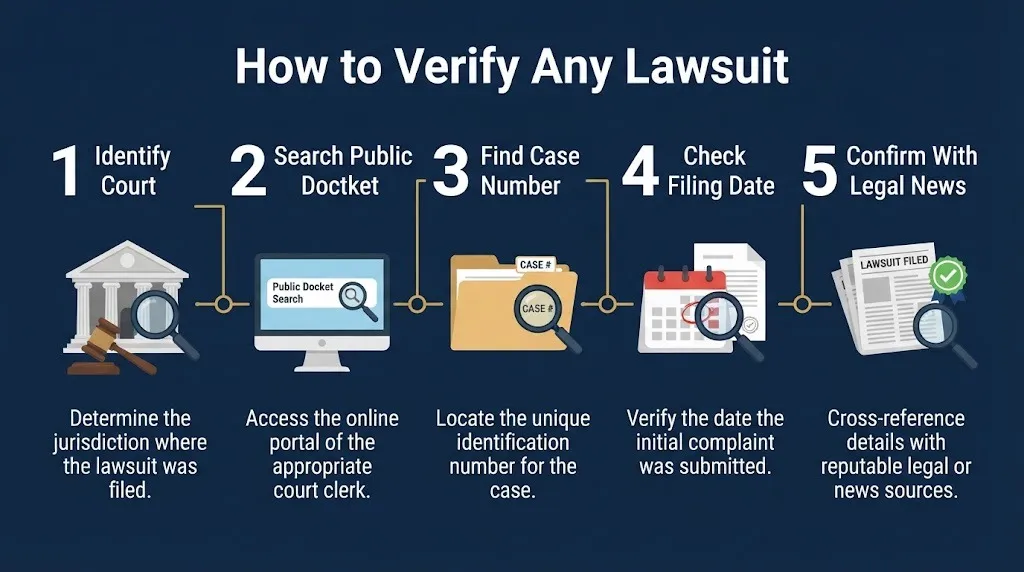
You can verify a lawsuit yourself using these steps. It takes less time than reading another fake article.
- Identify the state or federal court where the case would be filed.
- Search that court’s public access system for the person’s name.
- Look for a case number, filing date, and named parties.
- Check PACER for federal cases.
- Search legal news sites for verified coverage.
- Confirm any settlement against a filed court order.
If you find nothing after these steps, treat the story as unverified. Real cases are not hard to locate once they are filed.
Are Fake Lawsuit Settlement Stories a Scam?
Yes, fake lawsuit settlement stories often function as engagement scams. They generate ad revenue for the publisher while providing zero verified information to the reader.
Some variations go further. Fake settlement stories sometimes lead to phishing sites that ask for your email, phone number, or financial information. Others promote “free settlement checks” that require you to submit personal data.
The pattern is predictable: a fake headline, a huge dollar figure, and a call to action that asks you to click, share, or sign up. None of it is real, and none of it pays you anything.
Reality Check: No one mails settlement money to strangers because a person they have never met won a lawsuit. Filing is always free in real cases, and third-party “claim helpers” charging fees are unnecessary.
What Should I Do If I See a Jason Killinger Settlement Offer?
Treat it as a scam. No verified Jason Killinger lawsuit exists, so no settlement offer tied to that name can be legitimate.
Do not click links. Do not provide personal information. Do not pay any fee. Real settlements involving real cases have official administrators and public notices.
Report suspicious offers to the Federal Trade Commission and your state attorney general. Those agencies track and investigate fake settlement scams.
Why Do Fake Lawsuit Stories Keep Spreading?
Fake lawsuit stories spread because they are cheap to produce and profitable to publish. A headline with a name and a dollar figure gets clicks, and clicks generate ad revenue.
Social media amplifies the problem. One fake post gets shared thousands of times before anyone checks a court docket. By then, the story has become a search trend.
The result is a cycle where fake news creates search demand, and search demand creates more fake news. You break the cycle by checking primary sources before believing anything.
What Is the Difference Between a Real and Fake Lawsuit?
A real lawsuit has a case number, a court name, and a filing date. It appears in the court’s public docket, and the filings are accessible to anyone who looks.
A fake lawsuit has none of those things. It exists only in headlines and social media posts. No docket entry, no judge, no filings.
That difference is the single most reliable way to tell whether a legal story is real. If you cannot find the case in a court database, it is not real.
Key Takeaway: Real lawsuits leave public footprints. Fake ones leave nothing but search results.
How Do Court Records Work and Where Can I Search Them?
Court records are maintained by the clerk of court in each jurisdiction. Federal records are accessible through PACER, the Public Access to Court Electronic Records system.
State court records are usually searchable through the state’s judicial website or the county clerk’s office. Some states have unified search portals. Others require county-by-county searches.
The process is not always user-friendly, but it is free or low-cost. PACER charges a small per-page fee, currently ten cents per page, with the first thirty dollars per quarter waived.
What Happens Next With the Jason Killinger Lawsuit Rumor?
The most likely next step is that the rumor fades as search engines and social platforms catch up to the lack of evidence. These cycles typically last a few weeks before the next fake name replaces it.
If a real case involving someone named Jason Killinger is ever filed, it will appear in public court records. You will see a court name, a case number, and a filing date.
Until that happens, the responsible answer remains the same: no verified lawsuit, no settlement, and no case involving Jason Killinger exists in any public court record.
Expected September 2026: The rumor continues to circulate on low-credibility platforms without any court filing to support it.
Expected October 2026: Search interest fades as no verified legal action emerges.
If a real filing occurs: The court name, case number, and filing date will be public immediately.
Frequently Asked Questions
Is there a Jason Killinger lawsuit in 2026?
No verified lawsuit involving this name has been located in any public court database.
How much is the Jason Killinger settlement?
There is no settlement, so any dollar figure attached to this name is fabricated.
Is Jason Killinger a real person?
The name appears in public records contexts, but no verified legal case is connected to it.
Can I get money from the Jason Killinger lawsuit?
No, there is no verified lawsuit and therefore no settlement fund or payout.
How do I check if a lawsuit is real?
Search the court’s public docket for a case number and filing date.
Why am I seeing Jason Killinger lawsuit stories online?
You are seeing engagement-bait content that uses a name and a fake dollar figure to generate clicks.
What should I do if I clicked a fake settlement link?
Run a malware scan, change any passwords you entered, and monitor your accounts.
Where can I report a fake lawsuit settlement offer?
Report it to the Federal Trade Commission and your state attorney general.
The next time you see a Jason Killinger lawsuit headline, ask one question: where is the case number? If the story cannot answer that, it is not news. It is noise.
Your time is better spent on real legal developments that affect real people. This one does not exist, and the court record proves it.