Settlement Houses APUSH Definition 2026: What They Were and Why They Matter
Quick Answer
- A settlement house is a community center where middle-class volunteers lived among the urban poor to provide social services.
- Hull House, founded by Jane Addams in Chicago in 1889, was the most famous American settlement house.
- Settlement houses are key APUSH content for the Progressive Era, typically tested in Period 7.
What Is the APUSH Definition of a Settlement House?
A settlement house is a community center in a poor urban neighborhood where middle-class volunteers lived and provided services to immigrants and the working poor.
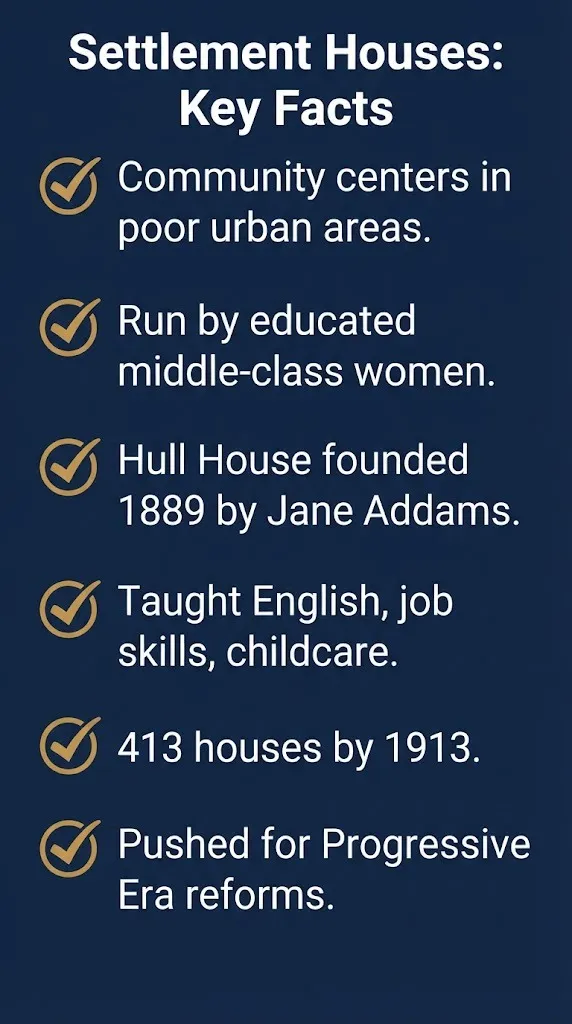
For APUSH, you need to know three things. First, they were run mostly by educated, native-born women. Second, they offered practical help like English classes, childcare, and job training. Third, they became training grounds for social reform movements .
The College Board loves settlement houses because they connect to multiple APUSH themes. They show urbanization, immigration, women’s activism, and Progressive Era reform all in one example.
If you can name Hull House and Jane Addams, you have the foundation. If you can explain what they did and why they mattered, you have a solid APUSH answer.
Who Founded Hull House and When?
Jane Addams and Ellen Gates Starr founded Hull House on September 18, 1889, in Chicago’s Near West Side .
Addams was inspired by Toynbee Hall, which she visited in London in 1888. Toynbee Hall was the first settlement house, founded in 1884 in London’s East End .
Hull House started in a rundown mansion. By 1907, it had grown into a 13-building complex covering nearly a city block . The complex included a gymnasium, theater, art gallery, music school, library, kindergarten, and cafeteria.
Addams led Hull House until her death in 1935. She won the Nobel Peace Prize in 1931 for her work .
What Services Did Settlement Houses Provide?
Settlement houses offered a wide range of services to help immigrants adjust to American life.
The core services included English language classes, childcare and kindergarten, job training and employment help, health care and dental clinics, recreational programs and clubs, and cultural activities like concerts and art classes .
Hull House residents also conducted community research. They studied housing conditions, sanitation, and labor issues in their neighborhoods. That research fueled their reform efforts .
Think of it like a community center, public library, and social services office combined. The difference was that the volunteers actually lived there. They were neighbors, not outsiders dropping in to help.
Why Were Settlement Houses Important for APUSH?
Settlement houses matter for APUSH because they connect the Progressive Era to urbanization, immigration, and women’s activism.
Here is why teachers and the AP exam keep coming back to them:
- Women’s leadership: Settlement houses were the first institutions created and staffed primarily by college-educated women. This opened the door to social work as a profession .
- Immigrant assimilation: They helped millions of European immigrants adjust to American life between 1890 and 1920 .
- Social reform: Hull House residents pushed for child labor laws, juvenile courts, housing codes, and workplace safety rules .
- Bridge between classes: The movement aimed to reduce class conflict by bringing rich and poor together in shared spaces .
Key Takeaway: Settlement houses were more than charity. They were reform laboratories where women built the foundation of modern social work.
How Many Settlement Houses Existed in America?
By 1913, there were 413 settlement houses in 32 states. By 1920, that number had grown to nearly 500 nationally .
The growth was rapid. The first American settlement house, University Settlement House in New York, opened in 1886 . Hull House followed in 1889. The movement peaked in the 1920s.
Other notable settlement houses included Henry Street Settlement in New York, founded by Lillian Wald in 1893, and Lenox Hill Neighborhood House, founded in 1894 .
| Settlement House | Location | Founded | Founder(s) |
|---|---|---|---|
| University Settlement House | New York | 1886 | (Oldest in U.S.) |
| Hull House | Chicago | 1889 | Jane Addams, Ellen Gates Starr |
| Henry Street Settlement | New York | 1893 | Lillian Wald |
| Lenox Hill Neighborhood House | New York | 1894 | (Various) |
How Did Settlement Houses Differ From Charity Organization Societies?
Settlement houses focused on environmental causes of poverty and lived among the poor. Charity organization societies focused on individual moral failings and investigated applicants from outside.
This distinction matters for APUSH essays. The settlement house movement believed poverty came from bad housing, low wages, and lack of opportunity. Charity societies often blamed personal failings and gave aid only after home visits to check if people “deserved” help .
Settlement workers wanted to change the system. Charity workers wanted to change individuals.
That is why Hull House residents pushed for laws on child labor, housing codes, and workplace safety. They saw those reforms as the real fix.
What Is the Difference Between a Settlement House and a Social Gospel Mission?
A settlement house was secular and focused on social reform. A Social Gospel mission was religious and focused on Christian duty to help the poor.
Jane Addams deliberately grounded Hull House in democratic ideals, not Christian theology . The Social Gospel movement, led by Protestant clergy, saw helping the poor as a religious obligation .
Both emerged in the same era. Both wanted to help the urban poor. But their motivations and methods differed.
For APUSH, know that settlement houses were part of the broader Progressive reform wave. They were not church-run charities, though some had religious roots.
How Do You Spot Settlement Houses on the APUSH Exam?
Settlement houses usually appear as a multiple-choice question about Progressive Era reform or as part of a DBQ on women’s activism or immigration.
Common question stems ask: What was the primary purpose of settlement houses? They provided social services to immigrants and the poor.
Another favorite: How did settlement houses differ from other reform efforts? They were run by women who lived in the communities they served.
You might see a quote from Jane Addams or a photo of Hull House. The answer choice will almost always connect to immigrant aid, women’s leadership, or urban reform.
Frequently Asked Questions
What is a settlement house APUSH definition?
A settlement house is a community center in a poor urban area where middle-class volunteers lived and provided services to immigrants.
Hull House in Chicago is the most famous example, founded by Jane Addams in 1889.
Who founded the first settlement house in the United States?
University Settlement House in New York, founded in 1886, was the first in the United States.
Hull House, founded in 1889, became the most famous and influential.
What was the main goal of the settlement house movement?
The main goal was to bridge the gap between rich and poor by having educated volunteers live among low-income immigrants.
They provided education, childcare, and social services while pushing for urban reform.
Was Hull House a settlement house?
Yes. Hull House was the most famous American settlement house, founded by Jane Addams and Ellen Gates Starr in Chicago in 1889.
It grew to 13 buildings and became a national model for the movement.
How did settlement houses help immigrants?
They offered English classes, job training, childcare, health care, and cultural activities.
They also helped immigrants navigate American institutions and advocated for better housing and labor conditions.
What happened to settlement houses after the Progressive Era?
Many continued as community centers, but their influence declined as social work professionalized.
By the 1950s, male social workers often led the organizations. Many still operate today under names like United Neighborhood Centers of America.
How many settlement houses existed by 1913?
There were 413 settlement houses in 32 states by 1913.
By 1920, that number reached nearly 500 nationally.
Why did Jane Addams win the Nobel Peace Prize?
Addams won the Nobel Peace Prize in 1931 for her social reform work and commitment to pacifism.
She was the first American woman to receive the honor.
If you are studying for APUSH, focus on the big three: Jane Addams, Hull House, and the services settlement houses provided. Know that they were run by educated women, aimed at helping immigrants, and became engines for Progressive Era reform. The exam loves that combination.