What Is Deferred Compensation? The 2026 Guide to Rules, Taxes, and Risks
Quick Answer:
- Deferred compensation is money you earn now but receive in a future year, postponing your tax bill.
- The amount you can defer varies widely: 401(k) limits cap at $23,500, but executive plans have no legal ceiling.
- There is no single deadline for all plans, but 409A election deadlines are typically set before the year you earn the income.
Most working Americans encounter deferred compensation without ever calling it that. Your 401(k) contributions at work are deferred compensation. So is the bonus your employer promises to pay you three years from now. So is the pension your uncle collected after 30 years on the assembly line. The term sounds technical, but the underlying idea is simple: earn now, get paid later, and deal with the IRS later too.
This article is for someone staring at a W-2 box that doesn’t match their take-home pay, or an employment contract offering “nonqualified deferred compensation,” or a Florida retirement system statement. It explains what these plans are, how the tax code treats them, and what risks you take when you agree to let someone hold your money.
One fact that surprises many readers: the dollars in an executive deferred compensation plan are not protected the way 401(k) money is. If your employer goes bankrupt, you stand in line with every other unsecured creditor, and you could lose every deferred dollar.
| The Facts | |
|---|---|
| Governing Law | Internal Revenue Code Section 409A (2004), with final Treasury Regulations issued in 2007 |
| 2026 401(k) Elective Deferral Limit | $23,500 (under age 50); $31,000 with catch-up contributions |
| Total Defined Contribution Limit (2026) | $70,000 (all sources combined, under age 50) |
| 457(b) Limit (2026) | $23,500 |
| Executive Plan Cap | No statutory dollar limit; set by employer plan document |
| Key Regulatory Body | Internal Revenue Service (IRS) |
| Tax Treatment | Income tax deferred until year of receipt; FICA taxes generally due when vested |
What Is the Definition of Deferred Compensation?
Deferred compensation is an agreement between you and an employer to delay payment for work you perform today until a future date. The legal meaning is broad. It covers qualified plans like 401(k)s and 403(b)s, nonqualified plans for executives, and even simple arrangements where a privately held company promises to pay a retiring founder over ten years.
The IRS defines deferred compensation functionally: if you have a legally binding right in one tax year to compensation that will be paid in a future tax year, the arrangement falls under Section 409A unless a specific exemption applies. This is not a fringe benefit. It is one of the core structures in American compensation law.
Two categories matter for anyone trying to understand their own situation. Qualified plans operate under strict ERISA rules, with contribution limits, nondiscrimination testing, and creditor protection. Nonqualified plans are everything else: supplemental executive retirement plans, deferred bonus arrangements, phantom stock, and certain severance agreements. Nonqualified plans face fewer limits but offer far less protection.
The distinction affects your taxes, your risk, and your options. A 401(k) is bankruptcy-remote from your employer. An executive deferred comp account is not. That single difference has cost executives millions when companies failed.
What Does Deferred Compensation Mean for Your Paycheck?
It means the number on your W-2 is bigger than the amount that hit your bank account. Your employer reports your full earned compensation to the IRS in Box 1 or Box 12, but the deferred portion sits in a plan account, not your checking account.
This gap can cause confusion. You might see $120,000 on your W-2 while your actual take-home pay for the year was $90,000. The $30,000 difference went into your 401(k), your 457(b), or a nonqualified plan. The IRS taxes the $120,000 figure unless the deferral meets the requirements for exclusion from current income.
For qualified plans, the deferral reduces your Box 1 wages. A $23,500 401(k) contribution in 2026 lowers the taxable wages reported on your W-2 by $23,500. You do not pay federal income tax on that money until you withdraw it, possibly decades later.
For nonqualified plans, the reporting is more complex. Amounts deferred under a compliant 409A plan are not included in Box 1 in the year of deferral. Instead, they appear on your W-2 in the year they are paid. FICA taxes work differently: Social Security and Medicare taxes are generally due when the compensation vests, not when it is paid. This means you could owe FICA tax on money you haven’t received yet.
Key Takeaway: The gap between your W-2 and your take-home pay is deferred compensation at work; for qualified plans it reduces your current tax bill, and for nonqualified plans the FICA clock starts early.
What Is Deferred Compensation on a W-2?
The entry on your W-2 that signals deferred compensation depends on the plan type. The IRS requires employers to report elective deferrals in Box 12 using specific codes. This is the line that answers the question for most people.
The most common Box 12 codes tied to deferred compensation are:
- Code D: 401(k) elective deferrals, up to the $23,500 limit for 2026.
- Code E: 403(b) salary reduction contributions, for certain nonprofit and public education employees.
- Code F: 408(k)(6) salary reduction SEP contributions.
- Code G: 457(b) contributions for state and local government employees and certain nonprofits, with the same $23,500 limit.
- Code S: 408(p) SIMPLE plan salary reduction contributions.
- Code AA: Designated Roth contributions under a 401(k) plan.
- Code BB: Designated Roth contributions under a 403(b) plan.
Code Y reports deferrals under a nonqualified Section 409A plan that became taxable in the current year, often because of a compliance failure. If you see Code Y with a dollar amount next to it, something went wrong with your plan. That money is taxable, plus a 20 percent additional tax and interest.
Nonqualified plan deferrals that are compliant and properly structured generally do not appear on the W-2 until the year of payout. You might have hundreds of thousands in a deferred comp account with nothing showing on your current W-2. The W-2 catches up later, reporting the full distribution as wages in the year you receive it.
How Does Florida Handle Deferred Compensation?
Florida does not have a state personal income tax, which makes deferred compensation simpler for Florida residents than for people in most other states. You defer federal income tax on contributions and pay federal income tax on distributions. There is no state tax layer to worry about.
This matters most for two groups. First, people who worked and deferred compensation in a high-tax state and then retire to Florida. The question is which state gets to tax the deferred money when it comes out. Federal law, specifically 4 U.S. Code Section 114, prohibits states from taxing retirement income of former residents who have moved away. Florida retirees who deferred compensation while working in New York or California should not pay state tax on those distributions to their former state.
Second, Florida public employees participate in the Florida Retirement System, which includes the state’s 457(b) deferred compensation plan. The FRS Investment Plan, one of two primary options for state employees hired after 2011, functions like a 401(k) with employer contributions. The 457(b) plan is a separate supplemental vehicle that allows additional pretax savings beyond the FRS pension or investment plan.
The Florida Division of Retirement oversees these plans. Participants can direct investments across a menu of funds managed by the State Board of Administration. The absence of a state income tax means Florida government employees pay only federal tax on these distributions, making the plans marginally more valuable than equivalent plans in states that tax retirement income.
What Is an Executive Deferred Compensation Plan?
An executive deferred compensation plan is a nonqualified arrangement that lets highly compensated employees defer salary, bonuses, or both beyond the dollar limits imposed on 401(k) plans. These plans are sometimes called supplemental executive retirement plans, SERPs, or top-hat plans. The defining feature is that they are unfunded, unsecured promises to pay.
The employer sets the terms in a plan document. An executive might defer 50 percent of a $300,000 bonus into the plan, receiving it in installments over ten years after retirement. The $150,000 deferred is not taxed now. It grows based on a notional investment return, often pegged to a market index or a fixed interest rate. When the executive receives distributions, every dollar is taxed as ordinary income.
These plans are not protected by ERISA’s funding and vesting rules. The money is an asset of the company until paid. If the company files for bankruptcy, deferred compensation participants are general unsecured creditors. They stand in the same line as vendors and bondholders, and behind secured lenders. This risk became real during the 2008 financial crisis, when Lehman Brothers executives lost deferred compensation accounts worth millions.
The IRS imposes strict rules under Section 409A. Elections to defer must be made before the year in which the compensation is earned. Distributions can only occur on specified dates or upon separation from service, death, disability, an unforeseeable emergency, or a change in control. Any deviation triggers immediate taxation, a 20 percent penalty, and interest.
Key Takeaway: Executive deferred comp plans let high earners defer unlimited amounts, but the money is the company’s until paid; if the employer fails, you may recover nothing.
What Are the Different Types of Deferred Compensation Plans?
Deferred compensation divides into two legal universes: qualified plans and nonqualified plans. Each operates under a different set of statutes, offers different protections, and suits different employee populations.
The qualified plan category includes the accounts most workers recognize:
- 401(k) plans: Private-sector defined contribution plans. Employee elective deferrals capped at $23,500 in 2026. Employer may match. Tax-deferred growth, taxable distributions.
- 403(b) plans: Same structure, available to public education employees and certain nonprofits.
- 457(b) plans: For state and local government employees and certain nonprofits. Similar limits. Distributions before age 59 and a half are not subject to the 10 percent early withdrawal penalty that applies to 401(k) and 403(b) plans.
- Defined benefit pension plans: Employer-funded promises to pay a formula-based monthly benefit for life. Rare in the private sector, still common in government employment.
- SIMPLE IRA and SEP plans: Small-business retirement vehicles with lower contribution limits and simpler administration.
The nonqualified category covers everything outside ERISA’s protections:
- Supplemental Executive Retirement Plans (SERPs): Employer-funded promises to make up the gap between what a pension or 401(k) would pay and a target retirement income.
- Deferred Bonus Plans: Elective deferral of annual incentive compensation, paid out on a schedule the executive chooses under 409A election timing rules.
- Phantom Stock and Stock Units: Awards that track the value of company equity without transferring actual shares. Taxed at vesting or distribution depending on the 409A election.
- Excess Benefit Plans: Plans that restore benefits lost because of the IRS compensation cap on qualified plans.
- Split-Dollar Life Insurance Arrangements: Employer-funded life insurance policies where the cash value serves as a de facto deferred compensation vehicle.
| Plan Type | 2026 Contribution Limit | Tax on Contribution | Creditor Protection | Typical Participant |
|---|---|---|---|---|
| 401(k) | $23,500 elective; $70,000 total | Tax-deferred | ERISA protected | Private-sector employees |
| 403(b) | $23,500 elective | Tax-deferred | ERISA protected | Nonprofit and education employees |
| 457(b) | $23,500 | Tax-deferred | Plan-specific | Government and certain nonprofit employees |
| SERP / Nonqualified | No statutory limit | Tax-deferred under 409A | None; unsecured | Executives and key employees |
| Phantom Stock | No statutory limit | Taxed at vesting or distribution | None; unsecured | Private company executives |
What Are the 2026 Contribution Limits for Deferred Compensation Plans?
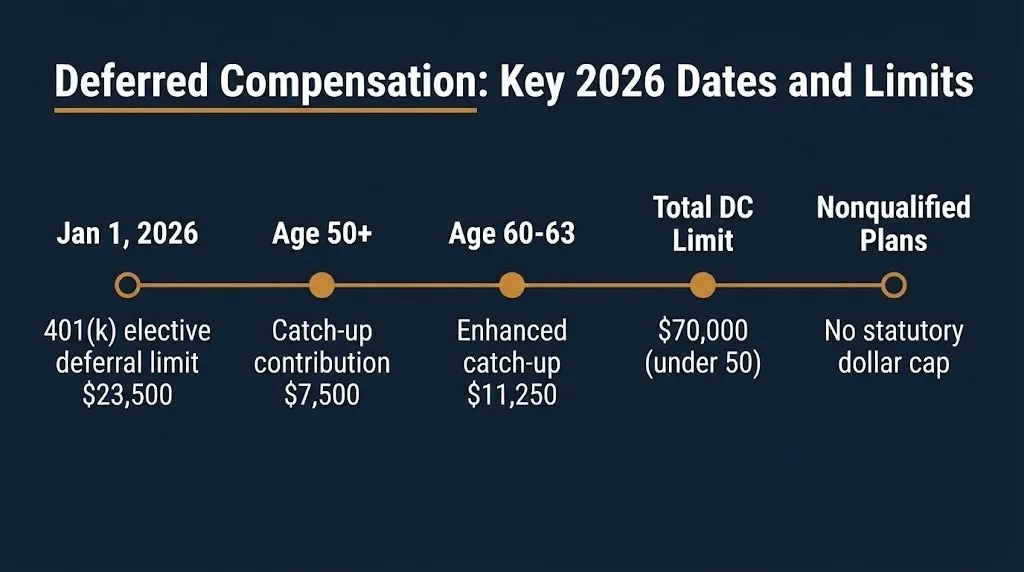
The IRS adjusts qualified plan contribution limits annually for inflation. For 2026, the elective deferral limit for 401(k), 403(b), and most 457(b) plans is $23,500, up from $23,000 in 2025. The catch-up contribution for employees age 50 and older remains $7,500, allowing total elective deferrals of $31,000.
The total defined contribution limit, which combines employee elective deferrals, employer matching and nonelective contributions, and any forfeitures allocated to your account, is $70,000 for 2026, up from $69,000. For employees age 50 and older, the total limit is $77,500 with catch-up contributions.
For those age 60 through 63, the SECURE 2.0 Act introduces a higher catch-up limit for 401(k) and 403(b) plans starting in 2025. This provision is now in its second year. The catch-up for this group is the greater of $10,000 or 150 percent of the regular catch-up amount. The IRS has confirmed the 2026 figure at $11,250. Employees in this age band can defer up to $34,750 in 2026.
Nonqualified plans have no statutory dollar limits. The employer decides how much an executive may defer, typically as a percentage of salary or bonus. The only constraint is the 409A requirement that the deferral election be made before the tax year begins, and the practical limit of what the employer is willing to promise.
How Does Section 409A Govern Deferred Compensation?
Section 409A of the Internal Revenue Code, enacted in 2004 as part of the American Jobs Creation Act, is the central federal law governing nonqualified deferred compensation. It was a direct response to Enron and similar scandals, where executives accelerated deferred compensation payouts ahead of bankruptcy while rank-and-file employees lost everything.
The statute does two things. It defines what counts as deferred compensation for tax purposes. Then it imposes strict rules on when and how participants can make deferral elections and take distributions. Plans that violate 409A trigger immediate taxation on all vested deferred amounts, a 20 percent additional tax, and interest from the date the compensation was first deferred.
The election timing rule is the one that trips up many arrangements. You must elect to defer compensation before the tax year in which you earn it. For performance-based bonuses, there is some flexibility: the election can be made up to six months before the end of the performance period, provided the period is at least twelve months long and the outcome remains substantially uncertain at the time of election.
Distribution rules are equally rigid. A nonqualified plan can only pay out upon: a specified date or fixed schedule, separation from service, death, disability, an unforeseeable emergency, or a change in control as defined in the Treasury Regulations. Acceleration of distributions is prohibited, meaning neither you nor your employer can decide to pay you early because you need the money or because the company wants to terminate the plan.
The 409A penalty is harsh by design. Congress wanted to discourage the kind of last-minute accelerations that left Enron employees without retirement savings while executives cashed out. Compliance is not optional. Even an inadvertent operational failure, such as a payment made three days before the scheduled date, can trigger the full penalty unless corrected under IRS correction programs.
Key Takeaway: Section 409A is the guardrail for nonqualified deferred comp; violate it and you face immediate taxation, a 20 percent penalty, and interest charges.
What Are the Risks of Deferred Compensation Plans?
Every deferred compensation arrangement involves risk. The nature of the risk depends on whether the plan is qualified or nonqualified.
For qualified plans, the primary risks are investment risk and legislative risk. Your 401(k) balance fluctuates with the market. The IRS could change the rules. But your money is held in trust, protected from your employer’s creditors, and governed by ERISA’s fiduciary standards. You own the account.
For nonqualified plans, the risks are fundamentally different and more severe. The biggest risk, one that does not exist for qualified plans, is employer credit risk. Your deferred compensation is an unsecured promise from a single company. If that company files for bankruptcy, your claim is a general unsecured claim in the bankruptcy estate. In a liquidation, secured creditors and priority claims get paid first. General unsecured creditors, including deferred comp participants, often recover pennies on the dollar.
Company bankruptcy is not a theoretical risk. General Motors, Lehman Brothers, Enron, and many others left executives with worthless deferred compensation accounts. A 2019 Supreme Court case, Mission Product Holdings v. Tempnology, addressed related bankruptcy issues, though the core vulnerability of nonqualified deferred comp remains unchanged.
Other nonqualified plan risks include change-in-control risk, where a merger or acquisition triggers a payout that may be tax-inefficient. There is also the risk that the IRS recharacterizes the arrangement and applies 409A penalties retroactively. And there is the basic risk that the plan administrator makes an operational error, such as a mistimed payment, that triggers 409A for every participant.
For participants in both types of plans, inflation risk erodes the real value of deferred dollars. A dollar deferred for twenty years buys less than a dollar today. The tax deferral has to outweigh the inflation loss and the credit risk for the arrangement to make financial sense.
Reality Check: The most dangerous myth about nonqualified deferred comp is that the money is yours. It isn’t. It’s a promise from your employer. Treat it like an IOU from one company, not like a bank account. Diversification, the strategy of not concentrating all your assets in one place, is impossible inside a single-employer nonqualified plan, and that fact alone should limit how much you defer.
How Do You Set Up a Deferred Compensation Plan?
Setting up a deferred compensation plan means different things depending on whether you are an individual employee choosing to defer or an employer creating the plan. For individuals, the process is straightforward. For employers, it involves legal documents and ongoing compliance obligations.
If you are an employee looking to participate in an existing plan:
- Confirm your employer offers a deferred comp plan and which type: qualified (401k, 403b, 457b) or nonqualified.
- Review the plan document or summary plan description. Pay close attention to distribution options, vesting schedules, and investment choices.
- For qualified plans, log into the plan portal and set your deferral percentage, up to the 2026 limit of $23,500 or $31,000 with catch-up.
- For nonqualified plans, complete the deferral election form before the enrollment deadline, which is typically November or December of the prior tax year.
- Choose a distribution schedule. Most plans require you to choose at the time of deferral whether you want a lump sum or installments and when they should begin.
- Designate beneficiaries in writing. This is critical: deferred comp accounts do not automatically pass through a will.
- Keep copies of every election form. 409A disputes often come down to whether a written election existed on time.
If you are an employer establishing a nonqualified plan, you need a plan document that complies with Section 409A, a trust vehicle if you choose to set aside assets (though the trust must remain subject to company creditors under the rabbi trust model), and administrative procedures to ensure election timing, distributions, and reporting all comply with the Treasury Regulations. This is not a do-it-yourself project.
How Are Deferred Compensation Withdrawals Taxed?
Deferred compensation distributions are taxed as ordinary income in the year you receive them. There is no capital gains rate available, no special tax treatment. Every dollar that comes out of a qualified or nonqualified plan gets taxed at your marginal income tax rate for that year.
For qualified plans, distributions before age 59 and a half generally trigger a 10 percent additional tax unless an exception applies. The exceptions include separation from service at age 55 or later (for 401k plans), substantially equal periodic payments under IRS Rule 72(t), total and permanent disability, death, and certain medical expenses. The 10 percent penalty does not apply to 457(b) plan distributions regardless of age, which is a significant advantage of government and nonprofit plans.
For nonqualified plans, the distribution itself is taxable as wages, reportable on Form W-2. Federal income tax withholding applies at the supplemental wage rate or your W-4 rate. FICA taxes should already have been paid when the compensation vested, so distributions generally do not trigger additional Social Security or Medicare tax.
Required minimum distributions apply to qualified plans starting at age 73, increased from age 72 by SECURE 2.0, with a further increase to age 75 scheduled for 2033. Nonqualified plans may have separate RMD rules depending on the plan document, and 409A generally requires compliance with a specified distribution schedule rather than ad hoc withdrawals.
State tax treatment follows the rules of the state where you reside when you receive the distribution. If you deferred the compensation while living in California and now live in Florida, you pay no state tax on the distribution. If you did the reverse, the full state tax applies.
What Happens to Deferred Compensation When You Change Jobs?
When you leave a job, your deferred compensation rights depend entirely on the plan type and the plan document. There is no one-size-fits-all answer.
For qualified plans, you generally have several options: leave the money in the former employer’s plan if the balance exceeds $5,000, roll the account into an IRA or your new employer’s qualified plan, or take a cash distribution. A cash distribution triggers ordinary income tax plus the 10 percent early withdrawal penalty if you are under 59 and a half. A direct rollover avoids current taxation.
For nonqualified plans, the options are narrower. The plan document dictates what happens upon separation from service. Many plans provide for a lump-sum distribution six months after separation, a delay required by 409A for key employees of public companies. Others pay out in installments over a specified period. You generally cannot roll nonqualified deferred compensation into an IRA or another employer’s plan. The distribution is taxable in the year received, and that is the end of the deferral.
Vesting matters too. Qualified plan contributions from your own salary deferrals are always 100 percent vested. Employer contributions may vest over a schedule, commonly three to six years. Nonqualified plan vesting follows the plan document. Some plans vest immediately. Others apply graded or cliff vesting. Unvested amounts are forfeited when you leave.
Key Takeaway: Qualified plan money is portable and can follow you to a new employer or an IRA; nonqualified plan money is governed strictly by the plan document and usually must be paid out, triggering an unavoidable tax bill.
What Happens Next
Deferred compensation rules are stable as of mid-2026. No major 409A legislation is pending in Congress. The IRS continues to audit nonqualified plans and issue guidance on specific compliance questions, but the regulatory framework set by the 2007 final Treasury Regulations remains intact.
SECURE 2.0 provisions continue phasing in. The age 60 to 63 enhanced catch-up is now in its second year. The requirement that catch-up contributions for employees earning over $145,000 be made as Roth contributions took effect in 2024 and remains in place. The age 75 RMD threshold arrives in 2033.
If you participate in a nonqualified plan, the most important upcoming date is your plan’s annual enrollment window. That is when you make the binding decision about how much salary or bonus to defer for the following tax year. Missing that window means you cannot defer any 2026 compensation that you have not yet elected, no matter how compelling the tax case.
Frequently Asked Questions
Is deferred compensation the same as a 401(k)?
Not exactly. A 401(k) is one type of deferred compensation.
Deferred compensation includes 401(k) plans, 403(b) plans, 457(b) plans, and nonqualified executive plans.
The 401(k) is the most common form, but it is only one piece of a larger category.
Can I withdraw deferred compensation early?
Rarely. Qualified plans penalize early withdrawals before age 59 and a half with a 10 percent additional tax.
Nonqualified plans are governed by 409A and permit early distributions only for specified reasons like an unforeseeable emergency.
Attempting to access the money outside the plan’s terms triggers severe tax penalties.
Do I pay Social Security tax on deferred compensation?
Yes. FICA taxes on nonqualified deferred comp are due when the compensation vests, not when paid.
For qualified plans, FICA taxes apply to the salary before it is deferred into the plan.
Distributions from qualified plans are generally not subject to FICA.
What is a rabbi trust?
A rabbi trust is a vehicle employers use to set aside assets for nonqualified plan obligations.
The trust is irrevocable but remains subject to the claims of the employer’s creditors in bankruptcy.
It provides some protection against an employer refusing to pay but no protection against insolvency.
Can I roll nonqualified deferred compensation into an IRA?
No. Nonqualified deferred compensation cannot be rolled into an IRA or any other qualified plan.
The distribution is taxable as ordinary income in the year received, with no option to continue deferral.
This is a key difference between qualified plans like 401(k)s and nonqualified arrangements.
How does deferred compensation affect my Social Security benefits?
Deferred comp distributions are considered wages in the year received and appear on your W-2.
Distributions received before full retirement age could reduce your Social Security benefit if they push you over the earnings test threshold.
Once you reach full retirement age, the earnings test no longer applies.
What happened to deferred comp at Enron?
Enron executives accelerated their deferred comp payouts before the company collapsed, withdrawing millions.
Rank-and-file employees were locked out of the plan because the plan amendment only applied to the top executives.
Congress enacted Section 409A specifically to prevent this scenario from repeating.
What You Should Do Now
If you are considering participating in a nonqualified deferred compensation plan, read the plan document. Not the summary. The actual document. Pay attention to the distribution triggers, the employer’s financial condition, and whether a rabbi trust exists. The tax benefits mean nothing if the company cannot pay.
Calendar the enrollment deadline now. A missed election means a lost year of deferral, and Section 409A offers no do-overs. If you already participate, review your distribution elections annually. Life changes, and a distribution schedule you set five years ago might make no sense after a divorce, a diagnosis, or a change in your employer’s credit rating.