What Is a 457 Deferred Compensation Plan in 2026? Contribution Limits, Withdrawal Rules, and How It Works
Quick Answer
- What it is: A tax-advantaged retirement plan for state, local government, and some nonprofit employees, similar to a 401(k) but with different rules.
- How much can you contribute? $24,500 in 2026, or $32,500 if you’re 50+, or up to $35,750 if you’re 60 to 63.
- Key deadline: The contribution limit resets each calendar year. To max out 2026, your payroll deferrals must be set before December 31, 2026.
What Is a 457 Deferred Compensation Plan?
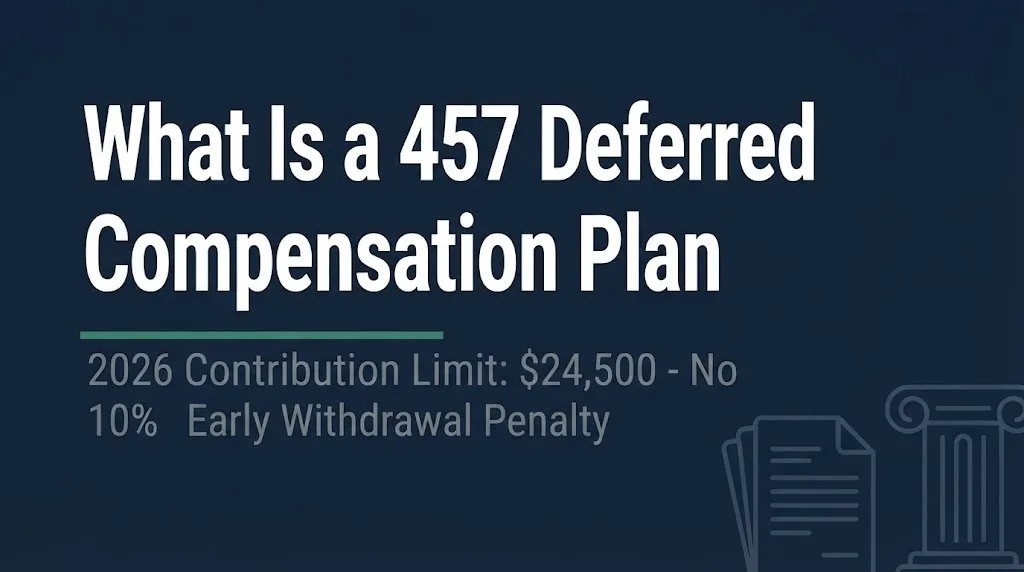
A 457 deferred compensation plan is a tax-advantaged retirement savings arrangement offered by state and local governments and certain tax-exempt organizations, allowing you to set aside part of your salary now and pay taxes later when you withdraw the money. Unlike a 401(k), which is technically a qualified retirement plan, a 457(b) is a deferred compensation plan, and that legal distinction creates both advantages and risks you need to understand before you enroll.
The most talked-about feature is the early withdrawal rule. Governmental 457(b) plans do not impose the 10% federal early withdrawal penalty that applies to 401(k)s and IRAs before age 59½ . That means if you retire or separate from service at age 45, you can access your 457(b) money without that penalty. You’ll still owe ordinary income tax on pre-tax withdrawals, but the 10% hit is gone.
This article breaks down the 2026 contribution limits, how the two types of 457(b) plans differ, what happens when you change jobs, withdrawal rules, and the risks that catch people off guard.
The Facts
| Plan Feature | 2026 Details |
|---|---|
| Standard Contribution Limit | $24,500 |
| Age 50+ Catch-Up | Additional $8,000 (total $32,500) |
| Age 60-63 “Super” Catch-Up | Additional $11,250 (total $35,750) |
| Special 457(b) Catch-Up | Up to double the limit ($49,000) in final 3 years before retirement |
| Early Withdrawal Penalty | None for governmental plans after separation from service |
| Rollover to IRA | Allowed for governmental plans; generally not allowed for non-governmental plans |
| Creditor Protection | Governmental plans: generally protected; non-governmental: subject to employer creditors |
How Much Can You Contribute to a 457(b) Plan in 2026?
The standard 457(b) contribution limit for 2026 is $24,500, the same as the 401(k) and 403(b) limits, up from $23,500 in 2025 . If you’re 50 or older, you can add an $8,000 catch-up contribution, bringing your total to $32,500.
There’s also a newer “super” catch-up for workers aged 60 through 63. Under the SECURE 2.0 Act, if you’re in that age range by the end of the calendar year, you can contribute an additional $11,250 instead of $8,000, for a total of $35,750 in 2026 .
One wrinkle for high earners: starting in 2026, if your prior-year FICA wages exceeded $150,000, your age-based catch-up contributions must be Roth contributions. If your plan doesn’t offer a Roth option, you can’t make catch-up contributions at all .
Key Takeaway: The 2026 457(b) contribution limit is $24,500, with catch-up options reaching $35,750 for workers aged 60 to 63, but high earners face a new Roth requirement for catch-up contributions.
What Is the Special 457(b) Catch-Up and How Does It Work?
The special 457(b) catch-up is a one-time opportunity in your final three years before reaching your plan’s normal retirement age, allowing you to contribute up to double the normal limit or make up for unused deferrals from prior years. The maximum for 2026 is $49,000, twice the standard limit.
This catch-up is different from the age-50 and age-60-to-63 catch-ups. You cannot use both the special catch-up and the age-based catch-up in the same year. You choose whichever gives you the larger contribution .
Here’s how it works in practice:
- The double-limit option: If your plan allows it, you can contribute up to $49,000 in one of your final three years before normal retirement age.
- The unused deferral option: You calculate how much you under-contributed in prior years and add that amount to your current limit, up to the double-limit cap.
- The pre-tax advantage: Unlike the age-based catch-ups, the special 457(b) catch-up can still be made on a pre-tax basis, even if you’re a high earner .
The calculation for unused deferrals gets complicated. Your plan administrator has to track every year you were eligible but didn’t max out. This is not something you can estimate on your own.
What Happens to Your 457(b) When You Change Jobs?
What happens to your 457(b) when you change jobs depends on whether your plan is governmental or non-governmental, and the difference is significant. Governmental plans generally allow you to roll funds into an IRA or another eligible retirement plan. Non-governmental plans typically do not allow IRA rollovers and often require distribution after you leave .
This distinction matters because rolling a governmental 457(b) into an IRA erases the penalty-free withdrawal benefit. Once the money is in an IRA, withdrawals before age 59½ trigger the 10% penalty again . If you’re planning to retire early and need access to that money, think carefully before rolling it over.
For non-governmental plans, which are common at nonprofit hospitals and tax-exempt organizations, the rules are stricter:
- Mandatory distribution: Many non-governmental 457(b) plans require you to take your money out after separation from service, sometimes as a lump sum.
- No rollover to IRA: You generally cannot roll non-governmental 457(b) funds into an IRA.
- Tax bracket risk: A lump-sum distribution can push you into a higher tax bracket for that year, increasing your tax bill and potentially raising your Medicare premiums .
Can You Withdraw From a 457(b) Before Retirement Age?
Yes, you can withdraw from a governmental 457(b) after separation from service at any age without the 10% early withdrawal penalty that applies to 401(k)s and IRAs. This is the plan’s most distinctive feature.
Here’s what you need to know:
- Separation from service: Once you leave your job, the penalty-free withdrawal option becomes available, regardless of your age.
- Income tax still applies: Pre-tax contributions and earnings are taxed as ordinary income when you withdraw.
- Roth distributions: If your plan offers a Roth option and you meet qualified distribution rules, withdrawals can be tax-free.
- In-service withdrawals: While still employed, you can generally only withdraw for an unforeseeable emergency or after reaching age 70½ (if your plan allows) .
One catch: if you rolled money into your 457(b) from another type of retirement plan, those rolled-in amounts may still be subject to the 10% penalty .
Key Takeaway: Governmental 457(b) plans allow penalty-free withdrawals after you leave your job at any age, but rolling the money into an IRA eliminates that benefit and subjects withdrawals before 59½ to the 10% penalty.
What Is the Difference Between Governmental and Non-Governmental 457(b) Plans?
The difference between governmental and non-governmental 457(b) plans comes down to who offers the plan and what protections apply to your money. Governmental plans are offered by state and local governments. Non-governmental plans are offered by tax-exempt organizations like nonprofit hospitals and charities.
| Feature | Governmental 457(b) | Non-Governmental 457(b) |
|---|---|---|
| Employer type | State/local government | Tax-exempt nonprofit |
| Rollover to IRA | Generally allowed | Generally not allowed |
| Mandatory distribution | Often optional | Often required after separation |
| Creditor protection | Generally protected | Subject to employer creditors |
| Roth option | Commonly available | Less common |
The creditor protection difference is the one that catches people off guard. Non-governmental 457(b) assets are typically held in a rabbi trust, which means the money legally belongs to your employer until it’s paid out. If your employer goes bankrupt, creditors can reach those funds . Governmental plans are generally held in trust for your benefit, so they’re protected.
If you work for a nonprofit hospital or a tax-exempt organization, check which type of plan you have before relying on it for retirement security.
How Does a 457(b) Compare to a 401(k)?
A 457(b) and a 401(k) are both tax-advantaged retirement plans, but they differ in who can offer them, how withdrawals work, and what happens to the money if your employer fails. The contribution limits are the same in 2026, but you can contribute to both in the same year if you have access to both .
Here’s the comparison:
| Feature | 457(b) | 401(k) |
|---|---|---|
| Who offers it | Government, nonprofits | Private employers |
| 2026 limit | $24,500 | $24,500 |
| Early withdrawal penalty | None (governmental) | 10% before 59½ |
| Rollover to IRA | Yes (governmental) | Yes |
| Creditor protection | Governmental: yes | Generally yes |
| In-service withdrawal | Unforeseeable emergency | Hardship, age 59½ |
The biggest practical difference is the penalty-free withdrawal. If you’re planning to retire early, a governmental 457(b) gives you access to retirement funds without the 10% hit. A 401(k) does not. That flexibility is why some public employees prioritize maxing out their 457(b) before their 401(k)-equivalent plan.
What Are the Risks of a 457(b) Plan?
The main risks of a 457(b) plan are employer creditor risk in non-governmental plans, limited rollover options, and tax consequences if you’re forced to take a lump-sum distribution. These aren’t dealbreakers, but you need to know about them.
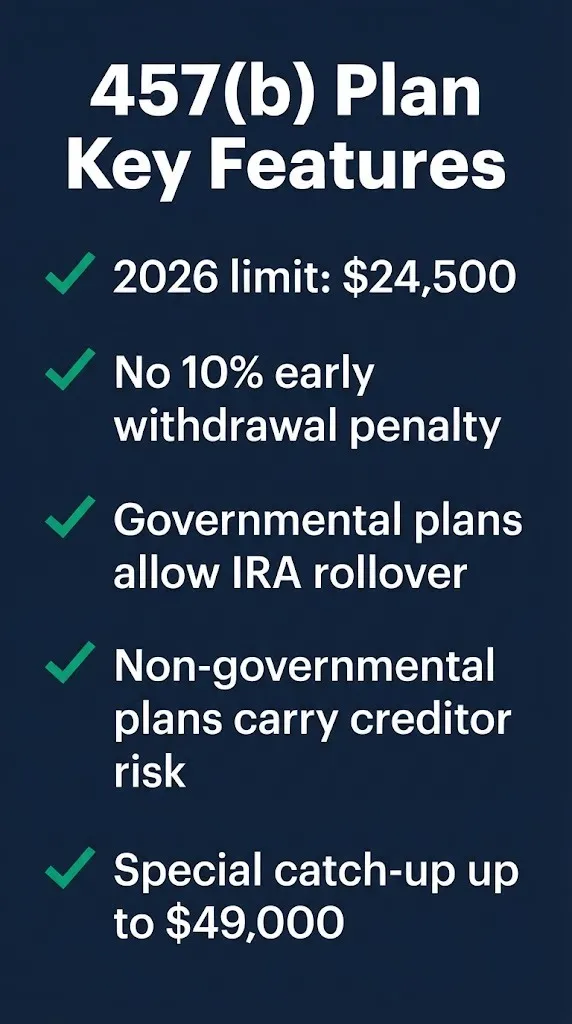
Creditor risk: If you have a non-governmental 457(b), your money sits in a rabbi trust. It’s not legally yours until it’s paid. If your employer goes bankrupt, you become a general creditor . Governmental plans don’t have this risk.
Lump-sum tax hit: If your non-governmental plan requires distribution after you leave, the entire balance becomes taxable in that year. That can spike your marginal tax rate and affect Medicare premiums .
Limited investment options: Some 457(b) plans offer a narrower menu of investments than you’d find in an IRA. Governmental plans like CalPERS offer institutional funds and a self-directed brokerage option, but not all plans are that flexible .
No employer match (often): Unlike 401(k)s, many 457(b) plans don’t offer employer matching contributions. Your contributions are yours alone .
Reality Check: A 457(b) is not a savings account. Non-governmental plans carry real creditor risk, and rolling a governmental plan into an IRA can cost you the penalty-free withdrawal benefit. Read your plan documents before assuming the money is fully protected.
What Happens Next With 457(b) Plans in 2026
December 31, 2026: Deadline to max out your 2026 457(b) contributions through payroll deferrals.
January 2027: New contribution limits announced by the IRS for the 2027 tax year.
Ongoing: SECURE 2.0 Roth catch-up requirement applies to high earners making age-based catch-up contributions.
Ongoing: Plan sponsors update documents to comply with Roth catch-up rules and super catch-up provisions.
Frequently Asked Questions
What is a 457 deferred compensation plan in simple terms?
A 457(b) is a retirement savings plan for government and some nonprofit employees that lets you defer part of your salary, pay taxes later, and withdraw after leaving your job without the 10% early withdrawal penalty.
How much can I contribute to a 457(b) in 2026?
The standard limit is $24,500. If you’re 50 or older, you can add $8,000. If you’re 60 to 63, you can add $11,250. The special pre-retirement catch-up allows up to $49,000.
Can I withdraw from my 457(b) before age 59½?
Yes, if you have a governmental plan and have separated from service. There’s no 10% early withdrawal penalty, though income tax still applies to pre-tax funds.
What’s the difference between a 457(b) and a 401(k)?
A 457(b) is for government and nonprofit employees, has no early withdrawal penalty, and may be subject to employer creditors if non-governmental. A 401(k) is for private employees and has a 10% penalty before 59½.
Can I roll my 457(b) into an IRA?
Governmental 457(b) plans can generally roll over to an IRA. Non-governmental 457(b) plans typically cannot. Rolling a governmental plan into an IRA eliminates the penalty-free withdrawal benefit.
What is the special 457(b) catch-up?
It’s a one-time opportunity in your final three years before normal retirement age to contribute up to double the normal limit, or make up for unused deferrals from prior years. The 2026 maximum is $49,000.
Are 457(b) contributions pre-tax or Roth?
Most 457(b) plans allow pre-tax contributions, and many governmental plans also offer a Roth option. Starting in 2026, high earners must make age-based catch-up contributions as Roth.
What happens to my 457(b) if my employer goes bankrupt?
If you have a non-governmental 457(b), your funds are subject to employer creditors and may be at risk. Governmental 457(b) plans generally hold assets in trust and are protected.