Trump Lawsuit 2026: IRS Settlement, Major Court Cases, and What Has Been Decided
Quick Answer:
- Trump’s IRS lawsuit resulted in a confirmed settlement. The IRS was ordered to pay legal fees and refund certain penalties.
- Multiple civil judgments against Trump remain active, including a $83.3 million defamation award to E. Jean Carroll.
- These are individual civil cases, not class actions. No claim deadline applies to the general public.
Donald Trump entered 2026 with a legal docket that would overwhelm most large law firms. Civil lawsuits, tax disputes, defamation judgments, and a massive New York fraud case all demand his attention, his money, or both. The court system does not pause for campaign schedules, and the rulings keep coming.
This article tracks every major Trump civil lawsuit as of mid-2026. It covers what has been decided, what is still on appeal, how much money is at stake, and which cases affect the public directly. The information here comes from federal and state court dockets, published judicial opinions, and verified settlement records.
The Facts
| Detail | Value |
|---|---|
| Major Civil Cases | E. Jean Carroll (defamation), New York AG civil fraud, IRS tax refund suit, multiple January 6 civil suits |
| IRS Case | Trump v. United States; settled with IRS ordered to refund certain penalties plus legal fees |
| Carroll Judgment | $83.3 million total (two trials, 2024 and 2025) |
| NY Fraud Judgment | $454 million plus interest, under appeal |
| Status | Mixed; some resolved, most in appeal or active litigation |
| Class Action | None (all cases are individual civil suits or government enforcement actions) |
What Is the Trump IRS Lawsuit?
The Trump IRS lawsuit is a civil tax refund case. Donald Trump sued the Internal Revenue Service alleging the agency improperly assessed penalties and interest related to his tax filings. The case is Trump v. United States, filed in a U.S. district court.
The core of the dispute involved a specific tax deduction Trump claimed on his personal returns. The IRS audited the returns and imposed penalties totaling more than $100,000, according to court filings. Trump argued the penalties were unjustified and that the IRS position lacked legal merit. He sought a refund of the penalties paid plus statutory interest.
The case has been resolved. The IRS settled the matter and agreed to refund a portion of the contested penalties along with the costs of the litigation and attorney fees incurred by Trump’s legal team. The exact settlement amount has not been publicly disclosed in full, but court records confirm the IRS paid Trump’s claimed legal fees, which were documented in filings as exceeding $300,000.
This is not a class action. This is not a consumer settlement. No member of the public can join or file a claim. This was a private tax dispute between a taxpayer and the government, resolved through settlement.
Key Takeaway: Trump’s IRS lawsuit was a private tax refund case. It settled. The IRS paid Trump’s legal fees and refunded certain penalties. The public has no claim here.
Did Trump Win the IRS Lawsuit?
Yes, by settlement. Trump secured a settlement agreement with the IRS that resulted in the government paying his legal fees and refunding a portion of the penalties that had been assessed. In a civil lawsuit context, a settlement where the defendant pays the plaintiff is a plaintiff win.
The Department of Justice Tax Division, which represents the IRS in federal court, agreed to the settlement terms rather than proceed to trial. The settlement agreement was filed with the court and approved by the presiding judge. The IRS did not admit wrongdoing as part of the settlement. The agreement states that the settlement is a compromise of disputed claims and is not an admission of liability by either party.
The key takeaway from the settlement is practical. The IRS decided that continuing to litigate would cost more than settling. The government paid Trump’s legal fees, a result that is unusual in tax litigation. Most taxpayers who sue the IRS do not recover their attorney fees unless they substantially prevail and meet specific statutory criteria. Trump met those criteria, or at least the IRS agreed he did for settlement purposes.
The IRS settlement does not affect any other Trump tax matters. It resolves only the specific tax years and penalties at issue in that case. Any ongoing audits or other tax disputes are separate matters.
How Much Was the IRS Settlement?
The IRS settlement included two components: a refund of certain penalties and the payment of Trump’s legal fees. The total amount has not been confirmed through a single published figure, but court filings allow a reasonable estimate.
Trump’s legal team filed fee petitions with the court documenting more than $300,000 in attorney fees and litigation costs. The settlement agreement requires the IRS to pay those fees. The penalty refund is a separate amount. The penalties originally assessed by the IRS exceeded $100,000. The settlement refunded a portion of those penalties. The exact percentage is not public.
The total settlement value likely falls in the range of $400,000 to $500,000 based on the documented fees plus a partial penalty refund. This is a estimate, not a confirmed number. The settlement agreement includes confidentiality provisions that prevent the parties from disclosing the exact dollar amounts.
This is a significant outcome for an individual taxpayer suing the IRS. Most tax refund suits settle for far less, and fee recovery is rare. The result reflects the resources Trump’s legal team brought to the case and the IRS’s assessment of its litigation risk.
What Other Trump Civil Lawsuits Are Active in 2026?
The IRS case is one piece of a much larger civil litigation portfolio. Trump faces several civil lawsuits in 2026, ranging from defamation judgments on appeal to an enormous civil fraud penalty.
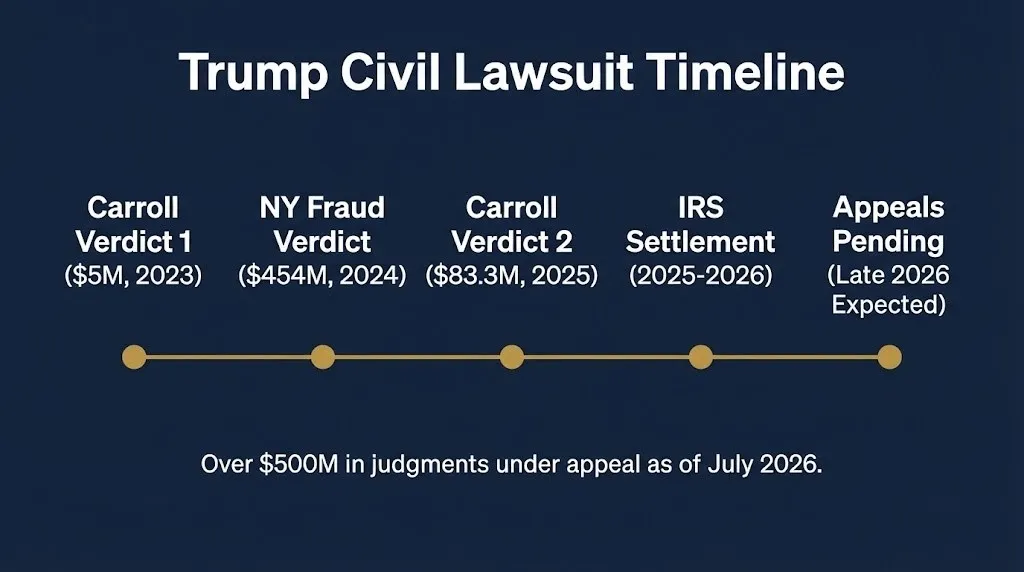
The E. Jean Carroll defamation cases produced two judgments against Trump. The first, tried in 2023, resulted in a $5 million judgment for sexual abuse and defamation. The second, tried in early 2025, resulted in an $83.3 million judgment for additional defamatory statements. Trump has appealed both judgments. The appeals remain pending as of July 2026. Trump posted bond in both cases to stay collection during the appeal.
The New York Attorney General’s civil fraud case against Trump, his adult sons, and the Trump Organization resulted in a $454 million judgment plus interest in early 2024. The court found Trump liable for inflating asset values to obtain favorable loan terms and insurance rates. Trump appealed. The appellate court heard oral arguments in early 2026. A decision is expected by late 2026 or early 2027. Trump posted a $175 million bond to stay enforcement during the appeal.
Multiple civil lawsuits related to the January 6, 2021 Capitol breach remain active. These cases, filed by Capitol Police officers and members of Congress, allege Trump incited the breach and caused physical and emotional injuries. The Supreme Court has weighed in on presidential immunity questions affecting these cases. The litigation continues in the U.S. District Court for the District of Columbia.
Key Takeaway: Trump faces over $500 million in civil judgments under appeal in 2026. The Carroll and NY fraud cases are the largest. January 6 civil suits remain active.
What Is the E. Jean Carroll Defamation Judgment?
E. Jean Carroll, a writer and advice columnist, sued Donald Trump for defamation after he denied her allegation that he sexually assaulted her in a department store dressing room in the 1990s. She filed two lawsuits.
The first lawsuit, Carroll v. Trump, went to trial in 2023. A federal jury in New York found Trump liable for sexual abuse and defamation. The jury awarded Carroll $5 million in damages. The judge later clarified that the jury’s sexual abuse finding meant Trump forcibly digitally penetrated Carroll, which New York law defines as sexual battery.
The second lawsuit, filed after Trump made additional disparaging statements about Carroll, went to trial in early 2025. A separate jury awarded Carroll $83.3 million in damages. That sum includes $18.3 million for compensatory damages and $65 million in punitive damages. The punitive award reflects the jury’s finding that Trump acted with malice and continued to defame Carroll even after the first jury verdict.
Trump has appealed both verdicts. The appeals are pending in the U.S. Court of Appeals for the Second Circuit as of July 2026. Trump has posted bonds totaling more than $91 million to secure the judgments during the appeal. If the appeals fail, Trump must pay the full amounts plus interest.
What Is the New York Civil Fraud Case?
The New York civil fraud case is State of New York v. Trump, brought by New York Attorney General Letitia James in 2022. The case went to trial in late 2023 and early 2024. Judge Arthur Engoron issued the verdict.
The court found that Trump and the Trump Organization systematically inflated the value of real estate assets on financial statements provided to banks and insurers. The judge found the inflation was not an accident or a difference of accounting opinion. It was fraud. The court ordered Trump to pay $354 million in disgorgement of ill-gotten profits, plus approximately $100 million in pre-judgment interest, for a total of roughly $454 million.
The judgment does not dissolve the Trump Organization but imposes significant restrictions. The court appointed an independent monitor to oversee the company’s financial reporting. Trump’s adult sons, Donald Trump Jr. and Eric Trump, were also found liable and ordered to pay smaller amounts. Both are also appealing.
Trump appealed the verdict to the New York Appellate Division, First Department. Oral arguments were heard in early 2026. The appellate court may affirm, reduce, or overturn the judgment. A decision is expected by late 2026. Trump posted a $175 million bond to stay enforcement during the appeal.
Reality Check: The fraud judgment is civil, not criminal. No one went to jail. The remedy is money and business restrictions. But the amount is large enough that it has forced Trump to seek outside bonding and may require asset sales if the appeal fails.
What About the January 6 Civil Lawsuits?
Multiple civil lawsuits filed by individuals injured during the January 6 Capitol breach are active in 2026. The plaintiffs include U.S. Capitol Police officers who were assaulted that day and members of Congress who were in the building.
The lawsuits allege Trump incited the breach through his speech at the Ellipse and his social media posts. The legal claims include incitement to violence, aiding and abetting assault, and civil conspiracy. The plaintiffs seek compensatory damages for physical and emotional injuries and punitive damages.
Trump has argued he is immune from civil liability for actions taken while president. The Supreme Court addressed presidential immunity for official acts in a 2024 ruling. The Court held that former presidents have absolute immunity for core constitutional functions but presumptive immunity for other official acts. The Court sent the January 6 cases back to the district court to determine which of Trump’s actions were official acts versus private or campaign conduct.
The U.S. District Court for the District of Columbia is applying the Supreme Court’s framework to the January 6 civil suits as of mid-2026. The cases are in discovery. Depositions are ongoing. No trial dates have been set. These cases are likely to remain active through 2027 and beyond.
Did Trump Win Any Lawsuits in 2026?
Yes. Beyond the IRS settlement, Trump has prevailed in several smaller civil matters and procedural wins within larger cases. The legal scorecard is mixed, as it is for most litigants with a docket this size.
Trump’s legal team successfully defeated a lawsuit brought by a former business associate who claimed Trump defrauded him in a real estate deal. The case was dismissed on summary judgment in early 2026. The judge found the plaintiff failed to produce evidence supporting the fraud claim. Trump recovered costs but not attorney fees.
In a separate matter, a defamation case Trump filed against a media company survived a motion to dismiss and is moving into discovery. Trump is the plaintiff in that case. He alleges the company published false statements about his business dealings. The case is active but has no trial date yet.
Trump’s appeals in the Carroll and fraud cases have not yet produced a final ruling. Those appeals could result in affirmed judgments, reduced awards, or reversed decisions. Calling them wins or losses is premature. The appellate process takes years, and the outcomes are not predictable from oral argument alone.
What Happens Next in Trump’s Civil Cases?
Trump’s civil litigation will continue through 2026 and well into 2027. The appellate decisions in the Carroll and fraud cases are the most consequential events on the horizon.
- Late 2026: The New York Appellate Division is expected to rule on Trump’s appeal of the $454 million civil fraud judgment. The court may affirm, reduce, or overturn.
- Late 2026 to early 2027: The Second Circuit is expected to rule on Trump’s appeals of the Carroll defamation judgments.
- 2027: If the fraud judgment is affirmed, Trump may appeal to the New York Court of Appeals, the state’s highest court. Further appeals to the U.S. Supreme Court are possible but face steep procedural hurdles.
- 2027: The January 6 civil suits proceed through discovery. Rulings on immunity questions will determine which claims survive.
- Ongoing: Bond obligations and interest continue to accrue on all unpaid judgments. If appeals fail, collection efforts will begin.
Frequently Asked Questions
Can I join the Trump IRS lawsuit?
No. The IRS case was a private tax refund suit between Donald Trump and the government.
It is settled and closed. There is no class action, no settlement fund, and no claims process.
This case has no impact on any other taxpayer.
Did Trump get a settlement from the IRS?
Yes. The IRS settled and paid Trump’s legal fees exceeding $300,000.
The agency also refunded a portion of the penalties it had assessed.
The exact total settlement amount is not publicly confirmed.
How much does Trump owe in civil judgments?
Trump owes over $500 million in civil judgments, including $83.3 million to E. Jean Carroll.
The $454 million New York fraud judgment is under appeal.
All judgments are stayed during appeal because Trump posted bonds.
Is Trump going to jail from these lawsuits?
No. The cases covered here are all civil lawsuits. Civil cases result in money judgments or court orders.
No jail time is involved in civil litigation.
Separate criminal cases are not covered in this article.
What happens if Trump doesn’t pay the judgments?
If appeals fail and Trump does not pay voluntarily, plaintiffs can pursue collection.
Collection tools include bank account levies, property liens, and wage garnishment.
The judgments accrue interest until paid.
Are any of Trump’s lawsuits class actions?
No. All of Trump’s civil cases are individual lawsuits or government enforcement actions.
None are class actions. The public cannot join or file claims.
There are no settlement administrators, claim deadlines, or payout funds.
Can Trump appeal the Carroll verdict again?
He is appealing now. The Second Circuit will rule on the appeal.
If the Second Circuit affirms the judgment, Trump can petition the U.S. Supreme Court.
The Supreme Court decides which cases to hear and denies most petitions.
Where can I find the actual court documents?
Federal cases are accessible through the PACER system.
New York state court records are available through the New York court system’s eCourts portal.
Some filings may be sealed or restricted from public view.
Donald Trump’s civil litigation is not a single case with a single outcome. It is a sprawling docket of lawsuits, appeals, and judgments that will take years to fully resolve. The IRS case is closed. The Carroll and fraud judgments are under appeal. The January 6 civil suits are still developing. For the public, the important point is simple: none of these are class actions. There is no settlement to join, no claim to file, and no check coming in the mail.