What Is a Civil Lawsuit in 2026? Definition, Process, and How to File
Quick Answer:
- A civil lawsuit is a non-criminal court case where one party sues another for money, property, or specific action.
- Most civil cases settle out of court. Only about 1 percent of federal civil cases reach a jury trial.
- Statutes of limitations vary by state and claim type, typically one to six years from the date of injury.
If someone owes you money, broke a contract, damaged your property, or caused you an injury, the legal tool for getting compensated is a civil lawsuit. It is not a criminal case. No one goes to jail. The goal is money or a court order, not punishment by the state.
This article explains what a civil lawsuit is in plain terms, how it works from start to finish in 2026, what types exist, how much it costs, and how to file one yourself or with an attorney. The information here comes from federal and state court procedural rules, the Administrative Office of U.S. Courts, and established legal reference sources.
The Facts
| Detail | Value |
|---|---|
| Definition | A non-criminal court action where a plaintiff seeks damages or equitable relief from a defendant |
| Governing Rules | Federal Rules of Civil Procedure (federal courts); state civil procedure codes (state courts) |
| Burden of Proof | Preponderance of the evidence (more likely than not) |
| Average Time to Trial | 28 months in federal court (median) |
| Trial Rate | Under 1% of federal civil cases reach a jury verdict |
| Typical Filing Fee | $402 in federal district court; $75 to $435 in state courts |
| Statute of Limitations | Varies by claim type and state, typically 1 to 6 years |
What Is a Civil Lawsuit?
A civil lawsuit is a court process where one person, business, or entity sues another person, business, or entity for money damages or a court order requiring some action. It is not a criminal prosecution. The government is not bringing charges. No one faces jail time.
The person who files the case is the plaintiff. The person being sued is the defendant. The plaintiff claims the defendant caused harm, broke a contract, or violated a legal right. The remedy is typically money, called damages. Sometimes the remedy is a court order to do something or stop doing something, called equitable relief or an injunction.
Civil lawsuits cover an enormous range of disputes. A tenant sues a landlord over a security deposit. A driver sues another driver after a car crash. A business sues a competitor for stealing trade secrets. A consumer sues a company for selling a defective product. These are all civil lawsuits. The common thread is a private party seeking compensation or action from another private party through the court system.
Think of a civil lawsuit as a formalized argument with a referee. The referee is the judge. The rules are the rules of civil procedure. The outcome is a judgment that the court can enforce through its legal powers.
What Is the Civil Lawsuit Definition Under U.S. Law?
The civil lawsuit definition in U.S. law is a legal action brought by one party against another in a court of law to resolve a private dispute and to provide a remedy for a claimed wrong. The case is captioned with the plaintiff’s name first and the defendant’s name second.
The Federal Rules of Civil Procedure govern civil cases in U.S. district courts. Each state has its own civil procedure code for state court cases. The core elements are the same across jurisdictions. A plaintiff files a complaint stating the facts and the legal basis for the claim. The defendant files an answer admitting or denying each allegation. The case proceeds through discovery, motions, and potentially trial.
The burden of proof in a civil case is “preponderance of the evidence.” That means the plaintiff must prove their case is more likely true than not. In a criminal case, the standard is “beyond a reasonable doubt,” a much higher bar. This is why O.J. Simpson was acquitted of murder in criminal court but found liable in civil court for the same events. The burden of proof is lower in civil court.
Civil cases are not about guilt or innocence. They are about liability. A defendant found liable must pay damages or comply with a court order. A defendant found not liable owes nothing.
Key Takeaway: A civil lawsuit is a private legal action for money or court orders. The burden of proof is lower than in criminal cases. The outcome is liability, not guilt.
What Are the Main Types of Civil Lawsuits?
Civil lawsuits fall into broad categories based on the legal theory behind the claim. Knowing the type matters because the statute of limitations, the damages available, and the court with jurisdiction all depend on the claim type.
The most common types of civil lawsuits include:
- Contract disputes. One party claims another broke a promise in a signed agreement. Damages are typically the value of what was lost.
- Personal injury claims. Covers car accidents, slip and falls, medical malpractice, and product liability. The plaintiff seeks compensation for medical bills, lost wages, and pain and suffering.
- Property disputes. Boundary disagreements, easement fights, landlord-tenant conflicts, and damage to real or personal property.
- Employment disputes. Wrongful termination, wage and hour violations, discrimination claims, and harassment cases.
- Family law matters. Divorce, child custody, child support, and alimony are civil proceedings, though often handled in specialized family courts.
- Debt collection. Creditors sue debtors for unpaid loans, credit card balances, and other financial obligations.
- Defamation. Libel and slander claims where the plaintiff alleges false statements caused reputational and financial harm.
- Consumer protection. Claims under state and federal consumer laws for deceptive business practices, fraud, and unfair trade.
Some cases combine multiple claim types. A business dispute might involve breach of contract and fraud. A car accident might include personal injury and property damage. The complaint lists each claim as a separate count.
How Does a Civil Action Lawsuit Work Step by Step?
A civil action lawsuit follows a structured path from filing to resolution. Most cases settle somewhere along the way. Understanding the stages helps you know what to expect if you sue or get sued.
- Pre-filing investigation and demand. The plaintiff gathers evidence, calculates damages, and often sends a demand letter asking the defendant to pay or act before a lawsuit is filed.
- Filing the complaint. The plaintiff files a complaint with the court and pays the filing fee. The complaint explains what happened, why the defendant is liable, and what the plaintiff wants.
- Service of process. The defendant must be formally notified of the lawsuit, typically by a process server or sheriff delivering a copy of the complaint and summons.
- Defendant’s response. The defendant files an answer, usually within 20 to 30 days. The answer admits or denies each allegation and raises any affirmative defenses.
- Discovery. Both sides exchange evidence. This includes documents, interrogatories (written questions), requests for admission, and depositions (sworn testimony out of court).
- Motions. Either side may file motions asking the judge to rule on specific issues. Summary judgment motions ask the judge to decide the case without a trial because no material facts are disputed.
- Settlement negotiations and mediation. Most courts encourage or require settlement talks. A mediator helps both sides reach a deal without trial.
- Trial. If no settlement, the case goes to trial before a judge or jury. The plaintiff presents evidence first. The defendant responds. The judge or jury delivers a verdict.
- Judgment. The court enters a judgment based on the verdict. The losing side may appeal.
- Collection. If the plaintiff wins and the defendant does not pay voluntarily, the plaintiff must take additional steps to collect the judgment, such as garnishing wages or placing liens on property.
The entire process typically takes 1 to 3 years from filing to trial. Complex cases take longer. Cases that settle early can resolve in months.
Key Takeaway: A civil lawsuit moves through complaint, answer, discovery, motions, and trial. Most cases settle during discovery or mediation, not in a courtroom.
What Are Some Civil Lawsuit Examples?
Real civil lawsuit examples help clarify what these cases look like in practice. Here are five common scenarios, drawn from typical court filings.
- Car accident with injuries. A driver runs a red light and hits your car. You suffer a broken arm and miss six weeks of work. You sue for medical bills, lost wages, and pain and suffering. This is a personal injury civil lawsuit.
- Breach of contract by a contractor. You pay a builder $50,000 to remodel your kitchen. They take the money and disappear. You sue for the $50,000 plus the cost of hiring someone else to finish the work. This is a contract dispute.
- Defective product injury. You buy a space heater that catches fire and burns your house. You sue the manufacturer, claiming the product was defectively designed. This is a product liability civil lawsuit.
- Wrongful termination. Your employer fires you the day after you report safety violations to OSHA. You sue for lost wages and emotional distress, claiming retaliation. This is an employment civil lawsuit.
- Neighbor property dispute. Your neighbor builds a fence three feet onto your property. You sue for trespass and seek a court order to remove the fence. This is a property dispute civil lawsuit.
Each of these examples involves a private party seeking compensation or a court order from another private party. No criminal charges are involved. The remedy is money or an injunction, not punishment.
How Do I Check If There Is a Pending Lawsuit Against Me?
A pending lawsuit against you exists when a plaintiff has filed a complaint and you have not yet been served, or you have been served and the case has not resolved. Checking is straightforward if you know where to look.
You can search for lawsuits against you by checking these sources:
- Your local county court’s online docket system. Most counties have a searchable database by name.
- Your state court system’s unified case search portal, if one exists in your state.
- The federal PACER system for U.S. district court cases. This requires a small per-page fee.
- A consumer reporting agency that compiles public records, though these can be out of date.
If you receive a summons and complaint, you have been sued. The papers will tell you the court, the case number, the plaintiff’s name, and the deadline to respond. Ignoring the papers does not make the case go away. It means the plaintiff can ask for a default judgment against you.
If you suspect a lawsuit might be filed but have not been served, check the court dockets in the county where you live and where the incident occurred. Some plaintiffs file and delay service. Others serve through alternative methods if personal service fails.
How Much Does It Cost to File a Civil Lawsuit?
Filing a civil lawsuit costs money, but the upfront fees are smaller than most people expect. The real cost is attorney time if the case goes deep.
The filing fee in federal district court is $402 as of 2026. State court filing fees range from $75 to $435 depending on the state and the amount of the claim. Small claims courts, which handle cases under $5,000 to $10,000, typically charge $30 to $100 to file.
Service of process costs $50 to $150 if you use a professional process server. The sheriff’s department in some counties serves papers for less.
Attorney fees are the largest cost by far. Most personal injury attorneys work on contingency, taking 33% to 40% of the recovery. For other civil cases, attorneys charge hourly rates ranging from $200 to $600 per hour depending on location and experience. A straightforward breach of contract case might cost $5,000 to $15,000 in attorney fees. A complex case heading to trial can cost $50,000 to $200,000 or more.
Court costs beyond the filing fee include deposition transcripts at $500 to $1,500 per deposition, expert witness fees at $2,000 to $10,000 per expert, and copying and document management fees that can run into thousands for large cases. The party that wins can sometimes recover costs from the losing party, but that recovery is often partial.
Key Takeaway: Filing fees are typically $75 to $402. Attorney fees are the real cost, ranging from a contingency percentage to hourly rates of $200 to $600 per hour.
How Do I Start a Civil Lawsuit Without a Lawyer?
You can start a civil lawsuit without a lawyer. It is called proceeding pro se. Courts allow it, but the rules still apply to you exactly as they apply to licensed attorneys.
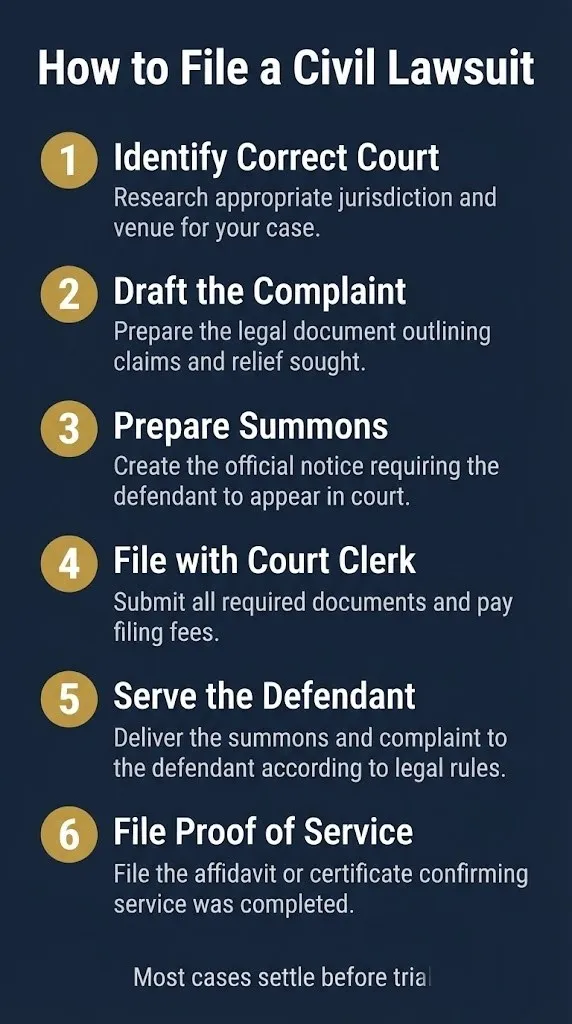
To file a civil lawsuit pro se:
- Identify the correct court. The court must have jurisdiction over the defendant and the subject matter. Generally, you sue where the defendant lives or where the incident occurred.
- Determine your claim type and the statute of limitations. File before the deadline or lose your right to sue.
- Draft the complaint. State the facts in numbered paragraphs. Explain what the defendant did, when, and how it harmed you. State the legal basis for each claim. State the relief you want.
- Prepare the summons. This is a separate form telling the defendant they are being sued.
- File with the court clerk. Submit the complaint, summons, and filing fee. Some courts require a civil cover sheet.
- Serve the defendant. Arrange for a process server or sheriff to deliver the papers.
- File proof of service with the court.
Small claims court is designed for pro se litigants. The procedures are simpler. The forms are often fill-in-the-blank. The damages cap is lower, typically $5,000 to $10,000. For anything above small claims limits, hiring an attorney is strongly recommended.
Reality Check: Filing a lawsuit is one thing. Winning it is another. Pro se litigants lose most cases against represented parties. The rules of evidence, discovery procedures, and motion practice are technical. Judges hold pro se parties to the same standards as attorneys. If the amount at stake is more than a few thousand dollars, an attorney’s fees may pay for themselves in a better outcome.
What Is a Federal Lawsuit and How Is It Different?
A federal lawsuit is a civil case filed in a U.S. district court rather than a state court. Federal courts have limited jurisdiction, meaning they can only hear certain types of cases. Most civil lawsuits belong in state court.
A case can be filed in federal court if it involves a federal question, meaning the claim arises under the U.S. Constitution, a federal statute, or a federal treaty. Civil rights cases, patent and copyright disputes, and antitrust claims are federal question cases.
A case can also be filed in or removed to federal court if it meets diversity jurisdiction requirements. Diversity jurisdiction exists when the plaintiff and defendant are from different states and the amount in controversy exceeds $75,000. A car accident between a California driver and a Nevada driver with $100,000 in claimed damages could be filed in federal court.
Federal courts follow the Federal Rules of Civil Procedure. Federal judges are appointed for life. Federal juries are drawn from a broader geographic area. The discovery process in federal court tends to be more structured and faster than in many state courts. Federal trials also tend to occur sooner after filing than state trials in backlogged jurisdictions.
Some defendants prefer federal court. Some plaintiffs prefer state court. The choice depends on the claim, the parties, and strategic considerations about which court is likely to move faster and provide a more favorable jury pool.
How Long Does a Civil Lawsuit Take in 2026?
The median time from filing to trial in federal civil cases is 28 months as of 2026, according to data from the Administrative Office of U.S. Courts. State court timelines vary widely by jurisdiction and case type.
Here is a realistic timeline for different case types:
| Case Type | Typical Time to Resolution |
|---|---|
| Small claims court | 1 to 3 months from filing to hearing |
| Uncontested divorce | 1 to 6 months |
| Contract dispute (settles early) | 6 to 12 months |
| Personal injury (moderate, settles pre-trial) | 12 to 24 months |
| Complex commercial litigation | 2 to 5 years |
| Federal civil rights case | 2 to 3 years to trial |
Cases that settle resolve faster. The timeline is dictated less by the court schedule and more by how long it takes both sides to evaluate the case, complete discovery, and reach a negotiation point. Cases that file for summary judgment take longer if the motion is denied and trial preparation follows.
The pandemic-era backlog in many courts has improved as of 2026, but some urban jurisdictions still have multi-year wait times for civil trials. Check with the specific court where the case is or will be filed for current estimates.
What Happens Next After You File a Civil Lawsuit?
After the complaint is filed and the defendant is served, the case moves through a predictable sequence. Here is the expected timeline for a typical civil lawsuit filed in 2026.
- Days 1 to 30: Defendant is served and must file an answer or a motion to dismiss within 20 to 30 days.
- Months 1 to 3: Initial disclosures are exchanged. The parties identify witnesses and produce basic documents.
- Months 3 to 12: Discovery proceeds. Written discovery is exchanged. Depositions are taken. Experts are retained.
- Months 12 to 18: Discovery closes. Summary judgment motions may be filed. Mediation is often scheduled.
- Months 18 to 24: If summary judgment is denied, trial preparation begins. Pretrial motions and jury instructions are filed.
- Months 24 to 30: Trial occurs. Verdict is rendered.
- Post-trial: Post-trial motions and potential appeals add months or years before the judgment is final and collectible.
Frequently Asked Questions
What is the difference between a civil lawsuit and a criminal case?
A civil lawsuit is between private parties seeking money or a court order.
A criminal case is brought by the government seeking fines, probation, or imprisonment.
The burden of proof is lower in civil court, preponderance of the evidence versus beyond a reasonable doubt.
Can I file a civil lawsuit for free?
Some courts offer fee waivers for litigants who cannot afford filing fees.
You must submit a financial affidavit proving your income falls below the threshold.
Small claims courts often have lower fees. Pro bono legal aid may be available through local bar associations.
What happens if I win my civil lawsuit but the defendant doesn’t pay?
You must take collection action. The judgment does not automatically transfer money.
You may garnish wages, levy bank accounts, or place liens on property.
Collection can be difficult if the defendant has few assets or declares bankruptcy.
Can a civil lawsuit turn into a criminal case?
No. The civil and criminal systems are separate.
But the same conduct can lead to both a civil lawsuit and a criminal prosecution.
Evidence from a civil case can sometimes be used in a criminal investigation.
Do I have to testify in my civil lawsuit?
You will likely be deposed during discovery, which is sworn testimony out of court.
If the case goes to trial, you may testify. Your attorney will prepare you.
You have a Fifth Amendment right against self-incrimination if your testimony could expose you to criminal charges.
How much can I sue for in a civil lawsuit?
There is no fixed cap for most civil claims, but your damages must be provable.
Small claims courts cap damages at $5,000 to $10,000 depending on the state.
Punitive damages may be available in some cases for particularly egregious conduct.
Can I settle my civil lawsuit at any time?
Yes. Most civil cases settle before trial.
Settlement can occur at any stage, from before filing to after a verdict is appealed.
A settlement is a private agreement. The court does not decide the terms.
How do I find a civil lawsuit attorney?
Seek referrals from your local bar association’s lawyer referral service.
Look for attorneys who specialize in your specific claim type, not general practitioners.
Check state bar records for disciplinary history before hiring.
If you are considering a civil lawsuit, the clock is running. Every claim type has a statute of limitations, and once that deadline passes, you lose the right to sue permanently. Get your evidence organized. Calculate your damages. Decide whether the amount at stake justifies the cost and time of litigation. Most cases settle, but you do not get to settlement without filing the case first.