What Is a Deposition in a Lawsuit? 2026 Guide to Sworn Testimony Before Trial
Quick Answer
- A deposition is a formal question-and-answer session under oath, before trial, with no judge or jury present .
- A court reporter records every word, creating a transcript that can be used to challenge a witness who changes their story later .
- You can be deposed as a party, a witness, or a corporate representative, and lying under oath is perjury with real consequences .
You searched for what a deposition is because a lawyer sent you a notice, or you are about to be involved in a lawsuit and want to know what happens next. The short definition is that a deposition is testimony under oath, taken outside a courtroom, recorded word for word, and usable later at trial or in settlement talks . It is not a trial, and there is no judge in the room to rule on objections in real time.
The number that matters most is not a dollar figure but a deadline: depositions happen during discovery, after a case is filed and before trial, and the rules about notice, attendance, and objections are strict . If you are a party, you must attend when properly noticed. If you are a non-party witness, you must be subpoenaed, and the subpoena comes with a $40 attendance fee under federal law .
This article explains the process step by step, what happens if you lie, how corporate depositions work, and the mistakes that turn a routine session into a sanctions fight.
The Facts
| Item | What to Know |
|---|---|
| Definition | Sworn testimony taken out of court, recorded by a court reporter |
| When It Happens | During discovery, after filing and before trial |
| Who Attends | Deponent, attorneys, court reporter, sometimes a videographer |
| Oath Required | Yes, administered by the court reporter or officer |
| Record Created | Stenographic, audio, or audiovisual transcript |
| Non-Party Attendance | Requires a subpoena, with $40 attendance fee |
| Perjury Risk | Sanctions can include dismissal of the case |
Is a Deposition Real Testimony or Just a Fishing Expedition?
A deposition is real testimony under oath, and it is not a fishing expedition in the casual sense, because the rules allow broad questioning about anything relevant to the case. The Massachusetts court system describes it as “testimony in court, under oath, but before trial, outside the courtroom, and without a judge or jury present” . The federal rules define it as an oral statement made before an officer authorized to administer oaths, taken to examine witnesses or obtain discovery .
The “fishing expedition” concern is real in practice. Attorneys use depositions to uncover information that supports their claims and undermines the other side’s claims . That means questions can range from background details to specific documents to conversations you barely remember. The scope is broad, but it is not unlimited. Attorneys can object to questions that invade privilege, and in extreme cases a court can limit or terminate a deposition that is conducted in bad faith or to harass the deponent .
Key Takeaway: A deposition is real sworn testimony, and its broad scope is exactly why preparation matters more than in ordinary conversation.
How Much Does a Deposition Cost?
A deposition costs money, and the amounts are concrete even though they vary by court reporter, location, and length. The noticing party bears the cost of the original recording, and any party can arrange to transcribe the deposition at its own expense . If a non-party witness is subpoenaed, the party requesting the deposition must pay a $40 per day attendance fee plus mileage or travel expenses under federal law . Court reporter fees are not published in the rules, but they are a real line item in every litigation budget.
The cost structure matters because it shapes strategy. A videotaped deposition costs more than an audio-only one. A transcript ordered by both sides costs more than one ordered by a single party. An interpreter adds another layer. For a consumer involved in a lawsuit, the practical takeaway is that you do not pay for your own deposition when the other side notices it; they bear the recording cost.
| Cost Item | Who Pays | Verified Amount |
|---|---|---|
| Original recording | Noticing party | Varies by reporter |
| Additional recording method | Requesting party | Varies |
| Non-party attendance fee | Requesting party | $40 per day |
| Transcript copies | Requesting party | Varies |
Not yet determined for any specific case until the court reporter’s rate schedule is known.
Key Takeaway: The party who notices the deposition pays for the record, and non-party witnesses are entitled to a $40 attendance fee.
Reality Check: No one charges you to be deposed, and no legitimate court reporter asks the witness for payment. If a “deposition service” asks you for money to appear or to get a copy of your own transcript, verify it against the notice and the court rules before paying anything.
How Does a Deposition Work Step by Step?
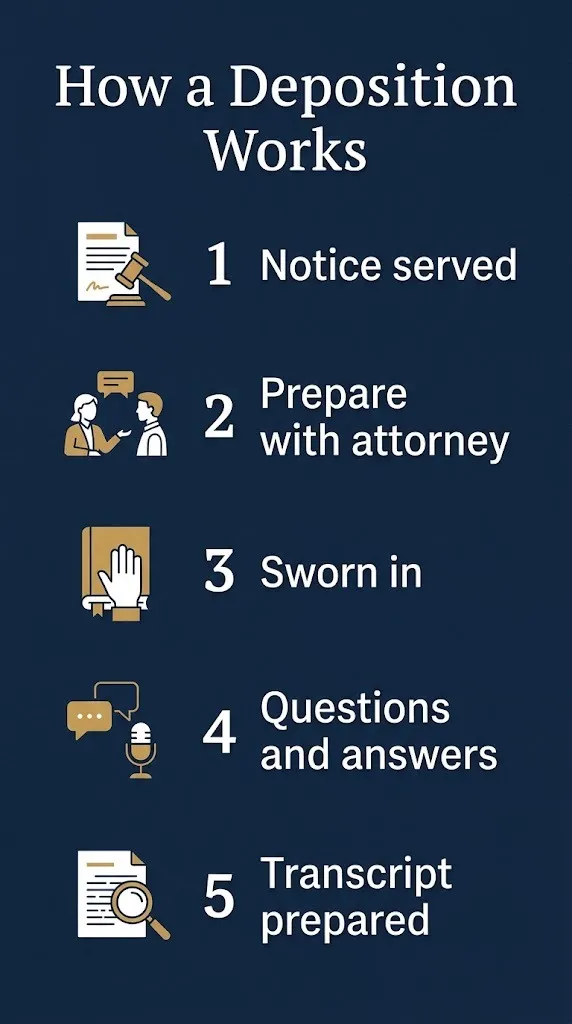
A deposition works through a set sequence: notice, preparation, oath, questioning, and transcript. The first step is the notice of deposition, which identifies who will be questioned, when, and where . For a party, the notice is enough to require attendance. For a non-party, a subpoena is required, and it can include a request to bring documents, called a subpoena duces tecum .
The session itself begins with the court reporter swearing in the deponent . The attorney who noticed the deposition asks questions first, usually starting with background and then moving into the facts. Opposing counsel can object, but under the federal rules objections must be concise and non-argumentative, and a witness generally must answer unless the objection is based on privilege or a court order . After questioning ends, the court reporter prepares a transcript, and the deponent may have a chance to review and sign it depending on the jurisdiction.
Here is the sequence in numbered form:
- Notice is served identifying the deponent, date, and location .
- Preparation begins with document review and practice sessions .
- The court reporter administers the oath .
- The noticing attorney asks questions about background and facts .
- Opposing counsel objects concisely when grounds exist .
- The transcript is prepared and can be used at trial or in motions .
What Happens If You Lie in a Deposition?
Lying in a deposition is perjury, and courts have imposed severe sanctions for it, including dismissal of the entire case. The rules do not spell out a specific penalty for perjury at a deposition, but courts use their inherent authority and Rule 37 to punish discovery abuse . In one reported case, a plaintiff lied repeatedly about how she used a product, and the court’s sanction power was invoked to seek dismissal; the plaintiff’s counsel withdrew before the court ruled .
The logic is straightforward. A deposition transcript is a sworn record, and if a witness contradicts it at trial, the other side can use the earlier statement to impeach them . If the lie is material, the court can treat it as an abuse of the discovery process that warrants terminating sanctions. That is why every deposition guide starts with the same instruction: tell the truth .
Key Takeaway: Perjury in a deposition can end a case, not just damage credibility, because courts treat sworn lies as an abuse of the judicial process.
Who Can Be Deposed in a Lawsuit?
Anyone with relevant knowledge can be deposed: the parties, fact witnesses, expert witnesses, and corporate representatives. The parties are the easiest to depose because they are already subject to the court’s jurisdiction and can be compelled by notice . Fact witnesses testify about what they saw, did, or experienced. Expert witnesses are hired for specialized knowledge and did not witness the events before litigation .
A company cannot sit for a deposition, so it must designate a person to testify on its behalf. This is often called a 30(b)(6) deposition, referencing the federal rule, and the designated witness’s answers are treated as the company’s own statements . The notice must describe the topics with reasonable particularity, and the organization must produce someone who can testify about those topics .
| Deponent Type | How Compelled | What They Testify About |
|---|---|---|
| Party | Notice | Their own knowledge and actions |
| Non-party fact witness | Subpoena | What they saw or did |
| Expert witness | Notice or subpoena | Specialized opinions |
| Corporate representative | Notice under Rule 30(b)(6) | Matters known to the organization |
What Are Common Deposition Objections and Rules?
Common deposition objections are about form, privilege, and scope, and the rules limit how far an attorney can go to disrupt questioning. Under the federal rules, objections must be made concisely and in a non-argumentative and non-suggestive manner, and directions not to answer are prohibited except in three circumstances: to claim a privilege, to enforce a court limitation, or to suspend the deposition to seek a court order .
That restriction exists because speaking objections can coach the witness. An attorney who objects with a long explanation is effectively telling the witness how to answer. The rules push back against that by requiring objections to be short and by allowing the deposition to continue. In extreme cases, a party can move to terminate or limit the deposition if it is conducted in bad faith or to annoy or oppress the deponent .
| Objection Type | Allowed? | Rule |
|---|---|---|
| Form of the question | Yes, concisely | Must be non-argumentative |
| Privilege | Yes | Grounds for instruction not to answer |
| Speaking objection | No | Prohibited as suggestive |
| Coaching the witness | No | Violates conduct rules |
Key Takeaway: Objections are supposed to be short and on the record, and a lawyer who lectures during a deposition is creating grounds for a motion.
How Do You Prepare for a Deposition?
You prepare for a deposition by reviewing the facts, practicing your answers, and understanding that you must tell the truth without volunteering extra information. Preparation is the step most likely to change the outcome, because a witness who is organized and consistent is harder to impeach than one who guesses or rambles . Attorneys often run practice depositions with their clients before the real one .
The core instructions are simple. Tell the truth. Do not guess or speculate. Answer concisely and stop talking when the question is answered . Listen to the full question before answering, and do not nod or gesture because the transcript only captures words. If you do not understand a question, say so rather than answering something you did not understand.
Here is a practical preparation checklist:
- Review the documents you will be asked about.
- Practice answering with your attorney.
- Confirm the date, time, and location on the notice.
- Arrive early and bring nothing you were not asked to bring.
- Answer only the question asked, then stop.
- Ask for a break if you need one, and consult your attorney if a question confuses you.
What Happens Next
Immediate: If you received a notice or subpoena, confirm the date, time, location, and whether you must bring documents.
Within days: Review the key documents and schedule a preparation session with your attorney.
At the deposition: Take the oath, answer truthfully and concisely, and let your attorney handle objections.
After the deposition: The court reporter prepares the transcript, which may be used in motions, settlement talks, or trial.
No fixed deadline: Deposition timing depends on the court’s scheduling order and the pace of discovery.
Frequently Asked Questions
What is a deposition in simple terms?
A deposition is a formal interview under oath, recorded by a court reporter, that happens before trial and outside a courtroom. It is testimony, not a conversation.
Do I have to attend a deposition?
If you are a party and receive proper notice, yes. If you are a non-party, you must be subpoenaed, and the requesting party must pay your attendance fee .
Can I have a lawyer at my deposition?
Yes. Your attorney can attend, object to improper questions, and advise you, though the rules limit how much they can interfere with questioning.
What happens if I refuse to answer a question?
Your attorney can instruct you not to answer only in limited circumstances, such as privilege or a court order . Otherwise, refusing can lead to a motion to compel and sanctions.
Is a deposition the same as a trial?
No. A deposition has no judge or jury, and it is not the trial itself. It is a discovery tool that creates a record for later use .
Can a deposition be used in court?
Yes. It can be used to impeach a witness who changes their story, and in some cases the deposition testimony itself can be presented at trial if the witness is unavailable .
How long does a deposition last?
There is no fixed national limit, but courts can impose time limits, and many jurisdictions have local rules or standing orders that cap length .