Products Liability Litigation 2026: How Defect Claims Work, What They Pay, and Who Qualifies
Quick Answer
- Products liability litigation is a civil claim against a seller or manufacturer for harm caused by a defective product.
- There is no single payout amount. Abbott’s 2026 infant formula settlement totals $670 million, but individual awards depend on injury and proof .
- You must file within your state’s statute of limitations, which varies by jurisdiction and is not uniform.
You searched “products liability litigation” because a product hurt you, or someone you know, and you need to know whether there’s a legal path to compensation. The honest answer is that there is a path, but it is not a claim form you fill out online.
Products liability is the area of law that holds sellers and manufacturers responsible when a product causes injury. It covers everything from a defective car part to a baby formula to a medical implant. The rules are state-specific, and the proof required is heavier than most people expect.
This article explains how the claims work, what Abbott’s $670 million settlement in 2026 actually covers, the three defect types, the steps to file, and why most of these cases never become class actions. The part that surprises people: “strict liability” does not mean automatic payment.
The Facts
| Case | Products liability litigation (a body of law, not a single case) |
|---|---|
| Status | Active. Abbott’s $670 million preterm formula settlement announced Aug. 20, 2026 |
| Fund Size | No single fund. Abbott settlement: approximately $670 million |
| Est. Per Person | Not yet determined for Abbott settlement. Amounts depend on injury, causation, and individual proof |
| Claim Deadline | Varies by state statute of limitations. Not uniform across jurisdictions |
| Administrator | Not applicable. Products liability cases are filed in court, not administered like class action funds |
| Proof Needed | Product identification, defect evidence, injury documentation, causation link |
Is Products Liability Litigation Legit or a Scam?
Products liability litigation is legitimate and grounded in state tort law, not a scam. The confusion comes from the word “litigation,” which sounds like a settlement program you can join. It is not. It is a lawsuit you or a lawyer files in court, and it requires proof that a specific product caused a specific injury .
The legal basis has existed for decades. Cornell’s legal definition explains that products liability holds any party along the chain of manufacture responsible for damage caused by a product . That chain runs from the component maker to the assembler to the wholesaler to the retail store.
What makes it legitimate is the burden of proof. You cannot simply say a product hurt you. You must show the product was defective when it left the defendant’s hands, and that the defect caused your injury . That standard is why so many claims fail or settle for less than plaintiffs hope.
The scam risk sits outside the courtroom. Ads promising “products liability settlement money” for vague injuries are common. There is no universal products liability fund. If a page asks for your Social Security number before naming a specific case, court, or defendant, treat it as a red flag.
How Much Can You Get From Products Liability Litigation?
There is no fixed payout amount in products liability litigation. Awards depend on the injury, the proof of defect, the jurisdiction, and whether the case settles or goes to trial. The most concrete 2026 figure is Abbott’s $670 million agreement covering approximately 2,000 claimants in the preterm infant formula litigation .
That settlement resolved the Gill case, where a St. Louis jury awarded $495 million in July 2024 . Abbott said the settlement amount was slightly higher than the roughly $600 million needed to satisfy the judgment and accrued interest . The per-person amounts for the roughly 2,000 covered claimants are not yet confirmed.
For context on scale, DLA Piper reported that product, automotive, and medical liability cases accounted for two-thirds of all nuclear verdicts from 2013 to 2022, with median verdicts of $21 million . Those are outlier verdicts, not typical recoveries. Most cases settle for far less.
| Case Type | 2026 Verified Figure |
|---|---|
| Abbott preterm formula settlement (total) | $670 million |
| Gill jury verdict (pre-settlement) | $495 million |
| Abbott remaining pending lawsuits | Approximately 1,700 |
| Abbott individuals still claiming harm | Up to 12,700 (includes duplicates) |
Key Takeaway: Products liability payouts are case-specific, and the $670 million Abbott figure is a total settlement, not a per-person amount. Individual recoveries depend on proving defect, causation, and damages.
What Are the Three Types of Product Defects?
Products liability claims fall into three defect categories: design defects, manufacturing defects, and marketing defects (also called warning defects) . The category matters because it determines what you must prove and who you sue.
A design defect exists before the product is built. The entire product line is flawed because of how it was engineered. In most states, the plaintiff bears the burden of proving the design was unreasonably dangerous . The risk-utility test asks whether the product’s danger outweighs its usefulness.
A manufacturing defect happens during production. Only some units of the product line are flawed. A batch of tires with weak sidewalls, or a lot of medication with wrong dosage, fits this category . You compare your unit to the intended design.
A marketing defect covers inadequate warnings or instructions. The product may be safely designed and correctly built, but the label fails to disclose a latent danger . Failure-to-warn claims are common in pharmaceutical and medical device cases.
Reality Check: No one texts you products liability money before a case is filed. There is no master database of defective products with automatic payouts. A legitimate claim starts with a specific product, a specific injury, and a lawyer or court filing.
Who Qualifies to File a Products Liability Lawsuit?
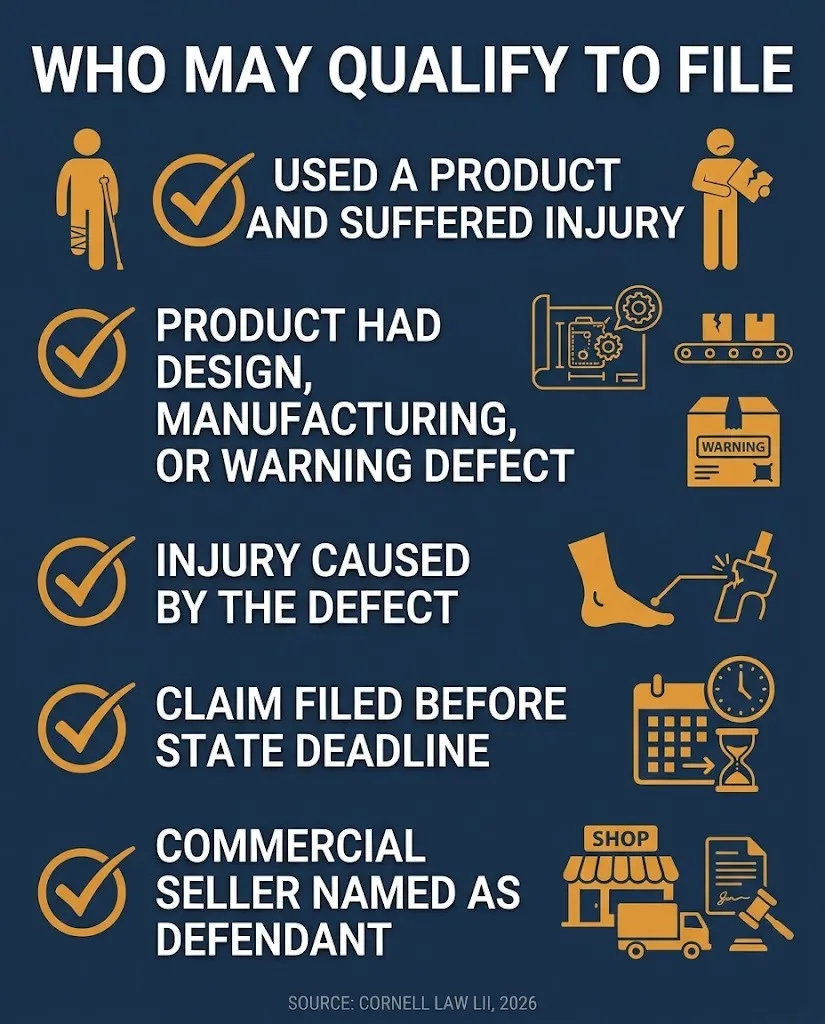
You may qualify to file if you used a product, suffered an injury, and can show the injury was caused by a defect in that product. The product does not have to be yours. It can be borrowed, given to you, or used by a family member, and you may still have a claim if it harmed you .
The defendant must be a commercial seller of the product. That usually means the manufacturer, distributor, or retail store. A private individual selling a used item on a marketplace is generally not treated the same as a commercial seller .
Timing matters. Every state has a statute of limitations for products liability claims, and the windows differ. Some states also have statutes of repose that cut off claims after a product has been in use for a set number of years, regardless of when the injury occurred. Those deadlines are not uniform, and a lawyer in your state is the only reliable source for your specific window.
The Abbott litigation shows how qualification works in mass torts. The settlement covered roughly 2,000 people represented by three law firms, including the Gill plaintiff . Abbott said its remaining claims include duplicates, infants diagnosed with NEC before receiving formula, and filings naming both Abbott and Mead Johnson without identifying which formula was used . Those categories get scrutinized because causation is harder to prove.
How Do You File a Products Liability Lawsuit?
Filing a products liability lawsuit starts with evidence preservation, not paperwork. The product itself is the core piece of proof, and losing it weakens your case before it begins.
Here are the steps, drawn from plaintiff-side litigation guidance and legal definitions :
- Preserve the product and packaging. Do not throw away the defective item, the box, the manual, or the receipt.
- Document the injury and the product condition. Photograph the defect, your injury, and the scene if relevant.
- Get medical treatment and keep records. Your damages depend on documented harm, not memory.
- Identify the seller and manufacturer. Check the label, receipt, and any registration records.
- Consult a products liability lawyer in your state. Deadlines and defect standards vary by jurisdiction .
- File the complaint before the statute of limitations expires. Your lawyer will confirm your state’s deadline.
- Prepare for discovery. The defendant will demand records, and your lawyer will demand design and safety documents .
The early phase matters more than television dramas suggest. Plaintiff Magazine notes that products cases are won in the quiet, frustrating initial months of foundational discovery, not with a dramatic closing argument . Contracts, maintenance logs, and internal communications often determine who was responsible for safety.
How Long Does Products Liability Litigation Take?
Most products liability cases take between 1.5 and 5 years to resolve if they are not part of a multidistrict litigation, according to DLA Piper’s 2024 symposium data . Cases consolidated into an MDL can take longer because of the coordination required across jurisdictions.
The Abbott litigation shows the timeline in practice. The Gill verdict came in July 2024. Abbott appealed in December 2024. The Missouri appeals court upheld the verdict in May 2026. The settlement was announced in August 2026 . That is more than two years from verdict to resolution, and the underlying injury happened years before trial.
Settlement likelihood is high. DLA Piper reported a 65% likelihood that federal class action cases settle, though products liability cases are often individual suits rather than class actions . The individual structure is one reason products cases do not follow class action payment schedules.
What Happens Next in Products Liability Litigation in 2026?
The timeline below covers the verified stages in the largest active products liability matter and the general court process.
- July 2024: St. Louis jury awards $495 million in the Gill preterm formula case .
- May 2026: Missouri appeals court upholds the Gill verdict .
- Aug. 20, 2026: Abbott announces $670 million settlement covering about 2,000 claimants .
- Ongoing: Approximately 1,700 lawsuits remain pending against Abbott and Mead Johnson .
- Ongoing: More than 825 federal preterm formula cases are consolidated before a judge in Chicago .
Frequently Asked Questions
Is products liability the same as a class action settlement?
No. Products liability is a legal claim you file in court. A class action is one procedural format, but many products cases are individual lawsuits or mass torts with separate claims.
Do you need a lawyer to file a products liability claim?
Not legally, but the proof requirements are heavy. You must show defect, causation, and damages, and defendants have legal teams. Most individuals with serious injuries use a lawyer.
What is strict liability in products liability?
Strict liability means you do not have to prove the manufacturer was negligent. You must still prove the product was defective and caused your injury .
Can you sue if the product was used or borrowed?
Often yes. Products liability can cover users beyond the original buyer, including someone the product was loaned or given to .
How much does the Abbott infant formula settlement pay per person?
Not yet determined. The total is $670 million for about 2,000 claimants, but individual allocations are not confirmed .
What is a marketing defect?
A marketing defect is a failure to warn or instruct adequately about a product’s risks. It is one of the three defect categories, alongside design and manufacturing defects .
Do all states have the same products liability rules?
No. There is no federal products liability statute, so standards, deadlines, and tests vary by state .
Can you join the Abbott preterm formula litigation now?
The settlement covers about 2,000 people represented by three law firms . Abbott says roughly 1,700 lawsuits remain pending, and new claims would go through the court system, not an open claim portal.
Your Next Step
If a product hurt you, preserve it. Do not throw away the item, the packaging, or the receipt. Those are your evidence. Then find a products liability lawyer in your state and ask about the statute of limitations. The Abbott settlement proves these cases can produce real money, but the proof and the deadline come first.