Class Action Lawyers 2026: How They’re Paid and How to Find One
Quick Answer
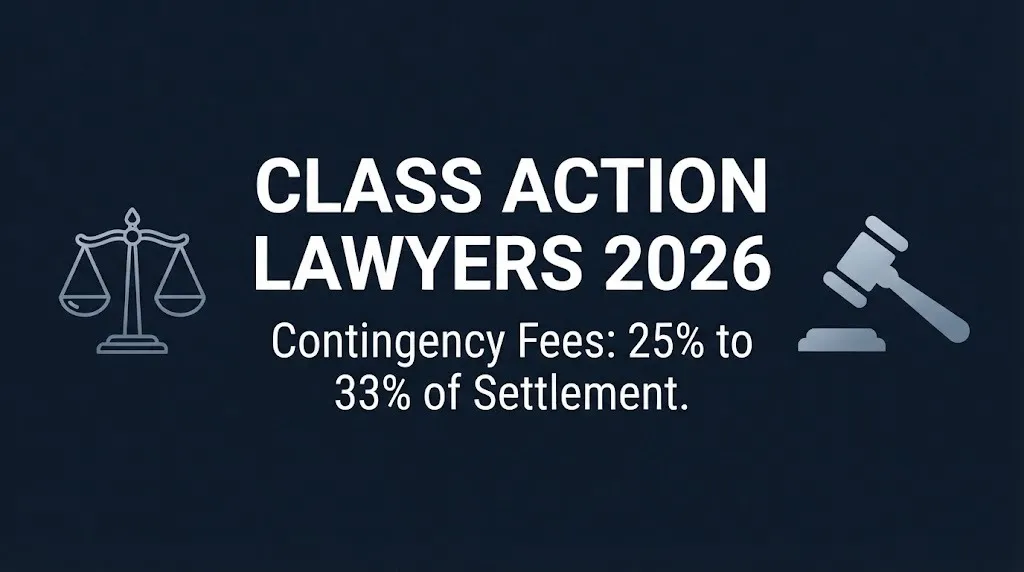
- Class action lawyers work on contingency, typically earning 25% to 33% of the settlement fund, set by a judge.
- You pay nothing upfront. Lawyers advance case costs and only get paid if the case wins or settles.
- There is no universal deadline. Filing timelines depend on the specific claim and statute of limitations involved.
If you’re searching for class action lawyers, the direct answer is this: you almost never pay them out of pocket. They work on contingency, meaning their fee comes out of whatever the court approves from the settlement fund, not your own wallet.
This matters whether you’re weighing whether to join an existing case or considering starting one yourself. The single most important fact to know upfront is that a federal judge, not the lawyers or the company being sued, decides exactly how much those attorneys collect.
This article breaks down how class action lawyers actually get paid, how to find one, and what recent 2026 court rulings mean for your eventual payout. One detail that surprises many people: a federal appeals court just restricted how much extra lawyers can collect above their base hourly calculation.
The Facts
| Category | Detail |
|---|---|
| Topic | How class action lawyers are paid and how to find one |
| Standard Fee Structure | Contingency, typically 25% to 33% of the settlement fund, decided by the court |
| Upfront Cost to You | None. Attorneys advance litigation costs and collect only if the case succeeds |
| Lead Plaintiff Incentive Award | Typically $2,500 to $25,000, subject to court approval |
| Court Oversight | Federal Rule of Civil Procedure 23 requires judicial approval of both settlements and fees |
| Recent Example | The $1.5 billion Anthropic copyright settlement included over $100 million in attorney fees |
| 2026 Legal Trend | A federal appeals court curtailed fee multipliers above standard lodestar calculations in June 2026 |
Are Class Action Lawyers Legitimate and Regulated?
Yes, class action lawyers are licensed attorneys operating under strict federal court oversight, not an unregulated side industry. Every fee they collect must be approved by a judge before it’s paid.
Federal Rule of Civil Procedure 23 governs how class actions proceed, including certification of the class and final approval of any settlement. That same rule requires courts to review attorney fees for reasonableness before any money moves.
This differs sharply from what many people assume. A class action lawyer can’t simply set their own percentage and collect it. The court reviews the request, and can reduce it if it looks excessive relative to the result achieved.
Key Takeaway: Every dollar a class action lawyer collects passes through court review first, which is your main built-in protection against overcharging.
Do You Have to Pay a Class Action Lawyer Upfront?
No, you do not pay a class action lawyer upfront under the standard contingency fee model used in nearly all these cases. If the case fails, you owe nothing.
Attorneys front all litigation costs themselves, including court filing fees (roughly $400 in federal court), expert witnesses, and the cost of notifying the class. That’s a real financial risk the firm takes on for years before any recovery happens.
If the case succeeds, the fee comes out of the settlement fund itself, not as a separate bill sent to you. That’s why class actions exist in the first place: they let large groups pursue claims too expensive to bring individually.
Reality Check: No legitimate class action lawyer will ever ask you to pay a retainer or upfront fee to join an existing case, and anyone requesting one before a settlement is confirmed should raise a red flag.
How Much Do Class Action Lawyers Charge?
Class action lawyers typically collect between 25% and 33% of the total settlement fund, though the exact figure varies by case and court. Some judges allow up to around 40% in unusually complex cases, while others cap fees closer to 20%.
| Fee Range Cited | Typical Context |
|---|---|
| 20% to 25% | Common benchmark used in many federal courts |
| 25% to 33% | Most frequently cited standard contingency range |
| Up to 35% to 40% | Occasionally seen in especially complex or lengthy cases |
A recent real example: in the $197.5 million Mackmin v. Visa ATM surcharge settlement, the court awarded $49.4 million in attorney fees, a figure the court reduced from the 30% originally requested by class counsel.
That reduction illustrates the pattern. Courts frequently trim the requested percentage rather than approve it automatically.
How Do Courts Decide What Class Action Lawyers Get Paid?
Courts use one of two main methods: the percentage-of-fund method or the lodestar method, sometimes combining both as a cross-check. Which method applies often depends on the settlement’s size and structure.
The percentage method simply awards the lawyers a share of the total fund, similar to the 25% to 33% range described above. The lodestar method instead multiplies the hours attorneys worked by a reasonable hourly rate, sometimes enhanced by a multiplier to reflect risk.
Courts often apply the lodestar approach in “mega-fund” settlements exceeding $100 million, where a flat percentage might produce an unreasonably large windfall. This is similar to how a plumber might charge a flat job rate for small repairs but switch to hourly billing on a massive renovation, where a flat percentage no longer makes sense.
Key Takeaway: Judges have real discretion in choosing how to calculate fees, and that discretion is exactly what’s now being tested and narrowed in appellate courts.
How Do You Find and Hire a Class Action Lawyer?
You find a class action lawyer by researching firms with experience in your specific type of claim, then contacting them for a free case evaluation. Most reputable firms won’t charge for this initial consultation.
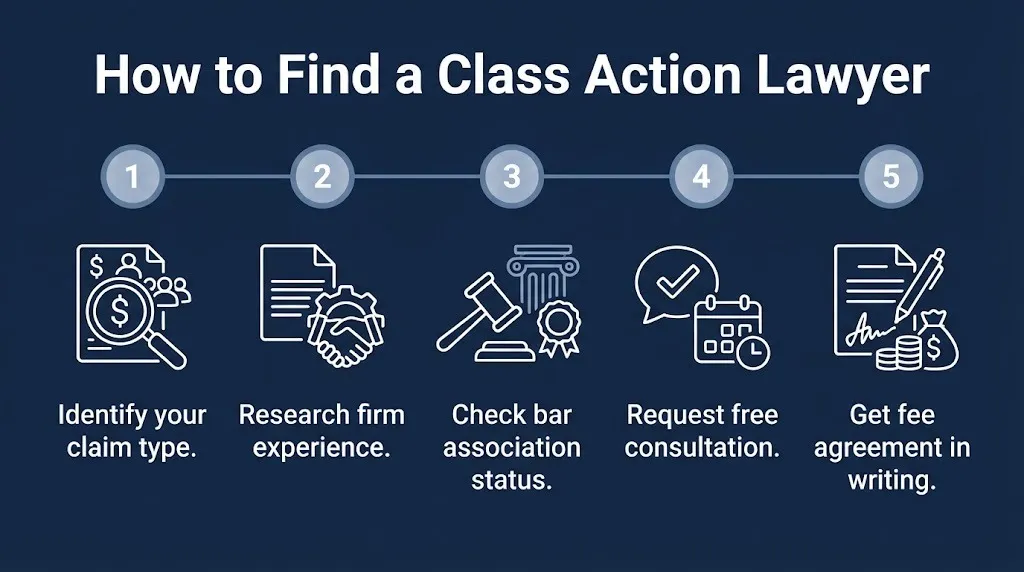
- Identify the type of harm involved, such as a data breach, defective product, or unpaid wages.
- Search for law firms with a documented track record in that specific area.
- Check state bar association records to confirm the attorney is licensed and in good standing.
- Request a free consultation, since most class action firms offer this at no cost.
- Ask directly how the firm structures its contingency fee and who covers litigation costs.
- Get any fee agreement in writing before your case moves forward.
- Confirm whether the firm plans to pursue an individual claim, join an existing class action, or seek class certification for a new one.
Avoid any firm that asks for payment before a case even begins, since that runs against how contingency arrangements are supposed to work.
How Do You Become the Lead Plaintiff in a Class Action?
You typically become a lead plaintiff by being one of the first people to bring a claim and agreeing to represent the interests of the entire class. Courts formally appoint lead plaintiffs, they aren’t self-appointed.
The lead plaintiff’s main responsibility is representing the class, not financing the case. Attorneys, not the lead plaintiff, cover the litigation costs, and the lead plaintiff typically participates in depositions, document review, and court proceedings on behalf of everyone else in the class.
In exchange for that added time and risk, lead plaintiffs often receive a service award, also called an incentive award, on top of their standard share of the settlement.
What Is the Difference Between Class Counsel and Your Own Lawyer?
Class counsel represents the entire class collectively, while an individual lawyer you hire represents only you and your specific interests. This distinction matters if you’re weighing whether to join a class or pursue your own claim.
If you simply file a claim form in an existing class action, class counsel already represents your interests as part of the group, and you don’t need to hire your own attorney to receive your share.
If your individual damages are unusually large, or your circumstances differ significantly from the rest of the class, some people choose to opt out and pursue an individual lawsuit with their own attorney instead.
Key Takeaway: Filing a claim in an existing class action doesn’t require hiring a personal lawyer, since class counsel is already working on your behalf.
What Is a Lodestar and Why Does It Matter for Legal Fees?
A lodestar is the base attorney fee calculation, found by multiplying the hours an attorney worked by a reasonable hourly rate. Courts sometimes apply a multiplier on top of this base figure to account for litigation risk.
Historically, courts applying the lodestar method have used multipliers ranging roughly from 1.5 to 3 times the base calculation. That multiplier is meant to compensate attorneys for years of unpaid risk on cases that could have produced nothing.
That practice is now facing real pushback. In June 2026, the Third Circuit Court of Appeals vacated a $3.7 million attorney fee award in a case against BMW of North America, questioning a 1.94 multiplier the district court had applied. The appeals court held that courts generally cannot increase fees above the standard lodestar amount absent truly exceptional circumstances.
Are Courts Cracking Down on Class Action Attorney Fees in 2026?
Yes, at least one major federal appeals court moved to tighten fee awards in 2026. The Third Circuit’s June 2026 ruling in Gelis v. BMW of North America signaled less tolerance for inflated fee multipliers going forward.
That ruling arose from a consumer class action over allegedly defective vehicle timing chains, where BMW had agreed to pay attorney fees separately from the relief given to the class. The district court’s original $3.7 million lodestar award, boosted by a 1.94 multiplier, got sent back for reconsideration.
This kind of appellate scrutiny doesn’t eliminate contingency fees, but it does suggest courts are watching fee requests more closely than in past years.
Key Takeaway: A 2026 federal appeals ruling is pushing back specifically on inflated fee multipliers, not on contingency fees generally.
What Are Some of the Largest Class Action Settlements in 2026?
Several major class action settlements moved through federal courts in 2026, offering real examples of how attorney fees get calculated at scale. These cases show both sides of the fee spectrum, from modest percentage awards to sizable eight-figure fee grants.
| Settlement | Verified Detail |
|---|---|
| Anthropic AI copyright settlement | $1.5 billion total, over $100 million in attorney fees, final approval granted 2026 |
| Colgate-Palmolive ERISA pension settlement | $332 million, preliminary approval granted in 2026, roughly 1,200 retirees affected |
| Mackmin v. Visa ATM surcharge settlement | $197.5 million fund, $49.4 million in attorney fees, payments began April 2026 |
| YouTube children’s content class action | Roughly 1 million estimated valid claims, individual payouts estimated between $20 and $30 after fees |
These figures come directly from court filings and legal news coverage of each case, not from estimates.
What Is a Class Action Lawsuit and How Does It Start?
A class action lawsuit is a case where one or more people, called named plaintiffs, sue on behalf of a larger group who suffered similar harm from the same defendant. It typically starts when an attorney identifies a pattern of harm affecting many people the same way.
Common triggers include a data breach affecting thousands of customers, a defective product sold widely, or a company charging the same hidden fee across its entire customer base. An attorney investigates the claim, files suit on behalf of a proposed class, and asks the court to formally certify that class.
Think of it like a group of neighbors filing one shared complaint about a pothole instead of a thousand separate complaints. It’s more efficient for the court and gives ordinary people leverage they wouldn’t have individually.
What Is Federal Rule of Civil Procedure 23?
Federal Rule of Civil Procedure 23 is the federal law that governs how class actions are certified, litigated, and settled in U.S. federal courts. It sets the requirements a case must meet before it can proceed as a class action at all.
Those requirements generally include numerosity (the class is too large for individual lawsuits to be practical), commonality (shared legal or factual questions), typicality, and adequate representation by the named plaintiffs and their attorneys.
Rule 23 also requires court approval before any class action settlement becomes final, including review of the attorney fees involved. This is the same rule courts cited when reviewing and adjusting fee requests in cases like the Visa ATM settlement.
What Is an Incentive Award for a Lead Plaintiff?
An incentive award, also called a service award, is extra compensation a court grants to a lead plaintiff for the time and risk of representing the class. It’s separate from, and in addition to, their standard share of the settlement.
These awards typically range from $2,500 to $25,000, depending on the size and complexity of the case. Courts weigh factors like how much time the lead plaintiff spent on depositions, document production, and other litigation demands.
Not yet determined for any specific case you may be considering: exact incentive award amounts always depend on that case’s particular facts and the judge’s final approval.
Can You Opt Out of a Class Action Instead of Using Its Lawyers?
Yes, class members generally have the right to opt out of a class action settlement and pursue an individual claim instead. This is a standard protection built into Rule 23 proceedings.
Opting out means you give up your right to a share of the class settlement, but you preserve your right to sue the defendant separately, usually with your own attorney. This route makes the most sense if your individual damages are significantly larger than what the class settlement would provide.
Deadlines to opt out are typically set early in the settlement approval process, often well before the final claim filing deadline. Missing the opt-out window generally means you’re bound by the class settlement, whether or not you ever filed a claim.
What to Watch Next in Class Action Fee Rules
- June 11, 2026: Third Circuit issues Gelis v. BMW ruling curtailing lodestar fee multipliers.
- July 2026: Final approval granted for the $1.5 billion Anthropic copyright settlement, including over $100 million in fees.
- 2026, ongoing: Federal courts continue applying stricter scrutiny to requested fee percentages in mega-fund settlements.
- Expected: Other circuit courts may weigh in on similar fee multiplier disputes following the Third Circuit’s ruling.
Frequently Asked Questions
Do class action lawyers get paid if the case loses?
No, class action lawyers working on contingency get paid nothing if the case doesn’t succeed.
That’s the core trade-off of the contingency fee model used in nearly all class actions.
What percentage do class action lawyers usually take?
Most courts approve fees in the 25% to 33% range of the total settlement fund.
The exact percentage depends on the case’s complexity, size, and the specific court’s practices.
Can a class action lawyer charge you an hourly rate instead?
It’s uncommon, but some attorneys do charge hourly rates, typically ranging from $100 to $500 per hour, for certain arrangements.
Most class action work still runs on contingency rather than hourly billing.
Do you need your own lawyer to join a class action settlement?
No, class counsel already represents your interests once you’re part of the certified class.
You only need a separate lawyer if you choose to opt out and pursue an individual claim.
How is a lead plaintiff different from other class members?
A lead plaintiff formally represents the entire class and often participates directly in depositions and litigation.
In exchange, they can receive an incentive award, typically between $2,500 and $25,000, on top of their regular settlement share.
Are class action attorney fees getting harder to collect in 2026?
Yes, at least one major appeals court tightened its review of fee multipliers in a June 2026 ruling.
That signals closer scrutiny ahead, though standard contingency fees remain the norm.
What happens to unclaimed money in a class action settlement?
Unclaimed funds are typically redistributed, returned to the defendant, or donated through a cy pres arrangement, depending on the settlement terms.
The specific process is always spelled out in that case’s settlement agreement.
Is it free to talk to a class action lawyer about your situation?
Most class action law firms offer a free initial consultation to evaluate your potential claim.
Confirm this directly with the firm before your first conversation, since practices can vary.
The number worth remembering here isn’t a settlement figure, it’s the 25% to 33% range that governs how most class action lawyers get paid. Courts, not lawyers, set the final number.
If you’re considering joining a class action or hiring your own attorney, ask for the fee structure in writing before you commit to anything.