Mass Tort Litigation 2026: What It Is, How It Works, and Who Qualifies
Quick Answer
- What is it? A legal action where many plaintiffs file individual lawsuits against the same defendant(s) for harm from the same product or event.
- How much can you get? Not yet determined. Payouts vary widely by case, injury severity, and available settlement funds.
- Key deadline: Every mass tort has its own statute of limitations. Most states give you one to three years from injury discovery.
Mass tort litigation is the legal system’s answer to harm that touches thousands of people at once. It’s not a single lawsuit. It’s a coordinated collection of individual claims, usually centralized before one federal judge through a process called multidistrict litigation.
If you were injured by a defective drug, a toxic chemical, or a dangerous product, you might have a mass tort claim. But the system is complex, the timelines are long, and the outcomes vary wildly depending on your specific facts.
This article explains what mass tort litigation actually is, how it differs from a class action, what the process looks like from filing to payout, and how to tell if you might have a claim worth pursuing. You’ll also learn why some cases produce blockbuster verdicts while others collapse before trial.
The Facts
| Item | Detail |
|---|---|
| What It Is | Coordinated individual lawsuits against common defendants for similar harm |
| Primary Mechanism | Multidistrict Litigation (MDL) under 28 U.S.C. § 1407 |
| Typical Timeline | 2 to 10+ years from filing to resolution |
| Settlement Rate | Over 90% of MDL cases resolve before trial |
| Top Settlements 2025 | $79 billion across top 10 cases |
| Fee Structure | Contingency fees, typically 33% to 40% of recovery |
What is mass tort litigation in simple terms?
Mass tort litigation is a legal process where many people who suffered similar harm from the same source file individual lawsuits that get coordinated in one court. It’s different from a class action in a key way: each plaintiff has their own case and their own lawyer.
Think of it like a highway pileup. One crash, many victims. Each victim has their own injuries, their own medical bills, their own damages. But the question of who caused the crash is the same for everyone.
In mass torts, the “cause” is usually a product, a drug, a chemical, or a corporate practice. Plaintiffs claim the defendant knew or should have known about the danger and failed to warn or protect them.
The cases get pulled together through the Judicial Panel on Multidistrict Litigation. That panel assigns all the federal cases to one judge for pre-trial proceedings. The judge handles discovery, expert challenges, and often pushes for a global settlement .
Over 90% of cases centralized in mass tort MDLs are resolved before trial . Most end in settlement, not verdicts.
Key Takeaway: Mass torts are collections of individual lawsuits, not a single class action. Coordination happens through MDL, and most cases settle.
How much is a mass tort settlement worth?
Mass tort settlement values vary enormously by case, injury type, and available defendant funds. There is no standard payout.
The top ten class action and mass tort settlements in 2025 totaled $79 billion . But that figure covers everything from consumer privacy to employment discrimination, not just product liability.
Individual payouts depend on several factors:
- Injury severity: Death, permanent disability, and cancer claims settle for far more than soft tissue injuries.
- Proof strength: Cases with clear causation and documented exposure are worth more.
- Defendant’s resources: A company in bankruptcy pays less than a solvent one.
- Number of claimants: More plaintiffs means each claim gets a smaller slice of a fixed fund.
- Litigation risk: Cases that survive summary judgment and expert challenges have more leverage.
In the Vioxx litigation, which involved nearly 50,000 claimants, settlements were structured through payment matrices . Similar approaches are used in asbestos, mesh, and opioid cases.
Key Takeaway: There is no standard mass tort payout. Values depend on your injury, your proof, and the defendant’s ability to pay.
How do you file a mass tort claim?
You file a mass tort claim by consulting an attorney who handles mass tort cases, providing your medical and exposure history, and having the attorney file your individual lawsuit.
The process typically follows these steps:
- Consultation: An attorney reviews your injury, exposure, and medical records.
- Investigation: The firm gathers documentation linking your injury to the product or event.
- Filing: Your individual complaint is filed in court and then transferred to the MDL.
- Discovery: Your case is part of the broader discovery process, but individual facts are documented.
- Expert review: Medical and scientific experts evaluate causation.
- Settlement or trial: If a global settlement is reached, your claim is evaluated under the settlement terms. If not, your case may go to trial.
Mass tort attorneys work on contingency. You pay nothing upfront, and fees come out of any recovery . The typical fee is around 33% to 40% of the settlement, though courts sometimes cap fees in global settlements .
Key Takeaway: Filing requires an attorney and documentation. There is no self-service claim form. Contingency fees mean no upfront cost to you.
What is the difference between mass tort and class action?
Mass torts involve individual lawsuits with distinct plaintiffs, while class actions consolidate many claims into one representative lawsuit. The distinction matters for how your case proceeds and what you recover.
| Factor | Mass Tort | Class Action |
|---|---|---|
| Structure | Individual lawsuits coordinated in MDL | One lawsuit representing a class |
| Plaintiff control | You have your own attorney and case | Class counsel represents everyone |
| Injuries | Often serious, varied, and individually provable | Usually similar, smaller claims |
| Opt-out | You are not bound unless you settle | You must opt out to pursue individual claim |
| Settlement | Global settlement with individual evaluations | Uniform or tiered payouts |
Class actions work best for small claims where individual litigation is impractical, like a $20 overcharge on a phone bill . Mass torts work for serious injuries where each plaintiff needs individual attention.
Some mass torts get certified as class actions for liability purposes, with individual damages trials to follow. But this is less common because plaintiffs’ injuries and causation proof vary so much .
Key Takeaway: Mass torts give you more control and often higher payouts for serious injuries. Class actions are more efficient for small, similar claims.
How long does mass tort litigation take?
Mass tort litigation typically takes two to ten years from filing to resolution. Complex cases involving bankruptcy can stretch longer.
An individual personal injury case might resolve in 18 to 24 months. Mass torts are different .
The MDL process has multiple phases: discovery, expert challenges (Daubert motions), bellwether trials, and then settlement negotiations. Each phase can take years.
The Boy Scouts of America bankruptcy, a mass tort involving childhood sexual abuse claims, filed in 2020 and was still distributing settlement funds in 2026, six years later . The trustee began distributing small percentages of proposed claim amounts before the total estate was even determined.
Bellwether trials are a key milestone. These are test cases that help both sides gauge the value of the remaining claims. If plaintiffs win big, settlement leverage increases. If defendants win, plaintiffs’ cases weaken .
Key Takeaway: Plan for years, not months. Mass torts are marathons, and bankruptcy cases can take even longer.
What is an MDL and how does it work?
An MDL, or Multidistrict Litigation, is a procedural tool that consolidates federal cases with common facts before one judge for pre-trial proceedings. It’s the primary mechanism for managing mass torts.
The Judicial Panel on Multidistrict Litigation decides whether to create an MDL. If approved, all related federal cases get transferred to a single district court .
The MDL judge handles:
- Discovery: Document production, depositions, and interrogatories.
- Expert challenges: Rulings on whether scientific evidence is admissible.
- Bellwether trials: Selecting representative cases for early trial.
- Settlement: Facilitating and approving global resolutions.
The MDL does not decide your individual case. If your case doesn’t settle, it gets remanded back to the court where it was filed for trial .
One criticism of MDLs is that individual claim scrutiny is reduced. With thousands of cases, judges focus on common issues rather than individual circumstances. That can let weak claims slip through, but it also means your case may not get the attention it deserves .
Key Takeaway: MDL is the coordination mechanism. Your case is part of a larger process, but it retains its individual identity.
Who qualifies for a mass tort claim?
You may qualify for a mass tort claim if you suffered a specific injury linked to a product, drug, or event that is the subject of coordinated litigation. Qualification depends on the specific case.
Each mass tort has its own eligibility criteria. Common requirements include:
- Documented injury: Medical records showing a diagnosis or condition.
- Exposure proof: Evidence you used the product, took the drug, or were exposed to the substance.
- Timing: Your injury occurred within the relevant time period.
- Causation: Medical or scientific evidence linking the product to your injury.
The Depo-Provera litigation, for example, involves women who developed meningioma after using the birth control shot. The statute of limitations is short, often one to two years . CPAP recall cases have deadlines that vary by state, from one to six years from the recall announcement .
Key Takeaway: Eligibility is case-specific. You need documentation of injury and exposure. Deadlines are strict.
What is the role of a plaintiff steering committee?
The Plaintiff Steering Committee (PSC) is a group of lawyers appointed by the MDL judge to coordinate discovery, argue motions, and lead settlement negotiations on behalf of all plaintiffs.
The PSC does the heavy lifting for the entire MDL. They take depositions, review documents, hire experts, and negotiate with defendants. Individual attorneys benefit from their work but don’t have to duplicate it.
This creates an interesting dynamic. Lawyers on the PSC get prestige and influence, but the work is funded by common benefit fees deducted from all settlements. That means every plaintiff contributes to the PSC’s compensation .
The PSC structure also creates incentives. Lawyers with more clients sometimes get PSC seats, which can encourage aggressive client recruitment even for weak claims .
Key Takeaway: The PSC drives the litigation. Its work benefits all plaintiffs, but you should understand how common benefit fees affect your recovery.
Reality Check
Mass tort litigation is not a lottery ticket. Most cases settle for modest amounts relative to the harm suffered. Lawyers spend millions on advertising to recruit clients, and many cases never make it past expert challenges. If someone promises you a specific payout before reviewing your medical records, that’s not how mass torts work. And you never pay upfront to file a claim.
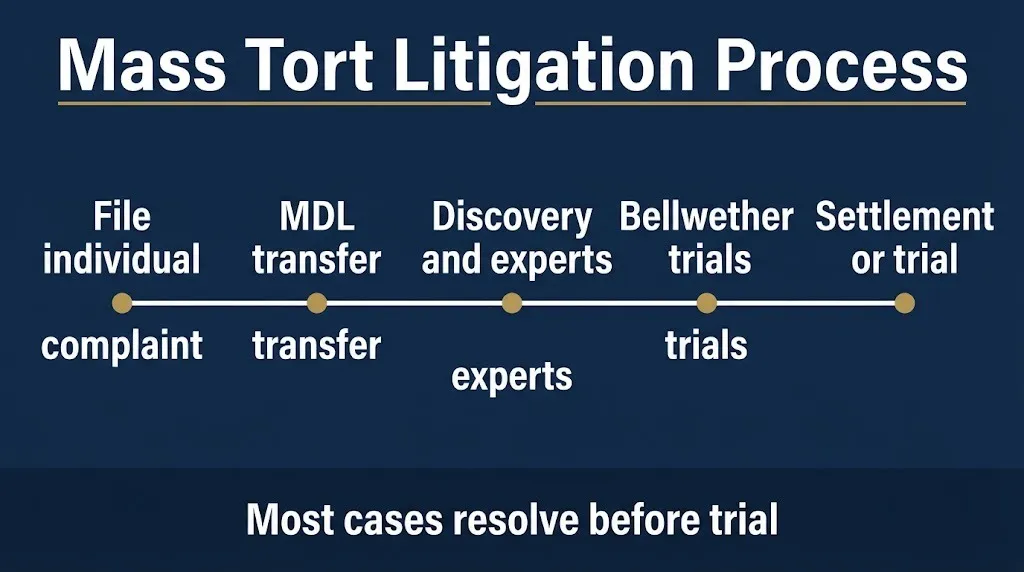
What happens next in a mass tort case?
Filing: Your attorney files an individual complaint.
MDL transfer: The case is centralized before one judge.
Discovery: Both sides exchange documents and take depositions.
Expert challenges: The court decides whether scientific evidence is admissible.
Bellwether trials: Representative cases go to trial to gauge value.
Settlement negotiations: Most cases resolve through a global settlement.
Claims processing: If a settlement occurs, an administrator evaluates and pays claims.
Trial (if no settlement): Your case returns to its original court for trial.
Frequently Asked Questions
What is mass tort litigation?
Mass tort litigation is a coordinated legal process where many people with similar injuries from the same product or event file individual lawsuits that get centralized in one court.
How is a mass tort different from a class action?
Mass torts involve individual lawsuits with separate plaintiffs and attorneys. Class actions consolidate all claims into one representative lawsuit.
How much can I get from a mass tort lawsuit?
There is no standard amount. Payouts depend on your injury, proof, the number of claimants, and the defendant’s resources.
Do I need a lawyer to file a mass tort claim?
Yes. Mass torts are complex and require an attorney to navigate the MDL process and represent your individual interests.
How long does a mass tort case take?
Typically two to ten years. Complex cases involving bankruptcies can take even longer.
What is an MDL?
MDL stands for Multidistrict Litigation. It’s the process that consolidates federal cases with common facts before one judge for pre-trial proceedings.
How much do mass tort lawyers charge?
Most work on contingency, taking about 33% to 40% of any recovery. You pay nothing upfront.
What happens if the mass tort doesn’t settle?
If no settlement is reached, your case is remanded to the court where it was filed and can proceed to trial.
If you believe you’ve been harmed by a product or event that’s the subject of mass tort litigation, talk to an attorney who handles that specific case. Gather your medical records and any documentation of your exposure. The single most important fact: mass torts take years, most resolve through settlement, and your deadline to file is set by your state’s statute of limitations, not the MDL.