Civil Lawsuit Lawyers: What They Actually Do, What They Cost, and How to Hire One in 2026
Quick Answer
- Civil lawsuit lawyers handle non-criminal disputes over money, contracts, injuries, property, and rights.
- Most personal injury lawyers work on contingency, charging 33 to 40 percent only if you win.
- No single deadline applies to all civil cases; each claim has its own statute of limitations.
If you typed “civil lawsuit lawyers” into a search bar, you are probably trying to figure out whether you need one, what one would cost, and how to tell a good one from a bad one. You may have a dispute with an insurance company, a former employer, a contractor, or a business partner.
A civil lawsuit lawyer is an attorney who represents clients in non-criminal legal disputes. That covers a wide range of cases: car accident claims, breach of contract, employment discrimination, debt collection defense, property disputes, and consumer fraud.
What surprises most people is not the law itself. It is the cost structure. Many civil lawyers charge nothing upfront in injury cases, while others bill by the hour whether you win or lose. Knowing which type you need changes everything about how you hire.
The Facts
| Item | Verified Details |
|---|---|
| Case | Not a single lawsuit; applies to all civil litigation categories |
| Status | Ongoing practice area, not a settlement or class action |
| Fund Size | Not applicable |
| Est. Per Person | Not applicable; fees vary by fee agreement |
| Claim Deadline | Governed by state statute of limitations for each claim type |
| Administrator | Not applicable |
| Proof Needed | Varies by case; documents, records, and witness statements |
What Is a Civil Lawsuit Lawyer?
A civil lawsuit lawyer is an attorney who represents plaintiffs or defendants in non-criminal legal disputes. These disputes typically involve claims for money damages or specific performance, not jail time.
Civil litigation covers a broad spectrum. Personal injury, breach of contract, property disputes, employment claims, consumer protection cases, and defamation all fall under civil law. The lawyer’s job is to investigate the facts, draft pleadings, conduct discovery, negotiate, and try the case if necessary.
What separates a civil lawsuit lawyer from other attorneys is the courtroom focus. Transactional lawyers draft contracts. Estate lawyers handle wills. Civil litigators prepare cases for trial, even though most cases settle before reaching a jury.
If someone threatens to sue you or you believe someone owes you money, a civil lawsuit lawyer is the professional who evaluates the claim and maps the path forward.
What Is the Difference Between a Civil Lawsuit Lawyer and a Criminal Defense Attorney?
The core difference is simple. A civil lawyer handles disputes over money, property, and rights. A criminal defense attorney handles cases where the government seeks to punish someone with fines, probation, or incarceration.
In a civil case, the burden of proof is usually preponderance of the evidence, meaning more likely than not. In a criminal case, the burden is proof beyond a reasonable doubt, a much higher standard. The same act can produce both types of cases. A drunk driver may face criminal DUI charges and a civil wrongful death suit from the victim’s family.
Civil lawyers cannot represent you in a criminal matter, and criminal lawyers may not handle civil claims. Some firms do both, but the attorneys specialize separately.
If you are facing a lawsuit for money, you need a civil lawyer. If you are facing charges, you need a criminal defense attorney. The two are not interchangeable.
Key Takeaway: Civil cases are about money and rights. Criminal cases are about liberty. The lawyers are different.
How Much Does a Civil Lawsuit Lawyer Cost?
The cost depends entirely on the fee arrangement. Civil lawyers use three main structures: contingency fees, hourly rates, and flat fees.
Personal injury lawyers almost always work on contingency. You pay nothing upfront. The lawyer takes a percentage of the settlement or verdict, typically 33 percent before filing a lawsuit and 40 percent if the case goes to litigation. If you lose, you owe no attorney fee, though you may owe case expenses.
Hourly lawyers bill for every hour worked, regardless of outcome. Rates vary by market, experience, and practice area. In 2026, solo practitioners in smaller markets may charge $200 to $350 per hour. Partners at large firms in major cities may bill $600 to $1,200 per hour or more.
Flat fees are less common in litigation but appear in simple matters like uncontested contract reviews or demand letters.
| Fee Type | Typical Cost | When Used |
|---|---|---|
| Contingency | 33% to 40% of recovery | Personal injury, some consumer cases |
| Hourly | $200 to $1,200+ per hour | Business disputes, defense work |
| Flat fee | $500 to $5,000+ | Simple, defined tasks |
Key Takeaway: Contingency means the lawyer only gets paid if you get paid. Hourly means you pay regardless of outcome.
When Do I Need a Civil Lawsuit Lawyer?
You need a civil lawsuit lawyer when the dispute involves significant money, complex facts, or a party who has already hired counsel. Small claims court handles minor disputes, often under $10,000 depending on the state, and many people navigate it without a lawyer.
The threshold for hiring counsel is not a fixed dollar amount. It is a question of whether the stakes justify the cost. A $5,000 contract dispute may not justify a lawyer’s hourly fees. A $50,000 injury claim almost always does.
You should consult a civil lawyer if the other side has an attorney, if the case involves complicated evidence, if you face a counterclaim, or if the statute of limitations is approaching. A consultation often costs nothing or a small fee.
Think of it like a car repair. A simple oil change you can do yourself. An engine rebuild you hand to a professional. The same logic applies to legal disputes.
How Do I Find a Good Civil Lawsuit Lawyer?
Finding a good civil lawyer requires checking a few specific things, not just picking the first name in a search ad.
Start with state bar records. Every licensed attorney appears in a directory that shows admission status and any disciplinary history. A clean record does not guarantee skill, but a disciplinary record should eliminate a candidate.
Then look at case results. Most lawyers publish representative settlements and verdicts. Those numbers are marketing, but they tell you what the lawyer actually handles.
Client reviews carry some weight, but they are filtered and often paid for placement. Better sources are peer ratings from organizations like Martindale-Hubbell, which rates lawyers based on evaluations from other attorneys.
What matters most is the consultation. The right lawyer asks about your facts, explains your options in plain language, and gives you a realistic assessment, not a promise.
- Check the state bar for licensing and discipline.
- Review the lawyer’s actual case results.
- Read client reviews with skepticism.
- Ask about trial experience, not just settlements.
- Meet for a consultation and judge the communication.
What Questions Should I Ask a Civil Lawyer Before Hiring?
The consultation is your interview. You are hiring a professional, and the questions you ask reveal whether the lawyer is a fit.
Ask about the fee structure first. Get it in writing. If the lawyer works on contingency, ask what percentage and whether expenses come out before or after the fee calculation. If hourly, ask for the rate and a retainer estimate.
Ask who will actually work on your case. A partner may sign the agreement, but an associate or paralegal may do most of the work. That is not always bad, but you should know.
Ask about the likely timeline. A lawyer who promises a fast settlement may be prioritizing volume over value. A realistic timeline includes investigation, negotiation, and possible litigation.
Ask what happens if you lose. In a contingency case, the lawyer eats the fee, but you may still owe costs. In an hourly case, you owe the bill regardless.
Key Takeaway: The fee agreement is the single most important document you sign. Read it before you sign it.
What Is the Statute of Limitations for a Civil Lawsuit?
The statute of limitations is the deadline for filing a lawsuit. Each claim type has its own deadline, set by state law. Missing it bars your case permanently.
Personal injury claims typically must be filed within two to three years from the date of injury, depending on the state. Breach of written contract claims often allow four to six years. Oral contracts usually have shorter windows. Employment discrimination claims have their own administrative deadlines that can be as short as 180 days.
The clock usually starts when the harm occurs, but some states apply a discovery rule that starts the clock when you discovered or should have discovered the injury. That rule matters in cases like fraud or hidden defects.
| Claim Type | Typical Deadline Range |
|---|---|
| Personal injury | 2 to 3 years |
| Breach of written contract | 4 to 6 years |
| Breach of oral contract | 2 to 4 years |
| Property damage | 2 to 5 years |
| Employment discrimination | 180 days to 3 years |
These ranges are general. Your state’s law controls your case. Check with a lawyer or the court.
What Is the Difference Between a Litigator and a Settlement Lawyer?
Some lawyers build their practice around settling cases quickly. Others prepare every case as if it will go to trial. The difference matters for your outcome.
A settlement-focused lawyer often handles high volume and values speed. That can be fine for straightforward cases with clear liability. The insurer knows the lawyer will settle, so the offers may be lower.
A litigator with trial experience signals to the other side that the case may actually reach a jury. That leverage often produces higher settlements. Insurers track which lawyers try cases and adjust offers accordingly.
You do not need a lawyer who tries every case. You need one who can credibly threaten trial. Ask how many jury trials the lawyer has handled in the last three years. If the answer is zero, the other side knows it too.
Key Takeaway: Trial experience is leverage, even if your case settles.
Can I Represent Myself in a Civil Lawsuit?
You can represent yourself, a choice called appearing pro se. It is legal in every state. It is also usually a mistake in any case with real money at stake.
Courts hold pro se litigants to the same procedural rules as lawyers. You must know the rules of evidence, the filing deadlines, and the local court practices. One missed deadline can end your case.
Judges cannot give you legal advice, even if they want to help. The other side’s lawyer has no duty to explain anything to you. The process is designed for professionals.
For small claims court, self-representation is common and often sensible. The procedures are simplified, and lawyers are sometimes not allowed. For anything above small claims, the risk usually outweighs the savings.
What Is a Demand Letter and Do I Need a Lawyer to Send One?
A demand letter is a written request for payment or action, usually sent before a lawsuit is filed. It states the facts, the legal basis, and the amount demanded, with a deadline for response.
You can write your own demand letter, but a letter from a lawyer carries weight. It signals that you are serious and that litigation is the next step. Some insurers and companies respond faster to law firm letterhead than to a letter from an individual.
A lawyer may send a demand letter for a flat fee, often $300 to $1,000. That is a low-cost way to test whether a dispute can resolve without a full lawsuit.
If the demand letter produces a fair offer, you save the cost and delay of litigation. If it produces silence or a lowball, you know where you stand.
Reality Check: No legitimate lawyer guarantees a result. If an attorney promises you a specific dollar amount before seeing the evidence, walk away. Settlements depend on facts, liability, policy limits, and negotiation. Anyone who guarantees an outcome is selling you something other than legal representation.
How Long Does a Civil Lawsuit Take in 2026?
Civil lawsuits take months to years, depending on the court, the complexity, and whether the case settles. A straightforward car accident claim with clear liability may settle in three to six months without litigation. A contested business dispute may take two to four years to reach trial.
Court backlogs remain significant in many jurisdictions. Even after a case settles, payment processing and lien resolution can add weeks or months.
The biggest variable is the other side. If the defendant denies liability and files motions, the timeline stretches. If both sides want resolution, the case can settle at almost any stage.
A realistic expectation for an average civil case is 12 to 24 months from filing to resolution. That is a long time to wait for money, and it is why many cases settle before trial.
What Happens After I Win a Civil Lawsuit?
Winning a lawsuit is not the same as collecting money. A judgment says the defendant owes you. Collecting that judgment is a separate process.
If the defendant has insurance, the insurer usually pays the judgment up to policy limits. If the defendant has assets, you may garnish wages or levy bank accounts. If the defendant has neither, the judgment may be uncollectible.
Your lawyer should investigate collectability before you file. Suing a person or company with no assets and no insurance may produce a paper victory and no money.
In contingency cases, the lawyer deducts the fee from the recovery before you see a dollar. In hourly cases, you paid along the way, and the judgment goes to you, minus any outstanding legal bills.
Key Takeaway: A verdict is not a check. Collectability is part of the case evaluation.
What Is the Difference Between a Civil Lawsuit and a Class Action?
A civil lawsuit is one party suing another. A class action is a civil lawsuit where one or more plaintiffs represent a larger group with similar claims. The class members share the recovery under a court-approved plan.
Class actions are common in consumer cases: defective products, false advertising, data breaches, and wage violations. You typically do not hire your own lawyer. The class attorneys represent the group.
If your individual damages are large, you may opt out of a class action and sue separately. That is a strategic decision a civil lawyer can help you evaluate.
The key difference is control. In an individual civil lawsuit, you make the decisions. In a class action, the class representatives and their lawyers make most of them.
What Should I Look for in a Contingency Fee Agreement?
The contingency fee agreement controls how your lawyer gets paid. Read it before you sign anything.
Look for the exact percentage. Most agreements state 33 percent before litigation and 40 percent after filing. Some states cap contingency fees in certain cases, including medical malpractice.
Check how expenses are handled. Some lawyers deduct costs from the gross recovery before calculating the fee. Others deduct the fee first, then costs. The difference affects your net amount.
Check what happens if you fire the lawyer or the lawyer withdraws. Most agreements give the lawyer a lien on any future recovery for work already done.
If anything is unclear, ask. A lawyer who cannot explain the fee agreement in plain language is not the lawyer for you.
What Happens Next
If you are considering a civil lawsuit, the next steps follow a predictable sequence.
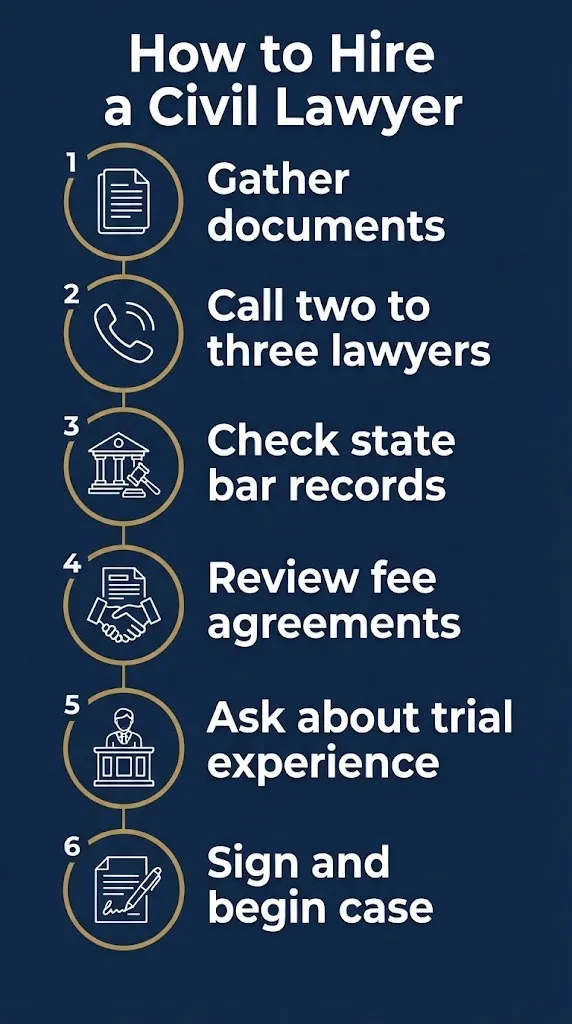
- Week 1: Gather every document, receipt, photo, and message related to the dispute.
- Week 1 to 2: Call two or three civil lawyers for consultations.
- Week 2 to 3: Review fee agreements and check state bar records.
- Week 3 to 4: Sign with a lawyer and begin the investigation or demand process.
- Ongoing: Track the statute of limitations for your specific claim type.
The single most important deadline is not a generic one. It is the date your state’s statute of limitations runs on your specific claim. That date is the difference between a case and a closed door.
Frequently Asked Questions
How much do civil lawsuit lawyers charge?
Personal injury lawyers typically charge 33 to 40 percent of the recovery on contingency.
Hourly civil lawyers charge $200 to $1,200 or more per hour depending on market and experience.
Flat fees appear in simple matters like demand letters.
Do I need a lawyer for a civil lawsuit?
You need a lawyer for any civil case with significant money, complex facts, or an opposing counsel.
Small claims court is designed for self-representation in minor disputes.
A consultation helps you decide without a large upfront cost.
What is the difference between a civil and criminal lawyer?
A civil lawyer handles money and rights disputes between private parties.
A criminal lawyer defends against government charges that threaten liberty.
The burden of proof is higher in criminal cases.
How long do I have to file a civil lawsuit?
The deadline depends on the claim type and your state.
Personal injury claims usually allow two to three years.
Contract claims often allow four to six years.
Can I sue without a lawyer?
Yes, you can represent yourself pro se in any civil case.
Self-representation is risky in cases with real money at stake.
Small claims court is the exception where self-representation is common.
What happens if I lose a civil lawsuit?
If you are the plaintiff and lose, you recover nothing and may owe costs.
If you are the defendant and lose, you may owe the judgment amount.
In contingency cases, the plaintiff owes no attorney fee if the case loses.
How do I know if a lawyer is good?
Check the state bar for licensing and disciplinary history.
Review case results and peer ratings.
Ask about trial experience and fee structure in the consultation.
Will my civil case go to trial?
Most civil cases settle before trial.
The settlement rate in civil litigation is typically above 90 percent.
Trial experience still matters because it affects settlement leverage.
A civil lawsuit lawyer is not a luxury. In most disputes with real money at stake, it is the difference between a structured outcome and a costly mistake. The fee structure you choose, the lawyer you hire, and the deadlines you track all matter more than the strength of your evidence alone.
The clearest action you can take today is to gather your documents and call two or three lawyers for consultations. Those calls cost little or nothing. The information they give you will either start your case or stop you from filing one you would lose. Either outcome is worth knowing.