What Is Variable Compensation in 2026? Types, Legal Rules, and What Workers Need to Know
Quick Answer
- Variable compensation is pay that depends on performance, not a fixed salary, including bonuses, commissions, and profit sharing.
- Legal disputes over unpaid variable comp are rising, with wage claims up in several states during 2025 and 2026.
- The most important deadline is your state’s wage claim statute of limitations, often two to three years for unpaid compensation.
If you searched for “what is variable compensation,” you’re likely reading an offer letter, reviewing a comp plan, or wondering if you’re owed money that your employer calls “discretionary.”
This article explains what variable compensation actually is, how it works legally, and what happens when employers don’t pay what they promised. It’s based on 2026 regulations, court decisions, and verified employment data.
Here’s the part most articles skip: the word “discretionary” in a comp plan doesn’t always mean the employer can decide not to pay. Courts have repeatedly found that promised variable comp is earned wages, not a gift.
The Facts
| Item | Detail |
|---|---|
| Legal Definition | Compensation contingent on performance, results, or discretion |
| Common Types | Bonuses, commissions, profit sharing, equity, incentives |
| Governing Laws | State wage laws, FLSA for overtime calculations |
| 2026 Regulatory Trend | More transparency requirements, clawback scrutiny |
| Wage Claim Deadline | 2 to 3 years in most states, longer in some |
| Dispute Rate | Increasing, per state labor department data |
Is Variable Compensation Legit or Just a Way to Underpay?
Variable compensation is legal and common. It’s not a scam, but it’s also not always as generous as it sounds.
The concept is simple: part of your pay depends on something. Maybe your sales numbers. Maybe the company’s profits. Maybe your manager’s discretion. The fixed part of your salary is guaranteed. The variable part is not.
Problems arise when the rules are unclear. An employer promises a “performance bonus” but never defines performance. A commission plan changes halfway through the year. A profit-sharing pool exists on paper but never pays out.
In 2026, state labor departments are seeing more disputes over unpaid variable compensation. Workers are filing wage claims, and some are winning.
Key Takeaway: Variable compensation is legitimate when the terms are clear and honored. It becomes a legal problem when promises are vague or broken.
What Are the Most Common Types of Variable Compensation?
Variable compensation comes in several forms, each with different legal treatment.
| Type | How It Works | Typical Payout Timing |
|---|---|---|
| Annual bonus | Based on company or individual performance | Year-end or Q1 |
| Commission | Percentage of sales or revenue | Monthly or quarterly |
| Profit sharing | Share of company profits | Annual |
| Equity awards | Stock options or restricted stock | Vesting over years |
| Spot bonus | One-time reward for specific achievement | Immediate |
| Incentive pay | Tied to specific metrics or goals | Quarterly or annual |
Each type has different rules about when it’s earned and when it must be paid. The key legal question is always the same: did the employer promise this as part of your compensation, or is it truly a gift?
What Is a Variable Compensation Program?
A variable compensation program is a structured system for determining and paying performance-based compensation.
A well-designed program includes:
- Clear eligibility criteria
- Defined performance metrics
- Specific payout formulas
- Payment timing
- Clawback provisions
- Dispute resolution procedures
The program document matters in legal disputes. If the program defines a formula and you hit the targets, the payout may be legally required. If the program says payouts are “discretionary” and “not guaranteed,” the employer has more latitude.
The difference between a clear program and a vague one is often the difference between a payout and a lawsuit.
How Do Variable Compensation Plans Work?
Variable compensation plans tie pay to specific outcomes. The structure varies by industry and role.
For sales roles, the plan might pay a percentage of revenue. For executives, it might pay based on company earnings targets. For hourly workers, it might be a production bonus for units completed.
The mechanics matter less than the legal status. Courts look at whether the plan created a contractual obligation or just a hope.
If the plan says “you will receive X if you achieve Y,” that’s likely a binding promise. If it says “the company may pay bonuses at its discretion,” that’s probably not.
The most important phrase in any plan is whether the payout is “earned” or “discretionary.” That single word changes everything.
Can an Employer Refuse to Pay a Promised Bonus?
Sometimes, but not always. The answer depends on the plan language and what you did to earn it.
If the bonus is truly discretionary, the employer can usually refuse without legal consequence. But if the plan defines specific criteria and you met them, the bonus may be earned wages under state law.
Several states treat earned bonuses and commissions as wages, not gifts. That means the same legal protections apply: timely payment, no unlawful deductions, and the right to file a wage claim.
The pattern in 2026: courts are increasingly willing to find that promised variable comp is earned wages, especially when the employer benefited from the worker’s performance.
Reality Check: No legitimate employer asks you to pay a fee to receive your bonus. No one charges a “processing fee” for a commission check. If someone asks you to pay money to get your variable comp, it’s a scam.
How Much Should Variable Compensation Be?
There’s no legal requirement for how much of your total pay should be variable. The split depends on your role and industry.
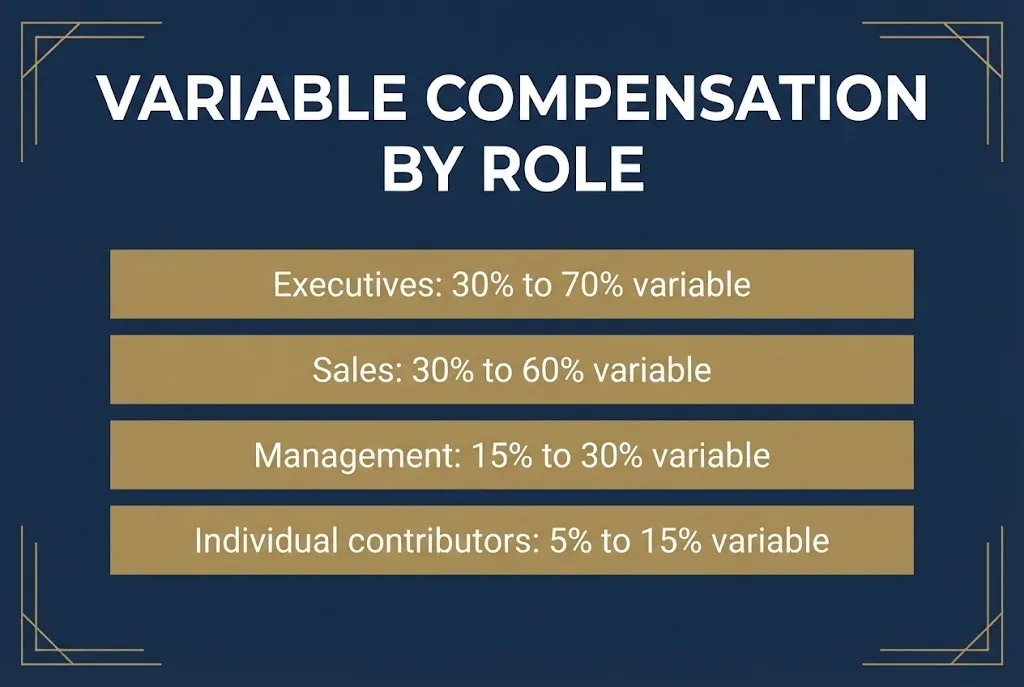
Common splits by role:
| Role | Typical Variable Percentage |
|---|---|
| Sales | 30% to 60% of total comp |
| Executives | 30% to 70% |
| Middle management | 15% to 30% |
| Individual contributors | 5% to 15% |
| Hourly workers | Usually 0% to 10% |
The higher the role, the more pay is typically at risk. That’s the tradeoff: more upside potential, but less guaranteed income.
For workers deciding whether to accept a variable-heavy offer, the key question is whether the targets are realistic and whether the plan is in writing.
What Are the Legal Risks of Variable Compensation Plans?
Both employers and workers face legal risks when plans are poorly designed or poorly documented.
For employers, the risks include:
- Wage claims for unpaid earned bonuses
- Misclassification claims if variable pay masks overtime violations
- Discrimination claims if payouts are uneven
- Clawback disputes if terms are unclear
For workers, the risks include:
- Promised pay that never materializes
- Changing plan terms mid-year
- Unclear metrics that make payouts impossible to verify
- Clawback demands after leaving the company
The 2026 trend is toward more written plans, more transparency, and more disputes when transparency is lacking.
Key Takeaway: A written plan protects both sides. A vague promise protects neither.
What Is a Clawback in Variable Compensation?
A clawback is an employer’s right to take back previously paid variable compensation under certain conditions.
Clawbacks are most common in executive compensation, but they’re spreading to other roles. The conditions might include:
- Financial restatement showing performance didn’t actually meet targets
- Leaving the company within a specified period
- Misconduct or policy violations
- Failure to meet post-employment obligations
The legality of clawbacks depends on state law and the plan terms. Some states restrict clawbacks of earned wages. Others allow them if the plan clearly discloses the conditions.
In 2026, the SEC continues to enforce clawback rules for public companies, while private employers face more state-level scrutiny.
What Happens If Your Employer Doesn’t Pay Variable Compensation?
You have options, but you need to act within your state’s deadline.
Here’s what to do:
- Review your comp plan and any written promises.
- Document the work you did and the targets you met.
- Request payment in writing from your employer.
- If refused, file a wage claim with your state labor department.
- Consult an employment attorney about a breach of contract claim.
- Consider whether a class action applies if others were similarly affected.
- Keep all documentation in case you need to file in court.
The wage claim process is free and often faster than a lawsuit. Many state labor departments can investigate and order payment without court involvement.
What Is the Difference Between a Bonus and a Commission?
The distinction matters legally, though both are variable compensation.
A commission is typically tied directly to sales or revenue you generate. It’s easier to prove that a commission is earned because it’s based on objective numbers.
A bonus is often tied to broader performance factors, some of which may be subjective. It’s harder to prove a bonus is earned if the criteria are vague.
Courts treat earned commissions as wages more consistently than discretionary bonuses. If you’re owed a commission, your legal position is usually stronger.
Key Takeaway: Commissions are more likely to be legally protected than bonuses because they’re tied to objective results.
How Does Variable Compensation Affect Overtime Pay?
This is one of the most common legal issues in 2026.
Under federal law, non-exempt workers must receive overtime pay based on their regular rate, which includes most bonuses and commissions. If you’re non-exempt and earn a bonus, that bonus must be factored into your overtime calculation.
Many employers get this wrong. They pay overtime on base salary only, ignoring the variable comp. That’s a violation of the Fair Labor Standards Act.
Workers who receive bonuses or commissions and work overtime should check whether their overtime rate includes the variable pay. If not, they may be owed back wages.
What Are the 2026 Trends in Variable Compensation?
Several trends are shaping how variable comp works this year.
| Trend | What It Means |
|---|---|
| Pay transparency laws | More states requiring comp ranges in job postings |
| Clawback scrutiny | Regulators looking at whether clawbacks are fair |
| Pay equity enforcement | More audits of whether variable pay creates disparities |
| AI-driven metrics | More disputes over how performance is measured |
| Remote work adjustments | New questions about who qualifies for location-based incentives |
The overarching theme: variable comp is getting more regulated, not less. Employers face more compliance requirements, and workers have more tools to challenge unfair practices.
What Should Workers Do Before Accepting a Variable Compensation Plan?
Do your homework before you sign.
- Read the plan document carefully, not just the summary.
- Ask what “discretionary” means in practice.
- Request examples of what top performers actually earned.
- Ask about clawback conditions and when they apply.
- Verify that the metrics are objective and measurable.
- Confirm how variable pay affects overtime if you’re non-exempt.
- Get the plan in writing before accepting the role.
The time to clarify terms is before you start, not after the payout fails to arrive. Once you’re in the role, your leverage is reduced.
What Happens Next With Variable Compensation Regulation?
The regulatory trend is toward more worker protection.
- Late 2026: More states expected to pass pay transparency laws.
- 2027: Federal regulators may issue updated guidance on bonus and commission overtime rules.
- Ongoing: Wage claim enforcement continues to increase in most states.
For workers, the practical next step is reviewing your current comp plan and checking whether you’re owed anything. For employers, the next step is auditing plan language for compliance risks.
The most important date is your state’s wage claim deadline. If you’re owed variable comp, that deadline is the hard wall you can’t cross.
Frequently Asked Questions
What is variable compensation?
Pay that depends on performance or results.
It includes bonuses, commissions, and profit sharing.
It’s not guaranteed like base salary.
Is variable compensation required by law?
No, employers don’t have to offer it.
But if they promise it and you earn it, they must pay.
The terms of the plan create the obligation.
Can my employer change my variable comp plan?
It depends on the plan terms.
Most plans reserve the right to change.
Changes that affect already-earned pay are riskier.
What if I’m owed a commission but the employer won’t pay?
File a wage claim with your state labor department.
Document everything in writing.
Consult an employment attorney if needed.
How does variable comp affect my overtime?
Bonuses and commissions must be included in your regular rate.
Overtime is calculated on that regular rate.
Many employers underpay overtime by ignoring variable comp.
Are bonuses taxable?
Yes, bonuses are taxable income.
The IRS treats bonuses as supplemental wages.
Withholding rules differ from regular salary.
What is a clawback?
An employer’s right to take back paid compensation.
Common in executive and sales roles.
Terms must be disclosed in the plan.
Can I negotiate variable comp?
Yes, everything is negotiable before you accept.
Ask for written definitions and realistic targets.
The time to negotiate is before you sign.
If you’re reviewing a variable comp plan or wondering if you’re owed money, start with the document. The language matters more than what anyone told you verbally. Then check your state’s wage claim deadline, because waiting too long means losing the claim.
The most important fact: if your variable comp is earned, not discretionary, it’s wages, and wages are protected by law.