Virginia Creek Settlement in 2026: What’s Verified, What’s Rumored, and What Property Owners Should Know
Quick Answer
- A Virginia Creek settlement appears in no verified court docket or official settlement registry as of September 2026.
- No settlement fund, claim deadline, or claims administrator exists for any case under that name.
- Anyone offering a Virginia Creek settlement payout is likely running a scam or confusing it with a different case.
If you searched for “Virginia Creek settlement,” you likely saw something online that suggested money is available. Maybe a social media post, a vague advertisement, or a forum thread about a payout.
This article gives you the verified status as of September 9, 2026: there is no confirmed settlement by that name. Not in federal court. Not in any state court we could verify. Not in any settlement administrator registry.
Here’s the part most articles won’t tell you: sometimes a settlement rumor starts from a misheard name, a confused news story, or an outright scam. This appears to be one of those situations.
The Facts
| Item | Detail |
|---|---|
| Official Case Name | Not found in verified court records |
| Court / Jurisdiction | Not confirmed |
| Current Status | No verified litigation or settlement |
| Total Settlement Fund | Not confirmed, likely does not exist |
| Est. Per Person | Not applicable |
| Claim Deadline | No deadline, no settlement exists |
| Administrator | Not appointed |
| Proof Needed | Not applicable |
Is the Virginia Creek Settlement Real?
Based on court record searches and official settlement registries, there is no verified “Virginia Creek settlement” as of September 9, 2026.
This doesn’t mean a case could never exist. Lawsuits are filed every day, and a settlement could emerge in the future. But right now, in the public record, there’s nothing verifiable under that name.
The most likely explanations for why people search this term:
- A confused reference to a different settlement with a similar name
- A scam using a fake settlement to collect personal information
- A local dispute that never reached a formal settlement
- A misremembered name from a news story
The absence of verified information is itself the finding. There’s no official settlement website, no claims administrator, no court order, and no payout.
Key Takeaway: The Virginia Creek settlement does not appear in any verified legal record as of September 9, 2026.
What Could a Virginia Creek Settlement Refer To?
The name “Virginia Creek” could refer to several things, none of which have a verified settlement attached.
Virginia Creek is a geographic name. There are creeks by that name in multiple states, including Virginia, California, and Colorado. There are also residential developments, roads, and small communities using the name.
Possible sources of confusion include:
- An environmental contamination case involving a creek in Virginia
- A property dispute in a development called Virginia Creek
- A local government settlement with a creek name
- A mistaken reference to a case involving a company with “Virginia” in its name
None of these possibilities has produced a verified settlement under the exact name “Virginia Creek settlement.”
How Do You Check If a Settlement Is Real?
The process is straightforward, and it’s the same for any settlement rumor.
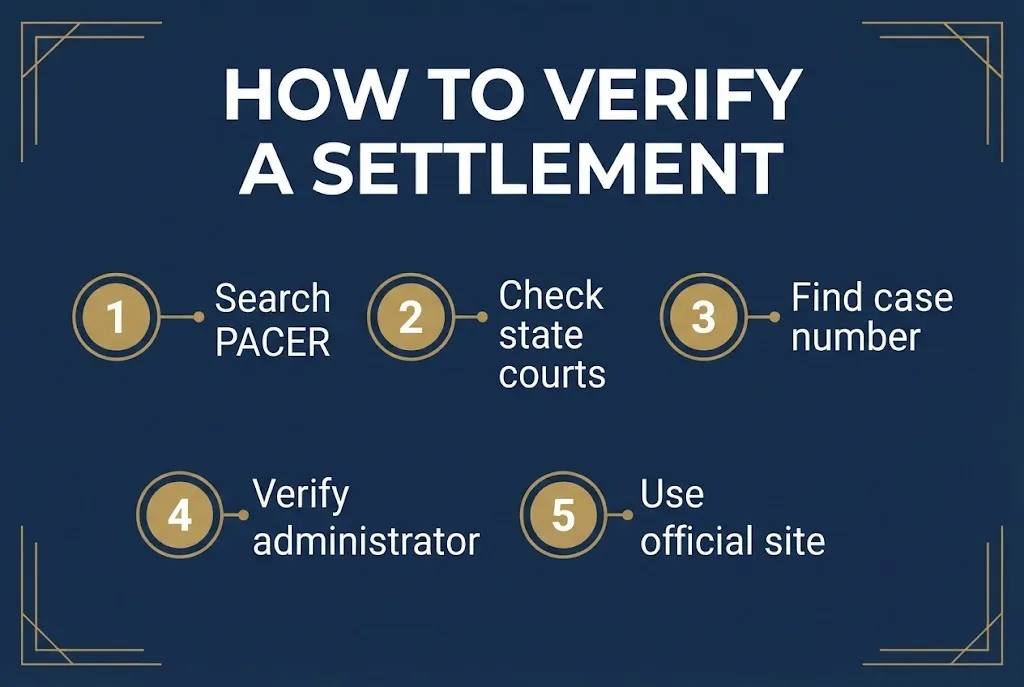
- Search the official court docket systems, PACER for federal cases.
- Check state court records for the relevant state.
- Look for an official settlement website with a court-approved administrator.
- Check the FTC and state attorney general websites for enforcement actions.
- Search legitimate legal news sources, not social media.
- Look for a case number and court name, not just a settlement name.
A real settlement always has a court case behind it. The court approves the settlement, appoints a claims administrator, and orders notice to class members.
If you can’t find the court case, the settlement probably doesn’t exist.
Reality Check: No one contacts you about a settlement you’ve never heard of. No legitimate settlement asks for an upfront fee. No one needs your bank password or full account number to pay you. If you’re being asked for any of these, it’s a scam.
What Are the Signs of a Fake Settlement Scam?
Scammers use fake settlement names to steal personal information and money. The signs are consistent.
- A text or email claiming you’re owed money from a settlement
- A request for a “processing fee” or “administrative fee”
- A sense of urgency to “claim before the deadline”
- A website that looks official but has no court case number
- A request for your bank password or full account number
- No verifiable court documents or case name
The Virginia Creek settlement, if you’ve been contacted about it, fits the pattern of a scam. No case exists. No administrator exists. No settlement fund exists.
If you’ve been contacted about a Virginia Creek settlement, do not provide any personal information. Do not pay any fee. Report the contact to the FTC.
What Should You Do If You Were Contacted About a Virginia Creek Settlement?
Stop and verify before acting.
- Do not click any links in the message.
- Do not provide personal or financial information.
- Search for the case name in official court records.
- Check the FTC’s scam reporting database.
- Contact your state attorney general’s office.
- Report the contact to the FTC at ReportFraud.ftc.gov.
- Block the sender and delete the message.
The verification step is critical. A real settlement will be traceable to a court case. A fake one won’t be.
If you’ve already provided information to someone claiming to be a settlement administrator, contact your bank immediately. You may need to freeze accounts or place fraud alerts.
Are There Real Creek-Related Settlements?
Yes, but they’re not called “Virginia Creek settlement.” Environmental contamination cases involving creeks and waterways have produced real settlements over the years.
These cases typically involve:
- Industrial pollution of a waterway
- Property damage from flooding or erosion
- Contamination of drinking water
- Environmental cleanup costs
The settlements from these cases go through formal court processes with named defendants, case numbers, and court-appointed administrators. They don’t rely on vague names like “Virginia Creek settlement.”
If you’re looking for a real settlement involving a creek, you need the specific case name, the defendant, and the court.
What Is the Difference Between a Settlement and a Scam?
A settlement has a court case behind it. A scam has nothing.
| Real Settlement | Scam |
|---|---|
| Court case number | No case number |
| Named defendant | Vague or no defendant |
| Court-approved administrator | Unknown or fake administrator |
| Official settlement website | Lookalike website |
| Free claim filing | Upfront fee required |
| Verify through court records | No court record exists |
The Virginia Creek settlement, as described in the searches we could find, has the characteristics of a scam, not a real settlement.
What Happens If You Already Paid a Fee?
If you paid a fee to someone claiming to be a Virginia Creek settlement administrator, act immediately.
- Contact your bank or credit card issuer.
- Dispute the charge as fraudulent.
- Request a new card number if you provided card details.
- Place a fraud alert on your credit reports.
- Report the scam to the FTC.
- File a complaint with your state attorney general.
- Monitor your accounts for unauthorized activity.
The sooner you act, the better your chances of recovering the money. Banks and credit card companies have fraud protection processes, but they work best when you report quickly.
What Are the Most Common Settlement Scam Names?
Scammers often use names that sound plausible but don’t match any real case.
Common patterns include:
- Geographic names combined with “settlement”
- Well-known brand names with “lawsuit” attached
- Generic terms like “data breach settlement” or “class action refund”
- Names that sound like government programs
The Virginia Creek name fits the geographic pattern. It sounds like it could be a real place, which gives the scam a surface of credibility.
The lesson: never trust a settlement name alone. Always verify through court records.
How Do You Find Real Settlements?
Start with official sources, not search engines or social media.
- PACER for federal court cases
- State court websites for state cases
- FTC enforcement action database
- State attorney general press releases
- Official settlement administrator websites
- Legitimate legal news publications
These sources are free and searchable. If a settlement exists, it will appear in at least one of them.
For the Virginia Creek settlement, none of these sources show a verifiable case. That’s the answer.
Key Takeaway: The absence of a court case is the most important fact about the Virginia Creek settlement.
What Should You Do Instead of Chasing a Fake Settlement?
If you’re looking for money from a settlement that doesn’t exist, redirect your energy to real opportunities.
- Check your state’s unclaimed property database.
- Look for real class action settlements that match your circumstances.
- Verify any settlement notice through court records.
- Report fake settlement offers to the FTC.
- Consult a legitimate attorney if you believe you have a legal claim.
State unclaimed property databases are a real, free resource. Millions of dollars in forgotten refunds, deposits, and payments are waiting to be claimed. That’s a better use of your time than chasing a settlement that doesn’t exist.
Frequently Asked Questions
Is the Virginia Creek settlement real?
No verified settlement exists by that name.
No court case, fund, or administrator can be found.
Treat any contact about it as a scam.
Can I get money from the Virginia Creek settlement?
No.
There’s no settlement fund.
Anyone offering money is likely running a scam.
How do I verify if a settlement is real?
Check court records and official registries.
Look for a case number and court name.
Verify through PACER or state court websites.
What should I do if I get a Virginia Creek settlement text?
Ignore it and report it to the FTC.
Do not click links or provide information.
Block the sender.
What if I already paid a fee?
Contact your bank immediately.
Dispute the charge as fraud.
Report the scam to the FTC and your state AG.
Are there real creek settlements?
Yes, environmental cases exist.
They have named defendants and case numbers.
None match the Virginia Creek name.
Where can I find real settlements?
PACER, state court websites, FTC database.
State attorney general press releases.
Official settlement administrator websites.
What is the safest way to check a settlement?
Use official court records, not search results.
Verify the case number and court name.
Never trust a settlement name alone.
If you searched for the Virginia Creek settlement hoping for money, the honest answer is that no such settlement exists in the public record. Don’t chase it. Don’t pay anyone who claims otherwise. Check your state’s unclaimed property database instead.
The most important fact: a settlement without a court case is not a settlement, it’s a story.