Union Settlement 2026: What a Union Settlement Actually Is, Who Gets Paid, and Why “Settlement Services” Usually Means Something Else
Quick Answer
- Is it legit? Yes, but “union settlement” is a category, not one case. There is no universal claim.
- How much? Varies. The April 2026 IBEW Local 111 settlement paid about $768,000 to affected employees .
- Deadline? None universal. Each settlement has its own terms, and most have no public claim window.
You searched for “union settlement” because you saw a headline, got a notice from your union, or heard a number attached to a labor case. You want to know if money is waiting for you.
The honest answer: probably not, unless you were named in that specific case. “Union settlement” is not a fund. It is a label that covers NLRB unfair labor practice settlements, Department of Labor election enforcement, and collective bargaining agreements. Each one works differently.
The largest recent example is the IBEW Local 111 case. The NLRB approved a settlement in April 2026 requiring the union to pay roughly $768,000 in make-whole remedies to employees it unlawfully terminated and threatened . That money goes to specific people. Not to the public.
This article explains what a union settlement is, how the money actually moves, why “settlement services” usually means something unrelated to labor law, and what to do if you think you are owed under one.
The Facts
| Item | Detail |
|---|---|
| Term | Union settlement (broad category, not one case) |
| Main types | NLRB settlement, DOL/OLMS settlement, collective bargaining agreement |
| Example case | IBEW Local 111, NLRB Region 27, approved April 10, 2026 |
| Example amount | About $768,000 total (make-whole plus benefit fund contributions) |
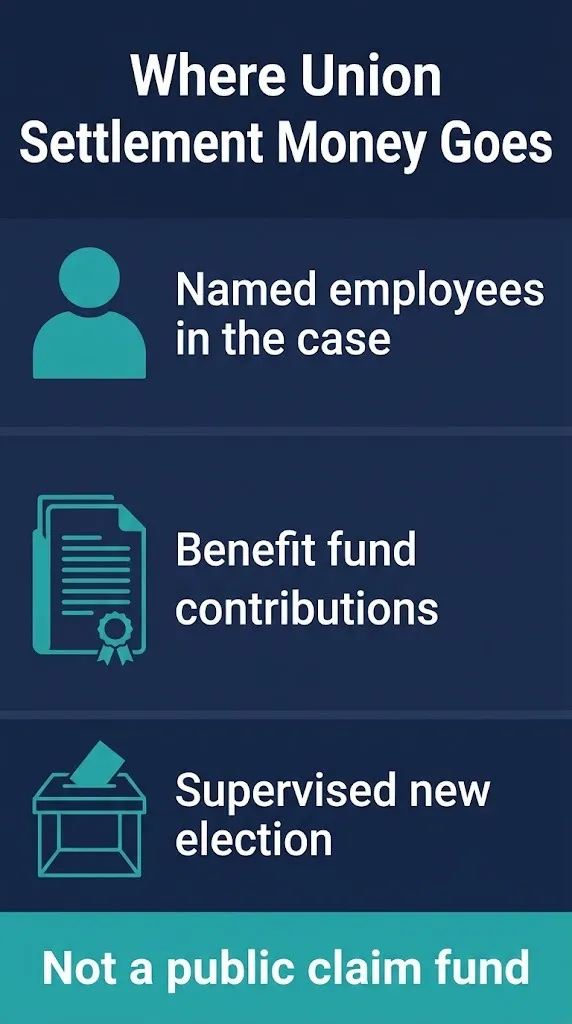
| Who gets paid | Named employees in the specific case, not the general public |
| Public claim form | Rare. Most settlements are internal or court-supervised. |
| Deadline | Set by the settlement agreement, not published universally |
| “Settlement services” | Usually financial securities settlement, not labor law |
Is a Union Settlement Real or a Scam?
A union settlement is real, but it is not a scam the way a fake class action is. The problem is confusion, not fraud.
When you search “union settlement,” you get a mix of results:
- Real NLRB and DOL settlements that resolve labor law violations.
- Union contract agreements that end strikes or lockouts.
- “Settlement services” pages that are about securities trading, not unions at all.
That third category is the trap. In financial regulation, “settlement services” means the back-end processing of securities trades. The UK and EU rules define it as the provision of settlement instructions by a central securities depository . It has nothing to do with labor unions.
If you landed on a page about “settlement services” while searching for a union case, you are in the wrong section of the internet.
Real union settlements come from government agencies. The National Labor Relations Board publishes them. The Department of Labor’s Office of Labor-Management Standards publishes them. Those are the sources to check.
How Much Is a Union Settlement Worth?
A union settlement’s value depends entirely on the case. There is no average because the cases are not comparable.
The IBEW Local 111 settlement in April 2026 broke down like this:
| Component | Amount |
|---|---|
| Make-whole remedy for terminated business agent | About $530,000 |
| Benefit fund contributions | $229,000 |
| Make-whole for two other affected employees | About $9,000 |
| Total | About $768,000 |
That is one case. A different settlement might be $5,000 or $5 million.
Department of Labor election settlements often involve no money at all. They require the union to rerun an election under supervision. For example, a September 2025 settlement required ATU Local 1700 to conduct its next officer election under OLMS supervision by January 30, 2026 . No back pay. No fund. Just a supervised election.
Other DOL settlements, like the one with UAW Local 140, required a new election under supervision by August 31, 2026 . Again, no payout.
So when you ask “how much,” the answer is: sometimes six figures, sometimes zero, and sometimes the remedy is procedural rather than financial.
Key Takeaway: Union settlement amounts are case-specific. The IBEW Local 111 case paid about $768,000. Many DOL settlements pay nothing and only require a new election.
Who Qualifies for Money From a Union Settlement?
You qualify for money from a union settlement only if you were a named affected employee in that specific case. There is no general eligibility test.
In the IBEW Local 111 case, the people who got paid were:
- The business agent who was unlawfully terminated.
- Two additional employees affected by unilateral changes .
Those are the only people covered by the make-whole remedy. If you were a member of Local 111 but not one of those employees, the settlement does not pay you.
This is the hardest part for people to accept. A union represents thousands of workers. A settlement might pay three of them. That is normal.
The same logic applies to NLRB settlements involving Amazon. A 2026 settlement required Amazon to restore unpaid time deducted from striking workers and post notices across 1,300 facilities . The remedy is policy change and notice posting, not a check to every warehouse worker.
If you think you are covered, look for your name in the settlement documents. If it is not there, you are probably not getting a payment from that case.
How Do You File a Claim for a Union Settlement?
You usually cannot file a claim for a union settlement because most do not have a public claim process.
Here is how the money actually moves in the common types:
- NLRB settlement: The charged party (usually the employer or union) pays the named employees directly or through the compliance process. No public form.
- DOL/OLMS settlement: The remedy is usually a supervised election or policy change. No payment form.
- Collective bargaining agreement: The employer pays wages and benefits under the new contract. No claim form. You get paid through payroll.
There are exceptions. If a settlement creates a fund for a defined group and the court orders a claims process, then a form exists. But that is rare in union cases compared to consumer class actions.
If someone sends you a link to a “union settlement claim form,” treat it as suspicious until you can verify it against an NLRB or DOL press release. Those agencies publish the case details. If the case is not there, the form is not real.
What Is “Settlement Services” and Why Does It Show Up in Union Searches?
“Settlement services” in search results usually means securities settlement, not labor union settlements. The two terms collide because they share a word.
In financial regulation, settlement services are the systems that process securities transactions. The EU rules define a central securities depository’s settlement services as important when its annual settlement value reaches 15% of the relevant market . That is a completely different field.
There is no connection between those rules and union settlements under the National Labor Relations Act or the Labor-Management Reporting and Disclosure Act.
If your search for “union settlement” pulled up pages about financial settlement services, you are seeing keyword overlap, not a real labor case. Close those tabs and go to the NLRB or DOL websites instead.
Reality Check: No agency texts you a union settlement payment. No one calls to “release” money from a labor case. If you get a message asking for your bank details to receive a union settlement, it is a scam. Real settlements are documented in public agency releases, and payment comes through the employer or the compliance process, not a random caller.
What Happens Next
Ongoing: NLRB and DOL settlements are published on agency websites as they are approved. Check those sources, not search ads.
Ongoing: If you are covered by a union contract, your union representative is the first person to ask about any settlement affecting your workplace.
No universal deadline: There is no single date to calendar because there is no single union settlement. Each case has its own timeline.
If you receive a notice: Verify it against the NLRB or DOL case number before sharing any personal information.
Frequently Asked Questions
What is a union settlement?
A union settlement is an agreement that resolves a labor law case or a contract dispute. It can involve back pay, policy changes, or a new election.
Is there a union settlement I can claim?
Not generally. Most union settlements pay specific named employees, not the public. There is no universal claim form.
How much money is in a union settlement?
It varies. The IBEW Local 111 settlement was about $768,000 . Many DOL settlements involve no payment at all.
What does “settlement services” mean?
In finance, it means securities transaction processing . It is unrelated to labor unions.
Who pays a union settlement?
The charged party pays. In NLRB cases that is usually the employer or the union found to have violated the law. In DOL cases it is the union required to comply.
Do I need a lawyer to get a union settlement payment?
Usually no, because you do not file a claim. If you are named in a case, the remedy is handled through the compliance process or your employer.
How do I check if a union settlement is real?
Search the NLRB or DOL press release database for the case name or case number. If it is not there, be skeptical.
What happens if I ignore a union settlement notice?
If you are named in a case, ignoring a notice can affect your remedy. If you are not named, ignoring it changes nothing.
The Bottom Line
“Union settlement” is not a fund. It is a category. The money goes to specific people in specific cases, and most cases have no public claim form.
If you want to know whether you are covered, check the agency release. Look for your name or your employer. If the case is not there, no money is waiting.
The most important number to remember: the IBEW Local 111 settlement paid about $768,000 to a handful of employees, not to every union member .