Settlement Fee in 2026: What You Actually Pay, Who Takes It, and the Numbers That Shrink Your Check
Quick Answer
- A “settlement fee” usually means the attorney’s cut, taken from your recovery, not a fee you pay upfront.
- Class action fees range 25% to 33% of the total fund, approved by a judge .
- Personal injury contingency fees often run one-third of the recovery, plus separate case expenses .
You searched for “settlement fee” and got a wall of legal jargon. That is not helpful when you are staring at a settlement letter and trying to figure out why the number on the page is smaller than the number you expected.
The phrase means different things depending on where you are standing. In a class action, it is the judge-approved percentage that comes out of the fund before anyone gets paid . In a personal injury case, it is the contingency fee your lawyer takes off the top, plus the costs of building the case .
This article breaks down what settlement fees actually cost, how judges decide them, why “no fee unless we win” still leaves you paying expenses, and the one number in your settlement agreement you should read before you sign anything. The surprising part: a federal judge in New York approved a $311,446.67 fee award in January 2026, exactly one-third of the settlement fund, because the law lets judges do that .
The Facts
| Item | Detail |
|---|---|
| What “Settlement Fee” Means | Usually the attorney’s contingency fee, taken from the recovery, not billed upfront |
| Class Action Fee Range | 25% to 33% of the total settlement fund, approved by a judge |
| Personal Injury Contingency Rate | Often one-third (33%) of the recovery |
| Who Approves Class Action Fees | The judge, after a fee petition and any class member objections |
| Case Expenses | Separate from the fee; court costs, experts, and records are often deducted too |
| When You Pay | Only if the case settles or wins; no recovery means no contingency fee |
What Is a Settlement Fee in a Lawsuit?
A settlement fee is the money deducted from your recovery to pay the attorney who handled the case, usually calculated as a percentage of the total settlement. It is not a filing fee and it is not a court cost, though those exist separately.
In class actions, the fee is called an attorney fee award. The lawyers petition the judge for a percentage of the fund, and the judge decides whether to approve, reduce, or deny it . The money comes out of the settlement fund before class members are paid.
In individual cases like personal injury, the fee is set by a written contingency agreement. The American Bar Association describes it as a fixed percentage, often one-third, that the lawyer receives only if the case succeeds .
The phrase gets confusing because some settlement agreements use “settlement fee” to mean something else entirely. In a Hong Kong case, the term referred to a contractual payment between business parties, not an attorney fee at all . Context matters.
Reality Check: No legitimate attorney asks you to pay a “settlement fee” upfront in cash. Contingency fees come out of the recovery. Filing fees and case costs are separate, and they are disclosed in your written agreement, not collected by text message.
How Much Do Class Action Lawyers Take from a Settlement?
Class action lawyers typically take 25% to 33% of the total settlement fund, with 25% being the most common benchmark . The exact percentage is not negotiated between you and the lawyer. It is approved by the judge.
Here is how the math works on a $10 million settlement, using the range:
| Deduction | Low End (25%) | High End (33%) |
|---|---|---|
| Attorney fees | $2,500,000 | $3,300,000 |
| Administration costs | $500,000 to $1,000,000 | $500,000 to $1,000,000 |
| Remaining for class members | $6,500,000 to $7,000,000 | $5,700,000 to $6,200,000 |
Those figures come from a 2026 explainer on class action attorney pay . The remaining money is divided among class members who file valid claims. If you file, your check is a share of that remainder, not the full fund.
In very large settlements, the percentage often drops. A billion-dollar fund might see fees at 15% to 20% rather than a full third . The judge is supposed to prevent windfalls that do not match the work performed.
The January 2026 New York case shows the one-third benchmark in action. The court awarded $311,446.67, described as “one-third of the Settlement Fund,” plus $8,310.86 in costs . The judge cited the contingent nature of the representation and the results achieved.
Why Does “No Fee Unless We Win” Still Cost You Money?
“No fee unless we win” is true about the contingency fee, and misleading about everything else. You still owe case expenses, win or lose, unless your agreement says otherwise.
The American Bar Association is direct: win or lose, you probably have to pay court filing fees, deposition costs, and similar charges . Those are expenses, not attorney fees. They go to the court, the court reporter, the expert witness, and the medical record company, not to your lawyer’s bank account.
A 2026 personal injury law explainer puts it plainly: contingency fee agreements do not include case expenses, and those costs are billed separately . Some firms advance the expenses and deduct them from your settlement before calculating the fee. Others ask you to cover them as they arise. The difference changes your net recovery.
A comparison: think of it like a home repair. The contractor’s labor is the fee. The lumber and permits are the expenses. You pay for the lumber even if the project goes over budget, and the contractor still expects to be paid for the work.
Key Takeaway: The contingency fee is only half the equation. Read the expense clause in your agreement before you sign, because that is where the surprise lives.
How Does a Judge Decide Attorney Fees in a Class Action?
A judge decides class action attorney fees by reviewing a fee petition and applying either the percentage-of-fund method or the lodestar method. The judge can approve the request, reduce it, or reject it entirely .
The percentage method is the most common. The lawyers ask for a slice of the fund, usually 25% to 33%, and the judge checks whether that slice is fair given the work and the risk .
The lodestar method is the backup. Lawyers multiply their hours by their hourly rates, and the judge may apply a multiplier of 1.5 to 3 times to account for the risk of taking the case on contingency . This method is used when a straight percentage would overpay or when a statute requires it.
You have a right to object. Class members can submit a written objection to the fee request before the final approval hearing, and judges do sometimes reduce fees based on those objections .
In the 2026 New York case, the judge conducted a lodestar cross-check and found the hourly rates reasonable before awarding the one-third fee . The cross-check is the judge’s way of confirming the percentage is not wildly out of line with the hours actually worked.
What Settlement Charges Come Out of My Check Besides Attorney Fees?
Settlement charges beyond attorney fees typically include administration costs, notice and claims processing, expert fees, court costs, and in some cases an incentive award for the named plaintiff. Each is deducted before your share is calculated.
In class actions, the settlement administrator is paid from the fund to send notices, process claims, and distribute checks . That cost can run $500,000 to $1 million on a $10 million settlement, and it comes out before class members are paid.
Lead plaintiffs sometimes receive an incentive award, typically $2,500 to $25,000, for the time they spent representing the class . The judge must approve it, and it comes from the fund.
In personal injury cases, the charges are different. Medical records, expert reviews, deposition transcripts, and court filing fees are deducted from the recovery, often before the contingency fee is calculated . If your case went to trial, the list grows longer.
A Pennsylvania court rule shows how seriously courts treat settlement fund delivery. Defendants must deliver settlement funds within 20 calendar days of receiving an executed release, and failure can trigger sanctions and interest . That rule protects you from a defendant who stalls after you have signed away your claim.
What Is the Difference Between a Settlement Fee and a Settlement Amount?
A settlement fee is what the professionals take. A settlement amount is what the case is worth before those deductions. Confusing the two is the most common mistake people make when they read a settlement headline.
When you see “$10 million settlement,” that is the gross amount. The attorney fee, administration costs, and expenses come out of it. What is left is divided among claimants. Your check is a fraction of the fraction.
In class actions, the judge approves the gross settlement and the fee separately. The fee petition is public, and you can read it. If the numbers do not make sense to you, you can object .
In personal injury, the gross settlement is negotiated between your lawyer and the insurer. Your net is the gross minus the contingency fee minus expenses. The retainer agreement should spell out the order of deductions, and if it does not, ask before you sign .
What Happens Next If You Are Reviewing a Settlement Agreement?
Here is the sequence to follow before you sign anything:
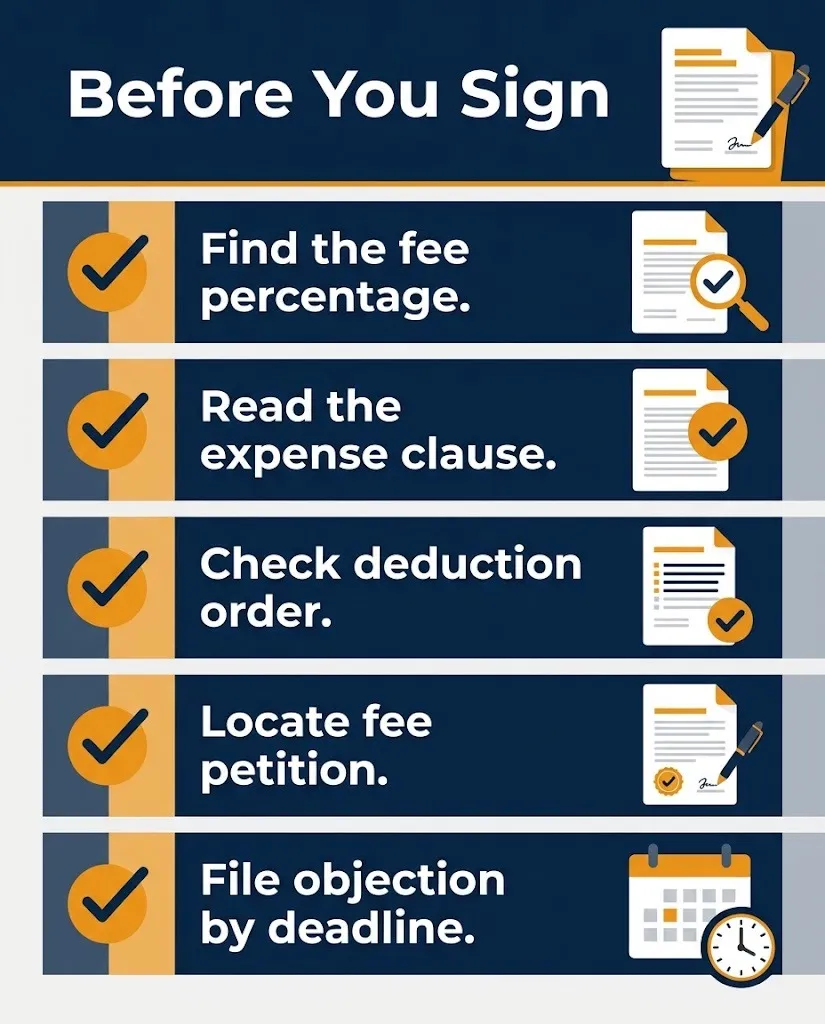
Step 1: Find the fee percentage in the agreement. It should be a number, not a range.
Step 2: Find the expense clause. Does the firm advance costs or do you pay them as they arise?
Step 3: Check whether expenses are deducted before or after the fee is calculated. The order changes your net.
Step 4: If it is a class action, look for the fee petition and the date of the final approval hearing.
Step 5: If you disagree with a class action fee, file a written objection before the deadline.
Step 6: Do not sign a release until you understand what you are giving up, including future claims.
Frequently Asked Questions
What is a settlement fee?
A settlement fee is usually the attorney’s contingency fee, taken as a percentage of your recovery. It is not a fee you pay upfront.
How much do lawyers take from a settlement?
Class action fees run 25% to 33% of the fund. Personal injury contingency fees are often one-third of the recovery.
Do I pay attorney fees if I lose?
No, under a standard contingency agreement. You may still owe case expenses, depending on your contract.
Who approves attorney fees in a class action?
The judge. Lawyers petition for a percentage, and the judge can approve, reduce, or deny it.
Are case expenses the same as attorney fees?
No. Expenses pay third parties like courts, experts, and record providers. Fees pay your lawyer.
Can I object to a class action fee?
Yes. You can file a written objection before the final approval hearing, and judges sometimes reduce fees because of them.
What is a lodestar calculation?
It is hours worked multiplied by hourly rate, sometimes with a multiplier, used as a cross-check on percentage fees.
The Bottom Line
The settlement fee is not a mystery tax. It is a disclosed percentage, usually 25% to 33% in class actions and often one-third in personal injury, taken from the recovery you already won. The expenses are the wild card, and they are negotiable only before you sign.
Read the fee clause and the expense clause in the same sitting. If the numbers do not add up to a net you can live with, ask before the release is signed, not after the check clears.