No Proof Class Action Lawsuits 2026: Which Ones Are Open and How to File
Quick Answer
- No proof class action settlements are real. Courts require a sworn statement instead of a receipt for eligibility.
- Payouts vary by case: from $50 flat (Circle K data breach) up to a pro-rata share of a $60.5 million fund (Tinder).
- The soonest deadline open right now is August 7, 2026 for the Nutricost settlement; most others run through September.
You don’t need a receipt to file most class action claims. Courts routinely accept a sworn statement, called self-certification, in place of a purchase record, and several large settlements open in 2026 use exactly that system.
This matters most if you paid for a subscription, bought a mislabeled product, or got a data breach notice sometime in the last several years and never kept the paperwork. Four verified no-proof settlements are accepting claims as of this writing, with fund sizes ranging from $1.83 million to $60.5 million.
This article walks through what “no proof” actually means in a legal filing, which specific settlements are open today, and how to file one correctly. One detail surprises most first-time filers: submitting a false claim, even a small one, is still fraud under penalty of perjury, no proof requirement or not.
The Facts
| Snapshot | |
|---|---|
| Topic | Multiple separate class action settlements, not one case |
| Status | At least 4 major no-proof settlements confirmed open as of July 18, 2026 |
| Largest Open Fund | $60.5 million (Tinder age discrimination settlement) |
| Smallest Confirmed Payout | $50 flat, no proof (Circle K data breach settlement) |
| Nearest Claim Deadline | August 7, 2026 (Nutricost Magnesium Glycinate settlement) |
| Administrator | Varies by case, named per settlement below |
| Proof Needed | None for baseline payout in each case listed; documentation increases payout in some |
Are no proof class action lawsuits real or a scam?
Yes, no proof class action settlements are a real, court-supervised part of consumer litigation, not a scam category. Courts approve claim forms that accept a sworn statement in place of a receipt when a company’s own records, or the low cost of the product, make formal proof impractical to require.
The mechanism is called self-certification. You confirm under penalty of perjury that you meet the eligibility criteria, and the settlement administrator processes the claim without demanding documentation. Every legitimate no-proof settlement listed in this article is verifiable through official court-approved settlement websites, not a private company promising free money.
Reality Check: No real settlement administrator contacts you first by text or unsolicited call asking for your bank details to “release” a payment. Filing a real class action claim is always free, and anyone charging a fee to file on your behalf is not a court-appointed administrator.
How much can you get from a no proof class action settlement?
Not yet determined in a single fixed way, because payout amounts depend entirely on each settlement’s fund size and how many people file valid claims. Confirmed examples from currently open cases show the real range.
| Settlement | No-Proof Payout | Fund Size |
|---|---|---|
| Circle K data breach | $50 flat cash | Fund amount not separately disclosed in public filings |
| Nutricost Magnesium Glycinate | Up to $19.95 per unit | $1,835,000 |
| Disney streaming (YouTube TV/DirecTV Stream) | Pro-rata share, estimated under $5 per claimant given ~17 million potential claimants | $50,000,000 |
| Tinder age discrimination (California only) | Pro-rata share based on subscription length | $60,500,000 |
Larger funds don’t always mean larger individual checks. The Disney settlement’s $50 million fund is split among an estimated 17 million potential claimants, which pushes typical per-person payouts well under $5 unless you had a long subscription history.
Key Takeaway: No proof settlements pay real money, but payout size depends more on the ratio of fund size to claimant count than on the headline fund total.
What are the top class action settlements open right now?
The top currently open no-proof settlements, ranked by fund size, are Tinder, Disney, Nutricost, and Circle K. Each has a confirmed, active claim window as of mid-July 2026.
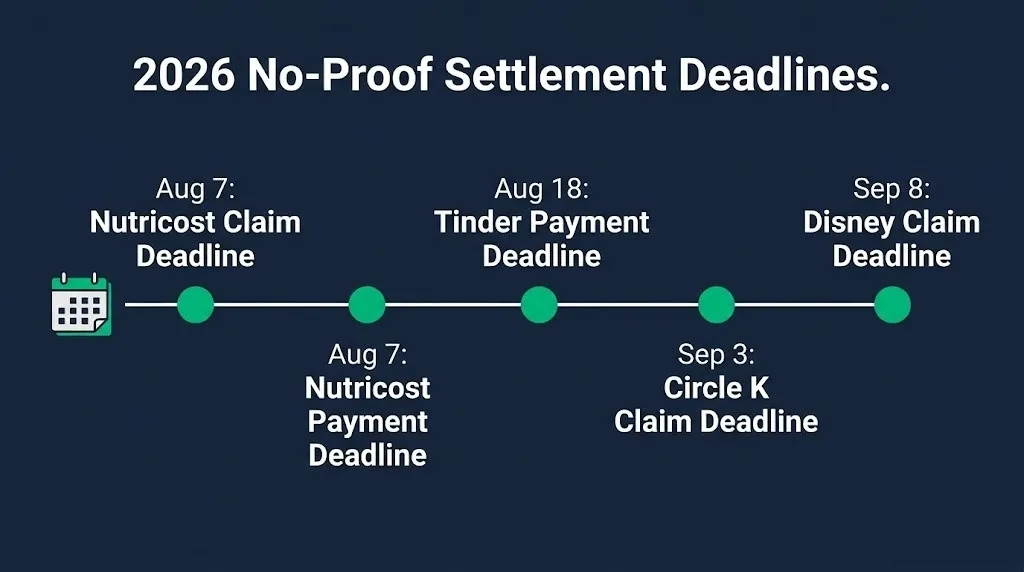
- Tinder Age Discrimination Settlement ($60.5 million): California residents who paid for Tinder Plus or Tinder Gold while over 29 (or over 28 after March 2016) may qualify. No claim form required for identified class members. Payment method deadline: August 18, 2026.
- Disney Streaming Settlement ($50 million): Anyone who paid for YouTube TV or DirecTV Stream (including DirecTV Now or AT&T TV Now) between April 1, 2019 and March 31, 2026 may qualify. Self-certify subscription length, no receipts needed. Claim deadline: September 8, 2026.
- Nutricost Magnesium Glycinate Settlement ($1.835 million): U.S. buyers of the 120- or 240-capsule product between February 1, 2021 and June 8, 2026 can file for up to $19.95 per unit. Claim deadline: August 7, 2026.
- Circle K Data Breach Settlement: Consumers affected by the May 2024 cyberattack can claim a flat $50 with no proof, or up to $2,000 for documented losses. Claim deadline: September 3, 2026.
All four are confirmed through official court-approved settlement administrator sites, not third-party claim aggregators.
How do you file a class action settlement claim with no proof?
You file a no-proof class action claim by completing the official claim form on the court-approved settlement website and certifying your eligibility under penalty of perjury. No receipts, screenshots, or account statements are required for the baseline payout tier.
- Confirm the official settlement website name, not a look-alike domain
- Check the eligibility window and criteria specific to that case
- Enter your Claim ID and PIN if you received a mailed or emailed notice
- Select “no proof” or “self-certification” option if the form offers a documented tier as well
- Choose your payment method, such as PayPal, Venmo, Zelle, or paper check
- Submit before the exact claim deadline, since most are strict cutoffs
- Save your confirmation number or screenshot for your records
Reality Check: Filing without proof still means signing a legal statement that your claim is true. Settlement administrators use data analysis to flag suspicious patterns, like many claims filed from one address, so only file for products or services you actually used.
What is a class action claim form?
A class action claim form is the official document a settlement class member submits to receive payment, listing eligibility criteria and payment options set by the court-approved settlement agreement. Each settlement has its own form, hosted on its own official administrator website.
Most forms request basic information: your name, mailing address, and either a Claim ID and PIN from a notice, or a self-certification statement if you didn’t receive direct notice. Some forms offer tiers, a no-proof baseline payout and a higher, documented payout if you have receipts.
- Basic tier: usually available without documentation
- Enhanced tier: typically requires receipts, screenshots, or account records
- Claim ID and PIN: found on mailed or emailed settlement notices, speeds up processing
- Deadline: always listed on the official settlement site, strictly enforced
Filing an incomplete or unsigned form is one of the most common reasons legitimate claims get rejected, so double-check every required field before submitting.
How does class action settlement administration work?
Class action settlement administration is the court-appointed process of verifying claims, calculating payouts, and distributing funds after a settlement receives final approval. An independent third-party administrator, not the defendant company, usually manages this.
The administrator’s job includes maintaining the official claim form, mailing or emailing notice to identified class members, processing submitted claims, and issuing payments once the court grants final approval. For the Tinder settlement, for example, the administrator is tied to the case caption Candelore v. Tinder, Inc., with claims processed through a dedicated post office box and email address specific to that case.
Payments are almost never distributed immediately after you file. They typically follow a specific sequence:
- Claim filing period closes
- Court holds a final approval hearing
- Court grants final approval, if no unresolved objections or appeals remain
- Administrator calculates final per-person payout based on total valid claims
- Payments are issued, often three to twelve months after the claim deadline closes
Key Takeaway: No proof claims still go through full court-supervised administration, so payment timing depends on the court calendar, not just your filing date.
What open settlement claims are active in 2026?
Multiple categories of open settlement claims are active in 2026, spanning consumer products, streaming subscriptions, dating app pricing, and data breaches. Coverage varies by state in some cases and nationwide in others.
- Consumer product mislabeling: Nutricost Magnesium Glycinate, nationwide, deadline August 7, 2026
- Streaming antitrust: Disney (YouTube TV/DirecTV Stream), nationwide, deadline September 8, 2026
- Age discrimination pricing: Tinder, California only, payment deadline August 18, 2026
- Data breach: Circle K, deadline September 3, 2026
Some previously open no-proof settlements have already closed. The Tom’s of Maine toothpaste settlement, for example, had a claim deadline of July 6, 2026, which has already passed as of this writing. That’s a useful reminder: “open” status changes weekly, and a settlement listed as active last month may already be closed.
What is the Tinder class action settlement update?
The Tinder settlement’s current active deadline is August 18, 2026, the date by which identified class members must choose a payment method. This is not a new filing deadline, since eligible class members were automatically certified through the class action process.
The case, formally Candelore v. Tinder, Inc., resolved allegations that Tinder charged users over age 29 (or 28 after March 2016) more for Tinder Plus and Tinder Gold subscriptions in California, in violation of the state’s Unruh Civil Rights Act. The court granted preliminary approval on January 13, 2026, and held a final approval hearing on May 20, 2026.
Tinder denies any wrongdoing. If you’re an identified class member, no separate claim form is required, only a payment method selection by the August 18, 2026 deadline. If you believe you qualify but never received notice, a verification form is available on the official settlement site through the same date.
What is the Disney streaming class action settlement update?
The Disney streaming settlement’s claim deadline is September 8, 2026, and the case is formally captioned Biddle et al. v. The Walt Disney Company, filed in the U.S. District Court for the Northern District of California. Preliminary approval was granted in April 2026.
The lawsuit alleged Disney used its control over ESPN and other channels to force YouTube TV and DirecTV Stream into bundling expensive channel packages, inflating subscriber prices. Eligible subscribers paid for YouTube TV or DirecTV Stream (including DirecTV Now or AT&T TV Now) between April 1, 2019 and March 31, 2026.
Traditional satellite DirecTV, Hulu + Live TV, fuboTV, and Sling TV are not covered by this settlement. The final approval hearing is scheduled for January 14, 2027, meaning payments won’t go out until after that date, and possibly later if any appeals are filed.
Key Takeaway: Both Tinder and Disney require action before their respective 2026 deadlines, but neither will pay out until after their separate final approval hearings clear.
Are there open data breach class action settlements right now?
Yes, multiple data breach class action settlements are currently accepting no-proof claims, with the Circle K settlement being one of the most recently confirmed. Data breach settlements typically follow a two-tier structure.
The Circle K case, Brittany Canup, et al. v. Gas Express, LLC d/b/a Circle K (Case No. 25EV012357), stems from a May 2024 cyberattack on Circle K’s computer systems. Affected consumers can claim:
- $50 flat cash, no proof required
- Up to $2,000 for documented identity theft losses
- Two years of free credit monitoring, regardless of which cash tier you choose
The claim and opt-out deadline is September 3, 2026. This two-tier structure, a flat no-proof payment plus a higher documented tier, is standard across most current data breach settlements, not unique to Circle K.
What does it mean to be a settlement class member?
Being a settlement class member means you fall within a legally defined group of people affected by the conduct at issue in a class action lawsuit, making you eligible for compensation if the settlement is approved. Membership is usually automatic; you don’t apply to become one.
Class definitions are specific. The Tinder settlement, for instance, defines class members as people who paid for Tinder Plus or Gold in California while over a certain age during a defined date range. If you don’t meet every listed criterion, including the state and date window, you’re not a class member for that case, even if you used the product.
Being a class member also carries a consequence if you take no action: unless you formally opt out by the exclusion deadline, you’re automatically bound by the settlement’s terms and give up your right to sue that company separately over the same claims.
What is the difference between a class action lawsuit in California and Illinois?
The core class action process is similar in California and Illinois, but the underlying consumer protection laws that support many claims differ by state. California’s Unruh Civil Rights Act, for example, was central to the Tinder pricing case, and that law doesn’t have a direct Illinois equivalent.
Illinois class actions frequently rely on the Illinois Consumer Fraud and Deceptive Business Practices Act, along with the state’s Biometric Information Privacy Act (BIPA), which has driven a large volume of privacy-related class actions specific to Illinois residents. California cases often draw on the Consumers Legal Remedies Act and Unfair Competition Law in addition to the Unruh Act.
Practically, this means a settlement like Tinder’s can be California-only, while other cases based on federal law, data breach claims, or nationwide consumer statutes, are open to residents of every state, including both Illinois and California. Always check a settlement’s specific geographic eligibility before assuming a claim applies to you.
What are the pros and cons of a class action lawsuit?
The main advantage of a class action lawsuit is efficiency: it lets many people with similar, often small, individual claims pursue compensation together without hiring their own attorney. The main drawback is that individual payouts are usually modest and you have limited control over case strategy or settlement terms.
Pros:
- No cost to join or file a claim
- No need to hire your own attorney
- Access to compensation for harms too small to justify an individual lawsuit
- Court oversight helps ensure fair treatment of all class members
Cons:
- Individual payouts are often small, sometimes just a few dollars
- You give up the right to sue separately unless you formally opt out
- Payment timing depends on court approval and can take a year or more
- You have little influence over settlement terms as an individual class member
This tradeoff resembles a warranty claim on a low-cost item: filing is easy and free, but the payout reflects the item’s modest value, not a jackpot.
What happens after the final approval hearing?
After a final approval hearing, the court either approves the settlement as fair, reasonable, and adequate, or requires changes before it can move forward, and payments only begin once approval is finalized and any appeal period passes. This is often the single biggest driver of how long you wait for a check.
For settlements like Disney’s, with a final approval hearing scheduled for January 14, 2027, payment cannot begin before that date even though claims are being accepted now, in mid-2026. Appeals can add several more months, sometimes longer, before funds are distributed.
What Happens Next
- August 7, 2026 (confirmed): Nutricost Magnesium Glycinate claim deadline closes.
- September 3, 2026 (confirmed): Circle K data breach claim deadline closes.
- September 8, 2026 (confirmed): Disney streaming claim deadline closes.
- October 15, 2026 (confirmed): Nutricost final approval hearing.
- January 14, 2027 (confirmed): Disney streaming final approval hearing.
How big can a class action lawsuit payout be?
Class action payouts range from a few dollars to tens of thousands, depending entirely on the fund size, the number of valid claimants, and whether the payout tier requires documentation. The four settlements covered in this article alone span from a flat $50 to a pro-rata share of $60.5 million.
Documented-loss tiers, which require receipts or records, generally pay far more than no-proof tiers. The Circle K settlement’s documented tier reaches up to $2,000, compared to its $50 no-proof flat rate, a 40-fold difference for the same case. If you have any records at all, it’s worth checking whether a settlement’s higher tier applies to you before defaulting to the no-proof option.
Frequently Asked Questions
Do I need a receipt to file a class action claim?
Not for every settlement.
Many current settlements, including Nutricost, Disney, and Circle K, offer a no-proof tier based on a sworn statement alone.
Some settlements do require documentation for higher payout tiers or for claims beyond a set unit limit.
Is filing a class action claim really free?
Yes, filing a legitimate class action claim through the official court-approved settlement website is always free.
Legitimate settlement administrators never charge a filing fee.
Be cautious of third-party sites or apps that charge for “filing help” you don’t need.
How long does it take to get paid after filing?
Payment timing depends on the court’s final approval hearing date, which varies by case.
The Nutricost settlement’s hearing is October 15, 2026, while Disney’s isn’t until January 14, 2027.
Payments generally arrive three to twelve months after a claim deadline closes, once approval is final.
Can I file multiple class action claims at once?
Yes, there’s no limit on how many separate class action settlements you can file for, as long as you’re an eligible class member for each.
Each settlement is a separate legal case with its own eligibility criteria.
You should only file for cases where you actually meet the qualifying criteria.
What happens if I miss a claim deadline?
You generally forfeit your right to a payout if you miss a settlement’s claim deadline, unless the court later reopens the claims period, which is uncommon.
The Tom’s of Maine toothpaste settlement, for example, closed its claim window on July 6, 2026.
Always confirm current deadlines on the official settlement website before assuming you still have time.
Is a class action settlement the same as a class action lawsuit?
No, a lawsuit is the legal case itself, while a settlement is the resolution reached, often before trial, that creates a fund and claims process.
Not every class action lawsuit ends in a settlement; some are dismissed or go to trial.
The word “settlement” specifically refers to the payout phase covered in this article.
How do I know if a class action settlement is legitimate?
Legitimate settlements are administered through official court-approved websites, often with a case caption and court name listed.
You can also verify a case through the presiding federal or state court’s public docket.
If a site asks for payment to file, or contacts you unsolicited demanding personal financial details, treat it as a red flag.
Check the official settlement website for each case before filing, since eligibility windows and deadlines can shift with amendments. The nearest deadline right now is August 7, 2026 for the Nutricost Magnesium Glycinate settlement, so don’t wait if that one applies to you.