Houston Business Litigation Attorney 2026: Costs, Court Rules, and When You Actually Need One
Quick Answer
- A Houston business litigation attorney helps companies resolve disputes over contracts, partnerships, and commercial fraud.
- Most charge hourly, with experienced Houston rates varying widely; contingency is less common in commercial cases.
- The most important deadline: Texas breach of contract claims carry a four-year statute of limitations.
If your business partner stopped paying, a vendor breached a supply agreement, or a competitor stole your trade secrets, you are probably weighing whether to sue. Houston has one of the busiest commercial dockets in the country, and the stakes are high. Choosing the right attorney matters, but so does understanding what the process actually costs and which court will hear your case.
Texas changed the game in September 2024 with a new Business Court. Houston is home to the First Business Court Division, which handles disputes involving $5 million or more. For smaller claims, you are still in Harris County district courts. The choice of forum affects timelines, costs, and strategy. This guide breaks down the real costs, the rules, and the situations where hiring a litigator pays for itself.
The Facts
Court | First Business Court Division (Houston), concurrent with Harris County District Courts
Jurisdiction Threshold | $5 million for certain derivative claims; $10 million for financial institution and commercial transaction disputes
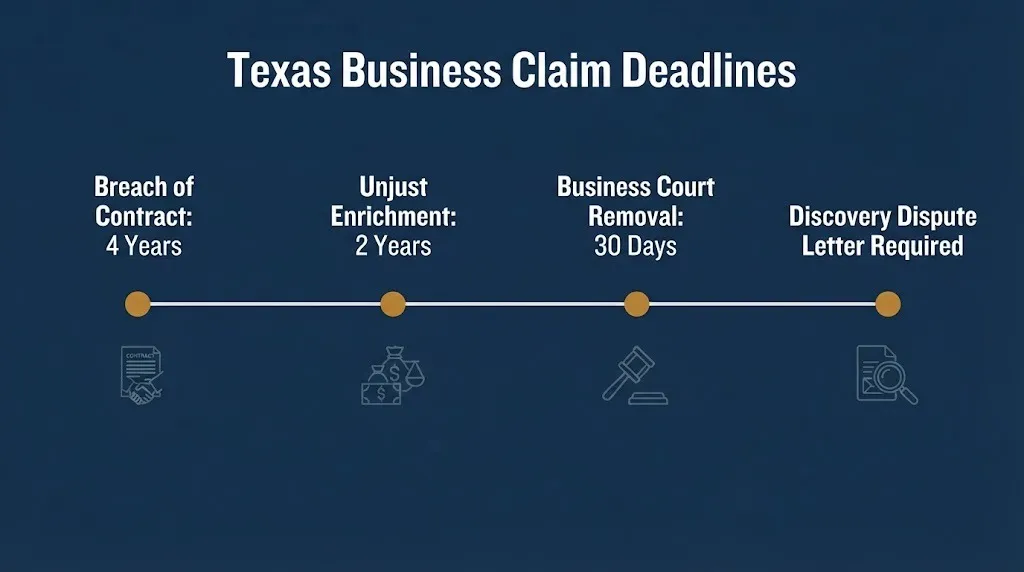
Limitations Period | 4 years for breach of contract; 2 years for unjust enrichment
Attorney Fees | Hourly most common; contingency and hybrid arrangements available in some cases
Fee Recovery | American Rule applies; fees recoverable only if contract or statute allows
Key Deadline | 30 days to remove a case to Business Court after discovering jurisdictional facts
Proof Needed | Contract, correspondence, damages documentation, expert analysis
How much does a Houston business litigation attorney cost?
A Houston business litigation attorney typically charges between $300 and $800 per hour, with senior partners at large firms exceeding $1,000 per hour for complex commercial matters. Hourly billing is the most common structure for business litigation in Texas, and rates vary based on the complexity of the matter, the attorney’s experience level, and the nature of the dispute .

Three fee structures dominate commercial litigation in Houston:
Hourly billing. The default for most business disputes. You pay for every hour the attorney and their staff spend on your case. A straightforward contract dispute between two parties might resolve with modest attorney time. A multi-party commercial dispute involving years of business records can generate substantial fees .
Contingency. Less common in commercial litigation but available in cases with clear liability and significant damages. The attorney takes a percentage of the recovery, typically 25% to 40% .
Hybrid arrangements. A reduced hourly rate combined with a success fee. Some Houston firms offer flat monthly retainers or hybrid structures for business clients .
Before hiring any attorney, you should ask for a written scope and budget. Berg PC, a Houston boutique firm, states that clients receive a written scope and budget before work begins, and the firm tells clients when a dispute is not worth litigating . That transparency is rare and worth demanding.
Key Takeaway: Most Houston business litigation is billed hourly, so your costs depend heavily on how efficiently the case is managed. Ask for a written budget and a candid assessment of whether the dispute justifies the expense.
What is the statute of limitations for business lawsuits in Texas?
The statute of limitations for most Texas business lawsuits is four years for breach of contract and two years for unjust enrichment and fraud claims. Missing these deadlines can end your case before it starts.
Texas Civil Practice and Remedies Code Chapter 16 sets the periods:
| Claim Type | Limitations Period |
|---|---|
| Breach of contract | 4 years |
| Unjust enrichment | 2 years |
| Quantum meruit | 4 years |
| Fraud | 2 years (typically) |
| Fraudulent concealment | Tolled until discovery |
The clock generally starts when the cause of action accrues. For a breach of contract, that is usually when the breach occurs. For fraud, it is when the plaintiff discovers or should have discovered the injury.
Texas recognizes equitable tolling in limited circumstances. If a defendant actively conceals wrongdoing, the plaintiff may argue the limitations period was tolled. But courts apply this narrowly. In one Texas appellate case, a plaintiff’s fraud and breach of contract claims accrued in 2017 and were barred by limitations when suit was filed in 2023 . A party alleging fraudulent concealment must plead specific facts showing the defendant obstructed their ability to assert rights .
If your claim is approaching the four-year mark, consult an attorney immediately. A day late can mean a permanent bar.
What is the Texas Business Court and does it apply to Houston cases?
The Texas Business Court is a specialized trial court that began hearing cases on September 1, 2024, and Houston is home to the First Business Court Division. The court has concurrent jurisdiction with Harris County district courts for qualifying commercial disputes.
The Business Court’s jurisdiction covers:
- Derivative and internal governance proceedings with an amount in controversy of $5 million or more (exclusive of interest, damages, penalties, attorney fees, and costs) .
- Derivative and internal governance proceedings involving a publicly traded company, regardless of amount .
- Financial institution, commercial transaction, or Texas Finance/Business & Commerce Code disputes with an amount in controversy of $10 million or more .
Some claims are excluded. Consumer transactions, insurance disputes, DTPA claims, and medical malpractice are not permitted in Business Court .
Houston’s Business Court judges include Sofia Adrogué, a partner at Diamond McCarthy LLP and founder of the Texas Business Litigation Treatise, and Hon. Grant Dorfman, a former Harris County district judge . The court issues written opinions on dispositive motions, which creates a body of precedent that can guide strategy .
A case can be filed directly in Business Court if jurisdiction and venue are proper. It can also be removed from a district court by a party if the case falls within the court’s jurisdiction. The removal deadline is 30 days after the party discovers or reasonably should have discovered facts establishing jurisdiction .
Key Takeaway: If your Houston business dispute involves $5 million or more, the Texas Business Court may hear your case. The court’s written opinions and specialized judges can produce more predictable outcomes, but the jurisdictional thresholds are strict.
How do you remove a case to the Texas Business Court?
You remove a case to the Texas Business Court by filing a notice of removal within 30 days of discovering facts that establish jurisdiction. The process is modeled on federal removal procedure but with Texas-specific rules.
Here are the steps:
- Confirm jurisdiction. The dispute must meet the amount-in-controversy threshold and fall within a covered category.
- Check venue. The county must be within an operating Business Court division. Houston is in the First Division.
- Draft the notice of removal. It must contain a short and plain statement of the grounds for removal, including the basis for jurisdiction .
- File with both courts. The notice goes to the Business Court and the court where the action was originally filed .
- Transfer occurs automatically. The clerk of the original court transfers the action upon receipt of the notice .
- Consider the 30-day deadline carefully. If a temporary injunction application is pending, the deadline runs from the date the application is granted, denied, or denied as a matter of law .
- Be aware of limits. A case filed in a court outside an operating division cannot be removed. Cases filed before September 1, 2024 cannot be removed .
If all parties agree, removal can occur at any time during the case. If not, the 30-day rule applies strictly.
What should you look for in a Houston business litigation attorney?
You should look for a Houston business litigation attorney with specific experience in your type of dispute, familiarity with the court that will hear your case, and a fee structure that aligns with your budget. Commercial litigation is not a generic skill. A lawyer who handles personal injury or family law is not equipped for a $10 million contract dispute.
Questions to ask before hiring:
- What percentage of your practice is business litigation? You want a specialist, not a generalist.
- Have you appeared before the Texas Business Court? If your case qualifies, experience in this new court matters.
- How do you staff cases? Some firms assign partners to routine tasks, driving up costs.
- What is your fee structure and budget? Hourly, contingency, hybrid, or flat fee? Get it in writing.
- How will you communicate? Set expectations for updates, response times, and who handles your case day to day.
- Will you tell me if the case is not worth litigating? A good attorney will counsel against expensive litigation when damages are modest.
Berg PC, a Houston boutique, describes itself as assisting businesses in complex commercial litigation with particular depth in digital assets . That kind of focused practice is often more efficient than a large firm with broad overhead.
What are the typical stages of a Houston business lawsuit?
A Houston business lawsuit typically moves through six stages: pre-suit negotiation, petition and answer, discovery, dispositive motions, trial or settlement, and appeal. Most cases settle before trial.
Pre-suit negotiation. Demand letters and mediation often resolve disputes without filing. The Business Court may refer cases to mediation at any time .
Petition and answer. The plaintiff files a petition stating claims and damages. The defendant answers and may file counterclaims.
Discovery. Both sides exchange documents, take depositions, and retain experts. Discovery is often the most expensive phase. The Business Court requires parties to confer on discovery disputes before filing motions and imposes word limits on discovery letters .
Dispositive motions. Summary judgment motions ask the court to rule without trial. The Business Court sets summary judgment motions for submission on the last business day before the 60th day after filing, unless a different setting is ordered .
Trial or settlement. If the case survives summary judgment, it proceeds to trial or settlement. Mediation is common and often mandatory.
Appeal. Losing parties can appeal to the Texas Courts of Appeals.
What happens next in your Houston business dispute?
The next stages depend on where you are in the dispute and whether you have filed suit.
Before filing: Send a demand letter and consider mediation. A well-drafted letter often produces settlement without litigation costs.
Filing decision: Confirm the statute of limitations and choose your forum. If the dispute exceeds $5 million and qualifies, consider the Business Court.
After filing: Expect discovery to dominate the timeline and budget. The Business Court’s local rules require conferences before discovery motions and impose strict word limits .
Settlement evaluation: Most cases settle. Mediation is the most common path. Evaluate settlement offers against the cost of continued litigation.
Trial: A small percentage of cases go to trial. If yours does, prepare for a significant time and financial commitment.
Frequently Asked Questions
How much does a Houston business litigation attorney cost?
Most charge hourly, with rates varying by experience and firm size. Some offer contingency or hybrid arrangements for cases with clear liability.
What is the statute of limitations for breach of contract in Texas?
Four years from the date of the breach . Missing the deadline bars your claim.
What is the Texas Business Court?
A specialized trial court for commercial disputes that began operating on September 1, 2024. Houston is in the First Business Court Division .
Can I recover attorney fees in a Texas business lawsuit?
Generally no, under the American Rule. You can recover fees only if a contract or statute authorizes it .
When can a case be removed to the Texas Business Court?
Within 30 days of discovering facts establishing jurisdiction, or at any time if all parties agree .
What types of cases does the Business Court handle?
Derivative and internal governance disputes over $5 million, and financial institution or commercial transaction disputes over $10 million .
Does the Business Court allow jury trials?
Yes. Parties retain the right to a trial by jury .
What is the deadline to respond to a motion in Business Court?
Unless otherwise ordered, responses to opposed nondispositive motions are due within 10 days after the motion is filed .
The Bottom Line
A Houston business litigation attorney is worth the cost when your dispute involves significant money, complex contracts, or claims that require specialized knowledge of the Texas Business Court. The four-year statute of limitations is the deadline that matters most for contract claims. Before hiring anyone, demand a written budget and a candid assessment of whether the dispute justifies litigation. The right lawyer will tell you when to walk away.