How Many People Are Needed for a Class Action Lawsuit in 2026? The Real Answer
Quick Answer
- No strict minimum exists, but courts generally find 40 or more class members sufficient for numerosity.
- Classes with 21 to 40 members get case-by-case treatment depending on joinder practicality.
- Classes with 20 or fewer members usually fail the numerosity requirement.
The question “how many people are needed for a class action lawsuit” gets answered badly all over the internet. Most pages throw out a number without explaining why, or they confuse the minimum to file with the minimum to win certification.
Here’s what the actual rule says. Federal Rule of Civil Procedure 23(a)(1) requires that a class be “so numerous that joinder of all members is impracticable” . That word “impracticable” is doing the heavy lifting. It doesn’t mean impossible. It means difficult or inconvenient enough that handling each claim separately makes no sense .
A class of 100 people scattered across ten states is impracticable to join individually. A class of 100 people who all work in the same building might not be.
The 40-person threshold is a judicial rule of thumb, not a statute. It comes from decades of court decisions, not from Congress. Some courts call it a “magic number.” Others say there is no magic number at all .
This article breaks down what actually matters for class certification, when small classes can work, and why the number of people is only one piece of a much bigger puzzle.
The Facts
| Legal Standard | Federal Rule of Civil Procedure 23(a)(1) |
| Numerosity Requirement | Class must be so numerous that joinder is impracticable |
| Judicial Rule of Thumb | 40 or more members generally sufficient |
| Mid-Size Classes | 21 to 40 members, case-by-case analysis |
| Small Classes | 20 or fewer members usually insufficient |
| Key Factors Beyond Number | Geographic dispersion, financial resources, ease of identification, judicial economy |
| State Court Variations | Some states have different thresholds or no specific number |
Is there a minimum number of people required for a class action?
No, there is no fixed minimum number of people required to file a class action lawsuit in federal court. The rule asks whether joining everyone individually would be impractical, not whether the group hits a specific headcount .
The confusion comes from how courts actually apply the rule. Judges need something concrete to work with. A group of three people is obviously not a class. A group of 3,000 people obviously is. The hard cases fall in between, and that’s where the 40-person rule of thumb emerged.
Federal appellate courts have said repeatedly that there is no “magic number” that applies to every case . The Supreme Court has never imposed an absolute numerical floor. The analysis is supposed to be fact-specific, not formulaic.
That means a class of 35 people can sometimes be certified. A class of 50 people can sometimes be rejected. The number matters, but it isn’t the only thing that matters.
If you’re wondering whether your situation qualifies, the honest answer is: it depends on facts a lawyer would need to evaluate. This article can’t tell you if you have a case. It can tell you how courts think about the question.
How many plaintiffs are needed for numerosity in federal court?
Courts generally presume numerosity is satisfied when a proposed class has 40 or more members. That presumption comes from decades of case law, not from the text of Rule 23 .
The 40-person threshold appears in countless federal decisions. One court noted that “a class that is likely to exceed forty members satisfies numerosity” . Another observed that numerosity is “generally satisfied if there are more than 40 class members” .
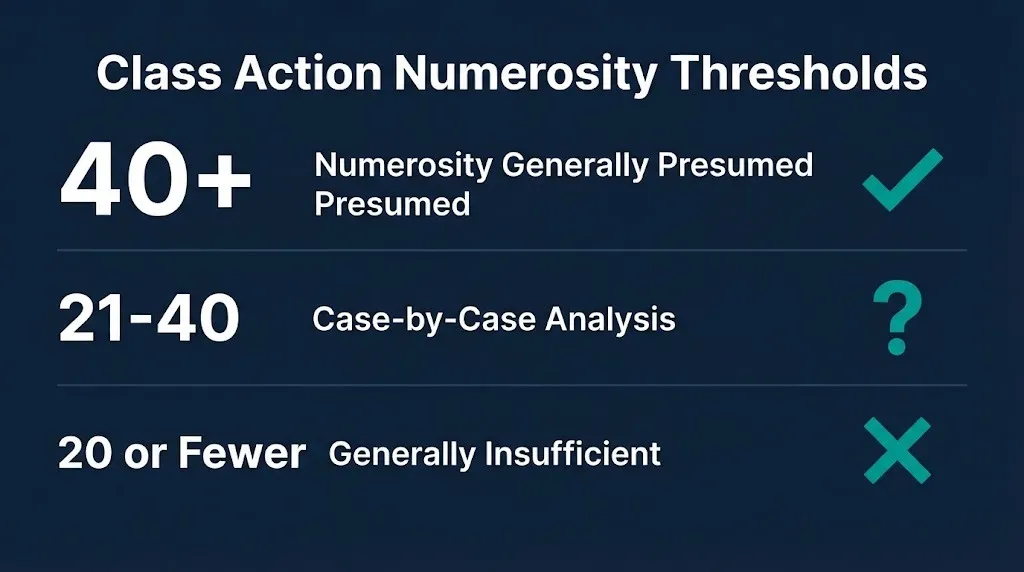
Here’s how the numbers typically break down:
| Class Size | General Treatment |
|---|---|
| 40+ members | Numerosity generally presumed satisfied |
| 21 to 40 members | Varies by jurisdiction and specific facts |
| 20 or fewer members | Numerosity generally not satisfied |
That table is a starting point, not a guarantee. Courts have certified classes smaller than 40 and rejected classes larger than 40 . The presumption cuts both ways.
A class of 25 people who are all elderly, low-income, and geographically spread out might get certified because individual lawsuits are unrealistic for them. A class of 45 employees who all work at the same facility might get rejected because joinder is actually manageable .
The word “impracticable” is where cases get won and lost.
Why is the 40-person threshold so common in class actions?
The 40-person threshold became common because it gives courts a workable proxy for the impracticability inquiry. It’s not in the rule, but it reflects practical experience about when individual joinder breaks down .
Think of it like a store return policy. The store doesn’t have a rule saying “returns under $20 are always approved.” But the clerk behind the counter has seen enough returns to know which ones are worth the hassle. The 40-person figure is that kind of judgment, accumulated across thousands of cases.
Federal courts have explained that the numerosity requirement exists because binding absent class members carries due process risks . The court needs to be satisfied that bringing everyone into the courtroom individually is genuinely unworkable before it can bind people who aren’t there.
Judicial economy plays a role too. One court noted that class certification should be granted where it “would resolve numerous claims in a single action, sparing the litigants the time and expense of multiple trials” . When 40 people each have a $500 claim, no lawyer will take those cases individually. The class action is the only realistic path to justice.
That’s the policy behind the number. It’s not arbitrary, but it’s not rigid either.
Key Takeaway: The 40-person threshold is a judicial rule of thumb, not a legal requirement, and courts can certify smaller or reject larger classes depending on the facts.
Can a class action have fewer than 40 people?
Yes, a class action can have fewer than 40 people and still be certified. Courts have approved classes in the 20s, teens, and occasionally even smaller when the circumstances make joinder impractical .
The key factors courts weigh when the class is small include:
- Geographic dispersion: Members spread across many states are harder to join than members in one city.
- Financial resources: Low-income plaintiffs may be unable to pursue individual suits.
- Ease of identification: If class members can’t be easily found, joinder is impractical.
- Judicial economy: Whether one class action saves the court from many repetitive trials.
- Future members: If the class will grow over time, unknown future members count toward numerosity .
One federal court certified a class of between 51 and 105 individuals, noting that given the size of individual claims and the gains in judicial economy, the class satisfied Rule 23(a)(1) even though some subclasses were small .
At the extreme end, some courts have suggested classes with as few as 15 members could theoretically qualify under the right facts. The Ninth Circuit once grappled with classes of 7, 9, and 10 members, ultimately reversing certification but not establishing a hard floor .
The lesson: if your group is small but scattered and poor, you might still have a class. If your group is small and clustered and wealthy, you probably don’t.
What factors beyond the number of people affect class certification?
The number of people is just one of four threshold requirements under Rule 23(a). A proposed class must also satisfy commonality, typicality, and adequacy of representation before a court will certify it .
Here are the four prerequisites in plain terms:
- Numerosity: The class is so large that joining everyone is impractical.
- Commonality: There are questions of law or fact common to the class .
- Typicality: The named plaintiff’s claims are typical of the class claims .
- Adequacy: The named plaintiff and their lawyers will fairly represent the class .
Numerosity is the gatekeeper, but passing it doesn’t guarantee certification. A class of 10,000 people with nothing in common fails commonality. A class of 100 people whose claims are wildly different fails typicality.
The commonality requirement is generally easy to satisfy. Courts look for “at least one question of law or fact, the resolution of which will affect all or a significant number of class members” . That’s a low bar. The harder fight is often at the predominance stage under Rule 23(b)(3), which requires that common questions predominate over individual ones .
So when someone asks “how many people are needed,” they’re asking the wrong question, or at least an incomplete one. The real question is whether the group has enough in common and whether a class action is the superior way to resolve their claims.
How does the numerosity requirement work in state courts?
State court numerosity rules vary significantly. Some states mirror the federal “impracticability” standard. Others set specific minimum numbers or use different language entirely .
Ohio’s Rule 23 is identical to the federal rule in its numerosity language, except for an added provision about aggregating claims for jurisdiction . California courts generally follow the federal approach but sometimes apply it more liberally. New York has its own class action statute, CPLR Article 9, which requires that the class be “so numerous that joinder of all members, whether otherwise required or permitted, is impracticable.”
Some states outside the U.S. use explicit numeric thresholds. Australian and Canadian class action regimes sometimes require a “specified minimum number of litigants” before a class can proceed . The U.S. federal system deliberately avoids that approach.
If you’re considering a class action, the state where you file can matter as much as the number of people in the class. A group that fails numerosity in federal court might pass in a more plaintiff-friendly state court, or vice versa.
This is one reason class action practice is specialized. The procedural rules are not uniform, and the strategic choices are consequential.
Reality Check: No one texts you class action money first. If someone contacts you claiming you’re owed money from a class action and asks for a fee or bank details upfront, it’s a scam. Court-approved settlements never require payment to claim. Filing is always free.
How do you know if you have enough people for a class action?
You know you have enough people when a court is convinced that joining everyone individually is impractical, which usually means 40 or more people but can mean fewer depending on the circumstances .
Here’s a practical checklist for evaluating numerosity:
- Count the potential class members. Even a rough estimate helps.
- Map where they live. Geographic dispersion supports numerosity.
- Check their financial situation. Low-income plaintiffs who can’t afford individual suits support numerosity.
- Assess how easy they are to find. Unknown or hard-to-identify members support numerosity.
- Consider whether the class will grow. Future members count toward the total .
- Look at the size of individual claims. Small claims that no lawyer would take individually support numerosity.
- Research the judge. Some judges apply numerosity more strictly than others.
This isn’t legal advice. It’s a framework for understanding how lawyers and courts think. If you think you have a class action claim, talk to an attorney who handles class actions. Most offer free consultations.
The worst thing you can do is assume you don’t have enough people without checking. The second worst thing is assuming you do have enough without understanding the other requirements.
What happens next if a class action is certified?
Once a class is certified, the case proceeds with the named plaintiffs representing everyone in the class. Class members receive notice and can choose to stay in the class or opt out .
Here’s the typical sequence after certification:
Notice period: The court directs notice to all class members who can be identified through reasonable effort. Due process requires the best notice practicable .
Opt-out window: Class members can exclude themselves from the class and pursue individual claims. Miss the deadline and you’re bound by the result.
Discovery and motions: Both sides gather evidence and file pretrial motions. This can take months or years.
Settlement or trial: Most class actions settle. If they don’t, the case goes to trial with the named plaintiffs representing the class.
Claims process: If there’s a settlement, a claims administrator is appointed. Class members submit claim forms and receive payments.
Final approval: The court holds a fairness hearing and approves or rejects the settlement.
Payment distribution: Checks or direct deposits go out after final approval and any appeals.
None of this happens until the class is certified. Numerosity is the first hurdle, and it’s a real one. Many proposed class actions die at this stage because the group is too small, too scattered, or too easy to join individually.
Frequently Asked Questions
Is there a minimum number of people for a class action lawsuit?
No. There is no strict minimum, but courts generally presume numerosity is satisfied with 40 or more members. Classes with fewer members can qualify depending on the facts.
How many plaintiffs are needed for a class action in federal court?
There is no specific number required by Federal Rule of Civil Procedure 23. Courts look at whether joinder of all members is impracticable, which usually means 40 or more people.
Can you have a class action with 10 people?
It is very difficult but not impossible. A class of 10 usually fails numerosity unless the members are geographically dispersed, have limited financial resources, or are hard to identify.
What is the numerosity requirement for class certification?
Numerosity requires that the class be so large that joining all members individually would be impracticable. It is the first of four prerequisites under Rule 23(a).
How many people typically make up a class action?
Most certified class actions involve hundreds, thousands, or even millions of class members. Securities fraud and consumer class actions often have the largest classes.
Does the number of people affect how much each person gets?
Yes. In a settlement with a fixed fund, more class members usually means smaller individual payments. The total fund is divided among everyone who files a valid claim.
What happens if the court says there aren’t enough people for a class?
The class action cannot proceed as a class. The named plaintiffs can still pursue individual claims, but they would have to do so separately.
Do all class members have to be identified before filing?
No. Courts can certify classes with unknown or future members if joinder is inherently impracticable. The exact number does not need to be known.
What Happens Next
If you are considering a class action: Gather documentation about your claim and any evidence showing others were affected similarly.
If you are researching a pending class action: Check the official settlement website or court docket for class definitions and deadlines.
If you receive a class action notice: Read it carefully. Note the opt-out deadline and the claims deadline if a settlement is proposed.
If you are already in a certified class: Watch for notice of settlement or trial dates. Missing a deadline can cost you your share.
If you think you might be part of a proposed class: Do not file anything until a class is certified and a claims process opens. Filing early does nothing.
The single most important fact to remember: there is no magic number, but there is a real requirement. If you think you have a claim, talk to a lawyer who handles class actions.