What Is Nonemployee Compensation? Full 1099-NEC Guide for 2026
Quick Answer
- Nonemployee compensation is pay reported on IRS Form 1099-NEC for work done by contractors, not employees.
- For 2025 tax year payments, the filing threshold is $600. For 2026 tax year payments, it rises to $2,000.
- Payers must send Form 1099-NEC to recipients and file with the IRS by January 31 of the following year.
If you got a tax form with “NEC” printed on it, or you’re a business trying to figure out who needs one, you’re in the right place. Nonemployee compensation is not a lawsuit or a scam. It’s an IRS reporting category, and getting it wrong can cost you at tax time.
This matters right now because the rules just changed. The threshold for reporting nonemployee compensation jumps from $600 to $2,000 starting with payments made in 2026, the first major shift to this form since 2020.
This guide walks through what the term means, who has to file, how the new threshold works, and what to do with a 1099-NEC once you have one. We’ll also flag one detail most explainers skip: the threshold change doesn’t apply retroactively to 2025 income.
The Facts
| Item | Detail |
|---|---|
| Form | IRS Form 1099-NEC (Nonemployee Compensation) |
| Reintroduced | 2020, split off from Form 1099-MISC |
| 2025 tax year threshold | $600 or more per recipient |
| 2026 tax year threshold | $2,000 or more per recipient (indexed for inflation after) |
| Filing deadline | January 31 of the following year, no extension for this deadline |
| Who files | Businesses paying contractors, freelancers, or non-corporate vendors |
| Where recipients report it | Schedule C, then Schedule SE if net earnings hit $400 or more |
| Legal source of 2026 change | One Big Beautiful Bill Act, Section 70433 of Pub. L. 119-21 |
What Is Nonemployee Compensation? (Meaning)
Nonemployee compensation is money a business pays to someone who performs work for it but isn’t on payroll. It refers to compensation paid to independent contractors who are not traditional employees.
Think of it like this: an employee gets a W-2 and taxes withheld automatically. A nonemployee, like a freelance designer or a plumber you hired once, gets paid the full amount and handles their own taxes.
The IRS uses four tests to decide if a payment counts as reportable nonemployee compensation. The payment must go to someone who is not your employee, for services connected to your trade or business.
That includes fees, commissions, prizes, and awards tied to work performed, not just simple hourly labor.
Non Employee Compensation Meaning on Form 1099-NEC
Form 1099-NEC exists specifically to report this category of payment to the IRS. The “NEC” stands for Nonemployee Compensation, and the form is how businesses report payments made to workers who aren’t on payroll.
Before 2020, this income sat in Box 7 of Form 1099-MISC. Nonemployee compensation used to be reported on Form 1099-MISC but now has its own separate form. The IRS reintroduced the standalone 1099-NEC in 2020 to separate contractor payments from the more general 1099-MISC, after different boxes on that older form created confusing, mismatched deadlines.
If you receive a 1099-NEC, Box 1 shows your total nonemployee compensation for the year. That figure is what you carry to your own tax return.
Key Takeaway: Nonemployee compensation is not a special tax bracket or a penalty. It’s simply the IRS label for pay to a non-employee that has to be reported on Form 1099-NEC.
What Does Non Employee Compensation Mean for Withholding?
It generally means no tax was withheld before you got paid. Unlike a paycheck, nonemployee compensation usually arrives at full value, with no federal income tax, Social Security, or Medicare taken out.
There’s one exception. Businesses that withhold federal income taxes from nonemployee payments should still file a 1099-NEC, even if the payment doesn’t reach the reporting threshold.
This can happen with backup withholding, which applies when a contractor doesn’t provide a valid Taxpayer ID Number. Box 4 on the form shows any backup withholding, which a payer must apply if the recipient never gave a valid TIN.
For most contractors, though, the full amount lands in your bank account. You’re expected to set aside your own money for taxes owed later.
Non Employee Compensation 1099: How the Form Works
The 1099-NEC is short, but every box matters for your tax return. Here’s what’s on it:
- Box 1: Total nonemployee compensation paid during the year
- Box 2: Checkbox for direct sales of $5,000 or more of consumer goods for resale
- Box 3: Excess golden parachute payments, rare for most filers
- Box 4: Federal backup withholding, if any
- Boxes 5–7: State income tax withheld, state ID number, and state income
The 1099-NEC is an informational return. You use it as a reference to complete your own tax return, and the IRS gets a copy of it too, usually along with state tax authorities.
That last point matters. The IRS already has this number before you file, so it needs to match what you report.
1099 Non Employee Compensation: Who Has to Receive One
You should get a 1099-NEC if a business paid you as a non-employee and the total crossed the threshold for that tax year. Nonemployee compensation can include fees, benefits, commissions, prizes, and awards for services performed.
Common examples of people who typically receive one:
- Freelance writers, designers, and consultants
- Independent contractors in construction, cleaning, or repair trades
- Gig workers paid directly by a business (not through a payment app)
- Sole proprietors and single-member LLCs providing services
- Attorneys paid fees for legal services, regardless of business structure
- Board members or directors paid fees, not salary
Corporations that provide services are usually excluded from this rule, with a few exceptions like attorney fees and medical payments.
Non Employee Compensation 1099 Threshold: The 2026 Change
This is the part that’s actually new in 2026, and it’s worth getting right. Form 1099-NEC’s reporting threshold for nonemployee compensation increases from $600 to $2,000 for the 2026 tax year, as part of the One Big Beautiful Bill Act.
The change is not retroactive. For payments made during calendar year 2025, the federal 1099-NEC threshold stays at $600 or more. That means anyone filing 1099-NEC forms in early 2026 for 2025 payments still uses the old $600 line.
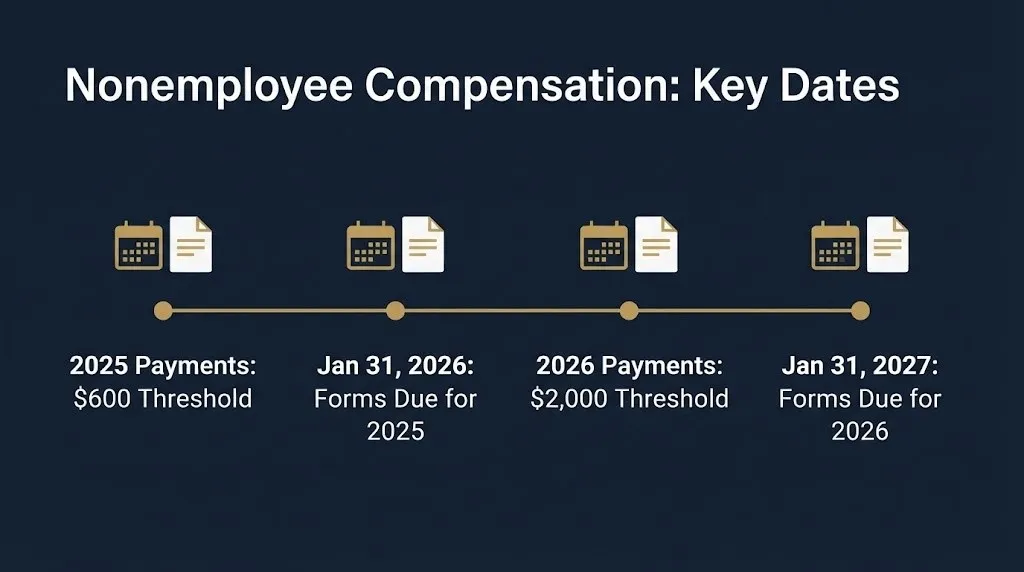
| Tax Year of Payment | Reporting Threshold | Forms Filed |
|---|---|---|
| 2025 | $600 or more | January 2026 |
| 2026 | $2,000 or more | January 2027 |
| 2027 and later | $2,000, adjusted for inflation | Following January |
The direct-sales checkbox rule at $5,000 remains separate and unchanged by this update.
Reality Check: No legitimate business or IRS office will text or email you asking to “confirm your 1099-NEC” through a link. This is a tax reporting form, not a claim you file for money. If someone asks you to pay a fee to “release” a 1099-NEC or a refund tied to one, that’s a scam, not IRS procedure.
Non Employee Compensation vs. Non Employment Compensation
These phrases get typed interchangeably in search bars, but they point to the same concept: pay to someone who is not an employee. “Non employment compensation” is not a distinct IRS term, it’s simply a common misspelling of nonemployee compensation.
The correct IRS terminology is “nonemployee compensation,” written as one compound idea, sometimes hyphenated as non-employee compensation in plain-English guides. Whichever version you searched, you landed on the right topic.
Nonemployee Compensation vs. Employee Wages
The difference comes down to control and tax handling, not the type of work itself. A graphic designer on staff and a freelance designer might do identical tasks, but the tax treatment is completely different.
| Factor | Employee (W-2) | Nonemployee (1099-NEC) |
|---|---|---|
| Tax withholding | Employer withholds automatically | None withheld in most cases |
| Payroll taxes | Split between employer and employee | Contractor pays both halves |
| Benefits | May include health insurance, PTO | Typically none |
| Work control | Employer sets schedule, methods | Contractor sets own methods |
| Form received | W-2 | 1099-NEC |
Misclassifying an employee as a contractor to avoid payroll taxes is a separate legal issue the IRS actively investigates. That’s a compliance risk for the business, not something the worker controls.
Key Takeaway: Nonemployee compensation status depends on how the work relationship functions, not just what a contract calls it.
How to File Form 1099-NEC (For Businesses)
If you’re the one paying a contractor, here’s the process in order:
- Collect a completed Form W-9 from the contractor before paying them.
- Track total payments made to that contractor across the calendar year.
- Compare the running total against the year’s threshold ($600 for 2025, $2,000 for 2026).
- Prepare Form 1099-NEC using the contractor’s W-9 information.
- Send Copy B to the contractor by January 31.
- File Copy A with the IRS by the same January 31 deadline.
- File any required state copies, since deadlines vary by state.
Payers should file Form 1099-NEC by January 31 to avoid penalties. There’s no automatic extension on this date the way there is for some other tax filings.
What Contractors Do With a 1099-NEC
If you received one, the number in Box 1 becomes the starting point for your tax return, not the final tax bill. When you receive a Form 1099-NEC, it typically means you are self-employed, and you claim your income and deductions on Schedule C, which calculates your net profit from self-employment.
From there, self-employment tax kicks in separately from income tax. The combined self-employment tax rate is 15.3 percent, split between 12.4 percent for Social Security and 2.9 percent for Medicare.
The Social Security portion applies only to net earnings up to $184,500 in 2026, while the Medicare portion has no income cap.
If your total self-employment earnings reach $400 or more, you’ll likely need to file Schedule SE to calculate and pay that self-employment tax. This applies even if you never received a 1099-NEC at all, since the reporting form and your legal obligation to report income are two separate things.
A missing 1099-NEC is a bit like a store forgetting to send a receipt after a return. The transaction still happened, and you’re still expected to account for it.
Non Employee Compensation vs. Other 1099 Forms
The 1099-NEC is one of many 1099 forms, and mixing them up is a common filing mistake. Form 1099-MISC is still used for other miscellaneous income types, such as royalties exceeding $10, prize payments, other awards, or rent, while 1099-G covers money from government sources like unemployment benefits.
| Form | Covers |
|---|---|
| 1099-NEC | Nonemployee compensation for services |
| 1099-MISC | Rent, royalties, prizes not tied to services |
| 1099-K | Payments through third-party processors like PayPal or Venmo |
| 1099-G | Government payments, including unemployment |
If you receive payments through an online payment service, you might also get a 1099-K, which is separate from a 1099-NEC. Getting both for the same income is possible; report it once, not twice.
Penalties for Getting Nonemployee Compensation Reporting Wrong
Late or missing 1099-NEC filings carry real IRS penalties, scaled by how late the form is. Businesses that skip this step also raise their audit risk, since the IRS cross-checks these forms against filed returns.
For contractors, the risk runs the other direction. Underreporting income that appears on a 1099-NEC the IRS already has on file is one of the more common triggers for a notice, since the numbers won’t match.
Key Takeaway: The IRS receives a copy of every 1099-NEC filed against you, so the safest move is always to report the full amount, whether or not the form itself ever arrives in your mailbox.
What Happens Next
January 2026: 1099-NEC forms for 2025 payments (at the $600 threshold) go out to contractors and the IRS.
Throughout 2026: Businesses track payments to contractors under the new $2,000 threshold.
January 2027: First round of 1099-NEC forms filed under the new $2,000 threshold, covering 2026 payments.
2028 and beyond: The $2,000 threshold adjusts for inflation each year going forward.
Frequently Asked Questions
What is nonemployee compensation in simple terms?
It’s pay a business gives to someone who isn’t an employee, for work performed.
It gets reported to the IRS on Form 1099-NEC, and the recipient owes tax on it directly.
Is nonemployee compensation the same as self-employment income?
For most people, yes, once it lands on your tax return.
You report it on Schedule C and pay self-employment tax if net earnings reach $400 or more.
What is the 1099 nonemployee compensation threshold for 2026?
It rises to $2,000 per recipient for payments made during the 2026 calendar year.
2025 payments still use the older $600 threshold, filed in early 2026.
Do I owe taxes on nonemployee compensation even without a 1099-NEC?
Yes. The obligation to report income exists whether or not a form was ever sent.
Missing forms don’t erase the underlying tax liability.
What’s the difference between non employee compensation and non employment compensation?
They mean the same thing. “Non employment compensation” is simply a common misspelling.
The correct IRS term is nonemployee compensation.
When do businesses have to send out 1099-NEC forms?
By January 31 of the year following the payments, with no automatic extension.
This applies to both the copy sent to the contractor and the copy filed with the IRS.
Can a corporation receive nonemployee compensation?
Generally no, most corporate payees are excluded from 1099-NEC reporting.
Exceptions exist for certain payments like attorney fees, regardless of business structure.
Does receiving a 1099-NEC mean I’m being audited?
No. Receiving this form is routine tax reporting, not a sign of any investigation.
It simply documents income you already earned and must report.
Nonemployee compensation is not a legal claim or a settlement you sign up for. It’s a tax reporting category tied to Form 1099-NEC, with a threshold that changes at the start of 2026.
If you pay or receive contractor income this year, mark January 31, 2027 as the deadline that matters for 2026 payments, and keep the $2,000 threshold in mind when tracking totals.