How Do You File a Lawsuit in 2026? The Step-by-Step Process, Costs, and Deadlines That Actually Decide Cases
Quick Answer
- Is it legit: Filing a lawsuit is a real court process, not a claim form. You file a complaint or plaint, pay a fee, and serve the defendant.
- How much: U.S. federal court costs $405 to file a civil case. State and small claims fees range from roughly $15 to $100.
- Deadline: The statute of limitations controls. Most contract and personal injury claims run two to three years, and missing it usually ends the case.
If you searched “how do you file a lawsuit,” you probably have a dispute that has gone past the point of a polite email. Maybe a company took your money and stopped responding. Maybe a contract was breached. Maybe you were injured and the insurer is lowballing you. You want to know the actual mechanics, not a lecture about hiring a lawyer.
Here is the direct answer: filing a lawsuit means preparing a formal legal document that states your facts and the remedy you want, filing it with the correct court, paying the required fee, and then legally notifying the other side. That sequence is the same in almost every court system. The details change by jurisdiction and claim type.
This article covers the full sequence in plain terms. It includes verified fee figures, the deadlines that kill cases before they start, the difference between filing a claim and winning, and the mistakes that get cases dismissed at the courthouse counter.
The Facts
| Item | Verified Detail |
|---|---|
| Process | Draft complaint or plaint, file with court, pay fee, serve defendant |
| U.S. Federal Filing Fee | $405 for a civil case in U.S. district courts |
| State/Small Claims Fees | Roughly $15 to $100 depending on the state and claim amount |
| Key Deadline | Statute of limitations. Common ranges: 2 years for torts, 3 years for contracts |
| Service | Defendant must receive formal notice. Registered agent for companies. |
| First Hurdle | Jurisdiction and venue. Filing in the wrong court delays or kills the case. |
Is Filing a Lawsuit Free or Does It Cost Money?
Filing a lawsuit is not free. You pay a filing fee to the court when you submit your complaint or plaint, and that fee varies widely by court and claim amount.

In U.S. federal district courts, the civil filing fee is $405 . That figure comes from the Judicial Conference fee schedule and appears on district court fee pages. It is not a suggestion. If you do not pay it, or get a fee waiver, the clerk will not accept the case.
State courts set their own fees. Small claims filing fees typically range from about $15 to $75, depending on the state . Some courts offer fee waivers for low-income filers. You have to ask for one and provide financial information.
Court fees are only the start. If you hire a lawyer, expect to pay a retainer or an hourly rate. If you serve the defendant through a professional process server, that costs money too. A process server typically charges $50 to $150 .
Key Takeaway: Filing costs money before you ever see a judge. Budget for the court fee, service costs, and legal help if you hire it. A fee waiver exists, but you must request it.
What Is the Deadline to File a Lawsuit?
The deadline to file a lawsuit is called the statute of limitations, and it is the single most important date in your case. If you miss it, the court can dismiss your claim even if your facts are strong.
Limitation periods depend on the claim type and the jurisdiction. In Pakistan, for example, the Limitation Act 1908 sets three years for suits on simple contracts and two years for tort damages . In the United States, the windows vary by state, but common patterns exist: personal injury claims often carry two years, written contracts often carry four to six years, and some consumer protection statutes have their own specific windows.
The clock usually starts when the harm happens or when you discover it. That discovery rule matters. If a company hid a fee from you, the clock may start when you found out, not when you were charged. But courts do not stretch that rule forever. Once you have enough information to suspect a problem, you are expected to investigate.
Limitation is a hard bar. A court can raise it on its own, even if the defendant forgets to mention it . Do not treat the deadline as a technicality you can talk your way around later.
| Claim Type | Common Limitation Range |
|---|---|
| Personal injury or tort | 2 years (varies by jurisdiction) |
| Simple contract | 3 years (Pakistan); 4 to 6 years in many U.S. states |
| Money lent | 3 years from loan or demand |
| Consumer protection claim | Set by the specific statute, sometimes 30 days to 2 years |
How Do You File a Lawsuit Against a Company?
Filing a lawsuit against a company requires the company’s exact legal name, its registered agent, and the correct court. Getting any of those wrong can stall the case before it starts.
The first step is finding the legal name. A company may trade as “Joe’s Gym,” but its registered name might be “Fitness Holdings LLC.” You can search your state’s Secretary of State business database or a public corporate registry to confirm the exact entity . Suing the wrong name can get your filing rejected or produce a judgment you cannot enforce.
Next, find the registered agent. That is the person or company designated to receive legal papers on behalf of the business. The agent’s name and address are on file with the Secretary of State. You serve the lawsuit there, not at a random storefront .
Then confirm jurisdiction. For a company, that usually means the state where it is incorporated, where it has its principal place of business, or where the dispute arose. If you sue in the wrong court, the case can be transferred or dismissed.
Key Takeaway: Suing a company is mostly a paperwork accuracy problem. Get the legal name, the registered agent, and the court right before you focus on the argument.
What Are the Steps to File a Lawsuit?
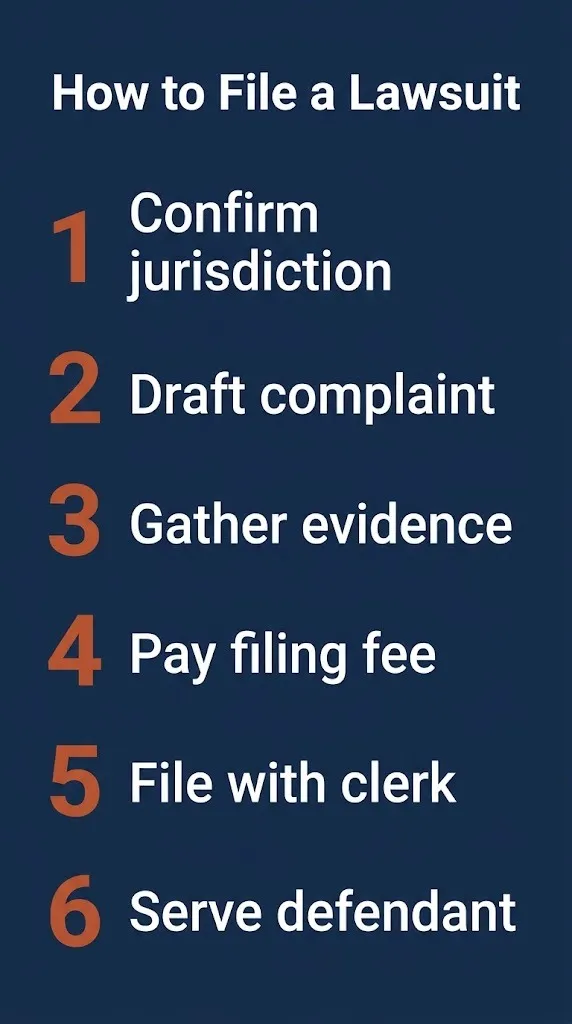
The steps to file a lawsuit are: confirm jurisdiction, draft the complaint or plaint, gather evidence and documents, pay the filing fee, file with the clerk, and serve the defendant. Each step has its own rules and failure points.
- Confirm the court has jurisdiction. Check whether the claim belongs in small claims, state court, or federal court. Check the money limit and the location rules.
- Draft the complaint or plaint. State the facts, the harm, the legal basis, and the remedy you want. In Pakistan, the plaint must meet Order VII CPC requirements .
- Gather your evidence. Attach contracts, receipts, photos, messages, and any correspondence. A claim without documents is harder to prove.
- Pay the filing fee. Or apply for a waiver. The clerk will not file the case without it.
- File with the court clerk. Submit the complaint and copies. The clerk assigns a case number.
- Serve the defendant. Use a process server, sheriff, or certified mail if the court allows it. Keep proof of service.
- Prepare for the response. The defendant files an answer or a motion to dismiss. You may need to respond.
- Track your deadlines. Missing a hearing or a response deadline can end your case.
What Happens After You File the Lawsuit?
After you file, the court serves the defendant, the defendant responds, and the case moves into a scheduling phase that includes discovery, motions, and possibly settlement talks.
The defendant usually has a set time to answer. In consumer court proceedings in Pakistan, for example, the defendant must file a written statement within 15 days, extendable by another 15 . Ordinary civil courts give longer windows. If the defendant ignores the case, you may be able to get a default judgment, but courts prefer to decide cases on the merits.
Discovery is where both sides exchange documents and answer questions under oath. This phase often drives settlement because it reveals what the other side actually has. It also costs money and time.
Many cases settle before trial. That is not a failure. A settlement is a contract, and it can be enforced. But a settlement is only as good as the defendant’s ability to pay. A judgment against a company with no assets is a piece of paper.
Reality Check: Filing a lawsuit does not guarantee payment. A judgment is an order, not a check. Winning in court is only step one. Collecting the money is step two, and it can be harder than the case itself.
How Much Does It Cost to Hire a Lawyer for a Lawsuit?
Hiring a lawyer for a lawsuit costs anywhere from a few thousand dollars to well over $100,000 depending on the claim, the court, and how long the case runs. The fee structure matters as much as the number.
Hourly rates are the most common in civil litigation. Consumer and small claims matters may be handled on a flat fee. Personal injury cases often use contingency fees, where the lawyer takes a percentage of the recovery and you pay nothing upfront. But contingency is not available for every claim type. Contract disputes and business claims usually require hourly billing or a retainer.
Court fees are separate from lawyer fees. You pay the court directly. Expert witnesses, depositions, and copying costs are also separate. A lawyer’s quote may not include those expenses.
If you cannot afford a lawyer, options exist. Legal aid clinics handle some civil matters. Court self-help centers provide forms and guidance. Small claims court is designed for people without lawyers, though the limits on claim amounts are low.
Key Takeaway: A lawyer changes the cost and the strategy, but not the deadline. The statute of limitations runs whether you have counsel or not.
What Happens Next After You File?
The timeline after filing follows a predictable pattern, though the dates depend on the court’s docket. The stages below are the general sequence.
Immediately after filing: The clerk assigns a case number and a judge. You receive a stamped copy of your filing.
Days to weeks after filing: You serve the defendant. The clock for their response starts when service is complete.
Weeks to months after service: The defendant answers or files a motion to dismiss. The court may set a scheduling conference.
Months after the answer: Discovery begins. Both sides exchange documents and take depositions.
Months to a year or more: Motions, settlement conferences, and possibly trial. Most civil cases resolve before a trial verdict.
Frequently Asked Questions
Do you need a lawyer to file a lawsuit?
No. You can file a lawsuit yourself in most courts. But drafting errors, missed deadlines, and procedural mistakes are common without help.
How much does it cost to file a lawsuit in the U.S.?
The federal civil filing fee is $405. State and small claims fees vary, typically $15 to $100 for small claims.
What is the statute of limitations for most lawsuits?
Common ranges are two years for personal injury and three years for simple contracts. The exact period depends on your jurisdiction and claim type.
Can you sue a company without knowing its legal name?
You need the legal name to file correctly. Search your state’s Secretary of State business database to find it.
What happens if you file in the wrong court?
The case may be transferred or dismissed. Filing in the wrong court delays the case and can waste the filing fee.
How long does a lawsuit take?
Small claims cases can resolve in months. Contested civil cases often take one to three years, and appeals add more time.
Can you file a lawsuit without paying the fee?
Yes, if the court grants a fee waiver. You must apply and provide financial information. Not everyone qualifies.
Filing a lawsuit is a process with hard deadlines and real costs. The filing fee is $405 in federal court, and the statute of limitations is the date that decides whether you have a case at all.
Check the limitation period before you do anything else. Then gather your documents, confirm the correct court, and decide whether you can afford to see it through. The deadline comes first. Everything else follows.