Defamation Character Lawsuit 2026: What It Means, Who Can Sue, and How These Cases Actually Work
Quick Answer
- A defamation character lawsuit is a civil claim for false statements that harmed your reputation.
- Payouts vary widely, from nominal damages to millions, with no standard settlement amount.
- Deadlines are strict, usually one to three years from the statement, depending on your state.
You searched for “defamation character lawsuit” because someone said something false about you, or you heard about a high-profile case and want to understand the rules.
A defamation character lawsuit is a real legal claim, not a scam. But it is not a class action, it has no settlement fund, and there is no form to fill out online to collect money.
This article explains what defamation lawsuits actually are, how they work in 2026, what you must prove to win, and why most people misunderstand how these cases end.
| The Facts | |
|---|---|
| Case Type | Civil defamation and character claims |
| Status | Active area of litigation, no single case |
| Fund Size | No settlement fund, damages vary by case |
| Est. Per Person | No standard amount, case-specific |
| Claim Deadline | State statute of limitations applies |
| Administrator | None, private lawsuits only |
| Proof Needed | False statement, publication, fault, harm |
Is a Defamation Character Lawsuit Real or Just a Threat?
A defamation character lawsuit is a real civil action, not a bluff, and courts treat it seriously when the required elements are proven.
Defamation is not a crime in most of the United States. It is a tort, meaning a civil wrong that lets one person sue another for harm caused by false statements.
When someone says they will sue for defamation, they may mean it. But many threats never become lawsuits because proving defamation is harder than people expect.
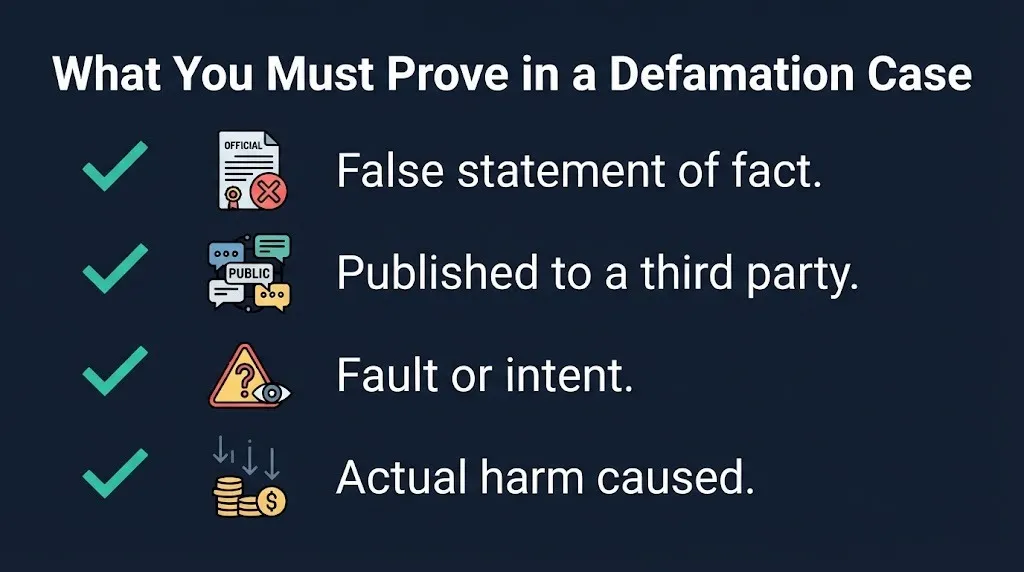
The law requires you to show a false statement of fact, not opinion, that was published to a third party, made with some level of fault, and caused actual harm.
If a statement is true, it is not defamation. If it is an opinion, it usually is not defamation. That is the first and most important filter.
How Much Is a Defamation Character Lawsuit Worth?
No standard payout exists for defamation character lawsuits because each case turns on its own facts and the harm shown.
Some defamation cases settle for a few thousand dollars. Others produce jury verdicts in the millions. A 2022 jury awarded $45 million against Infowars host Alex Jones in one defamation case, later reduced by statutory caps.
Here is how damages in defamation cases typically break down:
| Damage Type | What It Covers |
|---|---|
| Actual damages | Lost income, lost business, medical bills for emotional distress |
| Presumed damages | Harm assumed from the statement’s nature, in some cases |
| Punitive damages | Punishment for malicious or reckless conduct |
| Nominal damages | A small amount, sometimes one dollar, when harm is hard to prove |
The amount you may recover depends on your state’s laws, the severity of the false statement, your actual financial loss, and the defendant’s conduct.
There is no class action mechanism for defamation. You cannot join a group lawsuit because your reputation is personal to you.
How Do You File a Defamation Character Lawsuit?
Filing a defamation character lawsuit means preparing and filing a civil complaint in the correct court before your state’s deadline passes.
Here are the steps to consider before filing:
- Preserve every copy of the false statement with dates and screenshots.
- Identify who made the statement and who else saw or heard it.
- Document your financial losses and emotional harm.
- Check your state’s statute of limitations for defamation.
- Consult a lawyer who handles defamation and First Amendment cases.
- Send a retraction demand if your state requires one.
- File the complaint in state or federal court before the deadline.
Each state sets its own deadline. Many states allow one year from publication. Some allow two or three.
Missing the deadline kills your case no matter how false the statement was.
What Is the Difference Between Defamation, Slander, and Libel?
Defamation is the umbrella term. Slander is spoken defamation. Libel is written or published defamation.
Character defamation lawsuit is not a separate legal category. It is a common phrase for a defamation claim focused on harm to personal reputation, rather than business reputation.
Here is the breakdown:
| Term | Definition | Example |
|---|---|---|
| Defamation | False statement harming reputation | Any false claim told to others |
| Slander | Spoken defamation | A lie told at a meeting |
| Libel | Written or recorded defamation | A false post online |
Libel tends to be easier to prove because the statement exists in a permanent form. Slander often requires proof of special damages unless the statement falls into certain categories.
Understanding which type applies matters because it changes what you must prove and how much time you have.
Key Takeaway: Defamation is real, but it is a private lawsuit with no settlement fund, no class action, and no standard payout.
What Does a Defamation Lawsuit Mean for the Person Suing?
A defamation lawsuit means you carry the burden of proving the statement was false, published, harmful, and made with the required level of fault.
This is harder than it sounds. In the United States, the First Amendment protects a lot of speech, even unfair and unkind speech.
If you are a private person, you usually must prove the defendant was at least negligent about the truth. If you are a public figure, you must prove actual malice, meaning the defendant knew the statement was false or acted with reckless disregard for the truth.
That higher standard stops many public figure defamation cases before trial.
The person suing also faces the risk of an anti-SLAPP motion. Anti-SLAPP laws exist in most states and let defendants move to dismiss defamation cases that target protected speech.
If you lose an anti-SLAPP motion, you may have to pay the other side’s attorney fees. That risk alone discourages weak claims.
What Does a Defamation Lawsuit Mean for the Person Being Sued?
Being sued for defamation means someone claims you made a false statement that damaged their reputation and they want money or a retraction.
The first thing to do is check whether the statement was true. Truth is a complete defense in every American jurisdiction.
The second thing is check whether the statement was opinion. Saying a restaurant is “the worst” is opinion. Saying the owner “failed a health inspection” when it is false is a fact.
The third thing is check your insurance. Some homeowners and renters policies cover personal injury claims, including defamation, but many exclude it.
Do not ignore a defamation lawsuit. If you fail to respond, you can lose by default judgment.
Key Takeaway: Public figures face a higher legal bar, and private people face real hurdles proving harm.
Can You Sue for Defamation of Character on Social Media?
You can sue for defamation on social media, but you must identify the person who posted the false statement and show it caused real harm.
Anonymous posts create a problem. Courts may allow you to subpoena the platform for identifying information, but the process is slow and not always successful.
The Communications Decency Act, Section 230, protects platforms from liability for user posts. You cannot sue the platform for hosting a defamatory post, with limited exceptions.
You must sue the person who wrote it.
Screenshots are essential, but they are not enough on their own. You need to show the post was seen by others and caused measurable harm.
What Are the Defenses to a Defamation Character Lawsuit?
The main defenses to a defamation character lawsuit are truth, opinion, privilege, consent, and the statute of limitations.
Truth is the strongest defense. If the statement is substantially true, the case fails.
Privilege protects certain statements made in specific settings. Statements made in court, in legislative hearings, and sometimes in employment references carry absolute or qualified privilege.
Here are common defenses:
| Defense | What It Means |
|---|---|
| Truth | The statement was accurate |
| Opinion | The statement was not a factual claim |
| Privilege | The setting protects the statement |
| Consent | The plaintiff agreed to the publication |
| Deadline expired | The statute of limitations passed |
Each defense can end a case early, often before trial.
What Is the Statute of Limitations for Defamation Lawsuits in 2026?
The statute of limitations for defamation is set by state law, and most states require filing within one to three years of publication.
Here is a general guide, not legal advice for your state:
| State Category | Typical Deadline |
|---|---|
| One-year states | California, Texas, Georgia, Pennsylvania |
| Two-year states | New York, Florida, Illinois, Ohio |
| Three-year states | Michigan, Massachusetts, New Jersey |
The clock usually starts when the statement is published, not when you discover it. Some states apply the single publication rule, meaning one post starts one clock.
Online content creates tricky questions about republication. Reposting by someone else may restart the clock in some states.
Check your state’s specific law immediately if you are considering a claim.
Key Takeaway: The statute of limitations is the single most common reason viable defamation claims never reach court.
Reality Check: No government agency enforces defamation claims, and no class action exists to join. Anyone offering to file a “defamation settlement claim” for a fee is running a scam. You hire a private lawyer or go without one.
What Is Defamation Litigation and How Does It Differ From Other Lawsuits?
Defamation litigation is the court process for resolving a defamation claim, and it differs from personal injury or consumer class actions because reputation harm is personal and fact-heavy.
Most defamation cases settle before trial. Trials are rare because both sides risk high costs and uncertain outcomes.
Litigation typically follows this path:
- Complaint filed by the plaintiff.
- Answer or motion to dismiss by the defendant.
- Discovery, including depositions and document requests.
- Possible anti-SLAPP motion.
- Summary judgment motions.
- Trial or settlement.
Each stage takes months. A fully litigated defamation case can last two to four years.
If you expect a fast payout, defamation is the wrong place to look.
What Is Defamation and Slander Lawsuit Discovery Like?
Discovery in a defamation and slander lawsuit is invasive, expensive, and often more damaging than the original statement.
Both sides can demand documents, emails, texts, and social media records. Depositions force witnesses to answer under oath.
The person suing may have to turn over medical records, tax returns, and business records to prove harm. The person being sued may have to reveal sources and private communications.
This is why many defamation cases settle. The cost of discovery alone can exceed the potential payout.
Think of it like a store return without a receipt. You can try, but the process will ask for proof you may not want to give.
What Are the Most Common Defamation Lawsuit Examples?
Defamation lawsuits commonly arise from business reviews, social media posts, workplace references, and accusations of criminal or unethical conduct.
Here are frequent scenarios:
| Situation | Example |
|---|---|
| Negative online review | A false claim a restaurant served spoiled food |
| Workplace complaint | A coworker falsely says you stole company property |
| Social media accusation | A post falsely claims you committed a crime |
| Professional reputation | A competitor falsely says you lost your license |
Each example involves a factual claim, not an opinion, and publication to others.
If you are in one of these situations, the first question is not whether to sue. The first question is whether you can prove the statement was false and caused real damage.
What Should You Do Before Suing for Defamation of Character?
Before suing for defamation of character, gather evidence, calculate your actual losses, and ask yourself if the fight is worth the cost.
Here is a practical checklist:
- Save every copy of the statement with timestamps.
- List every person who saw or heard it.
- Write down how your life changed after the statement.
- Gather proof of lost income, lost clients, or medical treatment.
- Check your state’s filing deadline.
- Consider a retraction letter asking the person to remove the false statement.
- Talk to a lawyer before doing anything public.
A retraction can end the matter quickly and cheaply. In some states, a retraction limits the damages you can recover, so timing matters.
Do not post about your case on social media. Your own words can become evidence against you.
What Happens After You Win a Defamation Lawsuit?
Winning a defamation lawsuit means you get a judgment, but collecting the money is a separate fight.
A judgment is a court order saying the defendant owes you money. If the defendant has no assets, the judgment may be worthless.
Collection tools include garnishing wages, placing liens on property, and seizing bank accounts. Each takes time and more legal work.
Appeals are common in defamation cases. A defendant can delay payment for years by appealing.
Settlement remains the most reliable path to actual payment, even if the amount is lower than a jury verdict.
What Is the Future of Defamation Litigation in 2026 and Beyond?
Defamation litigation in 2026 is shaped by social media, deepfakes, and ongoing debates over Section 230 and free speech.
Courts are seeing more cases involving AI-generated content and manipulated media. Proving who created a false statement is harder when the content is synthetic.
Some states are tightening anti-SLAPP laws. Others are expanding protections for anonymous speakers.
If you are considering a defamation claim, expect the law to keep moving. What was true five years ago may not be true now.
What Happens Next in a Typical Defamation Character Lawsuit?
- Month 1 to 3: Complaint filed, defendant responds, early motions.
- Month 3 to 12: Discovery, including document requests and depositions.
- Month 6 to 18: Anti-SLAPP or summary judgment motions may end the case.
- Month 12 to 36: Settlement talks intensify, or trial is scheduled.
- After trial: Appeals possible, then collection efforts.
Each timeline varies by court and jurisdiction. Federal courts often move faster than crowded state courts.
Frequently Asked Questions
What is a defamation lawsuit?
A defamation lawsuit is a civil claim for a false statement that harmed your reputation.
It requires proving the statement was false, published, and caused damage.
How much can you get from a defamation lawsuit?
Damages vary from zero to millions depending on the harm and the defendant’s conduct.
There is no standard defamation settlement amount.
How long do you have to file a defamation lawsuit?
Most states require filing within one to three years of the statement.
Check your state’s specific statute of limitations.
Is it worth suing for defamation?
It may be worth suing if you have strong proof of false statements and real financial loss.
Legal fees can exceed the recovery, so evaluate carefully.
Can you sue someone for calling you a liar?
Calling someone a liar can be defamation if it is a false factual claim that causes harm.
Pure opinion or name-calling usually is not actionable.
What is the difference between slander and libel?
Slander is spoken defamation. Libel is written or published defamation.
Libel is often easier to prove because the statement is permanent.
Do I need a lawyer for a defamation lawsuit?
You are not required to have a lawyer, but defamation law is complex and unforgiving.
Most successful plaintiffs hire experienced counsel.
Can I sue for a false online review?
You can sue for a false online review if you can identify the reviewer and prove harm.
The review must be a false factual claim, not an opinion.
The most important thing to know about defamation character lawsuits is that they are real, personal, and hard to win.
Before you sue, gather evidence, check your deadline, and get a lawyer’s honest assessment. Before you respond to a threat, remember that truth and opinion are strong shields.
No settlement website will ever handle defamation claims. This is a private fight with a private price tag.