Litigation Paralegal 2026: Salary, Duties, Certification, and Career Path
Quick Answer
- A litigation paralegal is a legal professional who assists attorneys with lawsuits, trials, and appeals.
- Median pay for litigation paralegals in 2026 is approximately $62,000 to $68,000 depending on location and experience.
- No certification is legally required, but a paralegal certificate or degree improves hiring odds and salary.
You searched “litigation paralegal.” Maybe you’re considering the career. Maybe you’re already in it and want to know if you’re being paid fairly. Maybe you got a job posting and want to know what the work actually involves.
This article answers those questions using verified data from the Bureau of Labor Statistics, the National Association of Legal Assistants, the American Bar Association, and current job market reports. One fact matters more than any other: litigation paralegals earn more than paralegals in other practice areas, but the work is faster, more deadline-driven, and more stressful.
What Is a Litigation Paralegal?
A litigation paralegal is a legal professional who works under attorney supervision on lawsuits. That includes civil cases, commercial disputes, personal injury claims, employment cases, and class actions.
Litigation paralegals handle the mechanics of a lawsuit. They draft pleadings, manage discovery, organize exhibits, prepare deposition summaries, and coordinate trial logistics. They do not give legal advice. They do not represent clients. They do not sign court documents as attorneys.
The American Bar Association defines a paralegal as a person qualified by education, training, or work experience who performs substantive legal work under attorney supervision. Litigation paralegals are the subset focused on contested matters that may go to trial.
Think of a litigation paralegal as the person who keeps the lawsuit machine running. The attorney argues. The paralegal builds the file, tracks the deadlines, and makes sure nothing falls through the cracks.
How Much Does a Litigation Paralegal Make in 2026?
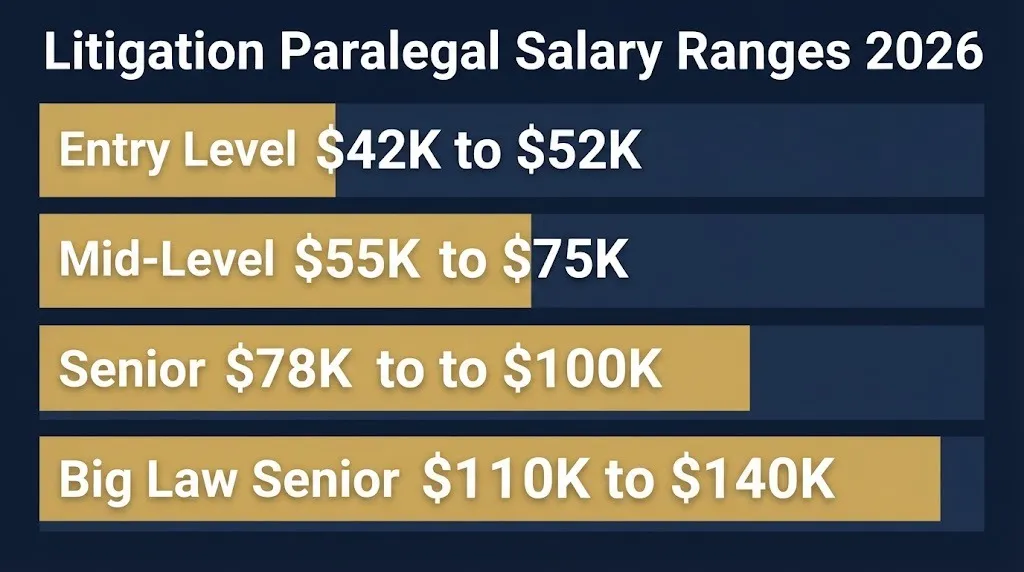
Litigation paralegal salaries in 2026 range from about $45,000 for entry-level positions to over $95,000 for senior paralegals in large firms or major cities.
The Bureau of Labor Statistics reports median annual pay for all paralegals and legal assistants at $62,840 as of the most recent data. Litigation paralegals tend to earn slightly above the median because trial work demands specialized skills and longer hours.
Here is a 2026 salary breakdown by experience level:
| Experience Level | Typical Salary Range |
|---|---|
| Entry level (0 to 2 years) | $42,000 to $52,000 |
| Mid-level (3 to 7 years) | $55,000 to $75,000 |
| Senior (8+ years) | $78,000 to $100,000+ |
| Big law firm senior paralegal | $110,000 to $140,000 with overtime |
Location changes everything. A litigation paralegal in New York, San Francisco, or Washington D.C. earns significantly more than one in a small Midwestern town. The cost of living drives part of that difference. Demand drives the rest.
Overtime is common in litigation. Trial preparation often means 50 to 60 hour weeks. Many litigation paralegals earn time-and-a-half overtime, which can push annual pay well above the base salary.
Key Takeaway: Litigation pays more than transactional paralegal work, but the hours are longer and deadlines are unforgiving.
What Does a Litigation Paralegal Do Daily?
The daily work of a litigation paralegal falls into five main areas. Each one corresponds to a stage of the lawsuit lifecycle.
Case intake and investigation. You gather facts from clients. You collect documents. You research public records, corporate filings, and prior lawsuits involving the same parties.
Pleadings and motions. You draft complaints, answers, motions, and notices. The attorney reviews and signs everything. You file documents with the court, often electronically.
Discovery management. This is the largest time sink. You organize document productions, review emails and records, track requests for production, and summarize depositions. Electronic discovery tools are now standard.
Trial preparation. You build exhibit lists, prepare witness binders, coordinate with expert witnesses, and manage the war room. The final two weeks before trial are intense.
Post-trial and appeals. You help prepare the record on appeal, organize transcripts, and cite-check briefs.
No two days look the same. That is why people choose litigation over corporate or real estate paralegal work.
Is Litigation Paralegal a Good Career in 2026?
Yes, litigation paralegal remains a strong career in 2026. The Bureau of Labor Statistics projects continued demand for paralegals, with litigation among the most stable practice areas.
Lawsuits do not stop during recessions. In fact, some litigation increases during economic downturns: contract disputes, employment claims, and bankruptcy-related litigation all rise when the economy weakens. That gives litigation paralegals more job security than many other legal support roles.
The downside is stress. Deadlines are court-ordered and non-negotiable. Missing a filing deadline can end a case. That pressure is constant in litigation.
Job satisfaction surveys consistently rank litigation paralegal work as high-pressure but intellectually engaging. People who thrive in this role like puzzles, deadlines, and detail. People who need a predictable 9-to-5 often burn out.
What Certification Does a Litigation Paralegal Need?
No state requires certification to work as a litigation paralegal. You can enter the field with an associate degree, a bachelor’s degree, or a paralegal certificate. Some people start as legal assistants and work their way up.
That said, certification improves your resume. The most recognized credentials come from three organizations:
| Certification | Issuing Organization | Requirements |
|---|---|---|
| Certified Paralegal (CP) | National Association of Legal Assistants | Exam plus education or experience |
| Registered Paralegal (RP) | National Federation of Paralegal Associations | Exam plus education or experience |
| Advanced Certified Paralegal (ACP) | NALA | CP credential plus specialty courses |
The Certified Paralegal exam through NALA is the most widely known. It covers legal research, ethics, judgment, and substantive law. The exam is offered year-round at testing centers.
California has its own path. The state requires paralegals to meet specific education or experience standards under California Business and Professions Code section 6450. That law also mandates continuing legal education.
Key Takeaway: Certification is optional in most states, but certified litigation paralegals earn more and get hired faster.
How Do You Become a Litigation Paralegal in 2026?
There are three common paths into litigation paralegal work. None is universally better. The right one depends on your background and budget.
Path one: Associate degree in paralegal studies. This takes about two years. Community colleges offer these programs at low cost. Graduates qualify for most entry-level litigation paralegal jobs.
Path two: Bachelor’s degree plus a paralegal certificate. This is the strongest resume combination. You earn a four-year degree in any field, then complete a certificate program. ABA-approved certificate programs carry the most weight.
Path three: On-the-job training. Some firms hire legal assistants with no formal paralegal education. You start with administrative tasks. Over time, you take on substantive legal work. This path takes longer and pays less at first.
The American Bar Association publishes a list of approved paralegal education programs. Choosing an ABA-approved program is not required, but it signals quality to employers.
What Skills Do Litigation Paralegals Need Most?
Litigation paralegals need a specific mix of technical and soft skills. The technical skills get you hired. The soft skills keep you employed.
Technical skills in demand for 2026:
- E-discovery platforms like Relativity, Logikcull, or Everlaw
- Electronic court filing systems, including PACER and state e-filing portals
- Legal research tools like Westlaw or LexisNexis
- Case management software like Clio, MyCase, or SmartAdvocate
- Document management and Bates numbering
- Deposition summarization and chronology building
Soft skills that matter daily:
- Deadline management under pressure
- Attention to detail on documents that may decide a case
- Clear written communication for drafting and client updates
- Discretion and confidentiality
- Calm under trial-week chaos
Firms now expect digital fluency. A litigation paralegal who cannot run an e-discovery review is at a disadvantage. The days of paper-only trial binders are mostly gone.
Litigation Paralegal vs. Corporate Paralegal: What Is the Difference?
Litigation paralegals and corporate paralegals do different work in different environments. The salary, stress, and daily tasks all differ.
| Factor | Litigation Paralegal | Corporate Paralegal |
|---|---|---|
| Primary work | Lawsuits, discovery, trials | Mergers, contracts, SEC filings |
| Deadline type | Court-ordered, inflexible | Transaction-driven, negotiable |
| Typical employer | Law firms, government agencies | Corporate legal departments |
| Stress level | High near trial dates | Moderate, steady |
| Overtime | Common before trials | Less common |
| Salary ceiling | High in big firms | High in large corporations |
Litigation paralegals often describe their work as cyclical. Weeks of quiet document review are followed by a sprint to trial. Corporate paralegals describe their work as steadier, with periodic spikes around deal closings.
Neither is better. The choice comes down to personality and tolerance for deadline pressure.
Key Takeaway: Litigation paralegal work pays well and stays interesting, but trial deadlines rule your calendar.
Can a Litigation Paralegal Work Remotely in 2026?
Yes, many litigation paralegals work remotely or hybrid in 2026. The shift began during the 2020 pandemic and has become permanent in many firms.
Remote litigation paralegal jobs are most common in document review, discovery management, and legal research. Trial preparation typically requires some in-person work, especially during the final weeks before a hearing.
Firms in major markets now hire remote paralegals from lower-cost cities. That arrangement can work well, but it means your salary may be set by your location rather than the firm’s location.
Job boards show remote litigation paralegal positions with salary ranges from $55,000 to $85,000. The highest-paying remote roles go to paralegals with e-discovery certification or trial experience.
What Is the Job Outlook for Litigation Paralegals?
The Bureau of Labor Statistics projects paralegal employment to grow 4 percent through 2033. That is about average for all occupations. But litigation-specific demand is stronger in certain sectors.
Growth areas for litigation paralegals in 2026:
- Complex commercial litigation in large firms
- Personal injury and mass tort cases
- Class action administration and settlement work
- Government litigation at state and federal levels
- Insurance defense litigation
Mass torts and class actions create especially high demand. Cases involving defective products, data breaches, and consumer fraud require large paralegal teams to manage discovery and claim administration.
Law firms are also consolidating. Larger firms have more resources to hire litigation paralegals. Smaller firms may rely more on legal assistants and technology.
How Much Overtime Do Litigation Paralegals Work?
Overtime varies widely by firm size, practice area, and case schedule. During active trial preparation, 10 to 20 hours of overtime per week is common.
Most litigation paralegals are classified as non-exempt under the Fair Labor Standards Act. That means they are entitled to overtime pay at one and a half times their regular hourly rate for hours over 40 in a workweek.
Some employers misclassify paralegals as exempt to avoid overtime. The Department of Labor has issued guidance clarifying that most paralegals are non-exempt. If you are told you are salary exempt and you do not have management duties, you may be misclassified.
Big law firm litigation paralegals often earn the most because of overtime. A base salary of $80,000 can become $110,000 or more with trial-week overtime and bonuses.
Key Takeaway: Litigation paralegal pay is not just base salary. Overtime and bonuses can add 20 to 40 percent in active years.
What Are the Hardest Parts of Being a Litigation Paralegal?
The hardest parts of litigation paralegal work are the parts no job posting mentions. You should know them before choosing this career.
Court deadlines. A missed filing deadline can result in sanctions against the attorney. Paralegals live under that pressure daily. There is no extension for a trial date because you were busy.
High-conflict cases. Litigation is adversarial by nature. Clients are often angry, frightened, or desperate. You absorb some of that emotion. It wears on you over time.
Tedious work in large volumes. Discovery review can mean reading thousands of emails looking for one relevant thread. It is mentally exhausting and repetitive.
Unpredictable schedules. You may plan a quiet week, then a judge schedules an emergency hearing. Your personal plans take a back seat.
Document management stress. Losing a key exhibit or misfiling a document can harm a client’s case. The responsibility is real and constant.
People who succeed in this career learn to manage these pressures. They build systems. They communicate early when deadlines are at risk. They accept that the calendar controls their week.
Reality Check: Can You Make Six Figures as a Litigation Paralegal?
Reality Check: Yes, some litigation paralegals earn six figures, but most do not. The six-figure jobs are concentrated in large cities, big firms, and specialties like mass torts or intellectual property litigation. In smaller markets, senior litigation paralegals may cap out around $75,000 to $85,000. Do not enter this field expecting guaranteed six-figure pay. Do enter it expecting steady demand and a solid middle-class income.
What Is the Difference Between a Litigation Paralegal and a Legal Assistant?
The terms are sometimes used interchangeably, but they are not the same job.
A legal assistant typically handles administrative tasks: scheduling, filing, phone calls, and office management. A paralegal performs substantive legal work: drafting documents, summarizing depositions, and managing discovery.
Some states and firms blur the line. Small firms may call one person both a paralegal and a legal assistant. But formal definitions from the American Bar Association and NALA distinguish the two roles.
Litigation paralegals are more likely to bill their time to clients. Legal assistants are usually overhead. Billing paralegal time makes the paralegal a revenue producer, which explains the higher pay.
How Much Does a Litigation Paralegal Certificate Cost?
Paralegal certificate program costs vary from under $5,000 to over $20,000.
Community college certificate programs are the most affordable. You can complete one for $3,000 to $8,000 depending on residency status and program length. Private universities and national online providers charge more.
An ABA-approved certificate program typically costs $8,000 to $15,000. Some university extension programs exceed $20,000. The ABA approval adds value because employers recognize the standard.
The NALA Certified Paralegal exam itself costs $250 for members and $300 for non-members. Study materials add a few hundred dollars more. That is a small investment compared to the salary boost it can bring.
What Types of Cases Do Litigation Paralegals Work On?
Litigation paralegals work across every civil and criminal practice area. Some specialize. Others stay general.
Common litigation paralegal practice areas:
- Personal injury and medical malpractice
- Employment discrimination and wage claims
- Commercial contract disputes
- Class actions and mass torts
- Insurance defense
- Intellectual property litigation
- Family law litigation
- Criminal defense support
- Government and regulatory enforcement
Class action and mass tort litigation is the fastest-growing segment. Cases like data breach lawsuits, product liability claims, and consumer fraud actions require large paralegal teams to manage millions of documents and thousands of claimants.
If you want job security, class action and mass tort experience is valuable. Those cases last for years and require constant paralegal staffing.
Key Takeaway: The more specialized your litigation experience, the more you can command in salary negotiations.
What Does a Litigation Paralegal Do at Trial?
Trial is the most intense phase of litigation. The paralegal’s role shifts from behind-the-scenes to active courtroom support.
During trial, a litigation paralegal may:
- Manage the exhibit list and ensure every exhibit is admitted and available.
- Coordinate witness schedules and prepare witness files.
- Take notes on testimony and track key admissions.
- Operate presentation software for electronic evidence.
- Liaise between the courtroom team and the office.
- Maintain the trial notebook and daily transcripts.
- Track jury instructions and verdict forms.
Trial days often start early and end late. The evening is spent preparing for the next day’s witnesses and exhibits. It is exhausting, but many paralegals say trial is the most rewarding part of the job.
How Do You Find Litigation Paralegal Jobs in 2026?
Litigation paralegal jobs are posted on general job boards, legal-specific boards, and through recruiters. The best openings never hit public boards.
Where to look:
- Law firm career pages, especially large and mid-size firms
- Legal staffing agencies like Robert Half Legal and Special Counsel
- NALA and NFPA career centers
- LinkedIn job listings and legal networking groups
- State and local paralegal association job banks
- Government job portals for prosecutor, public defender, and agency roles
Networking is the fastest path. Paralegal associations host local events and CLE sessions. Attorneys and senior paralegals often know about openings before they are posted.
What Should You Do Next If You Want This Career?
The next step depends on where you are today.
If you have no legal experience, research ABA-approved paralegal programs in your state. Compare costs and completion time. A certificate program is faster than a degree.
If you have some legal experience, consider the Certified Paralegal exam. The CP credential is the most recognized national certification. It signals competence and commitment.
If you are already a litigation paralegal, check your salary against the ranges in this article. If you are underpaid, gather data from the Bureau of Labor Statistics and salary surveys. Then negotiate or move firms. The market for experienced litigation paralegals remains competitive in 2026.
The single most important fact for anyone considering this career: litigation paralegals are in steady demand, but the work is deadline-driven and intense. Know that before you commit. If you can handle the pressure, the pay and stability are real.