What Is Workers Compensation Benefits? A 2026 Guide to Types, Payouts, and Deadlines
Quick Answer
- Workers compensation benefits are real, state-regulated support covering medical care, lost wages, and disability after a workplace injury.
- Wage replacement typically runs about two-thirds of your average weekly wage, tax-free, though exact amounts vary by state.
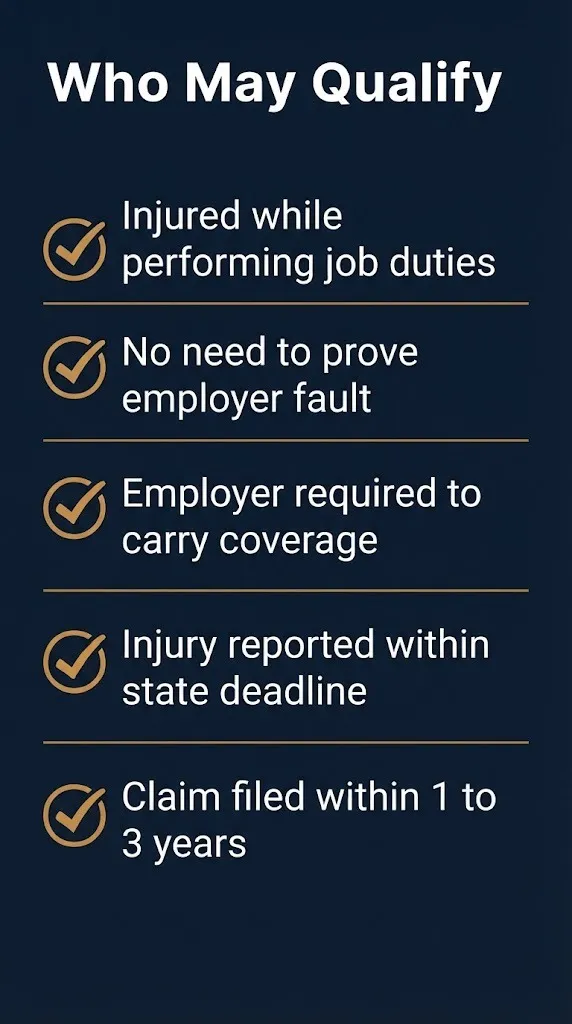
- You usually must report the injury within 30 days and file a formal claim within 1 to 3 years, depending on your state.
Workers compensation benefits are the medical, wage, and disability payments an injured employee receives after a work-related injury or illness. You don’t have to prove your employer did anything wrong to get them.
This matters to anyone hurt on the job in 2026, from a warehouse worker with a back injury to an office employee diagnosed with a repetitive strain condition. The number that matters most isn’t a settlement amount, it’s your state’s deadline: most require notifying your employer within 30 days and filing a formal claim within one to three years.
This guide breaks down what workers comp actually covers, how your weekly payment gets calculated, and the deadlines that can quietly end a valid claim. One detail catches people off guard: in Texas, and only Texas, private employers can legally skip workers comp coverage entirely.
The Facts
| Category | Detail |
|---|---|
| Topic | Workers compensation benefits (general explainer, not a single case or fund) |
| System Type | No-fault, state-regulated, varies by state |
| Wage Benefit Formula (typical) | Roughly two-thirds of average weekly wage x percent of disability |
| Injury Report Deadline | Commonly 7 to 120 days, most states around 30 days |
| Claim Filing Deadline | Commonly 1 to 3 years, varies significantly by state |
| Administrator | State workers’ compensation board or commission, not a private fund |
| Proof Needed | Employer notice, medical documentation, injury report |
Not yet confirmed: a single national benefit amount or deadline, because each state sets its own workers’ compensation rules and rates.
Is Workers Compensation Benefits Real, Legitimate Support?
Yes, workers compensation benefits are a real, legally required system in nearly every state, not a discretionary favor from your employer.
Workers’ compensation is a no-fault system designed to provide benefits to employees injured because of their job, and it also limits employer liability in exchange. You don’t need to prove your employer was negligent, and your employer generally can’t blame you for causing the injury either.
Nearly every state requires employers to carry this coverage, often starting at just one employee. Texas is the sole exception where private employers can legally opt out, though doing so carries its own consequences for the employer.
How Much Do Workers Compensation Benefits Pay?
Workers compensation wage benefits typically pay around two-thirds of your average weekly wage, tax-free, though the exact percentage and maximum amount depend on your state and your degree of disability.
New York’s formula illustrates how this works: lost wage benefits equal two-thirds of your average weekly wage multiplied by your percentage of disability. That average weekly wage is based on your gross earnings, including overtime, over the 52 weeks before your injury.
| Benefit Type | What It Covers |
|---|---|
| Medical benefits | Doctor visits, hospital care, surgery, medication, physical therapy |
| Temporary disability | Partial wage replacement while you recover and can’t fully work |
| Permanent disability | Ongoing payments if you’re left with lasting impairment |
| Death and burial benefits | Wage replacement and funeral costs for surviving dependents |
Maximum and minimum weekly amounts change yearly and are set by each state, so there’s no single confirmed national dollar figure. In New York, for example, minimum weekly benefits shift year to year and will be tied to a percentage of the statewide average wage starting in 2026.
Key Takeaway: Wage benefits generally target two-thirds of your prior earnings, tax-free, but the exact cap depends entirely on your state’s current rate table.
What Are the Different Types of Workers Compensation Benefits?
Workers compensation typically includes four to five benefit categories: medical care, temporary disability, permanent disability, vocational rehabilitation, and death benefits.
California’s insurance department lists five basic types: medical care, temporary disability, permanent disability, supplemental job displacement, and death benefits. Other states group these into three or four broader categories, but the coverage itself is largely consistent nationwide.
- Medical benefits: ER visits, hospitalization, prescriptions, diagnostic tests, surgery, physical therapy
- Temporary total disability (TTD): Wage replacement while you’re fully unable to work
- Temporary partial disability (TPD): Partial wage replacement if you can work reduced or lighter hours
- Permanent partial disability (PPD): Ongoing payments after reaching maximum medical improvement with lasting impairment
- Vocational rehabilitation: Retraining or job placement help if you can’t return to your old role
- Death and burial benefits: Support for dependents and funeral cost reimbursement
Key Takeaway: Nearly every state offers the same core benefit categories, medical, disability, rehabilitation, and death benefits, even if the labels differ slightly.
How Is Your Weekly Workers Comp Benefit Calculated?
Your weekly benefit is generally calculated by taking your average weekly wage before the injury and multiplying it by roughly two-thirds, adjusted by your percentage of disability.
The formula most states use looks like this: two-thirds of your average weekly wage, multiplied by your disability percentage, equals your weekly benefit. Average weekly wage is usually based on your gross earnings over the year before the injury, including overtime and bonuses in many states.
These payments are typically tax-free, which is one detail people often miss when comparing workers comp to a regular paycheck. A benefit that looks smaller on paper can be closer to your take-home pay than it first appears, similar to how a tax refund feels bigger than the number on the check because nothing more gets withheld from it.
Do You Need to Prove Your Employer Was at Fault?
No, workers compensation is a no-fault system, meaning you don’t need to prove your employer was negligent to receive benefits.
The employee needs to show only that the employment activities were a substantial contributing factor to the disability or need for care, not that the employer did anything wrong. In exchange, this system also limits your ability to sue your employer directly in most cases.
This cuts both ways. Your employer generally cannot deny your claim simply by arguing you were careless, but you typically give up the right to sue for pain and suffering damages the way you could in a personal injury lawsuit against a third party.
Key Takeaway: Workers comp trades a no-fault guarantee of coverage for limits on suing your employer directly, a tradeoff built into the system in nearly every state.
How Do You File a Workers Compensation Claim?
You file a workers compensation claim by reporting the injury to your employer immediately, seeking medical care, and submitting a formal claim form within your state’s deadline.
- Report the injury to your supervisor or employer right away, in writing if possible.
- Seek medical treatment and clearly tell the provider it’s work-related.
- Ask your employer for the correct state claim form.
- Keep copies of all injury reports, medical records, and correspondence.
- Submit your formal claim to your employer’s insurer or your state’s workers’ comp agency.
- Track your claim status and respond promptly to any requests for documentation.
- Appeal quickly if your claim is denied, since appeal windows are often short.
Key Takeaway: The most common way people lose valid benefits isn’t a weak injury claim, it’s simply missing the early reporting deadline.
What Is the Deadline to Report a Workplace Injury?
Most states require you to report a workplace injury to your employer within 30 days, though some states allow as little as 7 days or as much as 120 days.
This deadline is shorter, and stricter, than the deadline to file the full claim itself. Reporting late doesn’t just look bad, in many states it can bar your claim entirely regardless of how legitimate the injury is.
| State Example | Employer Notice Deadline |
|---|---|
| Nevada | 7 days |
| New York | 30 days |
| Pennsylvania | 120 days |
| Most states, general range | 30 days |
Not yet confirmed: a single universal notice deadline, since every state sets its own timeline and some shorten it further for specific injury types.
What Is the Statute of Limitations to File a Workers Comp Claim?
The statute of limitations to file a full workers compensation claim is typically 1 to 3 years from the date of injury, though the clock can restart with your last benefit payment in some states.
Kentucky and New York both generally use a two-year window, measured from either the injury date or the date of your last paid benefit, whichever comes later. Pennsylvania gives injured workers three years to file after the initial 120-day notice period.
| State Example | Claim Filing Deadline |
|---|---|
| New York | 2 years |
| Kentucky | 2 years (from injury or last payment, whichever is later) |
| Nebraska | 2 years |
| Virginia | 2 years |
| Pennsylvania | 3 years |
| Nevada | 90 days to file compensation claim form |
Filing a claim, getting a formal award order, or proving what’s called a de facto award are generally the only things that stop this clock in most states. Simply reporting the injury to your employer, without a claim actually being filed, usually does not protect your deadline.
Key Takeaway: Reporting your injury and filing your formal claim are two separate deadlines, and missing either one can end a valid case.
Reality Check
No legitimate workers compensation claim starts with an unsolicited text or online form promising a payout. Filing a claim is free, and your employer is legally required to provide the correct paperwork. If a third party demands an upfront fee to “process” your workers comp claim, that’s a red flag, not a shortcut.
What If Your Employer Doesn’t Have Workers Compensation Insurance?
If your employer is required to carry workers compensation insurance and doesn’t, you may still be able to recover benefits through a state uninsured employer fund, and your employer can face serious legal penalties.
In California, operating without required workers comp coverage is a criminal offense, punishable by up to one year in jail and fines up to $100,000. California’s Uninsured Employers Benefits Trust Fund steps in to pay benefits directly, then pursues the employer for reimbursement.
Other states run similar uninsured employer funds, though the exact penalties and fund names vary. If you’re unsure whether your employer carries coverage, your state’s labor department or workers’ comp board can typically confirm it.
How Long Do Workers Compensation Benefits Last?
How long benefits last depends on your disability classification: temporary benefits end when you recover or reach maximum medical improvement, while permanent disability benefits can continue for years or life.
Temporary total disability benefits generally continue only while you’re unable to work at all. Once you reach maximum medical improvement, meaning your condition has stabilized and isn’t expected to improve further, you may shift to permanent partial or permanent total disability benefits if lasting impairment remains.
Death benefits can extend even longer in some states. New York, for example, allows spouses of first responders killed in work-related incidents to receive death benefits for life, even if they remarry, for marriages on or after September 1, 2017.
What Is the Difference Between Temporary and Permanent Disability Benefits?
Temporary disability benefits replace lost wages while you’re recovering, while permanent disability benefits apply once your condition has stabilized and lasting impairment remains.
- Temporary total disability (TTD): You cannot work at all for a period of time.
- Temporary partial disability (TPD): You can work reduced hours or lighter duty at lower pay.
- Permanent partial disability (PPD): You’ve reached maximum medical improvement with some lasting impairment.
- Permanent total disability (PTD): You’ve reached maximum medical improvement but cannot return to any gainful work.
Maximum medical improvement is the point where your doctor determines your condition is as good as it’s going to get, even if some impairment remains permanently.
Are Workers Compensation Benefits Taxable?
No, workers compensation wage replacement benefits are generally not subject to federal or state income tax.
This is one of the more overlooked facts about the system. A workers comp check that looks smaller than your regular paycheck can still leave you with a similar amount in hand, since nothing is being withheld the way it is from ordinary wages.
Medical benefits paid directly to providers aren’t taxable income to you either, since they’re reimbursement for treatment rather than personal income.
Is Texas Really Different From Every Other State?
Yes, Texas is the only state where workers compensation coverage is optional for most private employers rather than legally required.
Employers who opt out in Texas, often called “nonsubscribers,” lose certain legal defenses if an injured employee sues them directly, since they’re stepping outside the no-fault system entirely. This trade-off is unique to Texas and doesn’t exist in the other 49 states, where coverage requirements are mandatory starting at a low employee threshold.
If you work in Texas, it’s worth directly confirming with your employer whether they carry standard workers comp coverage or operate as a nonsubscriber, since your legal options differ significantly either way.
What Happens Next
Expected process for a new 2026 claim: Timing varies by state, but most claims follow a similar general sequence.
- Within days of the injury: Report the injury to your employer and get medical treatment.
- Within 7 to 120 days, depending on state: Formal notice deadline to your employer expires if missed.
- Following weeks: Insurer reviews the claim and approves or denies benefits.
- If denied: Appeal window opens, often short, sometimes under 90 days.
- Ongoing: Benefits continue until you reach maximum medical improvement or your disability classification changes.
Frequently Asked Questions
What is workers compensation benefits in simple terms?
It’s state-required insurance that pays for medical care and partial lost wages after a work injury.
You generally don’t need to prove your employer was at fault to receive it.
How much do workers compensation benefits pay per week?
Most states target around two-thirds of your average weekly wage, tax-free.
The exact minimum and maximum amounts are set annually by each state and vary widely.
How long do I have to report a workplace injury?
Most states require notice within about 30 days, though some allow as little as 7 days.
Missing this deadline can jeopardize your claim even if the injury itself is legitimate.
How long do I have to file a full workers comp claim?
Typically 1 to 3 years from the date of injury, depending on your state.
Some states restart the clock based on your last benefit payment rather than the original injury date.
Are workers compensation benefits taxable income?
No, wage replacement benefits are generally not subject to federal or state income tax.
Medical benefits paid to providers also aren’t counted as your personal taxable income.
What if my employer doesn’t have workers comp insurance?
You may still be able to recover benefits through a state uninsured employer fund.
Employers who skip required coverage can face criminal penalties and fines in states like California.
Can I be denied benefits if the injury was partly my fault?
Generally no, since workers compensation is a no-fault system in almost every state.
Your employer typically cannot use your own carelessness as a defense to deny a valid claim.
Is workers compensation mandatory in every state?
Nearly everywhere, yes, though Texas is a notable exception for private employers.
In Texas, employers can legally opt out, but doing so removes certain legal protections for them.
If you were hurt on the job this year, the most urgent step is reporting the injury to your employer immediately, since that early deadline is often far shorter than the deadline to file the full claim. Confirm your specific state’s timelines with your state workers’ compensation board before doing anything else.