Is Bus Accident Compensation Real, or Is This a Scam?
Quick Answer
- Bus accident compensation is a real, standard legal process, not a scam or a settlement fund you sign up for.
- Published law firm data shows school bus settlements for injured children typically range from $100,000 to $1 million or more in serious cases.
- Claims against a public school district often require a written notice of claim within 60 to 180 days, far shorter than a normal injury deadline.
If your child, or you, were hurt in a bus crash this year, you are likely searching for one thing: a real number. There is no single verified national average, but published law firm data puts most bus accident settlements between $20,000 and over $1 million.
School bus cases involving injured children commonly land between $100,000 and $1 million, according to multiple personal injury firms tracking their own case data. The deadline that matters most isn’t the two-year injury statute of limitations you may know from a car crash. It’s the much shorter notice period, sometimes as little as 60 days, required before you can sue a government-run school district at all.
This article breaks down what drives the settlement number, how the claims process actually works, and why a school bus crash is legally different from almost any other kind of car accident. One detail surprises most parents: because buses are treated as “common carriers,” the driver and district owe a higher legal duty of care than an ordinary motorist does.
The Facts
| Category | Detail |
|---|---|
| Topic | General bus accident and school bus accident compensation (not a single lawsuit or fund) |
| Status | Ongoing personal injury claims area, not a class action or settlement fund |
| Typical Settlement Range (all bus accidents) | $5,000 to over $1 million, per published law firm data |
| Typical School Bus Injury Settlement | $100,000 to $1 million or more in serious injury cases |
| Government Claim Notice Deadline | Commonly 60 to 180 days, varies by state, Not yet uniform nationwide |
| Lawsuit Deadline | Often 1 to 2 years, varies by state |
| Fund/Administrator | Not applicable, this is direct litigation or insurance claims, not a mass settlement |
| Proof Typically Needed | Police report, medical records, bus company/district records, witness statements |
Not yet confirmed: any single “average” figure, because no government agency publishes an official national average bus accident settlement number.
Is Bus Accident Compensation Real, or Is This a Scam?
Bus accident compensation is a real, ordinary part of personal injury law, not a scam or a mass tort payout scheme.
There’s no text message, email, or online form that pays you automatically. Compensation comes from filing a claim or lawsuit against the driver, bus company, school district, or their insurer.
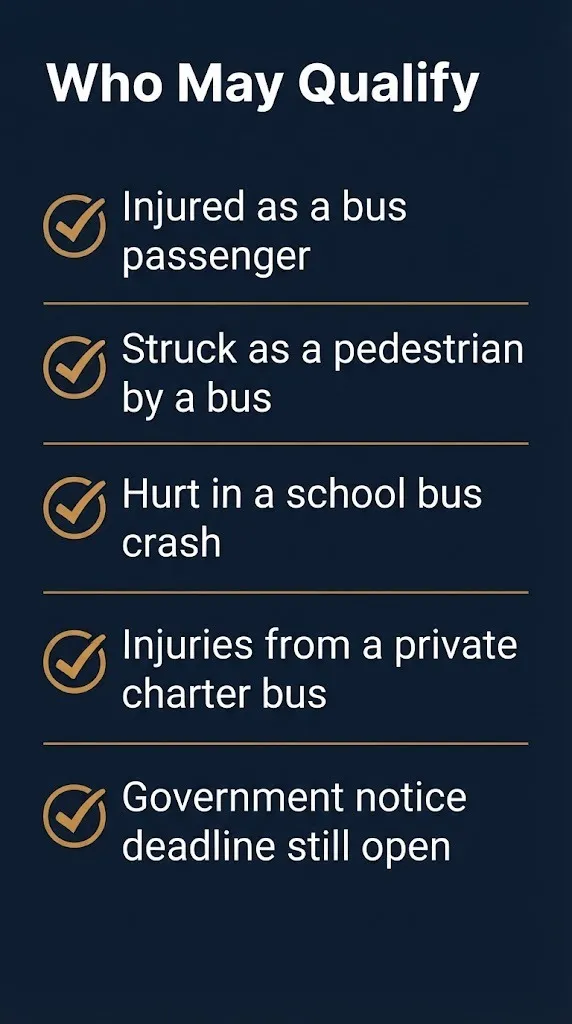
If you were hurt as a passenger, pedestrian, or in another vehicle struck by a bus, you may have a valid injury claim. That claim is handled through the normal civil justice system, not through a settlement administrator or class action fund.
Watch for these signs before trusting anyone claiming to “process” your bus accident payout:
- Anyone who contacts you first, unsolicited, offering a payout
- Requests for an upfront fee before any settlement is reached
- Pressure to sign paperwork within 24 hours
How Much Is the Average Settlement for a School Bus Accident?
A school bus accident settlement for an injured child typically falls between $100,000 and $1 million, according to published personal injury firm data, though minor-injury cases can settle far lower and catastrophic cases can exceed that range.
There is no single confirmed national average, because settlements aren’t centrally tracked or published by any court or government agency. What exists instead is a body of reported case outcomes from law firms.
One reported case involved a minor bus passenger whose family settled with the bus company for $156,000 to cover medical expenses and pain and suffering. In another case, a 6-year-old suffered sprains and bruises when a bus overturned after the driver failed to yield, and a jury awarded $400,500.
| Injury Severity | Reported Settlement Range |
|---|---|
| Minor injuries (bruises, sprains) | Low thousands to around $150,000 |
| Moderate injuries (fractures, lacerations) | $150,000 to $500,000 |
| Severe or catastrophic injuries | $500,000 to $3 million or more |
| Wrongful death | Often exceeds $1 million, case dependent |
Key Takeaway: There is no official average school bus settlement, but published case data consistently clusters serious child injury cases between $100,000 and $1 million.
What Is the Average Bus Accident Settlement Overall, Not Just School Buses?
Across all bus types, including public transit, private charter, and school buses, published settlement ranges run from roughly $5,000 to over $1 million, depending heavily on who was hit and how badly.
Pedestrian bus accident claims tend to sit at the higher end. Pedestrian accidents involving buses consistently produce the highest settlements because of the severe nature of injuries when a person is struck by a large vehicle weighing tens of thousands of pounds.
One legal data firm’s 2026 analysis put the average bus accident settlement at roughly $548,000, compared to an average car accident settlement of about $30,000, though this figure is drawn from private industry analysis rather than a government source and should be treated as directional, not exact.
That gap exists for a reason. Bus operators are usually held to the “common carrier” standard, a higher duty of care than an ordinary driver owes, which can make liability easier to prove.
What Determines Your Bus Accident Settlement Amount?
Your settlement amount is determined mainly by injury severity, medical costs, lost income, and how clearly the bus driver or company was at fault.
Insurance adjusters and courts weigh a consistent set of factors in nearly every case:
- Severity and permanence of the injury
- Total medical bills, including future treatment
- Lost wages and reduced future earning capacity
- Pain and suffering, harder to quantify but real
- Available insurance coverage limits
- Clarity of fault, and whether the victim shares any blame
Commercial buses typically carry higher insurance minimums than personal vehicles, which can raise the ceiling on what’s available to pay a claim. A private charter or transit company may carry several million dollars in liability coverage, while a personal driver might carry only state minimums.
This is one reason bus claims often settle higher than an ordinary car crash claim: there’s simply more insurance money on the table when liability is clear.
Can You Sue a School District for a Bus Accident?
Yes, in most states you can sue a public school district for a bus accident, but only through a narrow legal exception to something called sovereign immunity.
School districts are governmental units and generally carry sovereign immunity, meaning they cannot be sued unless a law specifically allows it. Most states carve out an exception for motor vehicle crashes, which is what makes school bus lawsuits possible at all.
Victims must often comply with a strict notice of claim requirement before filing a lawsuit against a government entity, and that notice typically must be filed within a much shorter window than an ordinary injury statute of limitations. Missing that early notice deadline can end a valid claim before it ever reaches court.
Key Takeaway: Suing a school district is possible almost everywhere, but only because of a specific legal exception, and missing the early notice deadline can permanently bar your claim.
What Is the Deadline to File a Claim Against a School Bus or District?
The deadline to notify a school district of your claim is often 60 to 180 days from the crash, far shorter than the 1 to 2 years typically allowed for a private lawsuit.
Deadlines vary sharply by state and even by city:
| Jurisdiction Example | Notice Deadline |
|---|---|
| Texas cities (some) | As short as 45 to 90 days |
| Georgia municipalities | 6 months (ante litem notice) |
| Georgia counties/school districts | 12 months |
| Florida | 6-month notice period required |
| Most states, general range | 60 to 180 days |
Not yet confirmed: an exact universal deadline, since every state sets its own rules, and some cities shorten the window even further than state law requires.
In Texas, written notice must generally go to the government within six months of the crash, and some cities shorten that to 90 days. Miss that window and the underlying claim is usually finished, even if the broader lawsuit deadline hasn’t technically arrived yet.
Reality Check
No legitimate settlement or compensation process starts with someone texting or emailing you out of the blue to say you’re owed money. Filing a personal injury claim is free to start, and a lawyer working on contingency only gets paid if you recover money. Anyone charging an upfront fee to “process” your bus accident payout is a red flag, not a shortcut.
What Is Sovereign Immunity and Why Does It Matter Here?
Sovereign immunity is a legal doctrine that normally shields government entities, like school districts, from being sued at all, unless a specific law waives that protection.
Sovereign immunity protects governmental entities from liability in civil issues, and if a school district owns its buses, those buses are generally covered by that immunity. Until a wave of reform legislation decades ago, government agencies in many states could not be sued for any reason, regardless of obvious fault.
Most states have since passed tort claims acts that waive immunity specifically for motor vehicle crashes involving a government employee acting within the scope of their job, which is exactly the situation in a typical school bus crash.
This is also why damages can be capped. In Florida, for example, recovery against a government entity is capped at $100,000 per person and $200,000 per incident under the state’s sovereign immunity statute, regardless of how serious the injury actually is.
Private Bus vs. Government Bus: What Changes for Your Claim?
A crash involving a private bus company, like a charter coach or tour operator, is legally simpler than one involving a public school or transit bus, because there’s no sovereign immunity to navigate.
A private bus operator carries no immunity and no statutory damage cap, but you’re facing a company and insurer that fight bus claims professionally. A government bus claim trades that corporate opposition for short notice deadlines and, in some states, hard damage caps.
| Factor | Private Bus (charter, tour, church van) | Government Bus (school, transit) |
|---|---|---|
| Sovereign immunity | None | Applies, with exceptions |
| Notice deadline | Standard statute of limitations | Often 60 to 180 days |
| Damage caps | Generally none | May apply, varies by state |
| Main opponent | Company and its insurer | Government entity and insurer |
Key Takeaway: Private bus claims skip sovereign immunity entirely, while government bus claims involve shorter deadlines and, in some states, a hard cap on what you can recover.
How Do You File a Bus Accident Compensation Claim?
You file a bus accident claim by documenting the crash, getting medical treatment, identifying every liable party, and meeting any government notice deadline before pursuing a lawsuit or settlement.
- Seek medical care immediately, even for injuries that seem minor.
- Report the crash to police and get a copy of the report.
- Photograph the scene, vehicles, and any visible injuries.
- Identify all potentially liable parties (driver, bus company, school district, other drivers).
- Send a formal notice of claim if a government entity is involved, before any deadline passes.
- Gather medical bills, lost wage records, and witness contact information.
- Consult a personal injury attorney to evaluate liability and insurance coverage.
- Negotiate or file suit if a fair settlement isn’t offered.
Key Takeaway: The single most time-sensitive step is the government notice of claim, which can run out weeks before the general lawsuit deadline even applies.
What Proof Do You Need for a Bus Accident Claim?
You typically need a police report, complete medical records, and documentation tying your injuries directly to the crash to support a bus accident claim.
Strong claims usually include:
- Official police or incident report from the crash
- Medical records and bills, from the ER visit through any follow-up care
- Photos or video of the scene, vehicles, and injuries
- Witness names and statements, especially other passengers
- Pay stubs or employer records if you missed work
- The bus company’s or district’s own incident report, if available
Gaps in documentation are one of the most common reasons insurers lowball a settlement offer, so treat this list as a checklist to build as soon as possible after the crash.
How Long Does a Bus Accident Settlement Take?
Most bus accident claims resolve anywhere from a few months to over a year, depending on injury severity, how clear liability is, and whether the case settles or goes to trial.
Straightforward claims with clear fault and modest injuries can sometimes settle within 3 to 6 months. Cases involving catastrophic injuries, disputed liability, or a government entity’s notice and review process routinely take a year or longer.
Government claims add extra time by design. The notice period itself, plus the entity’s internal review, often adds months before a lawsuit can even be filed, let alone resolved.
What If My Child Was Injured in a School Bus Accident?
If your child was hurt in a school bus crash, you generally file a claim on their behalf, and the notice deadline for suing the district still applies even though they’re a minor.
School bus operators owe an elevated duty of care to children, and juries are typically highly sympathetic to child victims, which can support stronger settlement outcomes in clear-liability cases.
Some states extend certain deadlines for injured minors, but the government notice of claim requirement often still runs on the standard short clock, not the extended minor’s deadline. Confirm your state’s specific rule quickly rather than assuming extra time.
How Common and Severe Are School Bus Accidents?
School bus crashes are relatively rare compared to overall car crashes, but injuries to people outside the bus, especially pedestrians at bus stops, are disproportionately severe.
Roughly 128 people are killed in school bus related crashes annually, with about 71 percent of fatalities being occupants of other vehicles and about 16 percent being pedestrians, according to one legal industry data analysis; this figure has not been independently confirmed against a primary government dataset for this article and should be treated as an industry estimate rather than an official statistic.
Because a city bus weighs 25,000 to 40,000 pounds compared to roughly 3,500 pounds for a passenger car, pedestrian and bystander injuries in bus crashes tend to be more severe than in typical two-car collisions.
What Happens Next
Expected 2026 to 2027: Most new bus accident claims follow the same general path, though timing depends entirely on your state and the facts of your case.
- Within days of the crash: Seek medical care and gather documentation while memories and evidence are fresh.
- Within 60 to 180 days (if a government entity is involved): File a formal notice of claim, or risk losing the right to sue entirely.
- Following months: Insurer or district review, negotiation, and possible settlement offer.
- If no fair offer is reached: Lawsuit filed before the state’s statute of limitations expires, typically 1 to 2 years.
- Trial or final settlement: Case resolves through negotiated settlement or, less commonly, a jury verdict.
Frequently Asked Questions
Is bus accident compensation a real thing or a scam?
It’s a real, standard part of personal injury law, not a scam.
You pursue it through a claim or lawsuit against the at-fault party’s insurer, not through an unsolicited payout offer.
What is the average settlement for a school bus accident?
Published law firm data shows serious child injury cases in school bus crashes commonly range from $100,000 to $1 million or more.
There’s no single official national average, because settlements aren’t centrally tracked by any court or agency.
How long do I have to file a claim against a school district?
Notice deadlines commonly run 60 to 180 days, far shorter than a typical 1 to 2 year lawsuit deadline.
The exact number depends entirely on your state and sometimes your specific city, so confirm it immediately after the crash.
Can I sue if my child was hurt on a school bus?
Yes, in most states, through an exception to sovereign immunity for motor vehicle crashes.
The short notice-of-claim deadline still generally applies, so don’t wait to start the process.
Does it matter if the bus was private or public?
Yes, significantly.
Private bus claims skip sovereign immunity and damage caps entirely, while public bus claims involve shorter deadlines and, in some states, capped recovery amounts.
What proof do I need to support my claim?
A police report, complete medical records, photos of the scene and injuries, and witness information.
The bus company’s or district’s own incident report can also strengthen your case if you can obtain it.
How much does it cost to file a bus accident claim?
Filing itself is free, and most personal injury attorneys work on contingency, meaning they’re paid only if you recover money.
Be cautious of anyone demanding an upfront fee to “process” a bus accident payout.
Do bus accident settlements really pay more than car accident settlements?
Some industry data suggests bus claims often settle higher than typical car accident claims, largely due to higher insurance minimums and the common carrier duty of care.
This isn’t guaranteed in every case, and outcomes still depend on injury severity and liability clarity.
If you or your child were hurt in a bus crash this year, the single most urgent step is confirming your state’s notice-of-claim deadline immediately, since it can run out in as little as 60 days. Start gathering medical records and the police report now, while the details are still fresh and easy to document.