How to File a Lawsuit in 2026: California Civil Filing Steps and Deadlines
Quick Answer
- What it is: Filing a lawsuit starts with a complaint filed in the correct court, then formal service on the defendant.
- How much: Small claims filing fees range from $30 to $100. Limited civil cases start at $205 in most cases.
- Deadline: Personal injury: 2 years. Written contract: 4 years. Government claims: 6 months.
If you are considering filing a lawsuit in California, the process is more structured than television dramas suggest. You do not walk into a courtroom and tell your story to a judge. You file paperwork, serve the other side, and wait for a response.
California civil courts handled over 700,000 limited civil filings in recent years, and the rules that govern those filings are specific. One mistake in timing, service, or the form you choose can delay your case or end it entirely.
This article covers what is confirmed as of September 2026: the statutes of limitations for common claim types, the filing fee structure under AB 2781, the difference between small claims and limited civil cases, how to serve a defendant, and what happens when the other side does not respond. Everything here traces to the California Code of Civil Procedure, official court self-help resources, and published legal guides.
What is the deadline to file a lawsuit in California?
The deadline to file a lawsuit in California depends on the type of claim. Most personal injury claims have a two-year statute of limitations. Breach of written contract claims have four years. Government claims must be filed within six months .
Here are the key deadlines under the California Code of Civil Procedure:
| Claim Type | Time Limit | Code Section |
|---|---|---|
| Personal injury | 2 years from injury | CCP § 335.1 |
| Breach of written contract | 4 years from breach | CCP § 337 |
| Breach of oral contract | 2 years from breach | CCP § 339 |
| Property damage | 3 years from damage | CCP § 338(b) |
| Fraud | 3 years from discovery | CCP § 338(d) |
| Medical malpractice | 1 year from discovery or 3 years from injury | CCP § 340.5 |
| Claims against government | 6 months (injury) or 1 year (contract) | Gov. Code § 911.2 |
The clock generally starts when the claim “accrues,” meaning when all elements of the claim exist and you have the right to sue. Some claims use a delayed discovery rule, which starts the clock when you knew or should have known about the injury .
A delayed tax refund eventually arrives. A missed statute of limitations deadline ends your claim permanently.
How much does it cost to file a lawsuit in California?
Filing fees in California depend on the court and the amount in dispute. Assembly Bill 2781, signed on July 16, 2026, adjusted several thresholds and fee tiers effective immediately .
Here are the current filing fee ranges:
Small Claims Court (claims up to $12,500):
- $30 for claims up to $1,500
- $50 for claims over $1,500 up to $6,250
- $75 for claims over $6,250
- $100 if you have filed more than 12 small claims in the past 12 months
Limited Civil Cases (claims up to $35,000):
- $205 uniform filing fee for cases where the amount demanded is $12,500 or less
- Higher fees apply for amounts between $12,500 and $35,000
Unlimited Civil Cases (claims over $35,000):
- Filing fees vary by county but typically start around $435
If you cannot afford the filing fee, you can ask for a fee waiver. California courts grant fee waivers based on income and financial hardship .
Key Takeaway: AB 2781 raised the small claims ceiling to $12,500, meaning more disputes can now be resolved without a lawyer. The $205 limited civil fee applies to cases where the demand does not exceed $12,500.
What is the difference between small claims and limited civil cases?
Small claims court handles disputes up to $12,500 and is designed for people without lawyers. Limited civil cases handle disputes up to $35,000 and allow attorney representation .
The $12,500 threshold was set by AB 2781 in July 2026, up from the previous $10,000 limit . This means you can now file in small claims court for disputes that previously required a limited civil filing.
Small claims court features:
- No lawyers allowed (with narrow exceptions)
- Simplified forms and procedures
- Faster hearing dates
- Lower filing fees ($30 to $100)
- No formal discovery process
Limited civil court features:
- Attorney representation allowed
- Formal pleadings, discovery, and motions
- Higher filing fees (starting at $205)
- Longer timelines
If your claim exceeds $35,000, it falls into unlimited civil jurisdiction, which has the most complex procedures and highest costs .
How do you file a civil lawsuit in California?
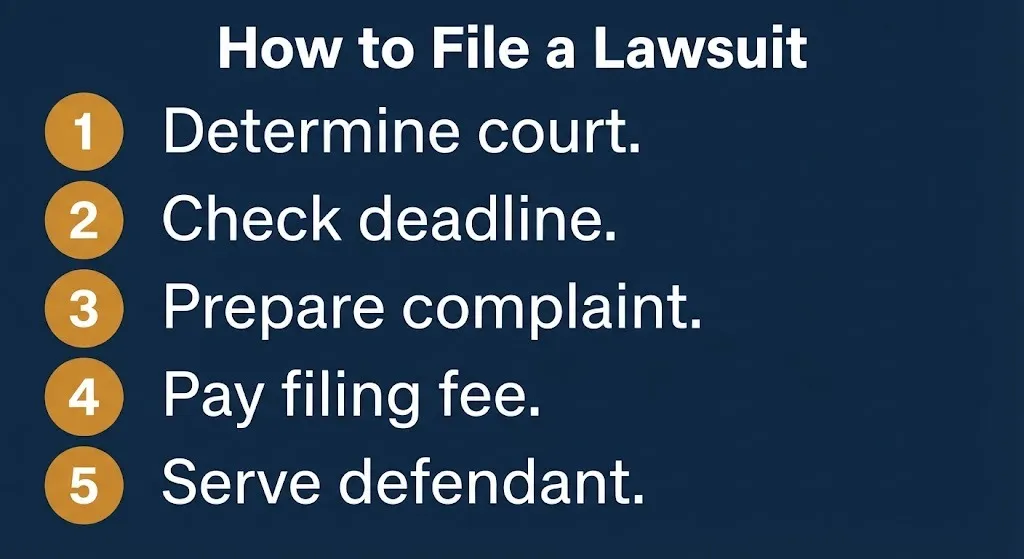
Filing a civil lawsuit in California starts with preparing a complaint and ends with serving the defendant. The process has specific forms and deadlines at each stage.
Here is the step-by-step process:
- Determine the correct court. File in the county where the defendant resides or where the dispute occurred .
- Check the statute of limitations. Confirm your claim is not time-barred .
- Prepare the complaint. This is the formal document stating your claims and the relief you seek .
- Complete the Civil Case Cover Sheet (CM-010). This form tells the court what type of case you are filing .
- Pay the filing fee or request a waiver. Fees vary by court and case type .
- File the complaint with the court clerk. You can file in person or electronically through the court’s e-filing system .
- Serve the defendant. You must deliver a copy of the summons and complaint using a method approved by law .
- File proof of service with the court. This confirms the defendant received notice .
For self-represented litigants, the California Courts Self-Help Center provides free forms and guided interviews through the Guide & File system .
How do you serve a defendant in California?
Serving a defendant in California means delivering a copy of the summons and complaint using a method approved by California Code of Civil Procedure §§ 415.10 through 415.50. You cannot serve the papers yourself.
Approved service methods include:
- Personal service: Hand-delivery to the defendant
- Substituted service: Delivery to a responsible person at the defendant’s home or business, followed by mailing a copy
- Service by publication: Used when the defendant cannot be located, requiring court approval
After service, the defendant has 30 days to file a response . The response can be an Answer, a Demurrer challenging the legal sufficiency of the complaint, or a Motion to Quash challenging jurisdiction .
If the defendant does not respond within 30 days, you can request a default judgment . A default judgment means the court can award you the relief you requested without the defendant participating.
Reality Check: Filing a lawsuit is not free, and winning does not guarantee payment. A judgment is a piece of paper. Collecting on that judgment requires additional steps, including wage garnishment or bank levies. Some defendants have no assets to collect.
What happens after you file a lawsuit in California?
After you file and serve the complaint, the case moves through a structured sequence of pleadings, discovery, and potentially trial. Most cases settle before trial.
Here is the typical sequence after filing:
Step 1: Defendant responds. Within 30 days of service, the defendant files an Answer, Demurrer, or Motion .
Step 2: Discovery. Both sides exchange information through interrogatories, document requests, requests for admission, and depositions .
Step 3: Pre-trial motions. Parties may file motions for summary judgment or motions to compel discovery .
Step 4: Mandatory settlement conference. California courts strongly encourage settlement before trial .
Step 5: Trial. If the case does not settle, it proceeds to trial before a judge or jury .
Step 6: Post-trial and appeals. The losing party may appeal legal errors to the appellate division .
Discovery responses in California are due within 30 days unless extended by agreement or court order .
What should you do if you cannot afford a lawyer?
If you cannot afford a lawyer, California offers several resources for self-represented litigants. You have the right to represent yourself in civil court.
Free and low-cost resources include:
- California Courts Self-Help Center: Free forms, instructions, and guided interviews
- Court self-help centers: On-site assistance at many courthouses
- Law libraries: Research assistance and reference materials
- Legal aid organizations: Free representation if you qualify based on income
- State Bar Lawyer Referral Services: Low-cost consultations
- Fee waivers: If you cannot afford filing fees, the court may waive them
The California Guide & File system provides step-by-step interviews for common case types, including small claims, divorce, and restraining orders . You can e-file directly at the end of some interviews .
Key Takeaway: You do not need a lawyer to file a small claims case or a simple limited civil case. The California Courts Self-Help Center provides free forms and guided interviews that walk you through the process.
What happens next after filing a California lawsuit?
The timeline for a California civil lawsuit depends on the court’s calendar and whether the case settles. Most cases resolve within 12 to 24 months.
Here is the expected sequence:
Day 0: File the complaint and pay the filing fee or obtain a waiver.
Day 1-30: Serve the defendant using an approved method.
Day 30-60: Defendant files a response. If no response, request default judgment.
Month 2-6: Discovery phase. Both sides exchange evidence.
Month 6-12: Pre-trial motions and settlement conference.
Month 12-24: Trial if no settlement, or resolution through settlement.
Post-trial: Appeals process if either party challenges the outcome.
The 30-day response deadline is the first critical date after service. If the defendant does not respond, you can seek a default judgment.
Frequently Asked Questions
How long do I have to file a lawsuit in California?
It depends on the claim type. Personal injury is 2 years. Breach of written contract is 4 years. Property damage is 3 years. Claims against government entities must be filed within 6 months.
How much does it cost to file a lawsuit in California?
Small claims fees range from $30 to $100. Limited civil cases start at $205. Unlimited civil cases typically start around $435. Fee waivers are available for those who qualify.
What is the small claims limit in California for 2026?
The small claims limit is $12,500 under AB 2781, signed July 16, 2026. This is an increase from the previous $10,000 limit.
Do I need a lawyer to file a lawsuit in California?
No. You can represent yourself in civil court. Small claims court does not allow lawyers. Limited and unlimited civil cases allow self-representation but the procedures are more complex.
How do I serve a defendant in California?
Approved methods include personal service, substituted service, and service by publication. You cannot serve the papers yourself. Proof of service must be filed with the court.
What happens if the defendant doesn’t respond to my lawsuit?
If the defendant does not respond within 30 days of service, you can request a default judgment. The court may award the relief you requested without the defendant participating.
Can I file a lawsuit without paying the filing fee?
Yes, if you qualify for a fee waiver based on income and financial hardship. The court will review your application and may waive all or part of the fee.
The Bottom Line for Filing a Lawsuit in California
Filing a lawsuit in California starts with confirming your deadline. Personal injury claims have a two-year statute of limitations. Written contract claims have four years. Government claims must be filed within six months.
Assembly Bill 2781, signed in July 2026, raised the small claims limit to $12,500 and adjusted filing fee tiers. Small claims filing fees range from $30 to $100. Limited civil cases start at $205.
The single most important step after filing is proper service on the defendant. You cannot serve the papers yourself, and the defendant has 30 days to respond. If they do not respond, you can request a default judgment. Gather your documents, confirm your deadline, and use the California Courts Self-Help Center for free forms and guidance.