How to File a Civil Lawsuit in California 2026: Forms, Fees, Deadlines, and the Steps That Actually Matter
Quick Answer
- You file a civil lawsuit in California by completing a Complaint, Summons, and Civil Case Cover Sheet, then paying the filing fee.
- Filing fees run $225 for claims up to $10,000 and $435 for unlimited civil cases over $35,000.
- The statute of limitations varies by claim type, with personal injury generally two years and libel or slander one year.
You decided to sue someone in California. Maybe a contractor took your deposit and disappeared. Maybe a driver who hit you won’t answer the insurance company. Or maybe you’re owed money and the other side has stopped responding entirely.
Filing a civil lawsuit is not complicated in concept. You write down what happened, fill out court forms, pay a fee, and deliver the paperwork to the person you’re suing. The complication lives in the details: which court, which forms, which deadline, and what happens if you get one of those wrong.
This article walks through the actual process as California courts describe it in 2026, from the first form to the moment the defendant has to respond. It also flags the step most people underestimate: service of process. A surprising detail from the official guides: you cannot serve the defendant yourself, even if you’re the one who filed the case.
The Facts
| Case | Not a single case: this covers the civil lawsuit filing process in California Superior Courts |
|---|---|
| Status | Active process. Forms and fee schedules current as of January 1, 2026 |
| Fund Size | Not applicable |
| Est. Per Person | Not applicable. Filing fees are $225 to $435 depending on claim amount |
| Claim Deadline | Statute of limitations varies: 1 year for libel or slander, 2 years for personal injury, longer for written contracts |
| Administrator | California Superior Court clerk in the county where you file |
| Proof Needed | Completed Complaint, Summons, Civil Case Cover Sheet, and filing fee or fee waiver |
Is filing a civil lawsuit in California legitimate or a scam?
Filing a civil lawsuit is a legitimate legal process available to anyone, with or without a lawyer. California courts publish free self-help guides for people representing themselves, called self-represented litigants or pro per parties. The forms are standard Judicial Council forms, not proprietary documents sold by third parties.
The scam risk sits outside the courthouse. Anyone charging you a fee to “prepare your lawsuit” without being a licensed attorney or a registered legal document assistant is operating outside the law. Court clerks cannot give legal advice, and they will not fill out your forms for you.
A second warning: no one can promise you a specific outcome or settlement before reviewing your facts. If a service guarantees you’ll win or quotes a dollar amount before seeing your evidence, that’s a sales pitch, not legal analysis.
How much does it cost to file a civil lawsuit in California?
The filing fee depends on how much money you’re asking for. California’s statewide civil fee schedule, effective January 1, 2026, sets the initial filing fees for complaints in superior court .
2026 California civil filing fees:
| Claim Amount | Filing Fee |
|---|---|
| Up to $10,000 | $225 |
| Over $10,000 up to $35,000 | $370 |
| Over $35,000 (unlimited civil case) | $435 |
If you’re suing for an amount that falls in the limited civil range, the case stays in limited civil court. If you’re suing for more than $35,000, the case is classified as unlimited civil, even if you never recover that much .
If you cannot afford the fee, you can request a fee waiver. The court grants waivers based on income, receipt of public benefits, or inability to pay without affecting basic needs . You fill out the fee waiver forms at the same time you file, not after.
The filing fee is only the first cost. Service of process by a professional process server typically costs $50 to $150 depending on the county. If you win, you may recover some costs from the defendant, but you pay them upfront.
What is the statute of limitations for a civil lawsuit in California?
The statute of limitations is the deadline to file your case, and it depends on the type of claim. California law sets different clocks for different kinds of disputes.
Common California civil statutes of limitations:
| Claim Type | Deadline |
|---|---|
| Libel, slander, false imprisonment | 1 year |
| Personal injury | 2 years (general rule) |
| Oral contract | 2 years |
| Written contract | 4 years |
| Fraud | 3 years |
| Medical malpractice | 3 years from injury or 1 year from discovery |
The one-year deadline for libel and slander is codified in California Code of Civil Procedure Section 340, which the Legislature amended in 2026 . Personal injury claims generally get two years from the date of injury under the standard discovery rule.
Missing the deadline almost always ends your case. California courts do not extend filing deadlines because you were busy, confused, or trying to settle without a lawyer. If you’re close to the deadline, file first and sort out the details afterward.
Key Takeaway: The filing fee and the statute of limitations are the two numbers you must know before you do anything else in a California civil case.
Which court do you file in and where?
You file in the California Superior Court in the county where the defendant lives or does business, or where the dispute happened. This is called venue, and it is separate from jurisdiction .
Jurisdiction is the court’s authority to hear your case. California superior courts have general jurisdiction over most civil disputes, but they split into limited and unlimited civil based on the dollar amount . Small claims court handles claims up to $12,500, but you give up the right to appeal and cannot use a lawyer at the hearing .
Venue is the county. If the person you’re suing lives in Los Angeles County, the accident happened in Riverside County, and the defendant’s business is in Orange County, you can usually choose among those three counties .
Where to file:
- The county where the defendant lives
- The county where the defendant’s business is located
- The county where the incident or breach occurred
- The county where the contract was signed or broken
Filing in the wrong county gives the defendant a reason to ask the court to move the case. That wastes time and can cost you a second filing fee.
What forms do you need to file a civil lawsuit in California?
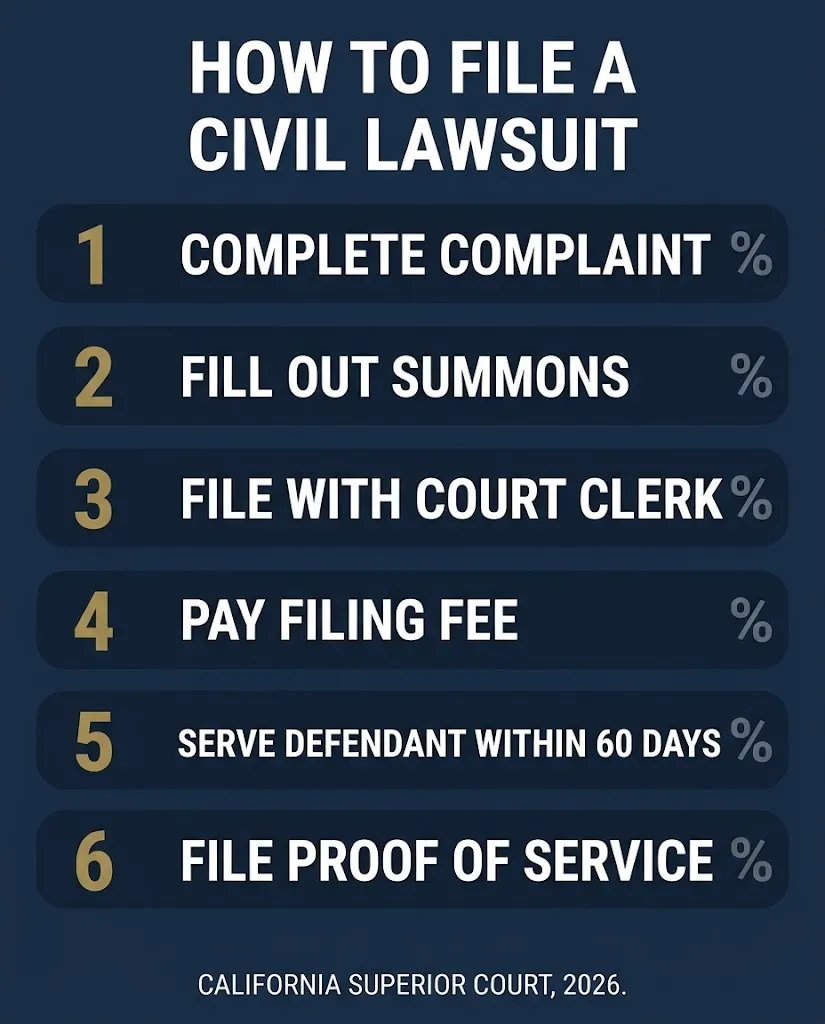
You need at least three forms to start a civil lawsuit in California: a Complaint, a Summons, and a Civil Case Cover Sheet. The Judicial Council provides these forms free on the California Courts website .
Required forms:
- Complaint (varies by case type): The document that states who you are, who you’re suing, what happened, and what you want. California has form complaints for some case types like breach of contract, and you may need to draft your own for others .
- Summons (SUM-100): Tells the defendant they’re being sued and that they have a deadline to respond. The clerk issues this after you file .
- Civil Case Cover Sheet (CM-010): Gives the court basic information about the case type and amount in dispute .
Your Complaint must include at least one cause of action, which is the legal theory for why you’re entitled to money. If the complaint doesn’t state the right elements, the defense can attack it and keep you from reaching trial .
Some courts require additional local forms. Check your county superior court’s website before you go to the clerk’s office. Alameda County, for example, requires a local ADR information packet and an addendum form for unlimited civil cases .
How do you serve the defendant after filing?
You serve the defendant by having someone who is not you deliver a copy of the filed Complaint and Summons. This is called service of process, and California gives you 60 days after filing to complete it .
You cannot serve the papers yourself, even if you filed the case. The server must be at least 18 years old and not a party to the lawsuit. You can ask a friend or relative, hire a professional process server, or in some cases use the sheriff’s civil division .
After delivery, the server completes a Proof of Service form (POS-010) and you file it with the court. Keep a copy for your records. If you don’t file the proof of service, the court has no record that the defendant was notified.
Service methods:
- Personal service: Hand delivery to the defendant. The most reliable method.
- Substitute service: Leaving papers with a responsible adult at the defendant’s home or workplace, plus mailing a copy.
- Certified mail: Allowed in some circumstances but less reliable for proving delivery.
- Process server: A professional who charges a fee but handles the paperwork and proof correctly.
If you can’t find the defendant, the court may allow service by publication in a newspaper, but that requires a court order and adds weeks to the process.
How long does a civil lawsuit take in California?
A civil lawsuit in California takes at least a year, and often longer. The California Courts self-help guide states plainly that a lawsuit can last at least a year, sometimes much more, because of the back-and-forth of discovery, motions, and court scheduling .
The defendant has 30 days to respond after being served, or 40 days if served by mail outside California . If the defendant doesn’t respond, you can request a default judgment, but that still requires paperwork and often a prove-up hearing.
If the defendant does respond, the case enters discovery, where both sides exchange evidence and take depositions. Discovery can take months. Then motions, then a trial date, which in many California counties is set 12 to 18 months after filing.
A delayed tax refund is a fair comparison. You know the money is yours, but the processing center sets the timeline. You can check the status, but you can’t speed up the queue.
What happens if the defendant doesn’t respond?
If the defendant doesn’t file a response within 30 days of service, you can ask the court for a default judgment. This means the court decides the case without the defendant’s participation.
The default process requires you to file a Request for Entry of Default and then a Request for Default Judgment. The court may hold a prove-up hearing where you present evidence of your damages. You still need to prove your case, even if the defendant ignored it.
Default judgments are collectible, but collecting is a separate problem. Winning a judgment does not mean the defendant has money or will pay voluntarily. You may need to garnish wages, place a lien on property, or use other collection tools.
What happens next in a California civil lawsuit
Day 1: File your Complaint, Summons, and Civil Case Cover Sheet with the superior court clerk. Pay the fee or request a waiver.
Within 60 days: Serve the defendant through a qualified server. File the Proof of Service.
30 days after service: The defendant’s response deadline. If they respond, the case moves forward. If not, you pursue default.
Expected 3 to 6 months after response: Discovery begins. Both sides exchange documents and may take depositions.
Expected 12 to 18 months after filing: Trial date or settlement. Most civil cases settle before trial.
Frequently Asked Questions
Do I need a lawyer to file a civil lawsuit in California?
No. You can file as a self-represented litigant. California courts publish free guides and forms. But consulting an attorney before filing can help you identify the right claims and avoid procedural mistakes.
How much does it cost to file a lawsuit in California?
The filing fee is $225 for claims up to $10,000, $370 for claims between $10,000 and $35,000, and $435 for unlimited civil cases over $35,000. Fee waivers are available if you cannot afford the fee.
What is the statute of limitations for a personal injury lawsuit in California?
Personal injury lawsuits in California generally have a two-year statute of limitations from the date of injury. Some claims, like libel and slander, have a one-year deadline.
Can I serve the defendant myself?
No. You cannot serve the papers yourself. The server must be at least 18 years old and not a party to the case. You can use a friend, relative, or professional process server.
Which court do I file in?
File in the California Superior Court in the county where the defendant lives, where the defendant does business, or where the dispute occurred.
What happens if I miss the statute of limitations?
If you miss the deadline, you likely lose the right to sue. California courts do not extend the statute of limitations for settlement negotiations or because you didn’t know the deadline.
How long does it take to serve the defendant?
You have 60 days after filing to serve the defendant. If you cannot complete service in that time, you can ask the court for an extension.
What if the defendant doesn’t respond to the lawsuit?
If the defendant doesn’t respond within 30 days of service, you can request a default judgment. The court may hold a hearing where you must prove your damages.
Check the deadline before you file anything
The forms are free. The process is public. The only thing you cannot get back is time.
Find your claim type. Find the deadline. Then file before it runs. The California Courts self-help website has every form and guide you need, and the clerk’s office will accept your papers the same day you walk in.