What Is a Putative Class Action? 2026 Legal Definition and Process Guide
Quick Answer
- What it is: A lawsuit filed on behalf of a group, but not yet approved as a class by a judge.
- Key distinction: “Putative” means alleged or proposed. The class does not legally exist until certified.
- Why it matters: Until certification, members are not bound, not notified, and not automatically included.
You see the phrase “putative class action” in nearly every securities lawsuit headline and data breach complaint. It sounds official. It sounds final. It is neither.
A putative class action is a lawsuit that claims to represent a group of people, but has not yet received the judge’s permission to actually do so . The word “putative” comes from Latin and means “supposed” or “reputed.” Until the court grants certification, that group is just a proposal on paper.
This distinction matters for you. If you see a headline about a putative class action involving a company you do business with, you are not automatically a plaintiff. You have no rights yet. You cannot file a claim. You cannot receive a payout.
This guide explains what a putative class action is, how it becomes a real class action, and what the process means for ordinary consumers.
The Facts
| Topic | What You Need to Know |
|---|---|
| Legal Definition | Lawsuit filed as a class action, not yet certified by a judge |
| Governing Rule | Federal Rule of Civil Procedure 23 (or state equivalents) |
| Certification Rate (2025) | 68% of contested rulings granted certification |
| Key Requirements | Numerosity, commonality, typicality, adequacy of representation |
| Opt-Out Rights | Only apply after certification for Rule 23(b)(3) classes |
| Binding Effect | Judgments bind all non-opted-out members after certification |
| Notice Requirement | Mandatory for (b)(3) classes, discretionary in some states |
What Is a Putative Class Action?
A putative class action is a lawsuit filed as a class action but not yet certified by the court. The term describes the procedural stage before a judge rules on whether the case can proceed on behalf of a group .
The word “putative” signals uncertainty. It means the class is alleged, not established. The plaintiffs are asking the court to let them represent a group. The judge has not yet said yes.
Until certification, the case is essentially an individual lawsuit with class allegations attached. The named plaintiffs are the only real parties. The “class” is a proposal.
This stage matters because it determines what rights you have. Before certification, you have no notice rights, no opt-out rights, and no claim to any potential recovery. You are a spectator to a lawsuit that might eventually represent you.
Cornell’s Legal Information Institute defines a class action as a procedural device allowing one or more plaintiffs to sue on behalf of a larger group . The “putative” label applies until that device receives judicial approval.
How Does a Putative Class Action Become Certified?
A putative class action becomes a real class action when a judge grants a motion for class certification. This is the single most important step in the entire process.
The plaintiffs must file a motion for certification at “an early practicable time” under Rule 23(c)(1)(A) . The motion must satisfy a two-step analysis.
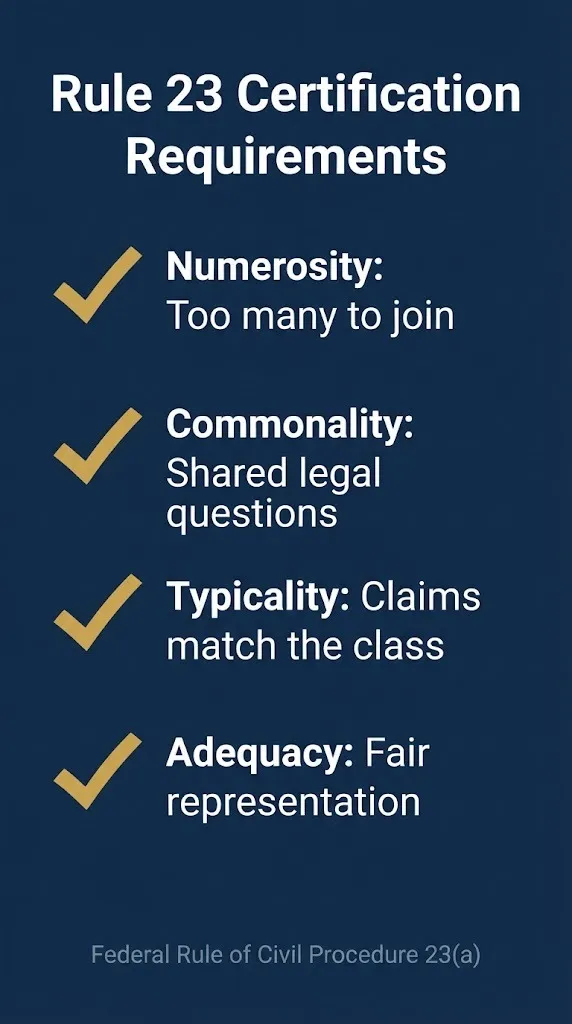
First, the plaintiffs must prove four prerequisites under Rule 23(a) :
- Numerosity: The class is so large that joining every member individually is impractical.
- Commonality: The class members share common questions of law or fact.
- Typicality: The named plaintiffs’ claims are typical of the class.
- Adequacy: The named plaintiffs will fairly and adequately protect class interests.
If those four are met, the class must also fit one of three categories under Rule 23(b) . The most common for consumer cases is Rule 23(b)(3), which requires that common questions predominate and that a class action is superior to individual lawsuits.
Courts apply a “rigorous analysis” standard. They do not take the plaintiffs’ word for it. They look at evidence, sometimes conducting mini-trials on the merits to test whether the requirements are truly met .
The certification rate for contested motions was 68% in 2025, up from 63% in 2024 .
Key Takeaway: A putative class action is not a class action yet. The “putative” label disappears only when a judge grants certification after a rigorous analysis of Rule 23’s requirements.
What Are the Four Requirements for Class Certification?
The four requirements are numerosity, commonality, typicality, and adequacy of representation. These come from Rule 23(a) and apply in every federal class action.
Numerosity asks whether the class is large enough that joining every member as an individual plaintiff is impractical . There is no magic number, but classes of 40 or more are usually sufficient. Some courts have certified smaller classes.
Commonality requires questions of law or fact common to the class . The Supreme Court in Wal-Mart v. Dukes held that commonality requires more than just raising common questions. The claims must depend on a common contention capable of classwide resolution .
Typicality means the named plaintiff’s claims are typical of the class . If the class representative suffered a different injury than the class members, typicality fails. The claims must be “sufficiently interrelated” so that adjudicating the representative’s claims will resolve common issues .
Adequacy of representation asks whether the named plaintiffs and their lawyers will fairly protect the class . Conflicts of interest, inadequate counsel, or a representative with unique defenses can defeat adequacy.
If any one requirement fails, certification is denied. The class never becomes real.
What Happens to Class Members Before Certification?
Before certification, potential class members have no formal rights or obligations. They are not parties. They are not bound by anything that happens.
The case proceeds as an individual lawsuit filed by the named plaintiffs. Discovery happens. Motions are filed. Settlement negotiations may occur. But the “class” is not legally recognized.
This means you do not receive notice. You cannot opt out. You cannot file a claim. You have no standing to intervene.
The one exception is if a settlement is reached before certification. Under Rule 23(e), any settlement of a certified class or a class “proposed to be certified for purposes of settlement” requires court approval . In New York, the Court of Appeals held in Desrosiers v. Perry Ellis that notice and approval are required even for settlements reached before a certification ruling .
If you see a headline about a putative class action settlement, that means the parties reached a deal and are asking the court to certify the class for settlement purposes only. That is a different pathway than litigation certification.
Reality Check: No one will text you asking for your bank information to join a putative class action. Filing claims in real class action settlements is always free. Third parties charging “processing fees” to enroll you are unnecessary and often predatory.
What Rights Do You Have in a Certified Class Action?
After certification, you gain notice rights, opt-out rights, and the right to object to settlements. These protections exist only for certified classes, primarily under Rule 23(b)(3).
For Rule 23(b)(3) damages classes, every class member must receive notice using the “best practicable” method . The notice explains the claims, the class definition, and your options.
You have the right to opt out . If you exclude yourself, you keep your individual claim and are not bound by the class judgment. The trade-off is that you must pursue your own lawsuit.
You also have the right to object to a proposed settlement. The court holds a fairness hearing before granting final approval .
Judgments in certified class actions bind all class members who do not opt out . That is the power of certification. It converts a proposal into a binding legal relationship.
Frequently Asked Questions
What is a putative class action in simple terms?
A putative class action is a lawsuit that claims to represent a group but has not yet been approved as a class by a judge. The word “putative” means alleged or proposed. Until certification, the group has no legal status.
What is the difference between a putative class action and a certified class action?
A putative class action is proposed. A certified class action is approved. Certification is the judge’s decision that the case meets Rule 23’s requirements for class treatment.
Can you join a putative class action?
No, because the class does not legally exist yet. You become a class member only if and when the court grants certification. At that point, notice and opt-out procedures begin.
How long does it take for a putative class action to be certified?
Certification typically happens 6 to 18 months after the complaint is filed. The timeline depends on discovery and the court’s schedule. Complex cases can take longer.
Do you get money from a putative class action?
Not until the case settles or goes to judgment after certification. If the case settles before certification, the court must still approve the settlement and give notice to the proposed class.
What happens if a putative class action is not certified?
The case proceeds as an individual lawsuit or is dismissed. If certification is denied, the class never becomes real. The named plaintiffs can continue their own claims, but the group is not bound.
Can you opt out of a putative class action?
No. Opt-out rights only apply after certification. Before certification, there is no class to opt out of. You are not bound by anything the court does at the putative stage.
What does “putative class period” mean?
It is the time frame during which the alleged wrongdoing affected the proposed class. In securities cases, the class period defines who may be included if the class is certified.
What Happens Next in a Putative Class Action
Expected 6 to 12 months: Motion for class certification filed after discovery.
Expected 12 to 18 months: Court rules on certification.
If certified: Notice program launches. Class members receive opt-out and claim information.
If not certified: Case continues as individual lawsuit or is dismissed.
After certification: Settlement negotiations or trial. Judgments bind non-opted-out members.
The most important thing to remember is that “putative” is a temporary label. It means the class is proposed, not approved. Until a judge grants certification, you have no rights, no obligations, and no claim to any recovery. Watch for the certification ruling. That is when the case becomes real.