Frivolous Lawsuit: Definition, Consequences, and 2026 Legal Standards
Quick Answer
- A frivolous lawsuit is a legal claim with no basis in fact or law, filed without legitimate purpose.
- Courts can impose monetary sanctions on lawyers and parties who file frivolous claims.
- Counterclaims for frivolous lawsuits exist in most states and can recover attorney fees and costs.
If someone has sued you and you believe the case is baseless, you are probably wondering whether it qualifies as frivolous and what you can do about it. The legal definition is specific.
A frivolous lawsuit is not simply a case you disagree with. It is a claim that no reasonable person would believe has legal merit. The standard is high because courts do not want to punish people for filing legitimate claims that simply lose.
One fact most people do not know: courts rarely declare lawsuits frivolous. The bar is intentionally high to protect access to the legal system.
The Facts
| Case | Frivolous lawsuit standards, general legal principle |
| Status | Active legal doctrine, consistent across jurisdictions |
| Fund Size | Not applicable; sanctions vary by case |
| Est. Per Person | Sanctions range from hundreds to tens of thousands of dollars |
| Claim Deadline | Varies by jurisdiction and underlying claim |
| Administrator | Not applicable |
| Proof Needed | Evidence of no factual or legal basis and improper purpose |
What Is a Frivolous Lawsuit?
A frivolous lawsuit is a legal claim that has no basis in fact or law and is filed for an improper purpose, such as harassment or delay.
The term comes from Rule 11 of the Federal Rules of Civil Procedure and similar state rules. These rules require attorneys and parties to certify that their claims are supported by law and evidence.
A losing case is not automatically frivolous. Many legitimate lawsuits lose because the evidence is weak or the jury disagrees. Frivolous means no reasonable person would have filed the case at all.
Courts look at what the filer knew or should have known at the time of filing. If a reasonable investigation would have shown the claim was baseless, it may be frivolous.
Key Takeaway: A frivolous lawsuit is not just a losing case; it is a claim with no reasonable basis in fact or law, filed for an improper purpose.
What Is the Frivolous Lawsuit Meaning in Legal Terms?
In legal terms, a frivolous lawsuit means a claim that lacks any arguable basis in law or fact. It is the legal equivalent of a claim that should never have been brought.
The legal standard comes from Rule 11 of the Federal Rules of Civil Procedure. An attorney or party signing a pleading certifies that it is not being presented for an improper purpose, the claims are warranted by law, and the factual contentions have evidentiary support.
Many states have adopted similar standards under their own rules of civil procedure. Some states use the term “frivolous” directly in their statutes.
The meaning is consistent across jurisdictions: a claim with no reasonable chance of success and no legitimate purpose.
What Are Some Examples of Frivolous Lawsuits?
Examples of frivolous lawsuits include claims based on facts that are demonstrably false, claims that have already been rejected by higher courts, and claims filed solely to harass the defendant.
A lawsuit against a celebrity for “being famous” with no legal theory would be frivolous. A claim based on a contract that does not exist would be frivolous.
Lawsuits filed after the statute of limitations has expired, with no legal basis for tolling, are often considered frivolous.
Claims that misrepresent what documents say or that ignore binding precedent are candidates for sanctions.
Not every unusual lawsuit is frivolous. Some cases that sound odd have legitimate legal theories. Courts evaluate the specific facts and law, not headlines.
| Example | Why It Is Frivolous |
|---|---|
| Claim based on nonexistent contract | No factual basis |
| Suit filed after deadline with no tolling | No legal basis |
| Claim rejected by higher courts repeatedly | Ignoring binding precedent |
| Suit filed solely to harass | Improper purpose |
| Claim misrepresenting document contents | Bad faith filing |
What Are the Consequences of Filing a Frivolous Lawsuit?
The consequences of filing a frivolous lawsuit can include monetary sanctions, dismissal of the case, and professional discipline for attorneys.
Rule 11 sanctions can require the filing party or attorney to pay the opposing party’s attorney fees and costs incurred in responding to the frivolous claims. These amounts can reach tens of thousands of dollars.
Courts can also dismiss the case with prejudice, meaning it cannot be refiled. This is a serious consequence for any plaintiff.
Attorneys who file frivolous lawsuits can face discipline from their state bar association, including suspension or disbarment in extreme cases.
Repeat frivolous filers may be declared vexatious litigants, requiring court permission before filing any new cases.
Key Takeaway: Filing a frivolous lawsuit can result in monetary sanctions, case dismissal, bar discipline, and restrictions on future filings.
Can You Counterclaim for a Frivolous Lawsuit?
Yes, you can file a counterclaim for a frivolous lawsuit in most jurisdictions. The counterclaim typically seeks recovery of attorney fees, costs, and sometimes additional damages.
A counterclaim for malicious prosecution or abuse of process may be available if the frivolous lawsuit was filed with malice and without probable cause. These are separate claims from Rule 11 sanctions.
Abuse of process claims arise when someone misuses the legal system for an improper purpose, such as forcing a settlement through harassment.
Malicious prosecution claims require showing the original case was filed without probable cause, was motivated by malice, and was resolved in your favor.
These counterclaims are not automatic. You must prove the elements, and the standard is high.
What Is Rule 11 Sanctions?
Rule 11 of the Federal Rules of Civil Procedure allows courts to impose sanctions on attorneys or parties who file frivolous pleadings or motions.
The rule requires that every pleading, motion, or other paper be signed by an attorney or party. The signature certifies that the filing is not for an improper purpose, the legal contentions are warranted, and the factual contentions have evidentiary support.
A party seeking Rule 11 sanctions must serve a motion on the opposing party and give them 21 days to withdraw the frivolous filing. If the filing is not withdrawn, the motion goes to the court.
Courts can impose sanctions on their own initiative as well. Sanctions can include attorney fees, court costs, and non-monetary directives.
Many states have similar rules under their own civil procedure codes.
How Do Courts Determine If a Lawsuit Is Frivolous?
Courts determine whether a lawsuit is frivolous by examining what the filer knew or should have known at the time of filing, the legal basis for the claim, and the purpose of the filing.
The standard is objective, not subjective. A court does not ask what the filer actually believed. It asks what a reasonable person would have believed after reasonable investigation.
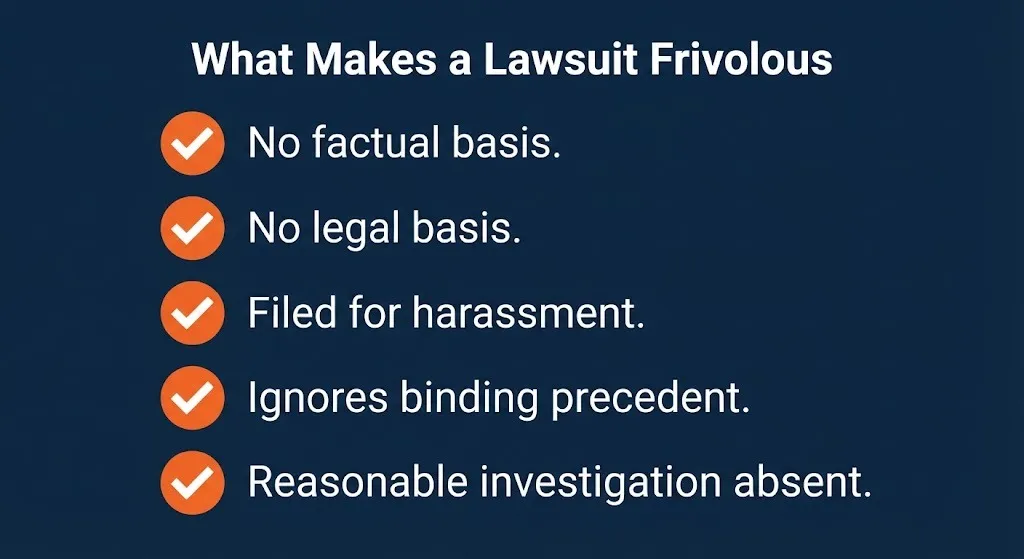
If a reasonable investigation would have revealed no factual basis for the claim, the lawsuit may be frivolous even if the filer genuinely believed it.
The legal basis is evaluated against existing law and reasonable extensions of the law. A claim is not frivolous simply because it seeks to change existing law through a good faith argument.
The purpose of the filing matters. A claim filed to harass, delay, or increase costs may be frivolous even if it has some superficial merit.
What Is the Difference Between a Frivolous Lawsuit and a Losing Lawsuit?
A losing lawsuit is a legitimate claim that fails on the merits. A frivolous lawsuit is a claim that should never have been filed at all.
Every lawsuit has a winner and a loser. The losing side is not automatically subject to sanctions. Sanctions require showing the claim was baseless from the start.
A case that loses on summary judgment may have been perfectly legitimate. The evidence was insufficient, but the claim had a reasonable basis.
A frivolous case is one where no reasonable attorney would have believed the claim could succeed. The distinction protects the right to bring good faith claims while punishing abuse of the system.
Key Takeaway: Losing a case is not the same as filing a frivolous one, and courts protect good faith claims while punishing abuse.
What Should You Do If You Are Sued in a Frivolous Lawsuit?
If you are sued in a frivolous lawsuit, you have options. Do not ignore the case, even if you believe it is baseless.
First, consult an attorney. A lawyer can evaluate the claim and advise you on the best response. Ignoring a lawsuit can result in a default judgment against you.
Second, preserve evidence. Document everything related to the dispute. Keep copies of all communications and records.
Third, consider filing a motion to dismiss or a motion for sanctions. Your attorney can determine the best procedural response.
Fourth, consider a counterclaim for malicious prosecution or abuse of process if the facts support it.
Reality Check
A lawsuit is not frivolous just because you think it is unfair or annoying. Courts set a high bar for sanctions to protect legitimate claims. If you believe a case against you is truly baseless, you need an attorney to document the lack of factual and legal support. Sanctions are rarely imposed, and counterclaims require proving malice and lack of probable cause.
What Happens Next
Day 1 to 30: You consult an attorney and respond to the lawsuit.
Month 1 to 3: Your attorney evaluates whether a motion to dismiss or sanctions motion is appropriate.
Month 3 to 6: If sanctions are pursued, the court reviews the filings and determines whether the standard is met.
TBD: A decision on sanctions or dismissal is issued by the court.
Frequently Asked Questions
What is a frivolous lawsuit?
It is a legal claim with no basis in fact or law, filed for an improper purpose.
A losing case is not automatically frivolous.
Can I sue someone for filing a frivolous lawsuit?
Yes, you may have a counterclaim for malicious prosecution or abuse of process.
You must prove malice, lack of probable cause, and that the case resolved in your favor.
What are Rule 11 sanctions?
Rule 11 allows courts to impose monetary sanctions for frivolous filings.
Sanctions can include attorney fees and costs.
How much can I recover for a frivolous lawsuit?
Recovery varies by case and jurisdiction.
It typically includes attorney fees and costs incurred responding to the frivolous claim.
Is a frivolous lawsuit a crime?
No, filing a frivolous lawsuit is not a crime.
But it can result in sanctions, discipline, and civil liability.
What is a vexatious litigant?
A vexatious litigant is someone who repeatedly files frivolous lawsuits.
Courts can require them to obtain permission before filing new cases.
How often are frivolous lawsuit sanctions imposed?
Sanctions are rare because the standard is intentionally high.
Courts balance punishing abuse against protecting legitimate claims.
Can I ignore a frivolous lawsuit?
No, you must respond to avoid a default judgment.
Consult an attorney even if you believe the case is baseless.
Your next step is to take the lawsuit seriously and consult an attorney. The law gives you tools to fight frivolous claims, but you must use them correctly.
The most important fact is this: courts rarely declare lawsuits frivolous, and the standard is high. But when a case crosses the line, sanctions and counterclaims are available. Document everything and act promptly.