Attorneys for Lawsuit in 2026: How to Find the Right Lawyer and What They Actually Cost
Quick Answer
- Finding an attorney for a lawsuit means matching your case type to lawyers who handle that specific work, not just any lawyer you find online.
- Most plaintiff-side attorneys for injury and consumer cases work on contingency, meaning you pay nothing unless you recover money.
- Always verify an attorney’s bar license and disciplinary history before signing a fee agreement or retainer.
Hiring an attorney for a lawsuit is not like picking a doctor from an insurance network. There is no central directory that tells you who is good, who is affordable, and who actually wins cases like yours. You have to do the matching yourself, or use a referral service that does it for you.
The stakes are high because the wrong lawyer can cost you the case entirely. A lawyer who handles real estate closings is not the right person for a patent dispute. A general practitioner may not know the local rules in federal court.
This article explains how to find attorneys for a lawsuit in 2026, what different fee structures mean for your wallet, how to check credentials, and the red flags that signal you should walk away. You will also see the average hourly rates by experience level and what contingency percentages look like in practice.
Is hiring an attorney for a lawsuit worth it, or can you handle it yourself?
Hiring an attorney for a lawsuit is worth it when your case involves complex legal rules, significant money, or an opponent with lawyers of their own. You can represent yourself in many civil cases, but you will be held to the same rules as a licensed attorney.
Pro se litigation, meaning representing yourself, is allowed in federal and state courts. Courts publish guides for people who go this route. But those same guides warn that you must follow every procedural rule, meet every deadline, and know how to present evidence.
The gap between what a lawyer knows and what a non-lawyer knows is real. Lawyers know how to draft complaints that survive motions to dismiss. They know how to conduct discovery and take depositions. They know when to settle and when to push for trial.
That said, hiring a lawyer is not always worth the cost. Small claims court exists for disputes under a few thousand dollars. Consumer courts in some jurisdictions are designed for people to file without representation. If your case is straightforward and the money at stake is modest, self-representation may make sense.
The honest answer depends on what you stand to lose. If you are fighting over $500, the math rarely works. If you are fighting over $50,000, or your home, or your livelihood, the math usually does.
Key Takeaway: Hiring an attorney makes sense when the stakes are high or the other side has lawyers, but small claims and consumer courts are designed for people to handle their own cases.
What do attorneys for a lawsuit cost in 2026?
Attorney fees for lawsuits in 2026 range from $150 per hour for junior lawyers to over $1,500 per hour for senior partners, with contingency fees typically running 25% to 40% of your recovery in plaintiff-side cases. What you pay depends on the fee structure, not just the hourly rate.
Here is how the main fee structures compare:
| Fee Structure | How It Works | Best For |
|---|---|---|
| Hourly | You pay for each hour (or 0.1 hour) of work | Complex litigation, business disputes |
| Flat fee | One set price for a defined task | Contract review, simple filings, uncontested matters |
| Contingency | Lawyer takes 25% to 40% of your recovery | Personal injury, consumer class actions |
| Retainer | Upfront deposit, then billed against it | Ongoing legal needs, business clients |
Hourly rates vary by experience level and location. A junior lawyer in a small market might charge $150 to $275 per hour. A senior partner in New York or San Francisco can charge $700 to $1,500+ per hour.
Contingency fees are the standard for plaintiff-side injury and consumer cases. You pay nothing upfront, and the lawyer takes a percentage of whatever you recover. If you recover nothing, you owe nothing for fees. The percentage often rises if the case goes to trial or appeal.
Key Takeaway: The fee structure matters as much as the rate, and contingency arrangements mean you can hire a lawyer without paying upfront in most injury and consumer cases.
What is the Reality Check on attorney fees and promises?
Reality Check: No legitimate attorney can guarantee you a specific outcome or a specific settlement amount before reviewing your case. If a lawyer promises you will win a certain dollar figure before they have seen your evidence, that is a sales pitch. Also, contingency fees mean the lawyer only gets paid if you recover, but you still owe them nothing if you lose. Read every fee agreement carefully, and never pay a “consultation fee” that was not disclosed upfront.
How do you find the right attorney for your lawsuit?
You find the right attorney for your lawsuit by matching your case type to lawyers who handle that specific work, then verifying their credentials through bar directories and disciplinary records. The right attorney is not the cheapest or the most advertised. It is the one who has handled cases like yours.
Start with these steps:
- Identify your case type (personal injury, employment, patent, consumer, etc.) and the jurisdiction where it will be filed.
- Search bar association directories for lawyers who list that practice area in your state.
- Check attorney rating services like Avvo, Best Lawyers, or Super Lawyers to see peer recognition and client reviews.
- Verify bar status through your state bar’s online attorney search to confirm they are licensed and in good standing.
- Check disciplinary history on the same state bar site to see if they have been sanctioned or suspended.
- Look for certified specialists if your state offers certification in your case type.
- Schedule consultations with two or three candidates and ask about their experience with cases like yours.
The Duke Law Library guide to attorney directories recommends starting with your state or local bar association website. Those sites often let you search by practice area and location, and they provide disciplinary history that commercial directories may not show.
Attorney directories like Avvo, Lawyers.com, and Super Lawyers can help you filter by location and practice area. But remember that those services often sell advertising, so a high listing does not always mean the best lawyer.
Key Takeaway: Finding the right attorney means verifying their license, checking disciplinary history, and matching their actual experience to your case type, not just picking the first name you find online.
What should you ask an attorney before hiring them?
You should ask an attorney before hiring them about their experience with cases like yours, their fee structure, who will actually handle your case, and what they expect to happen at each stage. A lawyer who cannot answer these questions clearly is not the right fit.
Here are the questions that matter most:
- How many cases like mine have you handled? Look for specific experience, not general practice.
- What is your fee structure, and what costs are extra? Filing fees, expert witness fees, and deposition costs add up.
- Will you handle my case personally or will an associate or paralegal do most of the work? This affects both quality and cost.
- What is your realistic assessment of my case? A good lawyer will tell you the weaknesses, not just the strengths.
- How will you communicate with me, and how often? Some lawyers send monthly updates. Some only call when something happens.
- What happens if we lose? In contingency cases, you owe nothing for fees, but you may still owe costs.
- Do you have malpractice insurance? Most states require it, but you should confirm.
The fee agreement should be in writing before any work begins. Read it carefully, and do not sign anything you do not understand. If the lawyer rushes you or dismisses your questions, that is a warning sign.
Key Takeaway: The best attorney for your case will welcome your questions and give you straight answers about fees, experience, and realistic outcomes.
What are the red flags when choosing an attorney for a lawsuit?
The biggest red flags when choosing an attorney for a lawsuit are guaranteed outcomes, pressure to sign immediately, unclear fee structures, and a lack of specific experience with your case type. Any one of these should make you pause.
Watch for these warning signs:
- Guaranteed results. No ethical lawyer can promise a specific outcome before reviewing your case.
- Pressure to sign immediately. Good lawyers give you time to consider the agreement.
- Vague fee explanations. If the lawyer cannot explain exactly what you will pay and when, walk away.
- No written fee agreement. Most states require written agreements for contingency cases.
- Bad reviews or disciplinary history. Check the state bar site before you sign.
- No malpractice insurance. Ask for proof.
- Poor communication during the consultation. If they are hard to reach before you hire them, it gets worse after.
Trust your instincts. If something feels off during the consultation, it probably is. There are plenty of qualified attorneys who will treat you with respect.
Key Takeaway: Walk away from any attorney who guarantees outcomes, pressures you to sign, or cannot explain their fees in plain language.
How do you check an attorney’s credentials and disciplinary history?
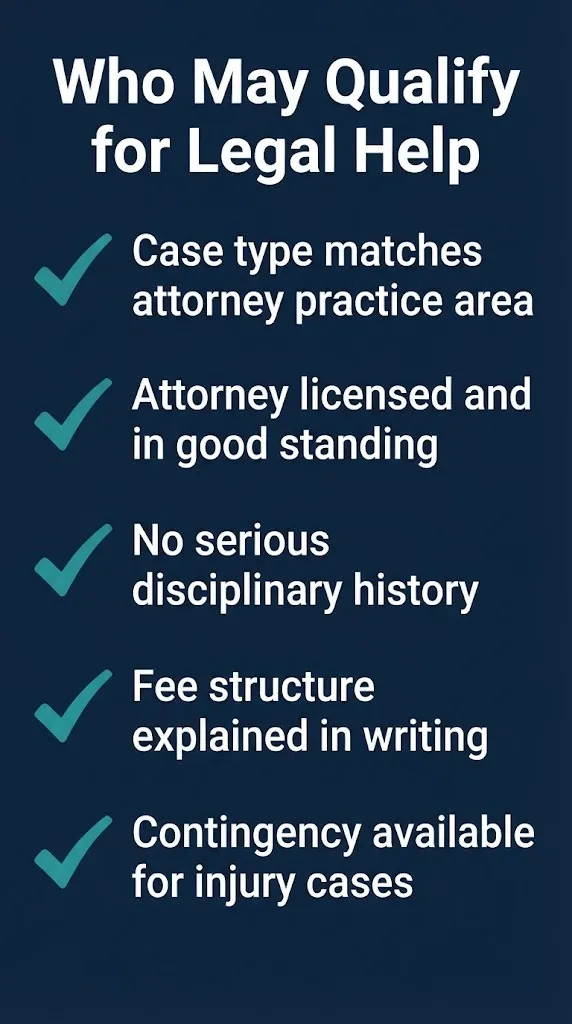
You check an attorney’s credentials and disciplinary history through your state bar association’s online attorney search, which shows license status, disciplinary actions, and sometimes practice areas and education. This takes five minutes and can save you from a serious mistake.
Every state bar maintains a searchable database of licensed attorneys. The State Bar of California, for example, lets you search by name, firm, location, and certified specialty. New York’s system allows search by attorney name.
On those sites, you can see:
- Whether the attorney is currently licensed and in good standing
- Any public disciplinary actions, suspensions, or disbarment proceedings
- Their educational background and admission date
- Whether they are certified as a specialist in a particular area
The Duke Law Library guide recommends using bar association sites for exactly this reason: they are the authoritative source, not a commercial directory. Commercial sites may not update as quickly or may omit negative information.
If you find a disciplinary action, read the details. A minor reprimand is different from a suspension for mishandling client funds. When in doubt, call the bar association and ask for clarification.
Key Takeaway: Five minutes on your state bar’s website will tell you whether an attorney is licensed, in good standing, and free of serious disciplinary problems.
What happens next after you hire an attorney for a lawsuit?
After you hire an attorney, the next steps depend on your case type, but the general sequence involves investigation, filing, discovery, and either settlement or trial. Your lawyer should explain the expected timeline and keep you informed at each stage.
Here is the typical flow for a civil lawsuit:
Initial investigation: Your attorney gathers evidence, interviews witnesses, and assesses the strength of your claim. This can take weeks or months.
Demand or complaint: In many cases, your lawyer sends a demand letter first. If that fails, they file a complaint in court.
Discovery: Both sides exchange documents, take depositions, and build their cases. This is often the longest phase.
Settlement talks or mediation: Most cases settle before trial. Your lawyer negotiates on your behalf.
Trial: If no settlement is reached, the case goes to trial. This is rare in civil cases.
Appeal: The losing side may appeal, which adds more time.
Your lawyer should give you a realistic timeline at the start and update you when things change. If you do not hear from them for months, that is a problem worth addressing.
Frequently Asked Questions
How do I find an attorney for a lawsuit near me?
Search your state bar association’s online directory and filter by practice area and location. Bar association sites are the most reliable source because they show license status and disciplinary history.
How much does it cost to hire an attorney for a lawsuit?
Costs range from $150 to $1,500+ per hour depending on experience and location, or 25% to 40% of your recovery in contingency cases. Many injury and consumer lawyers offer free initial consultations.
Do I need an attorney for small claims court?
No, small claims court is designed for people to file without lawyers. Many jurisdictions do not even allow attorneys in small claims proceedings.
What is a contingency fee for a lawsuit?
A contingency fee means your lawyer takes a percentage of whatever you recover, typically 25% to 40%, and you pay nothing upfront. If you lose, you owe nothing for fees.
Can I represent myself in a lawsuit?
Yes, you can represent yourself in most civil cases. Courts call this proceeding “pro se” and provide informational guides, but you must follow all the same rules as a licensed attorney.
How do I check if an attorney has complaints against them?
Go to your state bar association’s website and search for the attorney by name. The results will show any public disciplinary actions, suspensions, or other conduct issues.
What questions should I ask at an initial consultation?
Ask about their experience with cases like yours, their fee structure, who will handle your case, their realistic assessment of your claim, and how they communicate with clients.
What if I cannot afford an attorney for my lawsuit?
Look for legal aid organizations, pro bono programs through bar associations, or law school clinics. For injury and consumer cases, contingency fee arrangements mean you pay nothing upfront.
Your next step
Open your state bar association’s website right now and search for two or three attorneys who handle your case type. Check their license status and disciplinary history before you call anyone. That five-minute check is the difference between hiring a qualified lawyer and hiring someone who should not be practicing. If your case involves personal injury or consumer claims, ask about contingency fees first, because you may not need to pay anything out of pocket.