International Litigation Law Firm 2026: How to Choose Cross-Border Counsel, What It Costs, and When It’s Worth It
Quick Answer
- An international litigation law firm handles disputes that cross national borders, including foreign judgment recognition, asset tracing, and multi-jurisdiction enforcement.
- Costs vary widely by market. Court-appointed counsel rates in international tribunals run from €109.80 to €150.80 per hour depending on experience .
- U.S. recognition of foreign judgments is governed by state law, not federal statute. Most states follow the Uniform Foreign-Country Money Judgments Recognition Act .
A cross-border dispute is not just a domestic case with a passport. You need counsel who understands where the defendant’s assets are, which courts will actually enforce the ruling, and how long the money will take to reach you.
If you hold a foreign judgment and the debtor has assets in New York, you might file in the Southern District of New York to register that judgment under the state’s recognition statute. If the debtor’s assets are in Singapore or Dubai, you need a different strategy entirely.
This guide explains what international litigation firms do, what they charge, how to evaluate them, and the specific legal mechanics that determine whether you ever collect.
The Facts
| Item | Detail |
|---|---|
| Governing framework (U.S.) | State law, primarily the Uniform Foreign-Country Money Judgments Recognition Act |
| Arbitration enforcement | New York Convention and Federal Arbitration Act |
| Best U.S. forum for recognition | New York state courts, narrow non-enforcement grounds, expedited procedures |
| Court-appointed counsel rates (international tribunals) | €109.80 to €150.80 per hour based on experience |
| Private international litigation lawyer rates | €230 to €450+ per hour depending on jurisdiction and complexity |
| Estimated fees in 2026 | Not a flat number. Depends on jurisdiction, case complexity, and fee structure |
What Does an International Litigation Law Firm Actually Do?
An international litigation law firm handles disputes involving parties, courts, or assets in more than one country. The work goes beyond filing complaints and arguing motions.
Core services include foreign judgment recognition, cross-border asset tracing, and enforcement actions in multiple jurisdictions. Firms like Lalive and Baker McKenzie maintain offices across Europe, Asia, Africa, and the Americas specifically to coordinate these matters .
When you obtain a judgment in a foreign court, the firm’s job is to get that judgment recognized in the country where the defendant holds assets. In the U.S., that means filing under a state recognition statute, typically the Uniform Foreign-Country Money Judgments Recognition Act .
After recognition, the firm pursues collection through garnishment, liens, and post-judgment discovery. Asset tracing often happens before filing. As one practitioner notes, too many creditors spend heavily proving a foreign judgment is enforceable before checking whether the debtor owns anything they can reach .
Key Takeaway: An international litigation firm’s value is not just winning the case. It is knowing which courts will enforce the win and where the defendant’s money actually sits.
How Much Does an International Litigation Lawyer Cost in 2026?
International litigation lawyer rates in 2026 range from roughly €110 to €450 per hour or more, depending on the tribunal, jurisdiction, and counsel’s experience. There is no single global rate.
For counsel appointed before the International Residual Mechanism for Criminal Tribunals (IRMCT), January 2026 rates run from €109.80 per hour for lawyers with 0 to 9 years of experience to €150.80 per hour for those with 20 or more years . Co-counsel receives a fixed €109.80 per hour.
Private international civil servants and cross-border litigators charge more. The FICSA legal adviser roster shows hourly rates ranging from €230 to €450, with some advisers charging CHF 300 to CHF 500 .
U.S.-based litigation attorneys command $150,000 to $220,000 annually for in-house roles, but private practice rates for international matters are typically billed hourly or on contingency .
| Counsel Type | Hourly Rate Range |
|---|---|
| IRMCT-appointed lead counsel (0-9 years) | €109.80 |
| IRMCT-appointed lead counsel (20+ years) | €150.80 |
| Private international civil servant counsel | €230 to €450+ |
| Swiss-based international litigator | CHF 300 to CHF 500 |
For cross-border disputes, many firms now offer alternative fee arrangements, including capped fees, fixed-fee stages, and success-based bonuses. A Swiss adviser quoted rates of €150 to €300 per hour with a fixed-fee plus success bonus structure in limited cases .
Is International Litigation Worth the Cost for Consumer Claims?
International litigation is rarely worth the cost for individual consumer claims. The economics only work when the amount in dispute justifies five-figure legal fees and months of cross-border coordination.
A $5,000 consumer dispute against a foreign company will almost always cost more to litigate internationally than it could ever recover. Even a straightforward foreign judgment recognition action in New York requires filing fees, translation costs, authenticated documents, and attorney time .
The calculus changes for commercial disputes. A company owed $500,000 by a foreign supplier may find enforcement worthwhile. A judgment creditor holding a $2 million foreign award against a defendant with reachable assets in multiple jurisdictions has a strong case for hiring cross-border counsel.
Before hiring anyone, assess whether the debtor owns anything you can reach. A judgment is just paper if the defendant has no assets in jurisdictions where you can enforce it .
Key Takeaway: International litigation only makes financial sense when the disputed amount significantly exceeds the cost of cross-border enforcement. For most consumer claims, it doesn’t.
How Do You Recognize and Enforce a Foreign Judgment in the U.S.?
A foreign judgment is not automatically enforceable in the United States. You must first obtain recognition under state law, then pursue collection using the forum state’s procedures .
The U.S. is not a party to any treaty requiring recognition of foreign court judgments. That means each state decides for itself which foreign judgments to enforce. Most states have adopted the Uniform Foreign-Country Money Judgments Recognition Act .
The Act requires that the foreign judgment be final, conclusive, and enforceable where it was issued. It must grant or deny recovery of a sum of money. Judgments for taxes, fines, penalties, and domestic relations matters are excluded .
New York is often the best forum for recognition. The state has narrow grounds for non-enforcement and expedited procedures for summary judgment . Once you obtain recognition in one state, getting it recognized elsewhere is usually straightforward.
Here’s what you need before filing:
- Authenticated copy of the judgment with a certified translation.
- Proof the judgment is final and enforceable in the issuing country.
- Service records and pleadings showing the defendant had notice and an opportunity to defend.
- Information on any pending appeals or challenges in the foreign jurisdiction.
- A current calculation of the amount due, including interest and currency conversion .
Default judgments face extra scrutiny. U.S. courts will examine jurisdiction, service, and whether the defendant had a fair chance to participate .
What Can a Judgment Debtor Do to Resist Recognition?
A judgment debtor can resist recognition by challenging jurisdiction, notice, or public policy, but cannot relitigate the merits of the foreign decision. U.S. courts generally will not revisit whether the foreign court got the law right .
The strongest defenses are lack of jurisdiction and improper service. If the foreign court never had a valid basis to exercise jurisdiction over the defendant, U.S. courts may decline recognition. The same applies if the defendant never received proper notice of the proceedings .
Corporate identity matters. A judgment against a subsidiary does not automatically bind the parent company or its owners. If the foreign court imposed personal liability on someone who was never named or served, that raises due process concerns .
Public policy is a narrower defense. Courts may decline recognition if enforcing the judgment would violate the forum state’s public policy. This is rarely successful in commercial cases .
A company that voluntarily appeared in the foreign proceeding and failed to object to jurisdiction will have a much harder time resisting recognition in the U.S. .
How Do You Choose the Right International Litigation Firm?
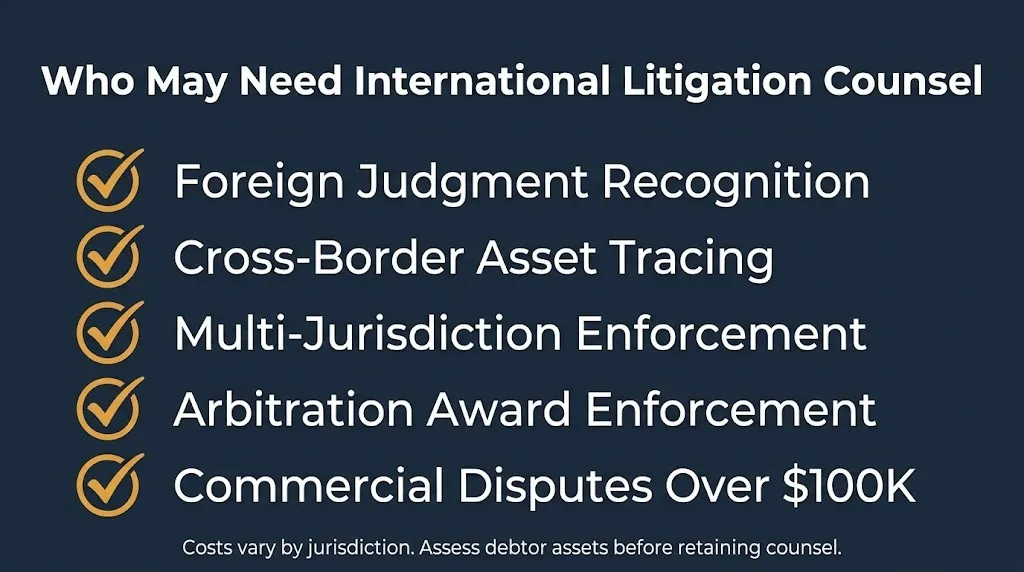
Choose an international litigation firm based on where your defendant’s assets are, not where the firm’s headquarters sits. The best firm for your case has attorneys licensed in the jurisdictions that matter.
Baker McKenzie maintains over 1,000 disputes lawyers globally across Europe, Asia, Australia, Africa, and the Americas . Lalive, with offices in Geneva, Zurich, and London, focuses on complex, high-value cross-border disputes . Norton Rose Fulbright has disputes teams across the UK, North America, the Middle East, Asia, and Africa .
These firms serve corporate clients and high-net-worth individuals. For consumer claims, look for regional firms with international enforcement experience in the specific jurisdictions you need.
Key questions to ask any firm:
- Where are the debtor’s assets located? The answer determines which courts and counsel you need.
- Have you enforced judgments in those jurisdictions before? Ask for specific examples.
- Who is your local counsel? International firms usually partner with local lawyers for filings.
- What is the fee structure? Hourly, capped, contingency, or hybrid.
- What is the realistic timeline? Recognition and collection can take months or years.
- What happens if the debtor has no reachable assets? Know the risk before you spend.
The International Bar Association’s 2026 Litigation Committee newsletter notes that obtaining evidence abroad, establishing jurisdiction, and securing recognition remain the core challenges in cross-border disputes . Your firm should have specific experience with those mechanics in your target jurisdictions.
Reality Check: No international litigation firm can guarantee collection. A judgment is only as good as the debtor’s reachable assets. Before paying a retainer, ask the firm to assess whether collection is realistically possible. If the debtor has no assets in enforceable jurisdictions, the best lawyer in the world cannot get you paid.
What Trends Are Shaping International Litigation in 2026?
International litigation in 2026 is shaped by AI-driven claim identification, third-party litigation funding, and growing cross-border coordination among claimant firms. These trends affect both commercial disputes and consumer class actions.
DLA Piper’s 2026 Global Class Action Summit highlighted that litigation funding has industrialized collective claims. Funders now invest in portfolios of claims across multiple jurisdictions. Cross-border coordination among claimant firms has increased in frequency and sophistication .
AI is creating new categories of exposure. Plaintiffs’ firms are using AI to identify class action opportunities and file hundreds of claim forms across jurisdictions at very low cost. This accelerates the volume and speed of claims .
Baker McKenzie’s 2026 Global Disputes Forecast found that 82% of respondents are concerned about cross-border or multi-agency investigations in the next 12 months. Cross-border coordination challenges, including data preservation and conflicting privacy rules, limit investigation preparedness .
The IBA Litigation Committee’s autumn 2026 newsletter identifies AI and digitalization as changing both the practice of litigation and the disputes reaching courts. Sanctions and geopolitical tensions increasingly affect commercial disputes .
Frequently Asked Questions
What does an international litigation law firm do?
It handles disputes involving parties, courts, or assets in multiple countries, including foreign judgment recognition, asset tracing, and cross-border enforcement.
How much does an international litigation lawyer cost?
Rates range from €110 to €450+ per hour depending on jurisdiction and experience. Some firms offer capped fees or success-based arrangements .
Can I enforce a foreign judgment in the United States?
Yes, if the judgment meets state recognition requirements. Most states follow the Uniform Foreign-Country Money Judgments Recognition Act .
Which U.S. state is best for recognizing a foreign judgment?
New York is often preferred because it has narrow grounds for non-enforcement and expedited procedures .
What defenses can a debtor raise against recognition?
Lack of jurisdiction, improper notice, and public policy violations are the primary defenses. The merits of the foreign decision generally cannot be relitigated .
Is international litigation worth it for small claims?
Rarely. Legal costs usually exceed the disputed amount unless the claim is substantial and the debtor has reachable assets .
What is the New York Convention?
It is a treaty for enforcing foreign arbitration awards, separate from court judgment recognition. The U.S. is a party to it .
How long does foreign judgment recognition take?
Timelines vary by jurisdiction. New York offers expedited procedures, but recognition can still take months .
What Happens Next: Choosing Your Cross-Border Counsel
Immediately: Identify where the defendant’s assets are located. No enforcement strategy works without reachable assets.
Within days: Determine which jurisdiction offers the best recognition procedures for your judgment type. New York is often preferred for foreign money judgments .
Within weeks: Interview firms with specific experience in your target jurisdictions. Ask for examples of enforcement actions they have completed there.
Before retaining: Request a written assessment of collection prospects. A good firm will tell you if the debtor has nothing to seize.
Ongoing: Monitor the debtor’s asset movements. Post-judgment discovery can reveal transfers, new accounts, or property that becomes reachable.
The most important step is the first one: find the assets. A foreign judgment is just a piece of paper until you know where the money is and which court will help you reach it.