What Resources Are Utilized When a Litigation Hold Is Lifted in 2026: People, Systems, and the Paper Trail That Protects You
Quick Answer
- Lifting a litigation hold requires coordinated effort from legal, IT, records management, and compliance personnel.
- Technology resources include legal hold software, eDiscovery platforms, email and collaboration systems, and backup archives.
- A formal written release notice and a documented audit trail are the most important resources, because they prove the release was defensible.
When a litigation hold is lifted, the resources you need are not just software and servers. They are people with specific roles, and a paper trail that shows the release was authorized, scoped, and executed properly .
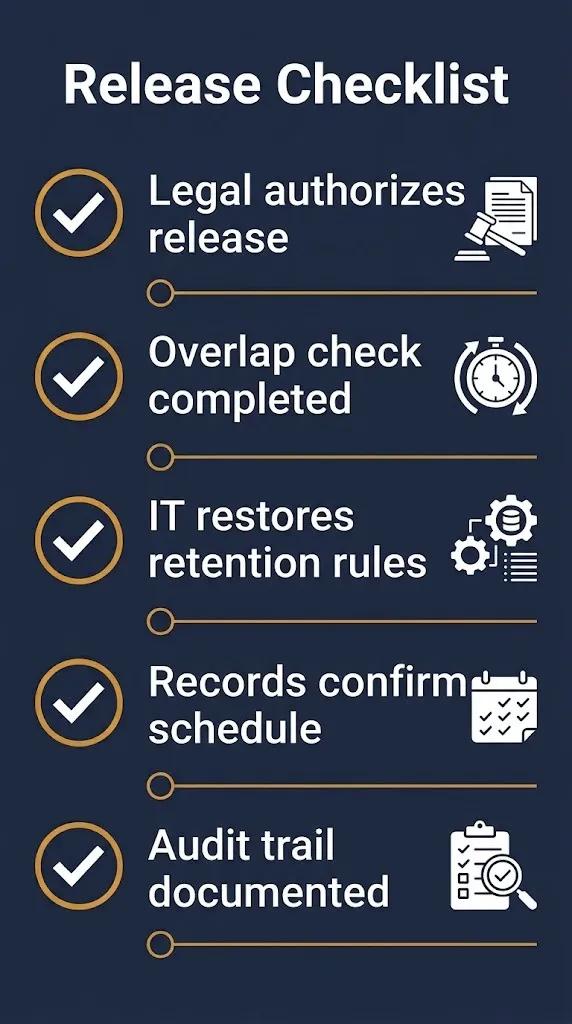
The legal team confirms the matter is truly over and no related holds remain. IT reinstates the deletion rules that were paused. Records management checks whether any regulatory retention schedule still applies. If any one of those steps is skipped, the organization can face sanctions for destroying evidence it was still obligated to keep .
This article covers who does what when a hold is released, which systems must be touched, what documents you need to create, and why the release decision is as important as the original preservation notice. One detail that surprises many people: a hold release does not mean automatic deletion. It means the legal bar on routine disposition is removed, and normal retention schedules take over .
The Facts
| Item | Verified Detail |
|---|---|
| Core Teams Involved | Legal, IT, records management, compliance, information governance |
| Key Technology | Legal hold software, eDiscovery platforms, email/chat systems, backup archives |
| Critical Document | Formal written hold release notice to custodians |
| Release Trigger | Settlement, dismissal, final judgment, or completed investigation |
| Deletion Rule | Data returns to standard retention schedule, not automatic destruction |
| Audit Requirement | Documented rationale, authorization, and scope of release |
| Overlap Check | Confirm no other active holds or regulatory obligations apply |
| Risk of Failure | Spoliation sanctions, adverse inference, loss of defensibility |
Is lifting a litigation hold just about deleting data?
Lifting a litigation hold is not about deleting data. It is about ending the legal obligation to preserve specific data, which allows normal retention schedules to resume. The resources you use are the people and systems that make that transition defensible.
The confusion comes from the word “lifted.” It sounds like a switch is flipped and everything gets erased. That is not what happens. A release removes the legal bar on disposition, but the data may still need to be kept under tax rules, industry regulations, or a separate legal matter .
The real resource that matters at this stage is documentation. The release decision, the authorization, the scope, and the date all need to be recorded. Without that paper trail, an organization cannot prove it acted reasonably if the release is challenged later .
Who is involved in lifting a litigation hold?
Four groups are involved in lifting a litigation hold: the legal department, IT and information governance, records management, and compliance. Each has a distinct role, and skipping one creates a gap in the release process.
Legal counsel confirms the matter is fully resolved, including appeal windows and related regulatory follow-ups. They authorize the release and issue the formal notice to custodians .
IT and information governance handle the technical side. They reinstate automated deletion rules, remove preservation controls from email and collaboration platforms, and confirm that server-level holds are actually lifted .
Records management checks the data against retention schedules. Some records must be kept longer for tax, HR, or regulatory reasons even after the litigation hold ends .
Compliance ensures the release does not conflict with privacy laws, industry rules, or internal policies. For regulated sectors like healthcare or finance, this step is mandatory .
What technology resources are needed to lift a hold?
The technology resources needed to lift a hold include legal hold management software, eDiscovery platforms, email and collaboration system controls, and backup archive systems. The specific tools depend on where the preserved data lives.
Legal hold software tracks which custodians are on hold, records acknowledgments, and generates the release notices. It also creates the audit trail that proves the release was done properly .
eDiscovery platforms hold collected data and review sets. When a hold is lifted, the organization must decide whether to keep data in the platform, archive it to cheaper storage, or delete it under policy. Leaving data in a hosting environment indefinitely creates unnecessary cost and risk .
Email systems, chat platforms like Slack or Teams, and cloud storage all have their own retention settings. IT must reverse the preservation overrides that were applied when the hold was issued .
Backup systems are easy to overlook. A hold release must account for backup archives, or the data may persist in a form the organization does not realize it still has .
Key Takeaway: The most important technology resource is not the review platform. It is the legal hold management system that records who was released, when, and by whose authority.
What documents do you need to create when a hold is lifted?
You need at least four documents when a hold is lifted: a formal release notice to custodians, an authorization record from legal counsel, a scope and overlap check, and a disposition decision record for the data.
The release notice tells custodians the hold is over and normal retention resumes. It should name the matter, the release date, and the custodians affected. It should be stored with the original hold documentation .
The authorization record shows that someone with authority, usually general counsel or a designated administrator, approved the release. It should include the date and the reason .
The overlap check documents that the organization confirmed no other holds or regulatory schedules require continued preservation. This is the step that prevents the most common post-release mistakes .
The disposition record captures what happened to the data after release. Was it returned to normal retention, archived, or deleted? Who authorized that decision? This record is the organization’s defense if the release is challenged .
What happens to the preserved data after a hold is lifted?
After a hold is lifted, preserved data returns to the organization’s standard retention schedule. Some data is kept because other rules require it. Some is deleted because its retention period has expired. Some is archived for business reasons.
Collected but unproduced ESI is the largest category. It can often be returned to normal retention or deleted once the hold is released, as long as no other obligation applies .
Produced documents and review sets are often kept longer. Many organizations retain them for several years after the case closes to support potential appeals or future related matters .
Privilege logs and attorney work product have their own retention rules and should not be disposed of on the same schedule as general ESI .
Data sitting in eDiscovery hosting environments is a common cost problem. Every post-release workflow needs a decision point: keep it in the platform, move it to cheaper storage, or delete it under policy .
Reality Check: A hold release is not a delete order, and it is not a free pass to destroy everything. Deleting data that is still subject to another hold or a regulatory schedule is spoliation, and the release notice does not protect you. The protection comes from the overlap check and the documented rationale.
Why is documentation the most important resource?
Documentation is the most important resource because it is what proves the release was defensible. Without it, the organization cannot show that it acted reasonably, and courts increasingly scrutinize post-case data management .
The Sedona Conference guidance is clear on this point. Organizations should document the factors considered in lifting or narrowing a hold, the dates, the custodians affected, and the reasons. That record is the defense if a later dispute arises .
The documentation also supports the organization’s own information governance. A hold that is never formally closed accumulates data, increases storage costs, expands future discovery scope, and creates privacy exposure .
The most common failure is not a technical one. It is an organization that lifts the hold informally, tells IT to “turn off the hold,” and never creates a record. Months later, no one can prove the release was authorized or scoped correctly .
What happens next in a hold release workflow?
The next stages in a hold release workflow follow a consistent sequence, with dates depending on the matter and the organization.
Immediately after resolution: Legal confirms the matter is final and appeal windows have closed.
Before any data action: Legal issues the formal release notice and records the authorization.
Before deletion: Records management and compliance check for overlapping holds and regulatory schedules.
After the overlap check: IT reinstates normal retention and deletion rules across all systems.
Ongoing: The organization documents the disposition decision and retains the audit trail with the matter records.
The final step is the one most organizations skip. The release documentation should be stored where it can be found years later, not in a matter management system that gets closed and archived .
Frequently Asked Questions
What does it mean when a litigation hold is lifted?
It means the legal obligation to preserve specific data for that matter has ended. Normal retention and deletion schedules resume, but only after the organization confirms no other obligations apply.
Does lifting a litigation hold mean the data is deleted?
No. A release removes the legal bar on disposition. Data may still be kept under tax rules, industry regulations, or another active hold.
Who authorizes a litigation hold release?
Legal counsel, typically the general counsel or a designated administrator. The authorization should be documented with a date and reason.
What resources are needed to lift a hold technically?
Legal hold software to track custodians and release notices, eDiscovery platforms to manage collected data, and IT access to email, chat, cloud storage, and backup systems.
What happens if data is deleted before a hold is properly lifted?
The organization can face spoliation sanctions, adverse inference instructions, or other penalties. The release must be authorized and documented before any deletion.
How long should release documentation be kept?
There is no single rule. Many organizations keep release records with the matter file for the same period they keep litigation records, often several years after the case closes.
Can a hold be lifted for some custodians but not others?
Yes. A hold can be narrowed or released for specific custodians or data sources if they are no longer relevant, as long as the decision is documented and no other obligation applies.
Your next step is to find the original hold notice and confirm who authorized it. The release must come from the same authority, and it must be written down. A verbal “we’re done with that case” is not a resource. It is the start of a defensibility problem.