Do I Need Workers’ Compensation Insurance in 2026? The State-by-State Rules, Exemptions, and Penalties That Actually Matter
Quick Answer
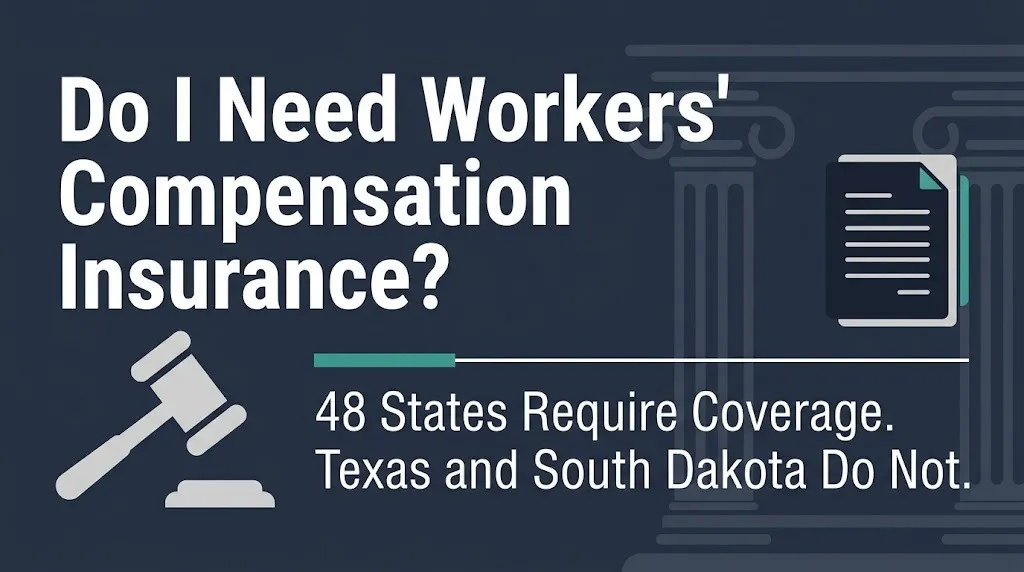
- Workers’ comp is mandatory in 48 states once you hire a certain number of employees, but that threshold varies from one to five .
- Texas and South Dakota are the only states where coverage is optional for most employers, though opting out in Texas leaves you open to lawsuits .
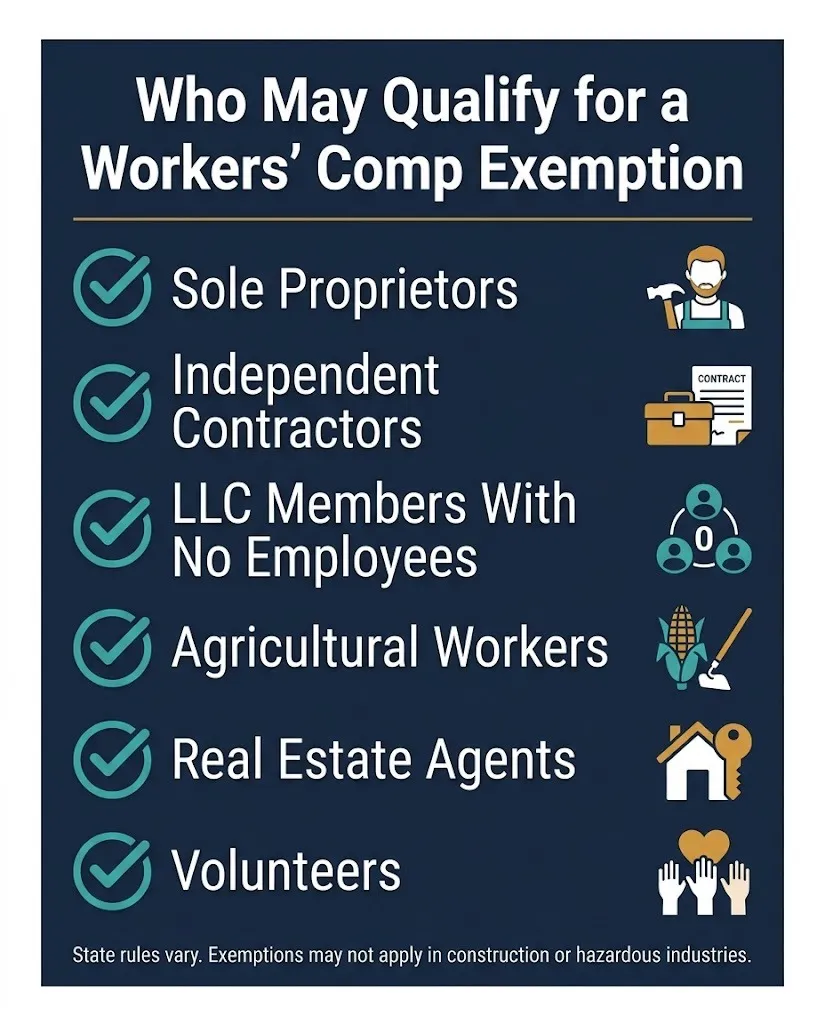
- Sole proprietors, independent contractors, and LLC members with no employees typically don’t need coverage, but construction and hazardous industries often override those exemptions .
Most states require workers’ compensation insurance as soon as you hire your first employee. If you run a business with even one W-2 worker, odds are you’re legally required to carry a policy .
But the rules aren’t uniform. Some states wait until you hire three, four, or five workers. A few carve out exemptions for agricultural laborers, real estate agents, and family members. And two states let employers skip coverage entirely, with serious strings attached .
This guide breaks down the actual thresholds, the exemptions that apply to you, and what happens if you guess wrong. One Connecticut business owner found out the hard way in March 2026 when he was charged with a felony for operating without coverage .
The Facts
| Item | Detail |
|---|---|
| Federal mandate | None. Workers’ comp is state-regulated. |
| States requiring coverage | 48 (all except Texas and South Dakota for most employers) |
| First-employee states | Colorado, Massachusetts, and many others require coverage at one employee |
| Five-employee states | Tennessee, Alabama, and a few others require coverage at five employees |
| Max penalty (California) | Up to $100,000 in fines for noncompliance |
| Criminal exposure | Felony charges possible in Connecticut, Pennsylvania, Illinois, and others |
| Administrator | State workers’ compensation boards, not federal agencies |
Who Actually Needs Workers’ Compensation Insurance?
You need workers’ compensation insurance if your state requires it and you have at least one employee who isn’t exempt. That’s the short answer .
The longer answer depends on three variables: where you operate, how many people work for you, and what kind of work they do.
Most states trigger the requirement at one employee. Colorado, Massachusetts, and a long list of others fall into this category. Hire one person, even part-time, and you’re on the hook .
Other states set higher thresholds. Tennessee and Alabama wait until you have five employees. Arkansas requires coverage at three employees for most businesses, but construction companies with even one employee need it .
The National Association of Insurance Commissioners confirms that workers’ comp coverage is mandatory for most employers in every state except Texas. Texas lets employers opt out, but those who do lose their standard legal defenses if an employee gets hurt .
Who Is Exempt from Workers’ Compensation Insurance?
Exemptions exist, but they’re narrower than most business owners assume. States carve out specific worker categories, not entire industries .
Common exemptions include agricultural workers, volunteers, real estate agents paid solely by commission, and domestic workers. Some states also exempt government workers, though federal employees fall under a separate statute .
Business structure matters too. Sole proprietors, partners, and LLC members often can opt out of coverage for themselves. Corporate officers who own a certain percentage of company stock may qualify for exemption in some states .
Independent contractors are usually exempt, provided they’re genuinely independent. The problem is misclassification. If a worker functions like an employee, your state may reclassify them and require coverage retroactively .
Here’s the trap: an exemption for you doesn’t exempt your employees. If you’re a sole proprietor with three W-2 workers, you can skip coverage for yourself but not for them .
Key Takeaway: Exemptions protect specific people, not entire businesses. One non-exempt employee triggers the coverage requirement even if you personally qualify for an exemption.
Which States Require Workers’ Compensation Insurance at One Employee?
Colorado, Massachusetts, and a majority of states require workers’ comp as soon as you hire your first employee. If you’re in one of these states, there’s no grace period and no minimum headcount .
The one-employee rule catches a lot of small businesses off guard. A solo founder hires a part-time assistant. The assistant works ten hours a week. The state still considers that employment, and coverage becomes mandatory.
California operates under a presumption that anyone who works for an employer is an employee. Independent contractor status requires meeting specific criteria, and most workers don’t qualify .
New York limits exemptions to businesses with no employees at all. If you’re a sole proprietor, partnership, or corporation where the owners hold all stock and offices, and there are no other workers, you may be exempt. Add one employee and the exemption disappears .
What About Texas and South Dakota?
Texas and South Dakota are the only states where workers’ compensation insurance is optional for most employers. That doesn’t mean going without coverage is a good idea .
In Texas, employers who opt out lose their traditional legal defenses if an employee is injured. That means the employee can sue for damages that would otherwise be limited by the workers’ comp system. You could face a jury trial and an uncapped verdict .
South Dakota also doesn’t mandate coverage, but the same litigation exposure applies. Injured workers can pursue civil claims against employers who don’t carry insurance.
Some states have monopolistic workers’ comp funds. North Dakota, Ohio, Washington, and Wyoming require employers to purchase coverage through a state fund rather than a private insurer. Puerto Rico and the U.S. Virgin Islands operate similarly .
Do Sole Proprietors and Independent Contractors Need Workers’ Compensation?
Most sole proprietors and independent contractors don’t need workers’ comp coverage, as long as they have no employees. But hazardous industries create exceptions that override the general rule .
Roofing is the classic example. Several states require workers’ comp coverage for roofers regardless of business structure or employee count. HVAC installation, concrete work, and other construction trades often face similar rules .
Even where coverage isn’t legally required, clients may contractually demand it. General contractors frequently require subcontractors to carry workers’ comp before allowing them on a job site. A ghost policy, which provides a certificate of insurance without full coverage, can satisfy that requirement for some self-employed workers .
The bigger risk is financial. Personal health insurance typically excludes work-related injuries. If you’re a sole proprietor and you fall off a ladder on a job, your medical bills land on you. Workers’ comp would have covered them .
How Do LLCs Handle Workers’ Compensation Requirements?
An LLC with employees needs workers’ comp insurance in virtually every state that mandates coverage. An LLC without employees depends on state rules for member exemptions .
Single-member LLCs often qualify for the same exemptions as sole proprietors. Multi-member LLCs may allow members to opt out, but only if the state permits it and the members file the right paperwork .
The confusion arises when an LLC has non-member employees. Those workers aren’t exempt. The LLC must carry coverage for them even if every member has opted out .
Some states require LLCs to maintain coverage regardless of member exemptions. New Jersey, for example, automatically exempts unpaid interns and volunteers but requires corporations, partnerships, and LLCs to maintain workers’ comp coverage or be approved for self-insurance .
What Happens If You Don’t Have Workers’ Compensation Insurance?
Penalties for operating without required workers’ comp coverage range from fines to criminal charges to jail time. The severity depends on your state and whether the noncompliance was knowing .
New Jersey treats failure to carry coverage as a criminal offense. The penalty can reach $10,000 in fines and up to 18 months in prison. California’s fines can climb to $100,000 .
Illinois escalates the charge from a misdemeanor to a felony for willful failure to obtain insurance. Pennsylvania classifies intentional noncompliance as a third-degree felony with fines up to $15,000 and seven years in jail .
Connecticut provides recent examples. In March 2026, the owner of an Enfield janitorial company was arrested and charged with noncompliance with insurance requirements, a class D felony carrying one to five years in prison and a $5,000 fine . In August 2026, a Bridgeport business owner faced the same charge after an employee was injured while he allegedly lacked coverage .
Beyond criminal exposure, uninsured employers lose their exclusive remedy protection. That’s the legal shield that prevents employees from suing over workplace injuries. Without it, you’re open to civil lawsuits for medical costs, lost wages, and pain and suffering .
Reality Check: No state sends you a check for having workers’ comp insurance. It’s a legal requirement, not a benefit program. If someone contacts you claiming you’re owed money from a workers’ comp policy you never bought, that’s a scam. Workers’ comp pays injured employees, not employers who comply with the law.
How Much Does Workers’ Compensation Insurance Cost in 2026?
Workers’ comp premiums depend on your payroll, your industry’s risk classification, and your claims history. There’s no flat rate .
The National Association of Insurance Commissioners notes that 2026 brings rising medical inflation and pharmacy costs. Higher severity claims are occurring despite lower frequency. Provider shortages are delaying treatment, which can extend claim durations .
Those trends push premiums upward. Low-risk industries like clerical work pay far less than construction, roofing, or trucking. A clerical employee might cost a few hundred dollars per year to cover. A roofer could cost several thousand.
The best way to get an accurate number is to request quotes from licensed insurers in your state. Most carriers provide online quotes within minutes .
How to Get Workers’ Compensation Coverage: 6 Steps
- Confirm your state requires it. Check your state’s workers’ compensation board website for the employee threshold.
- Determine who counts as an employee. Review worker classifications and state-specific tests for independent contractors.
- Gather payroll and job description data. Insurers price policies based on annual payroll and risk class codes.
- Request quotes from licensed carriers. Use an independent agent or go directly to insurers that write coverage in your state.
- Compare coverage limits and benefits. State minimums vary, but higher limits may be available.
- File required paperwork with your state. Some states require proof of coverage filings or exemption certificates.
- Post the required notices. Most states mandate workplace posters explaining employee rights under workers’ comp.
What Happens Next: Timeline for Compliance
- Immediately: Verify your state’s employee threshold and worker classification rules.
- Within days: Obtain quotes from licensed insurers if coverage is required.
- Before your next payroll: Ensure coverage is active and any exemption forms are filed.
- Ongoing: Monitor employee count changes. Adding workers can trigger coverage requirements.
- Annually: Review your policy at renewal. Payroll changes affect premiums.
Frequently Asked Questions
Do I need workers’ compensation insurance if I only have one employee?
Yes, in most states. Colorado, Massachusetts, and a majority of states require coverage as soon as you hire your first employee, including part-time workers .
Is workers’ compensation insurance required in every state?
No. Texas and South Dakota do not mandate coverage for most employers. All other states require it once you meet their employee threshold .
What happens if I don’t have workers’ comp insurance and an employee gets hurt?
You can be fined, charged with a crime, and sued. Uninsured employers lose their legal defenses and may face personal liability for the employee’s medical costs and lost wages .
Do independent contractors need workers’ compensation insurance?
Usually not, if they’re genuinely independent. But misclassification can trigger retroactive requirements. Hazardous industries like roofing often require coverage regardless of contractor status .
Can I get workers’ comp insurance if I’m self-employed with no employees?
Yes, many insurers offer coverage to sole proprietors and independent contractors. It’s optional in most cases but may be required by clients or contracts .
How much does workers’ comp insurance cost for a small business?
Premiums vary by state, industry, payroll, and claims history. There’s no flat rate. Low-risk clerical operations pay far less than construction or trucking .
What is a workers’ comp exemption certificate?
It’s a document some states issue to qualifying business owners, allowing them to opt out of coverage for themselves. It doesn’t exempt employees .
Does an LLC need workers’ compensation insurance?
An LLC with employees needs coverage in states that mandate it. An LLC without employees may qualify for member exemptions depending on state law .
The Bottom Line
Workers’ compensation insurance is mandatory in 48 states for most employers with employees. Texas and South Dakota are the only exceptions, and opting out in Texas means giving up your legal defenses .
If you have one employee in Colorado, Massachusetts, or most other states, you need a policy now. If you’re in Tennessee or Alabama, you have until five employees. Exemptions exist for sole proprietors, independent contractors, and certain industries, but they’re narrower than most people assume .
The penalties for guessing wrong aren’t abstract. Connecticut prosecutors charged multiple business owners with felonies in 2026 for failing to carry required coverage . California can fine you $100,000 .
Check your state’s threshold. Verify your worker classifications. If coverage is required, get quotes before your next payroll runs.