Breach of Contract Lawsuit in 2026: Elements, Damages, Deadlines, and How to File
Quick Answer
- What it is: A breach of contract lawsuit claims someone failed to do what a valid agreement required, causing you measurable financial loss.
- How much can you get? Damages aim to restore what you would have had if the contract was performed. No fixed amount exists.
- Key deadline: Statutes of limitations range from 2 years to 6 years by state. Written contracts usually give you longer than oral ones.
What Is a Breach of Contract Lawsuit?
A breach of contract lawsuit is a civil claim that one party to a binding agreement failed to fulfill their obligations, and that failure caused the other party a loss. The court does not punish the breaching party. It compensates you for what you lost, putting you back in the position you would have occupied had the contract been honored.
You do not need a written document to sue for breach. Oral agreements can be enforceable, though they come with shorter filing deadlines in most states. What you must prove is that a contract existed, you did your part, the other side did not, and you suffered a measurable loss.
Contract disputes fill court dockets at every level. Small claims courts handle disputes up to $10,000 in California, for example, while limited civil courts cover up to $25,000 . Larger disputes go to unlimited civil courts, where the damage awards can reach millions, as seen in a federal case where a damages calculation turned on whether monthly income was $133,000 or $127,896.62 .
This article breaks down the four elements you must prove, the damages you can recover, state filing deadlines, how to file, and what to expect at each stage.
The Facts
| Case Detail | Information |
|---|---|
| What It Is | A civil claim that a party failed to perform a contractual obligation, causing measurable loss |
| Elements to Prove | Valid contract, your performance, defendant’s breach, resulting damages |
| Damages Goal | Put you in the position you would have been in if the contract was performed |
| Filing Deadline | 2 to 6 years by state, shorter for oral contracts in most states |
| Where to File | Small claims (up to $10,000 in some states), limited civil, or unlimited civil court |
| Filing Fees | $30 to $100 in California small claims, varies by state and claim amount |
| Remedies | Money damages, specific performance, rescission, restitution |
What Are the 4 Elements of a Breach of Contract Claim?
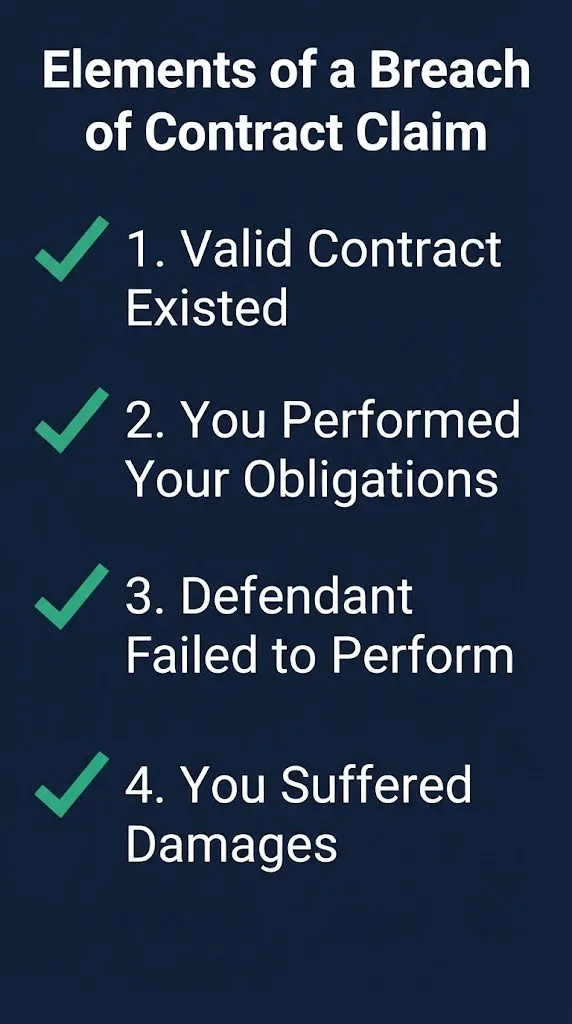
A breach of contract claim requires you to prove four elements: a valid contract existed, you performed your obligations, the defendant failed to perform, and that failure caused you damages. Missing any one element means the claim fails.
Courts across jurisdictions apply the same basic framework. New Jersey jury instructions list the four elements as contract formation, plaintiff’s performance, defendant’s non-performance, and causation of loss . New York courts use nearly identical language: formulation of a contract, performance by plaintiff, defendant’s failure to perform, and resulting damage .
Here is what each element requires in practice:
- Valid contract: An offer, acceptance, and consideration (something of value exchanged). It can be written or oral, though some agreements must be in writing under the statute of frauds.
- Your performance: You did what you promised, or you were ready and willing to perform and the other side prevented it.
- Defendant’s breach: The other party did not do what the contract required. This can be a total failure or a partial one.
- Damages: You lost money, property, or a benefit because of the breach. The loss must be provable, not speculative.
A Texas appeals court recently found no breach of contract when the evidence conflicted on whether the parties ever agreed on delivery timing, whether the plaintiff performed by paying in full, and whether the defendant breached by fabricating trusses too soon or delivering them too late . Without clear proof on each element, the claim collapsed.
Key Takeaway: Every breach of contract claim stands or falls on four elements. If you cannot prove all four with evidence, the court will dismiss your case regardless of how unfair the situation feels.
How Much Can You Recover in a Breach of Contract Lawsuit?
Breach of contract damages are designed to compensate you for losses caused by the breach, not to punish the other party. The goal is to put you in the same financial position you would have occupied if the contract had been performed. This principle is called expectation damages.
Expectation damages have two parts: the gains you would have received from performance, minus any costs you saved by not having to perform . A court calculating your damages must consider both sides of that equation. If you were a service provider who did not have to deliver the service after the breach, your damages get reduced by the money you saved on supplies and labor.
Recoverable damages typically include:
- Lost profits that you can prove with reasonable certainty.
- Cost of replacement if you had to pay someone else more to do the job.
- Consequential damages that flow naturally from the breach, if foreseeable.
- Incidental costs like storage fees or expedited shipping.
Courts do not award speculative damages. A new business with no track record often struggles to prove lost profits because there is no historical data to calculate what it would have earned. Emotional distress damages are generally not recoverable in contract cases unless the contract specifically involves emotional well-being, like building a home or a funeral services agreement.
Reality Check: Filing a breach of contract lawsuit is not free money. You must prove your damages with documents, receipts, and testimony. If you cannot show a dollar figure, the court cannot award one. A contract victory without provable damages is a waste of time and filing fees.
What Is the Statute of Limitations for a Breach of Contract Lawsuit?
The deadline to file a breach of contract lawsuit ranges from 2 to 6 years depending on your state and whether the contract was written or oral. Miss the deadline and you lose the right to sue permanently, no matter how strong your case.
Written contracts generally give you a longer window than oral ones. Here are representative state deadlines:
| State | Written Contract | Oral Contract |
|---|---|---|
| California | 4 years | 2 years |
| New York | 6 years | 6 years |
| Texas | 4 years | 4 years |
| Florida | 5 years | 4 years |
| Illinois | 10 years | 5 years |
| Alabama | 6 years | 6 years |
| Arizona | 6 years | 3 years |
| Connecticut | 6 years | 3 years |
These numbers come from a 50-state survey compiled by Gordon Rees . The clock usually starts when the breach occurs, not when you discover it. Some states apply a discovery rule that delays the start until you knew or should have known about the breach.
If you are outside the deadline, you have no case. You cannot negotiate an extension or apologize your way past a statute of limitations.
How Do You Prove a Breach of Contract in Court?
Proving a breach of contract requires evidence that establishes each of the four elements. The burden is on you, the plaintiff. The defendant does not have to prove anything.
Acceptable evidence includes the contract itself, emails or text messages showing the agreement and the breach, invoices and receipts, bank statements, canceled checks, witness testimony, and expert testimony on industry standards or damage calculations.
For oral contracts, evidence of the agreement might come from emails, text messages, or testimony about conversations. Without documentation, your case depends heavily on credibility. A judge or jury must believe your account over the defendant’s.
The best evidence is contemporaneous. A text message sent the day after a missed delivery carries more weight than your memory of a phone call six months ago. If you have an ongoing dispute, start preserving communications now. Screenshot texts, forward emails to yourself, and store everything in a folder you can access later.
How Do You File a Breach of Contract Lawsuit?
Filing a breach of contract lawsuit involves several steps, from drafting a complaint to serving the defendant. The process varies by state and by the amount you are claiming.
Here are the steps:
- Determine the correct court. Small claims handles disputes up to $10,000 in some states. Limited civil covers up to $25,000. Larger claims go to unlimited civil or superior court.
- Draft a complaint. State the parties, the contract terms, what you did, what the defendant failed to do, and the damages you suffered.
- File the complaint with the court clerk. Pay the filing fee, which ranges from $30 to $100 in California small claims, higher in civil courts.
- Serve the defendant. The court does not do this for you. Use personal service, certified mail, or a professional process server.
- Wait for the defendant’s answer. They can admit, deny, or file a motion to dismiss.
- Exchange discovery. Both sides request documents and conduct depositions.
- Attend mediation or settlement conference. Many courts require this before trial.
- Go to trial or settle. If you cannot agree, a judge or jury decides.
Process fees for serving a summons are small in most states, often just a few dollars per defendant . The bigger cost is your time and any attorney fees if you hire a lawyer.
How Long Does a Breach of Contract Lawsuit Take?
A breach of contract lawsuit typically takes six months to two years from filing to resolution, depending on complexity and whether the case settles. Simple small claims cases can resolve in weeks. Complex commercial disputes can stretch past three years.
Most cases settle before trial. Settlement negotiations often start immediately and continue through discovery, sometimes up to the courthouse steps . Defendants with strong legal positions may push for dismissal early. Plaintiffs with clear documentation often get favorable settlement offers before trial costs mount.
Discovery is usually the longest phase. Both sides exchange documents, answer interrogatories, and sit for depositions. In a commercial dispute, discovery can take a year or more. The more documents and witnesses involved, the longer it runs.
Trial is the final stage if settlement fails. A bench trial (judge only) is common in contract cases. Jury trials are available but less predictable. After trial, the losing party can appeal, adding another year or more to the timeline.
What Remedies Are Available in a Breach of Contract Case?
Money damages are the standard remedy in breach of contract cases, but courts can also order equitable relief when money is not enough. The type of remedy depends on what the contract was about and what you actually lost.
The main remedies are:
- Compensatory damages: Money to cover your losses and put you in the position you would have occupied if the contract was performed.
- Consequential damages: Money for indirect losses that were foreseeable at the time of contracting.
- Specific performance: A court order requiring the defendant to do what they promised. Used when the subject matter is unique, like land or a one-of-a-kind item.
- Rescission: Canceling the contract and returning both parties to their original positions. Used when the contract is unfair or involves fraud .
- Restitution: Returning property or money that belongs to you.
Liquidated damages clauses can set a fixed amount for breach, but courts will not enforce them if they amount to a penalty rather than a genuine estimate of loss. A Pakistani court recently held that a party claiming liquidated damages must prove actual loss, and the court can award reasonable compensation rather than the full stipulated amount .
What Happens Next in a Breach of Contract Lawsuit
Day 1: You file the complaint and pay the filing fee.
Weeks 1 to 4: The defendant is served and has 20 to 30 days to respond.
Months 2 to 6: Discovery exchange, including documents, interrogatories, and depositions.
Months 4 to 12: Settlement negotiations, often triggered by mediation or a pretrial conference.
Months 6 to 24: Trial, if no settlement is reached.
Post-trial: Judgment entered, with appeal rights for the losing party.
Frequently Asked Questions
What are the four elements of a breach of contract claim?
The four elements are a valid contract, your performance, the defendant’s breach, and damages caused by that breach. You must prove all four to win.
How long do I have to file a breach of contract lawsuit?
It depends on your state and whether the contract was written or oral. Written contracts typically give you 3 to 6 years, oral contracts 2 to 4 years.
Can I sue for breach of contract without a written agreement?
Yes, oral contracts are enforceable, but they come with shorter filing deadlines in most states and are harder to prove in court.
How much can I recover in a breach of contract lawsuit?
You can recover the amount needed to put you in the position you would have been in if the contract was performed. Speculative damages are not recoverable.
Do I need a lawyer to file a breach of contract lawsuit?
No. Small claims courts are designed for people without lawyers. Larger cases are harder to handle alone, but it is not required.
What is the difference between breach of contract and negligence?
Breach of contract involves a broken promise in an agreement. Negligence involves a failure to exercise reasonable care, regardless of any contract.
Can I recover attorney fees in a breach of contract case?
Only if the contract includes a fee-shifting clause or a statute allows it. Without that, each side pays their own lawyer.
What happens if the defendant cannot pay the judgment?
You must collect the judgment yourself. The court does not enforce it. You may need to garnish wages or place a lien on property.