Class Action Lawyers Near Me in 2026: How to Find, Vet, and Hire the Right Attorney
Quick Answer
- Class action lawyers work on contingency, meaning you pay nothing unless they win or settle the case.
- You can find qualified attorneys through bar referral services, directories, and firms that advertise active cases.
- Individual payouts in class actions are often small, but joining is free and requires no upfront payment.
A class action lawyer near you is an attorney who represents groups of people with similar legal claims against the same defendant. You do not pay these lawyers directly. Their fees come from the settlement fund or court award, typically 20% to 35% of the total recovery.
If you received a settlement notice, saw a headline about a product you bought, or believe a company harmed you and others the same way, you may be wondering how to find legal help. The most important thing to understand is that joining a class action costs you nothing. Filing a claim is always free.
This article explains how class action lawyer fees work, how to find the right attorney, what to look for during consultations, and how to tell legitimate offers from scams. One surprising fact: the named plaintiffs who actually file the lawsuit often receive extra “incentive awards” of $2,500 to $25,000 for their time and risk.
The Facts
| Case | Class action legal representation |
|---|---|
| Status | Active; attorneys available nationwide |
| Fund Size | Not applicable (legal service, not settlement) |
| Est. Per Person | Contingency fees 20% to 35% of recovery |
| Claim Deadline | Case-specific; varies by settlement |
| Administrator | Not applicable; you hire your own attorney |
| Proof Needed | Documentation of your claim and class membership |
Is Hiring a Class Action Lawyer Worth It?
Hiring a class action lawyer is worth it when you have a claim that would be too small to pursue individually. The class action mechanism exists specifically to make small claims economically viable by combining them into one large lawsuit.
Think of it like a warranty claim on a $20 product. You would never hire a lawyer at $300 per hour to recover $20. But when a million people each lost $20 to the same company, a class action makes the total claim large enough to justify legal work. The lawyers get paid from the recovery, and you get money you would otherwise never see.
The tradeoff is that individual payouts are often modest. In a $10 million settlement, attorney fees might take $2.5 million to $3.3 million, administration costs take another $500,000 to $1 million, and the remaining $5.7 million to $7 million gets split among everyone who files a valid claim. If a million people file, that is less than $7 each.
But here is what matters: without the lawyers, there would be no settlement at all. The fee structure is designed to align incentives. Attorneys only get paid if they produce a recovery.
Key Takeaway: Class action lawyers make small claims viable by pooling them, and their contingency fees mean you risk nothing by participating.
How Much Do Class Action Lawyers Charge?
Class action lawyers charge contingency fees of 20% to 35% of the settlement on average. The judge must approve the fee amount, and the money comes from the settlement fund, not from your pocket.
Here is how fees break down by case type and jurisdiction:
| Case Type | Average Contingency Fee |
|---|---|
| Federal court | 20% to 25% |
| State court | 25% to 30% |
| Securities class action | 20% to 35% |
| Consumer class action | 25% to 35% |
Federal judges tend to award lower percentages because they scrutinize large settlements more closely. State courts often award slightly higher percentages. Securities cases can reach 35% because of the complexity and risk involved.
The lodestar method is an alternative approach. Attorneys calculate their fees by multiplying hours worked by their normal hourly rate, then the court may apply a multiplier of 1.5 to 3 times that amount to account for risk. This method is used when the percentage approach would produce an unreasonable result.
A real example: in a securities case that settled for $85 million, the court awarded $21.25 million in attorney fees, which was 25% of the fund. The attorneys had worked about 36,000 hours, making the effective multiplier 1.04.
Reality Check: You never pay class action lawyers directly. If someone asks for payment to “join” a class action, that is a scam. Filing claims is always free.
How Do I Find a Class Action Lawyer Near Me?
You find a class action lawyer near you through bar referral services, attorney directories, and firms that handle your type of claim. The best approach depends on whether you already know about a specific case or need help identifying one.
Here are the most reliable methods:
- State bar lawyer referral service: Every state bar offers free referrals matched to your location and practice area.
- Attorney directories: Sites like FindLaw and Super Lawyers list class action attorneys by city, with credentials and reviews.
- Firm websites and case pages: Firms like Rosen Law maintain active case pages where you can submit your information for review.
- Reddit and consumer forums: Real people share experiences and recommendations, though you must verify any names you find.
- Legal aid organizations: For low-income clients, legal aid may provide referrals or direct help.
- Court dockets: If you know a case was filed, the docket lists the attorneys representing the class.
When searching, focus on attorneys who specialize in your type of claim. A consumer fraud class action is different from a securities class action or an employment class action. The right lawyer for one is not necessarily the right lawyer for another.
How Do I Vet a Class Action Attorney Before Hiring?
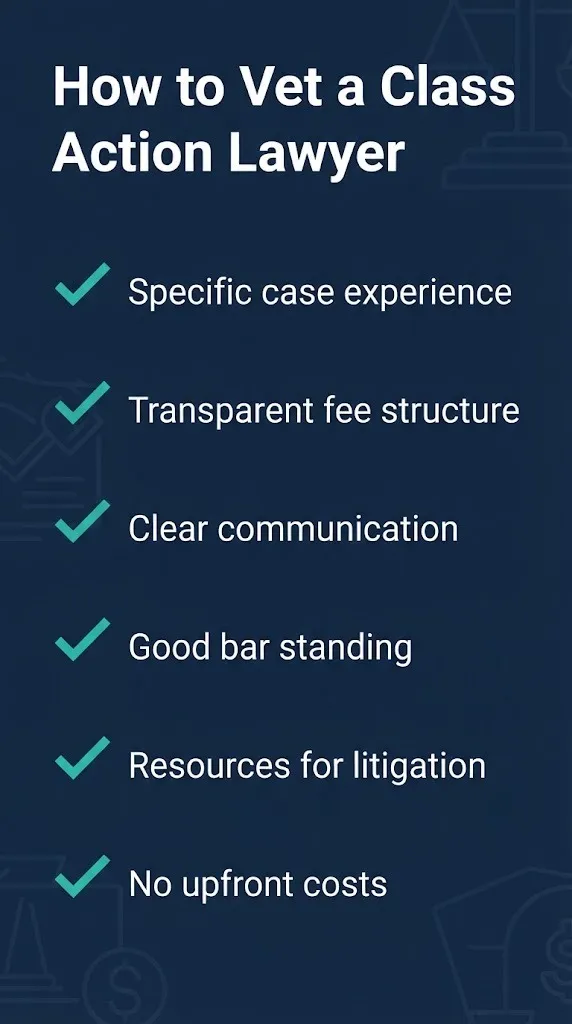
You vet a class action attorney by checking their experience with your specific claim type, their track record, and their disciplinary history. A free consultation is your opportunity to ask hard questions.
Here is what to evaluate:
- Specific case experience: Have they handled class actions like yours before?
- Track record: What settlements or verdicts have they achieved?
- Fee transparency: Can they explain the fee structure in plain language?
- Communication: Will they explain the process and timeline clearly?
- Bar standing: Check your state bar’s website for disciplinary actions.
- Resources: Class actions are expensive; does the firm have the capacity to litigate?
For a real example, Joanna Ghosh of Lawyers for Justice in Glendale, California, has been selected to Rising Stars from 2019 through 2026 and settled a $5 million wage and hour case in 2022. That kind of specific track record matters more than general advertising.
The consultation is also your chance to understand what you are getting into. Class actions often take 3 to 5 years or longer to resolve. If you need money quickly, a class action is not the right tool.
What Questions Should I Ask a Class Action Lawyer?
You should ask a class action lawyer about their experience, fees, timeline, and what they need from you. The answers will tell you whether they are the right fit for your situation.
Here are the key questions:
- Have you handled class actions involving this specific issue?
- How are your fees structured, and what percentage do you typically seek?
- What is the expected timeline for a case like this?
- What do you need from me to evaluate my claim?
- Will I be a named plaintiff or an absent class member?
- How will you communicate updates to me?
- What happens if the case is dismissed or lost?
- Are there any upfront costs I should know about?
The answers to questions 2 and 7 matter most. If the attorney says you owe anything if the case fails, that is unusual for class actions. Standard practice is that attorneys bear the risk and recover nothing if they lose.
How Do Class Action Lawyer Fees Compare to Individual Lawsuits?
Class action lawyer fees are structured differently than individual lawsuit fees. In individual litigation, you might pay hourly rates of $200 to $550 or a contingency fee of 25% to 40%. In class actions, the contingency model is nearly universal, and the fees are paid from the common fund.
The key difference is who bears the risk. In an individual lawsuit, you might owe fees even if you lose, depending on your agreement. In a class action, the attorneys front all costs, including expert witnesses, document review, and court filings. If they lose, they recover nothing.
For class members, the practical effect is simple: you risk nothing by participating. You do not pay retainers, hourly fees, or costs. The settlement fund covers everything, and the judge ensures the fees are reasonable before any money is distributed.
Key Takeaway: Class action fee structures shift all financial risk to the attorneys, which is why they are the best option for consumers with small individual claims.
What Are the Red Flags of a Class Action Scam?
The biggest red flag is anyone asking you to pay to join a class action. Legitimate class actions never require payment from class members. The attorneys get paid from the recovery, and filing claims is free.
Other warning signs include:
- Unsolicited texts or calls saying you “won” settlement money
- Requests for your Social Security number or bank account before verifying the case
- Pressure to act immediately
- Third-party “claim filing services” charging fees
- Websites that look official but are not the court-approved settlement site
Legitimate settlement notices come by mail or email from the settlement administrator. They include the case name, court, and a claim form or instructions. If you are unsure whether a notice is real, look up the case on the court’s public docket.
Reddit users discussing class actions consistently warn about these scams. One thread about a billing service overcharge noted that “a good lawyer will get paid out of the settlement if it’s a solid case, not from you”.
What Happens Next After You Contact a Class Action Lawyer
After you contact a class action lawyer, they will evaluate your claim and tell you whether it fits an existing case or could support a new one. The process moves through several stages.
Initial review: The attorney reviews your documents and information to assess the claim.
Case evaluation: They determine whether your situation matches an existing class or could form the basis of a new case.
Retainer agreement: If you join as a named plaintiff, you sign an agreement outlining the contingency fee and responsibilities.
Filing or joining: If a case exists, you may file a claim or be added as a class member. If not, the attorney may file a new complaint.
Litigation: The case proceeds through discovery, motions, and possibly trial or settlement.
Settlement approval: If a settlement is reached, the court must approve it, including attorney fees.
Claims distribution: Class members file claims, and payments go out after final approval.
Frequently Asked Questions
How do I find a class action lawyer near me?
Start with your state bar’s referral service, then check attorney directories and firm websites. Look for attorneys who specialize in your type of claim.
How much do class action lawyers charge?
Most work on contingency fees of 20% to 35% of the settlement. You pay nothing upfront, and fees come from the recovery.
Do I pay anything to join a class action?
No, joining a class action is free. Filing a claim costs nothing. If anyone asks for payment, it is a scam.
What is the difference between a named plaintiff and a class member?
A named plaintiff files the lawsuit and represents the class. A class member is automatically included but does not actively participate unless filing a claim.
How long do class actions take?
Class actions often take 3 to 5 years or longer to resolve. Complex cases can take even more time.
Can I hire my own lawyer for a class action?
Yes, you can hire your own attorney, but it is rarely necessary for class members. The class attorneys represent everyone’s interests.
What happens if I do nothing after receiving a settlement notice?
If you do nothing, you remain a class member but typically receive nothing. You must file a claim to get a payment in most settlements.
Are class action lawyers overpaid?
This is debated. Attorneys take significant risk and front all costs, but critics note that large fees sometimes dwarf individual payouts. Judges must approve all fees.
What You Should Do Now
If you believe you have a class action claim, start by identifying the type of harm and searching for attorneys who handle that specific issue. Use your state bar’s referral service and check firm websites for active cases.
Gather any documents that show your relationship to the defendant, such as receipts, contracts, or account statements. Most consultations are free. The single most important thing to remember is that you should never pay to join a class action. If a lawyer asks for money upfront, walk away.