NYC Deferred Compensation in 2026: Contribution Limits, Withdrawal Rules, and How It Compares to a 401(k)
Quick Answer
- NYC Deferred Compensation is a legitimate government retirement savings program offered to city employees through a 457 Plan and a 401(k) Plan.
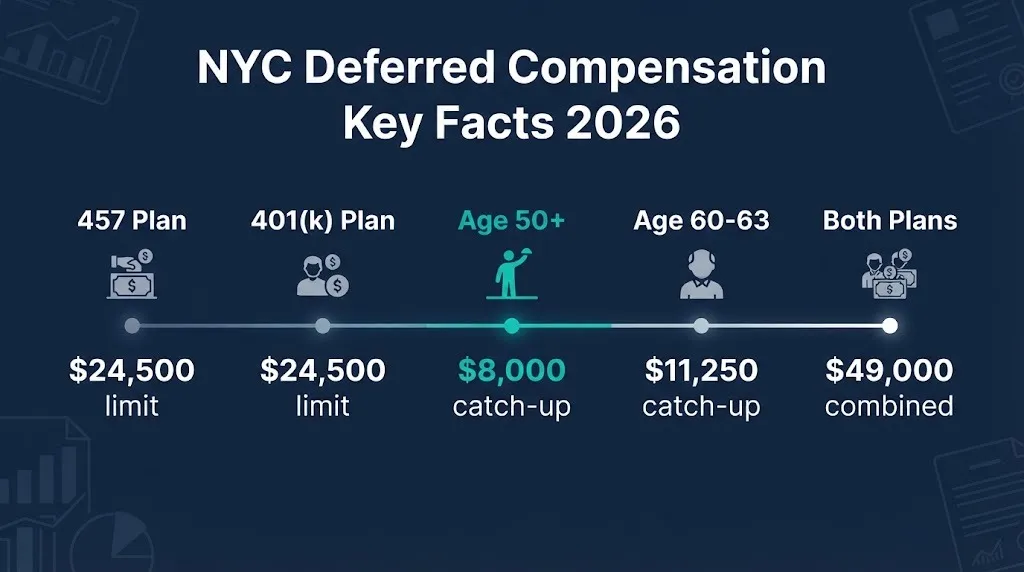
- Maximum contributions in 2026 are $24,500 per plan, or $49,000 combined for both.
- Catch-up contributions are available at age 50 and a higher tier at ages 60 through 63.
The NYC Deferred Compensation Plan is a tax-favored retirement savings program available to New York City employees. The plan includes a 457 Plan and a 401(k) Plan, and eligible workers can enroll in either one or both . The plan is administered by the City of New York through its Office of Labor Relations.
If you work for the City of New York or one of its affiliated agencies, this plan gives you a way to save for retirement beyond your pension. The most important number for 2026 is $24,500, the maximum annual contribution per plan . That means if you enroll in both the 457 and 401(k), you can defer up to $49,000 total.
This article breaks down how the plan works, the 2026 contribution limits, withdrawal rules, beneficiary designations, and how the 457 option compares to a traditional 401(k). One surprising detail: the 457 Plan has no early withdrawal penalty, which is a rare benefit in retirement savings .
The Facts
| Plan | 457 Plan and 401(k) Plan |
|---|---|
| Status | Active, accepting enrollments and contributions |
| Fund Size | Not applicable (individual accounts) |
| Est. Per Person | Contribution-based; no fixed payout |
| Claim Deadline | Not applicable |
| Administrator | NYC Office of Labor Relations, Deferred Compensation Plan |
| Proof Needed | Enrollment form and beneficiary designation |
Is NYC Deferred Compensation Legitimate?
NYC Deferred Compensation is a legitimate government retirement plan. It is established by the City of New York and administered through the Office of Labor Relations . The plan has been operating for decades and holds assets in custodial accounts for the exclusive benefit of participants and their beneficiaries .
The plan is funded entirely by participant contributions and investment earnings. Administrative fees are paid by participants, not taxpayers. The current fee is $20 per quarter, plus an annualized asset-based fee of 0.04% on investment funds .
Unlike some private-sector retirement plans, the NYC Deferred Compensation Plan operates under strict regulatory oversight. The Deferred Compensation Board governs the plan, and annual reports are published showing assets, contributions, and distributions .
One thing to understand: this is not a pension. Your pension is a separate defined benefit plan. The Deferred Compensation Plan is a defined contribution plan where the value of your account depends on contributions and investment performance.
Key Takeaway: NYC Deferred Compensation is a legitimate, government-administered retirement savings program, but it is separate from your city pension and its value depends on your contributions and investment choices.
How Much Can You Contribute to NYC Deferred Compensation in 2026?
The 2026 contribution limit for the NYC Deferred Compensation Plan is $24,500 for either the 457 Plan or the 401(k) Plan. If you participate in both, you can contribute up to $49,000 combined .
Here are the full 2026 limits:
| Plan Participation | Maximum Contribution |
|---|---|
| 457 only | $24,500 |
| 457, age 50+ | $32,500 |
| 457, age 60-63 | $35,750 |
| 401(k) only | $24,500 |
| 401(k), age 50+ | $32,500 |
| 401(k), age 60-63 | $35,750 |
| Both 457 and 401(k) | $49,000 |
| Both, age 50+ | $65,000 |
| Both, age 60-63 | $71,500 |
The catch-up contribution for age 50 and older is $8,000 in 2026 . Participants who reach age 60, 61, 62, or 63 during the year can contribute an additional $11,250 instead of the standard catch-up amount .
There is also a special pre-retirement catch-up for the 457 Plan. If you are within three years of your normal retirement age and have underutilized contributions in prior years, you may be able to defer up to double the normal limit, which is $49,000 .
Reality Check: The contribution limits are set by the IRS and adjust for inflation. They are not negotiable and do not vary based on your salary or job title. If you want to maximize your retirement savings, you need to track these limits and adjust your deferral percentage accordingly.
How Does NYC Deferred Compensation Differ From a 401(k)?
The NYC Deferred Compensation Plan includes a 401(k) option, but the plan also offers a 457 option that has distinct advantages. The key difference is in early withdrawal penalties and distribution flexibility.
A standard 401(k) imposes a 10% early withdrawal penalty on distributions before age 59 and a half, with limited exceptions . The 457 Plan has no early withdrawal penalty. You can withdraw funds after severance from city service regardless of your age, though you will owe income taxes .
Here is how the two compare:
| Feature | 457 Plan | 401(k) Plan |
|---|---|---|
| Early withdrawal penalty | None | 10% before 59 and a half |
| Contribution limit 2026 | $24,500 | $24,500 |
| Catch-up age 50+ | $8,000 | $8,000 |
| Catch-up age 60-63 | $11,250 | $11,250 |
| Rollover to IRA | Yes | Yes |
| In-service withdrawal | Age 70 (pre-tax), 59 and a half (Roth) | Age 59 and a half |
The 457 Plan also allows in-service withdrawals at age 70 for pre-tax accounts and age 59 and a half for Roth accounts . The 401(k) Plan allows in-service withdrawals at age 59 and a half.
For participants who plan to leave city service before traditional retirement age, the 457 Plan offers more flexibility. You can access your money without the penalty that applies to 401(k) accounts.
What Are the Withdrawal Rules for NYC Deferred Compensation?
Withdrawal rules for NYC Deferred Compensation depend on which plan you use and whether you have separated from city service. The 457 Plan is more flexible than the 401(k) for early withdrawals.
If you sever from city service, you can withdraw your 457 account without penalty regardless of your age . The 401(k) account is subject to a 10% penalty if you withdraw before age 59 and a half, unless an exception applies.
Hardship withdrawals are available for both plans but with different standards. The 457 Plan allows unforeseeable emergency withdrawals for severe financial hardship . The 401(k) Plan allows hardship withdrawals for immediate and heavy financial need, and the amount is limited to what is necessary to satisfy that need .
Small account withdrawals are available if your account does not exceed $5,000, you have not contributed for two consecutive years, and you have no outstanding loans .
For beneficiaries, distributions from an Inherited Distribution Account are subject to required minimum distributions. Roth 457 and Roth 401(k) accounts require RMDs beginning at age 72, but a spousal beneficiary can roll the account into a Roth IRA to avoid that requirement .
Key Takeaway: The 457 Plan allows penalty-free withdrawals after severance regardless of age, while the 401(k) imposes a 10% penalty before age 59 and a half, making the 457 more flexible for early retirees.
How Do You Enroll in NYC Deferred Compensation?
You enroll in NYC Deferred Compensation by completing an enrollment form and selecting your contribution percentage and investment options. Enrollment is available to eligible city employees, and you can choose to participate in the 457 Plan, the 401(k) Plan, or both .
Here are the enrollment steps:
- Confirm your eligibility as a city employee.
- Obtain the enrollment form from the Office of Labor Relations or the plan website.
- Decide whether to enroll in the 457, the 401(k), or both.
- Choose your contribution percentage, up to the annual limit.
- Select your investment allocation from the plan’s options.
- Designate one or more beneficiaries for each plan.
- Submit the completed form to the plan administrator.
- Adjust your contribution percentage as needed through the plan website or telephone system.
You can change your deferral percentage as often as you wish, in multiples of 0.5%, through the telephone voice response system or the plan website . You can also change your investment direction and initiate account transfers.
If you leave city service and later return, you can rejoin the plan. Even former employees who were city workers after 1985 may be able to join the 401(k) Plan, though only through rollovers or transfers .
What Happens to Your Account When You Leave City Service?
When you leave city service, your NYC Deferred Compensation account remains yours. You have several options for what to do with the money, depending on which plan holds the funds.
For the 457 Plan, you can:
- Leave the money in the plan and withdraw as needed.
- Roll the funds into another 457 plan, a 401(k), a 403(b), or an IRA .
- Take a distribution, subject to income taxes but no penalty.
For the 401(k) Plan, you can:
- Leave the money in the plan.
- Roll the funds into another 401(k), a 457 plan, a 403(b), or an IRA .
- Take a distribution, subject to income taxes and a 10% penalty if before age 59 and a half.
If you have an outstanding loan when you leave service, the loan balance may be treated as a distribution and subject to taxes. The plan does not allow loans to be transferred to beneficiaries .
Rollovers to other plans or IRAs must follow the receiving plan’s rules. Trustee-to-trustee transfers are available and avoid tax withholding issues.
What Happens Next for NYC Deferred Compensation in 2026
The plan operates on a calendar year cycle for contributions and a rolling basis for enrollment and investment changes. Here is what to expect:
Ongoing: Enrollment is open to eligible city employees throughout the year.
Ongoing: Contribution percentage changes can be made at any time through the plan website or telephone system.
January 2027: New IRS contribution limits for 2027 will be announced, typically in late 2026.
Quarterly: Administrative fees of $20 are deducted from accounts .
Annually: The Deferred Compensation Board publishes an annual report on plan performance and assets.
Frequently Asked Questions
What is NYC Deferred Compensation?
NYC Deferred Compensation is a retirement savings plan for city employees. It includes a 457 Plan and a 401(k) Plan, and you can enroll in either or both.
What is the 2026 contribution limit for NYC Deferred Compensation?
The limit is $24,500 per plan. If you contribute to both the 457 and 401(k), the combined limit is $49,000.
Can I contribute to both the 457 and 401(k) plans?
Yes, you can enroll in both plans and contribute up to the maximum in each. The limits are not coordinated, so $49,000 is the combined maximum for 2026.
What is the catch-up contribution for age 50 and older?
The age 50 catch-up is $8,000 in 2026. Participants aged 60 through 63 can contribute an additional $11,250 instead.
Is there a penalty for early withdrawal from the 457 Plan?
No, the 457 Plan has no early withdrawal penalty. You can withdraw after severance from city service regardless of age, though income taxes apply.
How do I change my contribution percentage?
You can change it through the plan website or by calling the telephone voice response system and pressing 1. Changes can be made in multiples of 0.5%.
What happens to my account if I leave city service?
Your account remains yours. You can leave it in the plan, roll it into another retirement plan or IRA, or take a distribution.
Can I take a loan from my NYC Deferred Compensation account?
Loans may be available if permitted by the plan and investment provider. The maximum loan is generally the lesser of $50,000 or half of your vested benefits.
What You Should Do Now
If you are a New York City employee and not yet enrolled in the Deferred Compensation Plan, review the enrollment materials and consider whether the 457 Plan, the 401(k) Plan, or both fit your retirement strategy. The 457 Plan’s lack of early withdrawal penalty makes it particularly valuable if you might leave city service before age 59 and a half.
If you are already enrolled, check your contribution percentage to make sure you are on track to reach the 2026 limit if that is your goal. The deadline to adjust your deferrals for the current calendar year is December 31, 2026.