Corporate Litigation in 2026: What It Is, How It Works, and What It Costs
Quick Answer
- What is it? Corporate litigation is a legal dispute between businesses, often over contracts, intellectual property, or regulatory compliance.
- How much does it cost? Costs vary widely, but 67% of lawyers say strong claims go unpursued due to cost concerns.
- Key deadline: Most cases settle within 12 to 24 months, though complex matters can take years.
Corporate litigation is the legal process businesses use to resolve disputes with other companies, partners, or regulators. It covers breach of contract claims, intellectual property fights, shareholder disagreements, and regulatory enforcement actions.
These cases affect business owners, executives, and anyone involved in a commercial relationship that goes wrong. The stakes are high: one recent Singapore case seeks over $2 billion in damages against commodities giant Glencore, while a Delaware coverage dispute over trade secret theft just wrapped up in September 2026.
This article breaks down what corporate litigation actually is, how the process works from filing to resolution, what it costs, and how the landscape is shifting in 2026. You’ll also learn the difference between commercial and civil litigation, and what to expect if your business gets pulled into a dispute.
The Facts
| Item | Detail |
|---|---|
| What It Is | Legal disputes between businesses over contracts, IP, partnerships, or regulatory matters |
| Typical Timeline | 12 to 24 months for most cases; complex matters can run 3 to 5 years |
| Settlement Rate | Over 90% of commercial disputes settle before trial |
| Cost Range | Varies widely; 67% of surveyed lawyers say strong claims go unpursued due to cost |
| Common Forums | Delaware Court of Chancery, UK High Court, Singapore High Court, DIFC Courts |
| Key Trend 2026 | Record filing volumes; 15% increase in UK High Court claims in Q1 |
What is corporate litigation in simple terms?
Corporate litigation is a legal dispute between businesses, or between a business and its shareholders, partners, or regulators. It’s the process companies use when a commercial relationship breaks down and they can’t resolve it through negotiation.
The term covers a wide range of conflicts. A breach of contract claim is the most common. But corporate litigation also includes intellectual property infringement, trade secret misappropriation, shareholder disputes, partnership disagreements, and regulatory enforcement actions .
Think of it like a warranty dispute on a major purchase. If your new truck’s transmission fails and the dealer won’t fix it, you escalate. Corporate litigation is that escalation, but between companies with contracts worth millions instead of a single vehicle.
The key distinction is who’s involved. Corporate litigation happens between business entities. Civil litigation can involve individuals suing each other or companies. If two corporations are fighting over a supply agreement, that’s corporate litigation. If an individual sues a corporation over a personal injury, that’s civil litigation .
The 2026 landscape is busy. UK High Court claims hit 2,192 in Q1 2026, the highest opening quarter since before 2019. Commercial Court filings alone jumped 71% year over year .
Key Takeaway: Corporate litigation is business-to-business dispute resolution, and 2026 filing volumes show it’s more active than it’s been in years.
How much does corporate litigation cost?
Corporate litigation costs vary widely depending on complexity, but cost concerns prevent many valid claims from ever being filed. A 2026 survey of senior UK lawyers found that 67% agree strong claims go unpursued because of cost or risk concerns .
There’s no flat fee. Costs include attorney time, expert witnesses, document review, court filing fees, and discovery expenses. Complex patent or securities cases can run into millions of dollars before trial. Simpler contract disputes cost far less.
The 2026 London Disputes Report found that 84% of businesses expect greater cost certainty than law firms can provide. And 60% say settlement decisions are often driven by management fatigue rather than case strength .
| Cost Factor | What Drives It |
|---|---|
| Attorney Fees | Hourly rates vary by firm and jurisdiction |
| Discovery | Document review and depositions can be the largest expense |
| Expert Witnesses | Technical or financial experts add significant cost |
| Court Fees | Filing and administrative costs vary by jurisdiction |
| Duration | Longer cases mean higher cumulative costs |
Litigation funding has grown as a response. Risk-transfer tools like legal finance now feature in 73% of surveyed lawyers’ experience. The idea is simple: a funder covers costs in exchange for a share of any recovery .
Key Takeaway: Cost uncertainty is the biggest barrier to corporate litigation in 2026, and even strong claims sometimes go unfiled because of it.
How do you file a corporate litigation claim?
You file a corporate litigation claim by submitting a complaint to the appropriate court, then navigating discovery, motions, and possibly trial. Most cases settle long before a verdict.
Here’s the step-by-step process:
- Pre-litigation negotiation: Attempt to resolve the dispute without court involvement. Many contracts require mediation first.
- File the complaint: Submit a formal document outlining your claims, the legal basis, and the relief sought.
- Serve the defendant: Deliver the complaint and a summons to the other party.
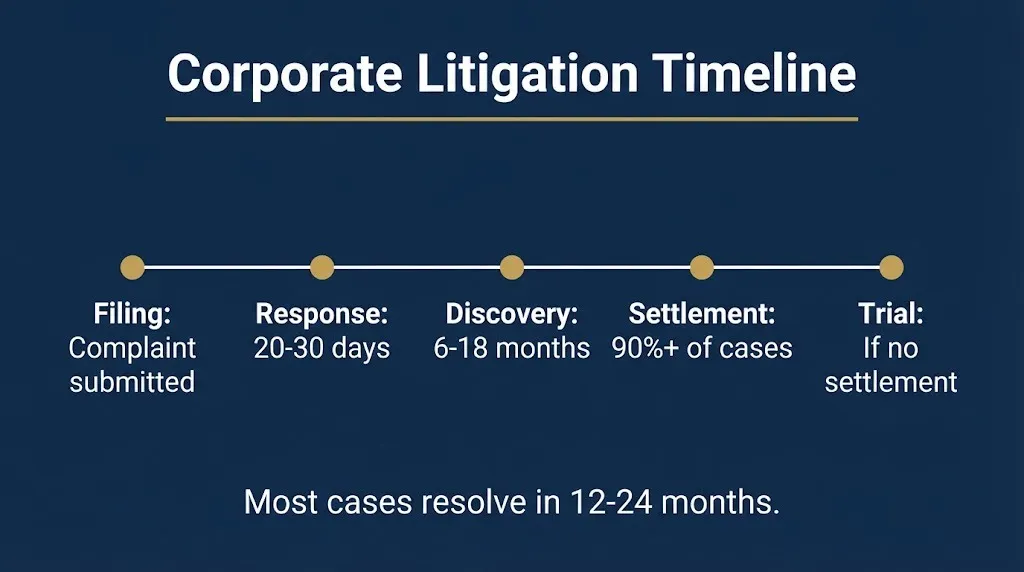
- Defendant responds: The other side files an answer or a motion to dismiss, typically within 20 to 30 days.
- Discovery: Both sides exchange documents, conduct depositions, and gather evidence .
- Pre-trial motions: Either side can file motions for summary judgment or to narrow issues.
- Mediation or settlement talks: Over 90% of commercial cases settle before trial .
- Trial (if needed): Present evidence and arguments before a judge or jury.
The choice of court matters. Delaware’s Court of Chancery is a preferred forum for corporate disputes because of its expertise in business law . The UK High Court, Singapore International Commercial Court, and DIFC Courts in Dubai also handle significant cross-border matters .
Key Takeaway: Filing is step one, but discovery and settlement talks consume most of the timeline in a typical corporate case.
What is the difference between commercial litigation and civil litigation?
Commercial litigation involves disputes between businesses, while civil litigation covers a broader range of non-criminal disputes, including those involving individuals. The overlap is significant, but the distinction matters for jurisdiction and strategy.
Commercial litigation focuses on business relationships. Breach of contract, partnership disputes, intellectual property infringement, and shareholder disagreements all fall under this umbrella .
Civil litigation is broader. It includes personal injury, family law, property disputes, and any other non-criminal matter. An individual suing a company over a defective product is civil litigation, not commercial litigation.
| Factor | Commercial Litigation | Civil Litigation |
|---|---|---|
| Parties | Business entities | Individuals or entities |
| Typical Issues | Contracts, IP, partnerships, regulatory | Personal injury, family, property, contracts |
| Complexity | Often higher due to business structures | Varies widely |
| Forum | Commercial courts, chancery courts | General civil courts |
The line blurs when individuals sue corporations. A shareholder suing a company for breach of fiduciary duty is typically commercial. A consumer suing over a defective product is civil, unless it’s a class action with business implications.
Key Takeaway: Commercial litigation is a subset of civil litigation focused on business relationships, and the distinction affects where and how a case proceeds.
What are the most common types of corporate litigation?
The most common corporate litigation types are breach of contract, intellectual property disputes, shareholder disagreements, and business torts like fraud or tortious interference.
These categories cover most commercial disputes you’ll encounter:
- Breach of contract: Failure to perform under a supply, service, or partnership agreement
- Intellectual property infringement: Trademark, copyright, patent, or trade secret violations
- Shareholder disputes: Conflicts over control, dividends, or fiduciary duties
- Business torts: Fraud, negligent misrepresentation, tortious interference, unfair competition
- Employment disputes: Non-compete enforcement, trade secret theft by former employees
- Regulatory enforcement: Government actions over environmental, securities, or consumer protection violations
A recent case illustrates the IP angle. In September 2026, a Delaware judge dismissed the last insurer in a coverage dispute over defense costs for an arbitration alleging a broker-dealer recruited employees to steal trade secret software code . The underlying dispute was corporate litigation; the coverage fight was a separate commercial matter.
Another 2026 example: Radiant World filed a $2 billion lawsuit against Glencore in Singapore’s High Court alleging fraud, breach of contract, and conspiracy . That case combines multiple corporate litigation categories in one filing.
Key Takeaway: Corporate litigation covers a broad spectrum, but contract, IP, and shareholder disputes account for most filings.
How long does corporate litigation take?
Most corporate litigation takes 12 to 24 months from filing to resolution, but complex cases can run three to five years or longer. The timeline depends on jurisdiction, complexity, and whether the case settles.
Discovery is usually the longest phase. Exchanging documents and conducting depositions can take months or even years in large cases. Expert witnesses add time. Pre-trial motions and appeals extend it further .
Settlement is the norm. Over 90% of commercial disputes resolve before trial. That’s not necessarily faster. Settlement talks often run parallel to discovery and can drag on for months.
The 2026 UK data shows courts are feeling the pressure. Anna Myrvang, a commercial disputes partner at Clyde & Co, said the impact of high claims volumes is “already evident, particularly in delays to the earliest hearing and trial dates” .
| Phase | Typical Duration |
|---|---|
| Filing to defendant response | 30 to 60 days |
| Discovery | 6 to 18 months |
| Pre-trial motions | 2 to 6 months |
| Settlement talks | 1 to 12 months |
| Trial (if reached) | Days to weeks |
| Appeal (if filed) | 6 to 24 months |
Key Takeaway: Plan for at least a year, and understand that discovery is where most of the time goes.
What happens after a corporate litigation settlement?
After a corporate litigation settlement, the parties execute a settlement agreement, dismiss the case, and comply with the agreed terms. If the case doesn’t settle, it proceeds to trial and potentially appeal.
Settlement terms can include monetary payments, injunctive relief, contract modifications, or non-monetary commitments. A Delaware case in 2026 resolved when the parties filed a stipulation of dismissal with prejudice, ending the coverage dispute .
Court approval matters in some cases. Class action settlements require judicial approval. The Delaware Court of Chancery has approved settlements based solely on therapeutic benefits, though it has questioned that practice .
If settlement fails, trial follows. Post-trial motions can challenge the verdict. Appeals can add years to the process. In the GM transmission litigation, the Sixth Circuit decertified a class action in June 2025, sending the case back to the district court for further review .
Key Takeaway: Settlement ends most cases, but court approval and compliance terms can extend the process well past the signing date.
What are the biggest corporate litigation trends in 2026?
The biggest corporate litigation trends in 2026 are record filing volumes, the rise of collective actions in Europe, growth in mass arbitration, and increased board-level scrutiny of dispute costs.
UK High Court claims hit 2,192 in Q1 2026, the highest opening quarter in years. Commercial Court filings jumped 71% year over year. Insolvency-related actions also surged, with 4,100 new matters in the first quarter .
Europe’s collective action regime is expanding. The EU’s Representative Actions Directive now requires all member states to have a mechanism for collective redress. Class action filings in Europe reached 97 cases in 2024 worth over EUR 380 billion, an 800% increase in value since 2020 .
Mass arbitration is another growth area. The American Arbitration Association reported 180,000 filings against tech companies in 2024, and that number is likely to grow. Plaintiff firms now use social media to advertise potential claims to massive audiences at low cost .
Boards are more involved. The London Disputes Report found 73% of surveyed lawyers agree boards are becoming more sophisticated in viewing disputes as financial assets .
Key Takeaway: Corporate litigation is growing in volume and value, and boards are treating disputes as financial decisions, not just legal ones.
Reality Check
Corporate litigation is not a quick fix. Most cases take a year or more, cost more than you expect, and end in a settlement that neither side loves. If someone promises a fast, cheap resolution to a complex commercial dispute, they’re selling something that doesn’t exist. The companies that manage litigation best are the ones that treat it like a business decision from day one.
What happens next in 2026?
Expected Q4 2026: Delaware Supreme Court ruling on S.B. 21’s constitutionality could reshape shareholder litigation standards. Decision pending.
Expected late 2026: UK High Court filing volumes may continue at record levels if insolvency and professional services claims keep rising.
Expected 2027: European collective action filings likely to increase as member states implement the Representative Actions Directive.
TBD: Mass arbitration rules continue evolving as arbitral institutions adapt to high-volume filings.
TBD: AI-related disputes in tech M&A and digital assets are expected to grow but specific cases remain pending.
Frequently Asked Questions
What is corporate litigation?
Corporate litigation is a legal dispute between businesses, or between a business and its shareholders or partners, resolved through the court system. It covers contract, IP, partnership, and regulatory matters.
How much does corporate litigation cost?
Costs vary widely and depend on complexity, duration, and jurisdiction. A 2026 survey found 67% of lawyers say strong claims go unpursued due to cost concerns.
How long does a corporate lawsuit take?
Most cases take 12 to 24 months. Complex matters can run three to five years. Discovery is usually the longest phase.
What is the difference between commercial and civil litigation?
Commercial litigation involves business-to-business disputes. Civil litigation is broader and includes cases involving individuals, like personal injury or family law.
Do most corporate lawsuits go to trial?
No. Over 90% of commercial disputes settle before trial. Settlement talks often run parallel to discovery.
What types of disputes fall under corporate litigation?
Breach of contract, intellectual property infringement, shareholder disputes, business torts, employment matters, and regulatory enforcement all qualify.
Can a corporation represent itself in litigation?
Legal entities cannot represent themselves in Delaware state courts. They must have an attorney. Individual litigants may represent themselves in some jurisdictions.
What is the best court for corporate litigation?
Delaware’s Court of Chancery is a preferred forum for corporate disputes. The UK High Court, Singapore International Commercial Court, and DIFC Courts also handle significant matters.
If your business is facing a commercial dispute, gather every contract, email, and document related to the relationship before you do anything else. Consult with an attorney who handles cases like yours in the relevant jurisdiction. The single most important fact to remember: over 90% of corporate disputes settle, so preparation and realistic cost expectations matter more than trial strategy.