Litigation and Dispute Resolution 2026: Choosing the Right Path for Your Case
Quick Answer
- Litigation is a public court process where a judge or jury decides your case. Arbitration is a private process with a binding decision. Mediation is a facilitated negotiation with no binding outcome.
- Outcomes vary: litigation and arbitration produce enforceable decisions, while mediation only works if both parties agree to settle.
- No single deadline applies. Courts often require mediation or settlement conferences before trial, and timing depends on your specific jurisdiction and case complexity.
You searched for “litigation and dispute resolution” because you’re facing a legal conflict and need to understand your options. Maybe you’re deciding whether to file a lawsuit. Maybe a contract requires arbitration. Or maybe a court ordered you to try mediation first.
Here’s the reality: these are not interchangeable processes. Each has distinct rules, costs, timelines, and outcomes. Choosing wrong can cost you time, money, and control over your case.
This article breaks down the three main dispute resolution methods, explains when each makes sense, and walks you through the litigation process from filing to judgment. You’ll also see how courts in 2026 are pushing parties toward settlement before trial.
The Facts
| Item | Details |
|---|---|
| Primary Methods | Litigation, arbitration, mediation |
| Decision-Maker | Judge/jury (litigation); arbitrator (arbitration); mediator facilitates (mediation) |
| Outcome | Binding judgment or award; mediation non-binding unless settled |
| Process | Public and formal (litigation); private and flexible (arbitration); confidential and informal (mediation) |
| Enforcement | State mechanisms; arbitration under New York Convention (170+ states) |
| Appeals | Available in litigation; very limited in arbitration; none in mediation |
| Typical Timeline | Months to years depending on complexity and jurisdiction |
What is the difference between litigation, arbitration, and mediation?
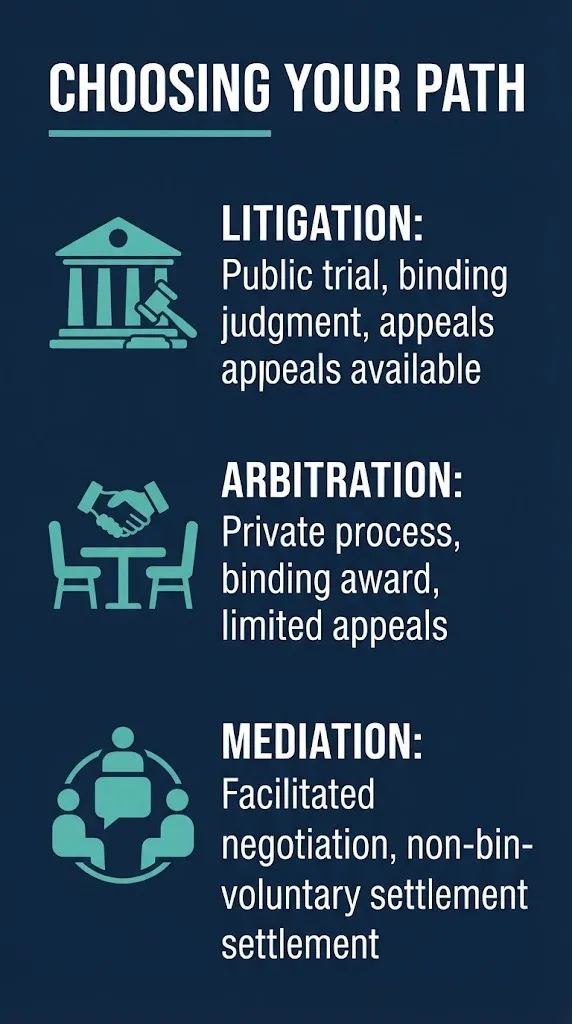
The difference between litigation, arbitration, and mediation comes down to who decides, how formal the process is, and whether the outcome is binding. Litigation is a public court proceeding where a judge or jury decides. Arbitration is a private proceeding where an arbitrator issues a binding award. Mediation is a facilitated negotiation where the parties decide whether to settle.
Here’s how they compare:
| Aspect | Litigation | Arbitration | Mediation |
|---|---|---|---|
| Decision-Maker | Judge and/or jury | Arbitrator(s) | Neutral mediator (facilitator only) |
| Outcome | Binding judgment | Binding award | Non-binding unless parties agree |
| Process | Public, formal | Private, flexible | Confidential, informal |
| Control | Court controls process | Parties and arbitrator share control | Parties control outcome |
| Appeals | Available | Very limited review | None (final if settled) |
| Enforcement | State mechanisms | New York Convention (170+ states) | Contract if settlement reached |
Arbitration requires an agreement between the parties, usually written into a contract before any dispute arises. Mediation can happen at any time, even during litigation, and courts often require it before trial.
The choice matters because arbitration awards are extremely difficult to appeal. Litigation allows appeals on legal errors. Mediation lets you walk away if you don’t like the proposed resolution.
Which dispute resolution method should you choose?
You should choose your dispute resolution method based on three questions: what your goals are, what features of the dispute matter most, and what barriers exist to settlement.
Harvard’s Program on Negotiation suggests asking:
- What are my goals? If you want a public precedent or need to compel evidence, litigation is your path. If you want speed and privacy, arbitration or mediation may work better.
- Which process capitalizes on the dispute’s best features? If the relationship matters and creative problem-solving could work, mediation is ideal. If you need enforceable protection, arbitration or litigation is stronger.
- Which process overcomes barriers to resolution? If parties need to air feelings or multiple parties are involved, mediation helps. If the law itself is disputed, a judge or arbitrator’s expertise may be needed.
Mediation is often the default starting point because it’s low-risk and non-binding. If it fails, you can still arbitrate or litigate.
Key Takeaway: Mediation is the safest first step because it cannot harm your legal position. Arbitration and litigation are for when you need a binding, enforceable outcome.
What are the stages of litigation?
The stages of litigation follow a predictable path: pre-litigation negotiation, filing the complaint, discovery, dispositive motions, mediation or settlement conference, trial, and appeal.
Here is the typical sequence:
- Pre-litigation negotiation: Parties discuss the dispute before any formal filing. Some contracts require mediation before filing suit.
- Filing the complaint: The plaintiff files a petition or complaint outlining facts and requested relief. The defendant responds with an answer or motion to dismiss.
- Discovery: Both sides exchange documents, answer interrogatories, and conduct depositions under oath. This is often the longest phase.
- Dispositive motions: Either party may file a motion for summary judgment asking the court to decide the case without trial if facts are undisputed.
- Mediation or settlement conference: Most courts require a formal settlement attempt before trial. Many cases resolve here.
- Trial: Opening statements, witness testimony, evidence presentation, cross-examination, and closing arguments before a judge or jury.
- Judgment and appeal: The court enters judgment. The losing party may appeal to a higher court.
Over 90% of commercial disputes settle before trial. That means most litigation work happens before a judge ever hears the case.
How long does litigation take in 2026?
Litigation timelines vary widely by jurisdiction and complexity, but most civil cases take 12 to 24 months from filing to resolution if they settle, and longer if they go to trial.
Here is a rough timeline for a typical civil case:
- Initial legal advice and case assessment: 1 to 4 weeks
- Filing court proceedings: 2 to 6 weeks
- Defence and pleadings: 1 to 3 months
- Evidence and discovery: 3 to 12 months
- Mediation or settlement conference: 1 day to several weeks
- Trial: Several days to several weeks
- Judgment: Several weeks to several months after trial
Court backlogs, the complexity of the dispute, cooperation between parties, and expert evidence all affect timing. A straightforward debt collection case moves faster than a multi-party construction defect dispute.
A delayed tax refund works the same way: the process is predictable, but the actual wait depends on how many other cases are ahead of yours and whether any complications arise.
Key Takeaway: Discovery is the longest phase of litigation. Most cases settle during or shortly after discovery, before trial costs escalate.
What are the advantages of arbitration over litigation?
Arbitration offers four main advantages over litigation: privacy, procedural flexibility, finality, and international enforceability under the New York Convention.
Privacy: Arbitration hearings are not public. The award is usually confidential. Litigation hearings are generally open, and judgments are published.
Flexibility: Parties can choose the arbitrator, set the rules, decide the language, and customize the process. Litigation follows fixed procedural and evidentiary rules.
Finality: Arbitration awards are binding with only very limited grounds for challenge. Litigation allows multiple levels of appeal, which prolongs the process.
International enforcement: Arbitral awards are enforceable in over 170 countries under the New York Convention. Court judgments face more barriers across borders.
The downside is that arbitration can be expensive for small disputes, and the limited appeal rights mean an arbitrator’s mistake may be final.
What happens during mediation?
During mediation, a neutral third party helps you and the other side negotiate a resolution. The mediator does not decide the case, does not take sides, and does not give legal advice.
The process is flexible. The mediator may meet with everyone together, meet separately with each side in “caucus,” or use a mix of both. The goal is to find a resolution that both parties can accept.
Mediation is confidential. Statements made during mediation generally cannot be used later in court if the case does not settle.
Mediation often results in settlement when the parties find a resolution that is better than continued litigation. Speed, cost, certainty, control, and risk reduction all favor settlement over trial.
The agreement that results from mediation is usually not exactly what either party expected before the mediation started. That’s normal. Compromise is the point.
What happens next after a dispute is resolved?
After a dispute is resolved, the next steps depend on how it ended: settlement, arbitration award, or court judgment. Each path has different enforcement procedures.
If you settled through mediation: The settlement agreement is a contract. If the other side doesn’t pay, you may need to file a breach of contract lawsuit to enforce it.
If you received an arbitration award: You must confirm the award in court before enforcing it. Courts generally confirm awards unless there are narrow procedural grounds to vacate.
If you received a court judgment: You can enforce it through wage garnishment, bank levies, liens on property, or other collection methods available in your jurisdiction.
If you are the losing party: You have limited time to file an appeal. In litigation, appeals must be filed within strict deadlines, often 30 days after judgment. In arbitration, appeals are extremely rare and limited to procedural challenges.
The key is to act quickly. Enforcement deadlines and appeal windows are strict.
Frequently Asked Questions
What is the difference between litigation and dispute resolution?
Litigation is a court process where a judge or jury decides your case. Dispute resolution is a broader term covering litigation plus alternatives like arbitration and mediation.
Which is better, arbitration or litigation?
It depends on your goals. Arbitration is faster and private but has limited appeals. Litigation is public and allows appeals but takes longer and costs more.
How long does mediation take?
Mediation usually takes one day to several weeks. Most sessions last a few hours to a full day. Complex multi-party disputes may require multiple sessions.
Do I need a lawyer for mediation?
You do not need a lawyer for mediation, but having one can help you understand your legal position and evaluate settlement offers. Mediators cannot give legal advice.
What happens if mediation fails?
If mediation fails, you can proceed to arbitration (if you have an agreement) or litigation. The failed mediation does not harm your legal position.
Is arbitration binding in 2026?
Yes, arbitration awards are binding. Courts can only overturn them on very narrow procedural grounds, not on disagreements with the arbitrator’s legal reasoning.
What is the New York Convention?
The New York Convention is a treaty that makes arbitral awards enforceable in over 170 countries. It is a major advantage of arbitration over litigation for international disputes.
Understand Your Options, Choose Strategically, Act Before Deadlines Pass
Dispute resolution is not one-size-fits-all. Litigation, arbitration, and mediation each serve different purposes. The right choice depends on your goals, your relationship with the other party, and whether you need a public precedent or a private resolution.
If you are facing a dispute, consult a lawyer about your options before filing anything. If your contract has an arbitration clause, understand what it means. If a court orders mediation, take it seriously. Most cases settle, and the earlier you resolve, the less you spend.