Insurance Litigation Attorney 2026: What They Do, When You Need One, and What It Costs
Quick Answer
- An insurance litigation attorney represents policyholders against insurers in coverage disputes, denials, and bad faith claims.
- Attorneys can file lawsuits, interpret policy language, and pursue damages that public adjusters cannot.
- Most insurance disputes resolve without trial through negotiation, mediation, or arbitration.
If you’re searching for an insurance litigation attorney, you likely have a claim that’s been denied, delayed, or undervalued. The question is whether hiring a lawyer makes sense for your situation.
The answer depends on one thing: whether your dispute is about money or about legal rights. A public adjuster handles valuation fights. An attorney handles coverage denials, bad faith conduct, and lawsuits.
Here’s what an insurance litigation attorney actually does, when they’re worth the cost, and how the process plays out from demand letter to resolution.
The Facts
| Role | Policyholder-side representation against insurance carriers |
| Typical Case Types | Denied claims, delayed claims, bad faith, coverage disputes |
| Timeline | 1 to 2 years typical for litigation; faster through negotiation |
| Fee Structures | Hourly, contingency, or hybrid; varies by firm and case type |
| When to Hire | Denial, stonewalling, statute of limitations approaching, bad faith suspected |
| Difference from Adjuster | Attorneys can file suit and pursue bad faith; adjusters cannot |
What is an insurance litigation attorney?
An insurance litigation attorney is a lawyer who represents policyholders in disputes with their insurance companies. They handle coverage disputes, denied claims, bad faith actions, and lawsuits against carriers .

The key distinction is who they work for. Insurance companies have teams of defense attorneys. An insurance litigation attorney works for you, the policyholder, against that machinery.
These attorneys handle both first-party claims (your own insurer, like a homeowners or auto policy) and third-party claims (liability situations where someone else’s insurer should pay). They also defend declaratory relief actions, where an insurer sues you asking a court to declare it owes nothing .
Most disputes never reach trial. Attorneys file suit when needed, but the majority resolve through negotiation, mediation, or arbitration before a jury is ever seated .
How much does an insurance litigation attorney cost?
Insurance litigation attorney fees vary widely by case type and fee structure. Public adjusters and plaintiff-side insurance attorneys typically charge 10 to 33 percent of settlement proceeds or hourly rates from $75 to $350 per hour .
Large commercial insurance disputes command higher rates. Court filings show insurance coverage counsel billing at $525 to $945 per hour in complex coverage matters . Those rates reflect bet-the-company stakes and multi-jurisdictional fights.
For individual policyholders, contingency fee arrangements are common. You pay nothing upfront, and the attorney takes a percentage of whatever recovery they secure. This structure works when liability is clear and the dispute is about the amount owed.
Hourly arrangements make more sense for smaller disputes or when you want legal advice without committing to full representation. Some firms offer hybrid structures with reduced hourly rates plus a success fee.
Before hiring anyone, ask for the fee structure in writing. Insurance companies use sophisticated defense attorneys. You need to know what your representation costs before the fight begins .
Reality Check: No one texts you settlement money first. Filing a claim against your own insurer is always free. Third-party “claim recovery” services that charge upfront fees to “process” your insurance dispute are unnecessary. If someone demands payment before they’ve recovered anything for you, walk away.
What’s the difference between a public adjuster and an insurance attorney?
A public adjuster documents damage and negotiates claim value, while an attorney interprets policy language, files lawsuits, and pursues bad faith claims. Adjusters handle valuation. Attorneys handle legal rights .
Public adjusters inspect damage, prepare repair estimates, and negotiate with the insurance company. They work best when coverage is clear but the insurer’s offer is too low . They cannot file suit, cannot interpret whether an exclusion applies, and cannot pursue bad faith damages.
Attorneys do all of that. They analyze policy exclusions, challenge improper claim handling, and file lawsuits when insurers stonewall. They also protect against procedural traps like proof-of-loss deadlines and one-year suit limitations that can kill otherwise valid claims .
Here’s the practical breakdown:
| Situation | Public Adjuster | Insurance Attorney |
|---|---|---|
| Coverage acknowledged, dispute is amount | Yes | Maybe |
| Claim denied outright | No | Yes |
| Insurer stonewalling or delaying | No | Yes |
| Bad faith suspected | No | Yes |
| Need to file suit | No | Yes |
| Complex policy language dispute | No | Yes |
Many policyholders start with a public adjuster and escalate to an attorney if the insurer refuses to negotiate fairly .
When should you hire an insurance litigation attorney?
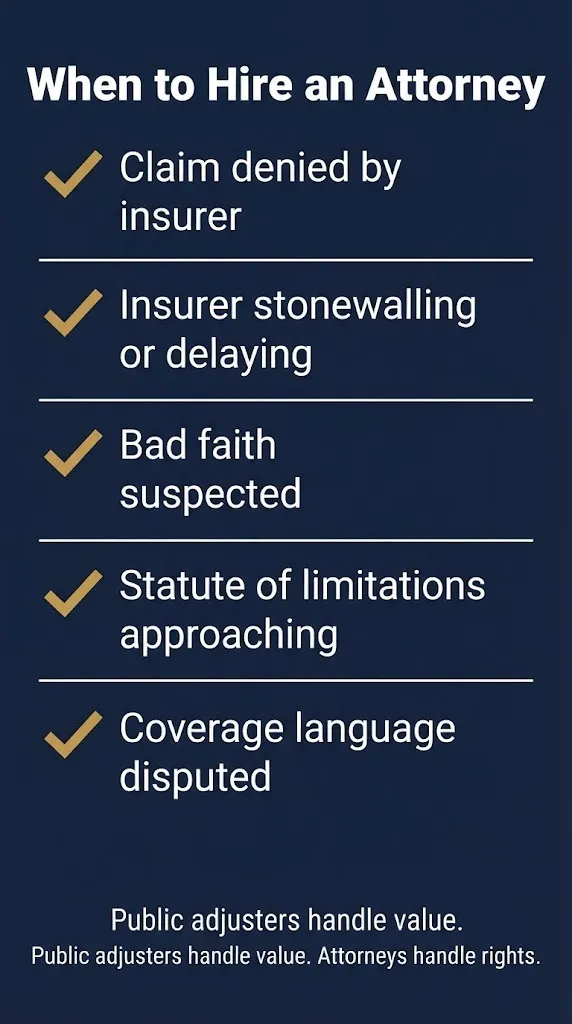
You should hire an insurance litigation attorney when your claim has been denied, your insurer is stonewalling, or you suspect bad faith conduct. These are legal problems, not valuation disputes .
Here are the specific triggers that call for legal representation:
- Denial: The insurer says your loss isn’t covered.
- Delay: Weeks or months pass with no explanation or progress.
- Lowball offers: The offer bears no reasonable relationship to documented losses.
- Threats to rescind: The insurer claims you misrepresented something on your application.
- Statute of limitations approaching: The deadline to sue is near and the claim isn’t resolved.
- Silence: Your calls and emails go unanswered.
Some policyholders hire counsel early, before filing a claim, to review coverage and identify gaps. That’s especially useful for large commercial policies where exclusions can swallow coverage .
Key Takeaway: If your dispute is about whether the insurer owes you anything at all, you need a lawyer. If it’s only about how much, a public adjuster may be enough.
How long does an insurance lawsuit take to resolve?
An insurance lawsuit typically takes at least one to two years from filing to resolution, not including appeals. Complex cases with expert witnesses can run longer .
The timeline depends on several variables. Discovery, where both sides exchange evidence, can take several months or over a year if engineers or fire investigators are involved . Motions add weeks or months. Trial itself lasts days to weeks depending on complexity.
Even without trial, most insurance disputes take at least two years to resolve. Appeals extend that timeline by additional months or years .
Alternative dispute resolution can shorten things. Structured mediations in large catastrophe events, like the 2018 California wildfires, resolved thousands of claims faster and at a fraction of litigation costs . When policyholders need cash flow and insurers want to close files, mediation delivers.
For individual policyholders, the practical question is whether you can afford to wait two years for resolution. If not, negotiation and mediation become more attractive. Your attorney can advise on the realistic timeline for your specific dispute.
How do you file an insurance lawsuit against your carrier?
Filing an insurance lawsuit means preparing a complaint, filing it in the appropriate court, and serving the insurer. Your attorney handles the mechanics, but here’s what the process looks like.
The steps typically follow this sequence:
- Demand letter. Your attorney sends a formal demand outlining the claim and legal basis.
- Negotiation window. The insurer responds, often with a counteroffer or denial.
- Complaint drafted. If talks fail, your attorney prepares the legal filing.
- Court selection. State or federal court, depending on jurisdiction and amount.
- Filing and service. The complaint is filed and formally delivered to the insurer.
- Insurer response. The carrier answers or files a motion to dismiss.
- Discovery. Both sides exchange documents and take depositions.
- Resolution. Settlement, mediation, or trial.
Most cases settle before trial. Insurers know their own documents and conduct will be scrutinized. The mere fact of litigation often brings them to the table .
Key Takeaway: The decision to file suit is strategic, not automatic. A good attorney will tell you when litigation helps and when it just burns money.
What happens next in your insurance dispute?
Immediately: Document everything. Save every letter, email, and denial from the insurer.
Within days: Request a written explanation for any denial. Insurers must provide their reasoning.
Within weeks: Consult an insurance litigation attorney if the denial is unexplained or the delay is unreasonable.
Expected timeline: Negotiation and demand phase, typically one to three months.
Expected timeline: If litigation is filed, discovery and motions, six months to one year.
Expected timeline: Settlement or trial, one to two years from filing.
Frequently Asked Questions
What does an insurance litigation attorney do?
An insurance litigation attorney represents policyholders in disputes with insurers. They handle denials, bad faith claims, coverage interpretation, and lawsuits against carriers.
How much does an insurance litigation attorney cost?
Fees range from 10 to 33 percent of settlement proceeds on contingency, or $75 to $350 per hour for individual policyholders. Complex commercial disputes command higher rates.
Can I sue my insurance company for denying my claim?
Yes, if the denial was improper. Breach of contract and bad faith are the two most common claims against insurers. You need evidence that coverage should have applied.
Do I need a lawyer or a public adjuster for my insurance claim?
It depends on the dispute. Public adjusters handle valuation disagreements. Attorneys handle denials, bad faith, and lawsuits. If coverage itself is contested, you need a lawyer.
How long do I have to sue my insurance company?
Deadlines vary by state and policy. Many property policies require suit within one year of the loss. Check your policy language immediately.
Can I hire an attorney after filing a claim myself?
Yes. You can hire counsel at any point before accepting a settlement or signing a release. Earlier is usually better for preserving evidence.
Will my insurance dispute go to trial?
Most insurance disputes settle before trial through negotiation, mediation, or arbitration. Only a small percentage reach a jury.
Gather every document your insurer has sent you. Write down the denial reason or delay timeline. Then consult an insurance litigation attorney to evaluate whether you have a legal claim worth pursuing. The one-year suit deadline in many policies is the date that matters most.