Bad Faith Lawsuit 2026: What Courts Are Actually Deciding
Quick Answer
- A bad faith lawsuit is real legal action against an insurer for unreasonably denying, delaying, or underpaying a valid claim.
- Payout amounts vary case by case. There is no standard formula, despite claims you may see online.
- There’s no single filing deadline. Your state’s statute of limitations controls, and it varies by state and claim type.
If you’re searching “bad faith lawsuit,” you likely feel your insurance company screwed you over. Maybe they denied a claim, lowballed you, or dragged their feet for months.
You’re not imagining it. Courts across the country ruled on active bad faith cases throughout 2026, and one Nevada case produced a $114 million verdict against a major insurer.
This article walks through what actually counts as bad faith, what real 2026 court rulings show about how these cases play out, and how filing deadlines work. One thing worth knowing upfront: most sites ranking for this term repeat a “3 to 10 times your claim” payout formula that no court or law actually guarantees.
The Facts
| Category | Detail |
|---|---|
| Topic | Bad faith insurance litigation, a legal process, not a specific settlement |
| Legal Basis | Breach of the implied covenant of good faith and fair dealing, state insurance codes |
| Notable 2026-Era Verdict | Kuhn v. USAA, Nevada: $114 million total ($100M punitive, $14M compensatory), verdict entered January 2025, appeal status not yet confirmed |
| Typical Payout | Not standardized. Depends on state law, insurer conduct, and jury findings |
| Filing Deadline | Varies by state, no single national deadline |
| Administrator | None. These are individual lawsuits, not class settlements |
| Proof Needed | Denial letters, claim file, adjuster notes, communication records, policy documents |
Is a bad faith lawsuit a real legal option, or just a scare tactic term?
A bad faith lawsuit is a genuine, recognized legal claim, not marketing language. Courts across the country actively rule on these cases every month.
Bad faith litigation stems from the idea that insurers owe policyholders a duty of good faith and fair dealing, separate from the insurance contract itself. When an insurer breaches that duty, you may have grounds to sue beyond just the original claim amount.
Trade publications tracking this area, including Dykema’s monthly Insurance Bad Faith Report, documented multiple active rulings in April and July 2026 alone, covering states from Alabama to Texas to South Carolina.
Key Takeaway: Bad faith claims are litigated constantly across state and federal courts, and 2026 has produced real rulings on both sides, for insurers and against them.
What actually counts as insurance bad faith?
Bad faith generally means an insurer unreasonably denied, delayed, or underpaid a claim it should have honored under the policy.
Courts typically look for evidence like:
- Denying a claim without a reasonable investigation
- Ignoring evidence that supports your claim
- Offering a settlement far below the claim’s documented value
- Failing to explain a denial in writing
- Delaying payment without a legitimate reason
- Misrepresenting policy terms to avoid paying
Not every denied claim is bad faith. Insurers are allowed to dispute claims in good faith, and losing your claim dispute alone doesn’t prove bad faith occurred.
One example from Alabama courts in early 2026 illustrates this. A court found the insurer had a “reasonably legitimate basis” to deny coverage after conducting an actual investigation, and dismissed the bad faith claim on summary judgment.
What is first-party versus third-party bad faith?
First-party bad faith happens when your own insurer mishandles your claim. Third-party bad faith happens when the insurer of the person who harmed you fails to settle within policy limits.
| Type | Who Sues | Example Scenario |
|---|---|---|
| First-party | You, against your own insurer | Your homeowner’s claim is denied without investigation |
| Third-party | You or an insured, against the at-fault party’s insurer | An insurer refuses to settle within policy limits, exposing its own insured to a larger judgment |
The Kuhn v. USAA case blended elements of both. USAA was Kuhn’s own insurer, but the dispute involved how the company handled his underinsured motorist claim after determining he wasn’t at fault, then reversing course during litigation.
How much money can I get from a bad faith lawsuit?
There’s no fixed or guaranteed payout formula. Amounts depend entirely on your state’s laws, your documented damages, and how a judge or jury views the insurer’s conduct.
You’ll see claims online that bad faith cases pay “3 to 10 times” your original claim. That’s not a legal standard anywhere. It’s a rough pattern some sites cite, not a rule any court applies.
What actual damages categories look like:
| Damage Type | What It Covers |
|---|---|
| Contract damages | The amount your policy should have paid |
| Extra-contractual damages | Emotional distress, financial harm caused by the delay or denial |
| Punitive damages | Separate damages meant to punish the insurer, available in most but not all states |
In the Kuhn case, the jury awarded $14 million in compensatory damages and $100 million in punitive damages, a ratio far outside typical outcomes. Most bad faith cases settle for amounts that never become public record.
Reality Check: No insurer or law firm can promise you a specific multiplier on your claim before a case is even filed. Filing a Department of Insurance complaint is always free. Be skeptical of anyone guaranteeing a payout amount before reviewing your actual claim file.
Do bad faith lawsuits usually go to trial or settle?
Most bad faith cases settle before trial, though a portion proceed to verdict, sometimes with substantial results either way.
Insurers often prefer settling once internal claim-handling documents are set to become public through discovery. Those files sometimes reveal how a claim was actually processed internally, separate from what the policyholder was told.
That said, trial outcomes aren’t automatically favorable to policyholders. In April 2026, a federal court in Florida’s Southern District found in favor of an insurer, ruling it had not acted in bad faith despite failing to settle within policy limits before an underlying jury verdict.
Key Takeaway: Bad faith cases can go either way at trial, and insurers do win these cases when they can show a genuine investigation and reasonable basis for their decision.
How do I file a bad faith insurance lawsuit?
Filing starts with documentation, not a lawsuit itself, since most cases build on records created well before any court filing.
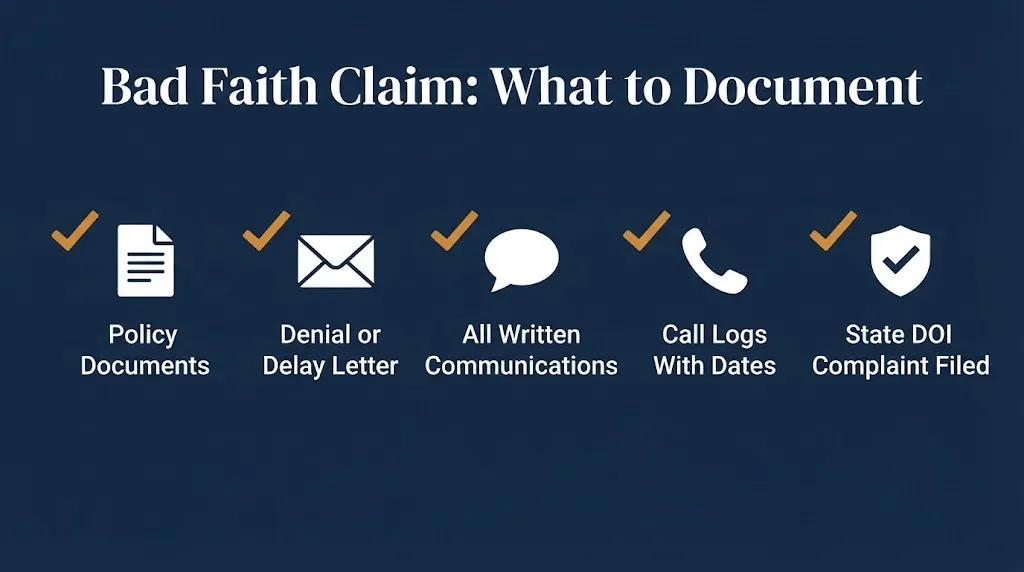
- Gather your full policy documents and the denial or delay letter
- Collect every written communication with the insurer, including emails and claim portal messages
- Log phone calls with dates, names, and summaries immediately after each call
- File a complaint with your state’s Department of Insurance, which creates an official record
- Request your complete claim file from the insurer in writing
- Consult an attorney who handles bad faith litigation in your state
- Confirm your state’s statute of limitations before waiting any longer
- Decide, with your attorney, whether to pursue first-party or third-party bad faith claims, or both
Filing a state insurance complaint doesn’t require an attorney and doesn’t cost anything. It sometimes prompts an insurer to revisit a denial before litigation even starts.
What’s the deadline to file a bad faith lawsuit?
There is no universal deadline. Each state sets its own statute of limitations for bad faith claims, and the clock can start at different points depending on your state and claim type.
Some states treat bad faith as a tort claim with its own timeline, separate from your original breach of contract deadline. Waiting to consult an attorney can quietly shrink your filing window without you realizing it.
Because these rules vary so significantly by state, and by whether your claim is first-party or third-party, check directly with your state bar’s referral service or a licensed attorney in your state rather than relying on a generic number.
What does a recent bad faith verdict actually look like in practice?
The clearest 2026-era example is Kuhn v. USAA, where a Nevada jury returned a verdict of $114 million total after finding USAA acted in bad faith toward its own insured.
Timothy Kuhn was rear-ended in a 2018 crash. USAA initially found the other driver fully at fault. When Kuhn later pursued compensation for a traumatic brain injury, USAA reversed course and argued he shared blame, despite its own earlier finding.
USAA offered just $10,000 early in the claims process before eventually agreeing to pay its full $250,000 policy limit, but only days before trial. The jury saw that timeline as evidence of a “delay, deny, defend” pattern and awarded $14 million in compensatory damages plus $100 million in punitive damages.
As of this writing, the appeal status of that verdict is not yet confirmed in public reporting. Large punitive awards like this one are frequently challenged and sometimes reduced on appeal, so treat the final number as still in motion.
Can I still sue if the insurer eventually paid my claim?
Yes, in some cases. Even if an insurer eventually pays, the delay itself can form the basis of a bad faith claim if the delay caused you financial or emotional harm.
The Kuhn case demonstrates this directly. USAA did eventually pay its policy limit, but the jury still found bad faith based on how and when that payment happened, not just whether it happened at all.
This is different from simply being unhappy with how long a claim took. Courts generally look for evidence the delay was unreasonable given the actual complexity of your claim, not just inconvenient for you.
What if the insurer says it had a legitimate reason to deny my claim?
An insurer having some reason for a denial doesn’t automatically defeat a bad faith claim, but courts do weigh whether that reason was genuinely reasonable.
Courts in 2026 have gone both directions on this question. The Alabama ruling mentioned earlier sided with the insurer because it found an actual investigation took place and a legitimate basis existed for the denial.
By contrast, other 2026 rulings, including a South Carolina appellate decision, allowed bad faith claims to proceed even alongside disputes over coverage itself, rejecting attempts to delay or block that litigation entirely.
Why do California and Florida keep coming up in bad faith litigation news?
California and Florida generate a large share of publicized bad faith litigation because both states have well-developed case law and juries willing to issue significant punitive awards.
That doesn’t mean every case in those states results in a large verdict. It means enough high-profile cases originate there that legal publications and industry trackers report on them more frequently.
If you’re in a different state, your rights and likely outcomes depend on your own state’s specific bad faith statutes and case law, not the headlines coming out of California or Florida.
What Happens Next
- Ongoing through 2026: Courts nationwide continue ruling on active bad faith cases monthly, tracked in publications like Dykema’s Insurance Bad Faith Report.
- Pending: Appeal proceedings in the Kuhn v. USAA case remain unconfirmed in public records as of this writing.
- If you file a state complaint: Expect your Department of Insurance to open a file and may contact the insurer directly.
- If you pursue litigation: Expect discovery to be the phase most likely to produce a settlement, once internal claim files are set to become evidence.
Frequently Asked Questions
What qualifies as insurance bad faith?
Bad faith generally means an insurer unreasonably denied, delayed, or underpaid a valid claim without a legitimate basis.
Simply disagreeing with a denial isn’t enough. Courts look for evidence the insurer’s process itself was unreasonable.
How much can I sue for in a bad faith lawsuit?
There’s no fixed amount. Recovery depends on your actual damages, your state’s laws, and whether punitive damages apply.
Be cautious of any source promising a specific multiplier before reviewing your case.
How long do I have to file a bad faith claim?
Deadlines vary by state and by whether your claim is first-party or third-party.
Check with your state bar or a licensed attorney rather than relying on a generic timeline.
Do I need a lawyer to file a bad faith insurance complaint?
You can file a state Department of Insurance complaint yourself for free.
An actual lawsuit typically requires an attorney experienced in bad faith litigation in your state.
What’s the difference between breach of contract and bad faith?
Breach of contract means the insurer failed to pay what the policy required.
Bad faith adds a separate claim that the insurer’s conduct in handling your claim was itself unreasonable or dishonest.
Are punitive damages available in every state?
No, not every state allows punitive damages in bad faith cases, and some states cap them.
States without punitive damage caps, like Nevada in the Kuhn case, can produce significantly larger verdicts.
What was the outcome of the USAA bad faith case?
A Nevada jury awarded $114 million total, $100 million in punitive damages and $14 million in compensatory damages, in January 2025.
The case’s appeal status was not yet confirmed as of this writing.
Can an insurer win a bad faith lawsuit?
Yes. Courts have ruled in favor of insurers in 2026 when they showed a genuine investigation and a reasonably legitimate basis for their decision.
A denied claim alone doesn’t automatically prove bad faith occurred.
Start by pulling your complete claim file and denial letter before anything else. Whatever your state’s deadline turns out to be, waiting to find that out is the one mistake you can’t undo later.