Litigation Support 2026: What Services Actually Cost, Who Uses Them, and What Changed This Year
Quick Answer:
- Litigation support is a real, established industry serving law firms, corporations, and government agencies with case management and e-discovery.
- Costs vary widely by service type, from under one hundred dollars per hour for paralegal tasks to tens of thousands for complex e-discovery.
- No single deadline applies to litigation support, but 2026 e-discovery rule changes affect how quickly parties must respond to data requests.
If you searched for litigation support and expected a single answer, here it is: this is an entire industry built around helping lawyers manage the non-legal parts of lawsuits. Document review, data collection, trial graphics, and case databases all fall under that umbrella.
Litigation support firms employ paralegals, technologists, project managers, and forensic analysts. They do not replace lawyers. They handle the volume and technical complexity that modern litigation creates.
This article explains what litigation support actually includes, what it costs in 2026, how to choose a provider, and what changed this year. One verified fact: the e-discovery segment alone is projected to exceed twenty billion dollars globally in 2026.
The Facts
| Industry | Litigation Support Services |
| Primary Users | Law firms, corporate legal departments, government agencies |
| Core Services | E-discovery, document review, trial support, case management |
| Cost Range | Varies by service, hourly and project based |
| 2026 Key Change | Updated e-discovery rules on data preservation and production |
| Regulation | Federal Rules of Civil Procedure, state court rules |
| Market Status | Active and growing, no consumer class action |
| Consumer Relevance | Affects anyone involved in litigation or responding to subpoenas |
Is litigation support a real industry or a made up term?
Litigation support is a real, established industry. It has existed for decades and grew rapidly as courts moved from paper to digital evidence.
The term covers any service that assists lawyers in preparing and managing cases without practicing law. That includes organizing documents, managing electronic discovery, preparing exhibits, and running trial presentation software.
Law firms of all sizes use litigation support. Solo practitioners may outsource a single deposition transcription. Large firms may contract with litigation support companies to handle millions of pages of documents in complex commercial litigation.
The industry has its own professional associations, certification programs, and conferences. The Association of Litigation Support Professionals and similar groups set standards and provide training.
Government agencies also use litigation support firms. The Department of Justice contracts with outside vendors for large scale document review in investigations and civil cases.
This is not a scam or a fly by night operation. It is a core part of the modern legal process. If you are involved in a lawsuit, you will likely encounter litigation support professionals even if you never hear the term.
Key Takeaway: Litigation support is a legitimate, decades old industry that handles document management, e-discovery, and trial preparation for law firms and legal departments.
What services do litigation support firms actually provide?
Litigation support firms provide services that fall into six main categories. Each category solves a specific problem in the litigation process.
Electronic discovery
Collecting, processing, and hosting digital evidence. Emails, text messages, social media posts, and cloud documents all get pulled into searchable databases.
Document review
Teams of contract attorneys and paralegals review documents for relevance, privilege, and responsiveness. This is often the largest cost in major litigation.
Case management
Building and maintaining databases that track pleadings, deadlines, exhibits, and correspondence. Think of it as the operational backbone of a case.
Trial preparation
Creating exhibit lists, preparing demonstrative exhibits, and organizing trial notebooks. The goal is to present evidence clearly to a judge or jury.
Court reporting and transcription
Recording depositions and hearings. Producing transcripts with quick turnaround, often with real time feeds.
Expert witness coordination
Finding and managing expert witnesses. Scheduling, document sharing, and report preparation all fall under this umbrella.
Each of these services can be purchased separately or as a package. The right mix depends on the case size and complexity.
Key Takeaway: Litigation support covers six core service areas: e-discovery, document review, case management, trial preparation, court reporting, and expert coordination.
How much do litigation support services cost in 2026?
Litigation support costs vary widely depending on the service, the provider, and the case complexity. There is no single price list, but industry ranges are well established.
Here are typical 2026 cost ranges based on industry surveys and provider pricing data:
| Service | Typical Cost Range | Billing Basis |
|---|---|---|
| Paralegal support | 75 to 150 dollars per hour | Hourly |
| Contract document review | 40 to 80 dollars per hour | Hourly per reviewer |
| E-discovery processing | 25 to 75 dollars per gigabyte | Volume based |
| E-discovery hosting | 10 to 40 dollars per gigabyte per month | Monthly |
| Trial presentation technician | 1,500 to 3,000 dollars per day | Daily rate |
| Court reporting and transcript | 3 to 7 dollars per page | Page count |
| Project management | 150 to 300 dollars per hour | Hourly |
These are market ranges, not fixed prices. Large firms with volume agreements pay less per unit. Small firms and individuals pay more because they lack negotiating power.
The biggest cost driver in any major case is document review. Reviewing a million pages of documents at contract attorney rates can cost hundreds of thousands of dollars. Technology assisted review, where software ranks documents by relevance, has lowered these costs but not eliminated them.
Litigation support is generally billed as a case expense. In most litigation, each side pays its own costs. In some cases, the winning party can recover costs from the losing party, but that recovery is usually partial.
How do I choose a litigation support company?
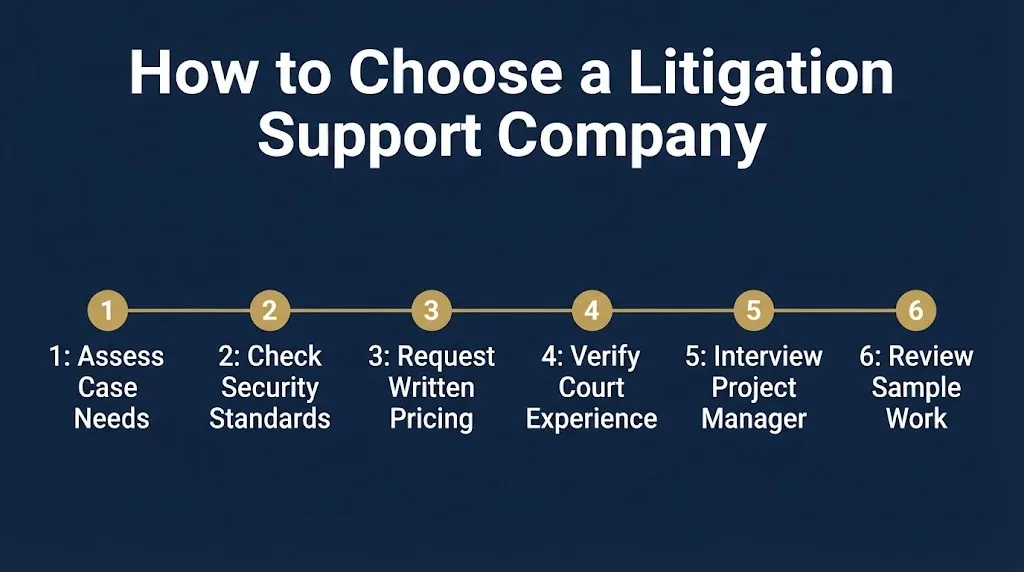
Choosing a litigation support company starts with matching the provider’s strengths to your case needs. A firm that excels at e-discovery may not be the best choice for trial graphics.
Here are the factors that matter most:
- Experience with cases similar to yours in size and subject matter
- Technology platform compatibility with your existing systems
- Security certifications and data protection protocols
- Pricing transparency and willingness to provide written estimates
- References from other law firms or legal departments
- Turnaround time for urgent requests
- Project manager assigned to your account, not just a call center
You should also ask about data security. Litigation support firms handle sensitive information. Medical records, financial data, and trade secrets all pass through their systems. Ask about encryption, access controls, and incident response plans.
Pricing should be documented in writing. Ask for a rate card and a sample project estimate. Reputable firms will provide both without hesitation.
Finally, check the firm’s track record in actual court cases. Have their e-discovery processes survived judicial scrutiny? Have their trial presentations been used in high stakes trials? A provider that has been tested under fire is worth more than one with a glossy website.
Key Takeaway: Choose a litigation support company based on case fit, security standards, pricing transparency, and proven court experience, not marketing claims.
What is e-discovery and why does it dominate litigation support?
E-discovery is the process of identifying, collecting, and producing electronically stored information for litigation. It dominates litigation support because nearly all modern evidence is digital.
Twenty years ago, discovery meant boxes of paper. Today, it means email archives, text messages, cloud storage, social media, and databases. A single employee can generate tens of thousands of documents per year.
The volume creates three problems. First, you must find the relevant documents among millions of irrelevant ones. Second, you must preserve them so they cannot be deleted or altered. Third, you must produce them to the opposing party in a usable format.
E-discovery tools solve these problems. Processing software extracts text and metadata from native files. Hosting platforms provide search, filtering, and review interfaces. Predictive coding uses machine learning to rank documents by likely relevance.
The Federal Rules of Civil Procedure govern e-discovery in federal court. Rule 26 requires parties to discuss e-discovery early in the case. Rule 34 covers the format of production. Rule 37 covers sanctions for failing to preserve data.
State courts have similar rules. California, Texas, and New York all have specific e-discovery provisions. Anyone involved in litigation in 2026, even as an individual party, should understand the basics of e-discovery obligations.
Key Takeaway: E-discovery dominates litigation support because digital evidence is now the default, and managing it requires specialized tools and expertise.
What changed in litigation support for 2026?
The biggest litigation support change in 2026 is the continued adoption of generative artificial intelligence for document review and case analysis. Courts are also updating rules to address AI generated evidence.
In late 2025, several federal courts issued standing orders requiring parties to disclose any use of generative AI in preparing court filings. Those orders took effect in 2026 and apply to many cases filed this year.
The practical effect on litigation support is significant. Firms that use AI for document review must now document their processes. They must be able to explain how the AI was trained, what it reviewed, and how human attorneys verified the results.
Data privacy rules also continue to tighten. The European Union’s data protection framework and state level privacy laws in California and other states affect how litigation support firms handle personal data during cross border cases.
Cloud based litigation support platforms are now the default. Most firms abandoned on premises servers years ago. The 2026 conversation is about which cloud platform offers the best security, uptime, and integration with existing legal software.
For consumers involved in litigation, these changes mean more efficiency but also more complexity. A case that once took three years might now take two. But the technical demands on everyone involved have increased.
Do individuals need litigation support or is it only for law firms?
Individuals may need litigation support services, but they rarely purchase them directly. Instead, their lawyer handles that relationship.
Here is how it works in practice. You hire a lawyer. The lawyer hires a litigation support firm. You pay for it as part of your case costs. You may see line items on your bill for e-discovery, deposition transcripts, or trial preparation.
In some cases, individuals can use litigation support style services directly. If you are representing yourself in a case, you can hire a court reporter for a deposition or use a document management platform to organize your exhibits.
Self represented litigants can also access some e-discovery tools. Consumer grade platforms offer document organization and search features at a fraction of the cost of enterprise systems. These tools are not as powerful as what law firms use, but they are better than nothing.
The key difference is scale. A law firm managing a case with a million documents needs enterprise e-discovery. An individual managing a case with two hundred documents needs a well organized folder structure and a scanner.
If your case grows beyond what you can manage alone, that is a signal to hire a lawyer. The lawyer brings litigation support infrastructure with them.
Key Takeaway: Individuals indirectly use litigation support through their lawyers, but self represented litigants can access basic document and transcript services directly.
What is the difference between litigation support and paralegal services?
Litigation support is broader than paralegal services. Paralegals are one component of litigation support, but the term also covers technology, project management, and specialized technical roles.
A paralegal typically works for a law firm or legal department. They prepare documents, conduct legal research under attorney supervision, and manage case files. Their work is substantive but not the practice of law.
Litigation support professionals may be paralegals, but they may also be technologists, data analysts, or project managers. Many have no legal training at all. They have technical training in databases, software, and data processing.
The distinction matters for billing. Paralegal time is often billed to clients at rates ranging from one hundred to three hundred dollars per hour. Litigation support technology costs are billed as expenses or included in platform fees.
Some firms blur the line by having litigation support teams that include both paralegals and technologists. The team approach lets the firm handle both the legal and technical aspects of discovery without external vendors.
If you are hiring for a legal role, understand which one you need. A paralegal drafts and reviews documents. A litigation support technologist builds and maintains the systems that store those documents.
What are litigation support firms and how do they differ from staffing agencies?
Litigation support firms provide project based services for specific cases. Staffing agencies provide temporary personnel who work under the client’s direction. The lines blur but remain distinct.
A litigation support firm typically takes responsibility for an entire function. You hand them a data set and they return processed, hosted, and reviewed documents. They own the workflow, the quality control, and the deadlines.
A legal staffing agency places contract attorneys or paralegals at your office. Those people work under your supervision. The agency handles payroll and benefits. You handle the work product.
In practice, large litigation support firms often provide both services. They may host your e-discovery platform and also supply contract reviewers who work remotely on that platform.
The model you choose depends on control. If you want to direct every step, a staffing agency gives you that. If you want to hand off a problem and get a result, a litigation support firm is the better fit.
Pricing reflects the difference. Litigation support firms charge project fees or volume based rates. Staffing agencies charge hourly rates with a markup over the contractor’s pay.
Key Takeaway: Litigation support firms own the workflow and the result, while staffing agencies supply personnel you direct yourself.
How has artificial intelligence changed litigation support?
Artificial intelligence has changed litigation support by automating document review, predicting case outcomes, and streamlining discovery workflows. The change is real and accelerating.
Five years ago, every document in a large case was reviewed by a human attorney. Today, technology assisted review ranks documents by relevance and routes only the top tier to human eyes. The savings are substantial.
Generative AI tools now draft deposition summaries, privilege logs, and even initial motion drafts. Litigation support firms integrate these tools into their platforms. Law firms use them to reduce junior associate hours.
The risks are equally real. AI can miss nuance. It can hallucinate citations. It can produce plausible but wrong summaries. Courts have sanctioned lawyers for filing AI generated briefs with fake case names.
The 2026 response has been cautious adoption. Standing orders require disclosure of AI use. Professional standards bodies have issued guidelines. Litigation support firms market their AI tools as human supervised, not fully automated.
For the consumer or small business involved in litigation, AI means faster document production and potentially lower costs. It also means you may be asked to produce data in formats that AI tools can process. The technical bar is higher than it was a decade ago.
What should I expect to pay for litigation support in a typical case?
In a typical mid sized commercial case, litigation support costs can range from ten thousand to one hundred thousand dollars or more, depending on the discovery volume and trial complexity.
A small employment case with limited documents might incur five thousand dollars in total litigation support costs. A complex patent case with millions of documents and a multi week trial could easily exceed five hundred thousand dollars.
Here is a breakdown of where the money goes in a typical case:
| Cost Category | Small Case | Medium Case | Large Case |
|---|---|---|---|
| E-discovery processing | 1,000 to 5,000 | 10,000 to 50,000 | 100,000+ |
| Document review | 2,000 to 10,000 | 25,000 to 100,000 | 250,000+ |
| Deposition transcripts | 1,000 to 3,000 | 5,000 to 15,000 | 25,000+ |
| Trial preparation | 2,000 to 5,000 | 10,000 to 25,000 | 50,000+ |
| Case management platform | 500 to 2,000 | 3,000 to 8,000 | 15,000+ |
These figures are market estimates, not quotes. Every case is different. The only way to know your costs is to get a written estimate from a provider.
Reality Check: No litigation support firm can give you an accurate total cost before seeing your data volume and understanding your case timeline. Be skeptical of anyone who quotes a flat fee without asking what you have and when you need it done.
What happens next in the litigation support industry?
The litigation support industry will continue evolving through 2026 and beyond. Here is what to watch.
- Ongoing 2026: More federal courts adopt standing orders on AI disclosure in litigation.
- Expected mid 2026: New e-discovery rules proposed by the Civil Rules Advisory Committee.
- Expected late 2026: Industry consolidation as larger firms acquire smaller e-discovery providers.
- Ongoing: Pricing pressure from AI tools reduces document review costs while raising technology platform fees.
These timelines are general expectations based on the rulemaking cycle and market trends. Specific dates will be announced through official court channels.
For anyone involved in litigation this year, the practical advice is unchanged. Understand your data obligations early. Budget for litigation support as a case expense. Choose providers based on demonstrated competence, not sales pitches.
The industry is professionalizing quickly. The gap between firms that embrace technology and firms that lag is widening. Your case outcomes depend in part on which side manages its litigation support better.
Frequently Asked Questions
What is litigation support?
Litigation support is the set of services that helps lawyers manage cases without practicing law.
It includes document management, e-discovery, trial preparation, and court reporting.
How much does litigation support cost?
Costs range from under one hundred dollars per hour for basic services to hundreds of thousands for complex e-discovery.
The total depends on case size, data volume, and service mix.
Do individuals need litigation support?
Individuals rarely purchase litigation support directly.
Their lawyer handles that relationship and bills it as a case expense.
What is the difference between litigation support and e-discovery?
E-discovery is one type of litigation support.
It focuses on digital evidence collection, processing, and production.
Can I get litigation support without a lawyer?
Yes, some services like court reporting and document organization are available to self represented litigants.
Enterprise e-discovery tools generally require working through a law firm or vendor.
What changed in litigation support in 2026?
The biggest change is wider adoption of AI with new court rules requiring disclosure.
Data privacy rules also tightened for cross border cases.
How do I choose a litigation support company?
Choose based on case fit, security standards, pricing transparency, and court tested experience.
Ask for written estimates and check references.
Is litigation support a growing industry?
Yes, e-discovery alone is projected to exceed twenty billion dollars globally in 2026.
The industry grows as digital evidence volume grows.
Litigation support is not something most people think about until they are in a lawsuit. Then it becomes one of the largest line items on the bill and one of the biggest factors in whether the case moves smoothly.
The smart move, whether you are a lawyer or a party to a case, is to understand the landscape before you need it. Know what services exist. Know what they cost. Know what changed in 2026. That knowledge saves money and avoids surprises when the clock is ticking.