Banking Litigation Attorney 2026: What They Do, What They Cost, and When You Need One
Quick Answer
- A banking litigation attorney handles lawsuits involving banks, lenders, and financial institutions.
- Large law firm partners bill $1,000 or more per hour; associates bill $500 to $1,000.
- Contingency fees in collection actions can run 17% or more of the recovered debt.
Banking litigation attorneys are the lawyers who handle disputes between banks and their customers, between financial institutions, and between banks and regulators. The work spans consumer fraud defense, commercial loan defaults, regulatory enforcement actions, and lender liability claims.
Most people encounter these attorneys when they’re on the receiving end of a bank lawsuit or when they’re trying to sue a bank for fraud or negligence. The cost structure varies wildly depending on which side you’re on and how complex the case is.
This article breaks down what banking litigation attorneys actually do, how they charge, what recent cases reveal about enforcement trends, and how to decide whether you need one.
The Facts
| Detail | Status |
|---|---|
| Typical large-firm partner rate | $1,000 to $1,500 per hour |
| Typical associate rate | $500 to $1,000 per hour |
| Contingency fee in collection cases | Approximately 17% of recovered debt |
| Consumer banking litigation salary range | $100,000 to $140,000 base for non-partner roles |
| Major active case (2026) | SVB Financial Trust v. FDIC ($1.71B claim) |
| Key regulatory agency | FDIC, OCC, Federal Reserve, CFPB |
What does a banking litigation attorney do?
A banking litigation attorney represents financial institutions or their customers in disputes involving loans, fraud, regulatory compliance, and lender liability. The scope covers everything from pre-litigation demand letters to full trials and appeals.
At Fifth Third Bank, litigation counsel “leads litigation strategy across assigned matters, including pleadings, discovery, dispositive motions, trial/arbitration, and settlement” . At JPMorgan Chase, the role includes “retaining outside counsel, guiding them regarding strategy, reviewing briefs, assisting with discovery, and advising our clients” .
For banks, the work is defensive. They’re defending against claims of fraud, negligence, wrongful foreclosure, or violations of consumer protection laws.
For consumers or businesses suing a bank, the attorney’s role flips. They’re pursuing claims for lender liability, breach of contract, fraud, or regulatory violations.
Key Takeaway: Banking litigation attorneys work both sides: defending banks against lawsuits or pursuing claims on behalf of consumers and businesses harmed by bank misconduct.
How much does a banking litigation attorney charge?
Banking litigation attorneys charge hourly rates that scale with seniority and firm prestige. Large-firm partners bill $1,000 or more per hour, while associates bill $500 to $1,000.
Court records from a 2026 bankruptcy case show the range clearly. One financial restructuring partner billed $1,465 per hour . A litigation associate with four years of experience billed $995 per hour . A law clerk not yet admitted to the bar billed $565 per hour .
| Role | Hourly Rate Range | Source |
|---|---|---|
| Large-firm partner | $1,000 to $1,465 | Court filings |
| Senior associate | $790 to $995 | Court filings |
| Junior associate | $565 to $700 | Court filings |
| In-house counsel (salary) | $100,000 to $140,000/year | Job postings |
For collection actions, contingency fees apply. One court-approved agreement set the fee at 17% of the original debt . Debt recovery pricing for smaller claims shows staged flat fees: £600 to £1,200 for pre-action work, another £600 to £1,200 for issuing a claim .
Reality Check
Not every banking dispute needs a $1,000-per-hour attorney. If you’re fighting a $3,000 wrongful fee, hiring a large-firm litigator makes no economic sense. Small claims court, arbitration, or a consumer protection agency complaint may be faster and cheaper. Save the high-rate litigators for disputes where the stakes justify the cost.
What types of cases do banking litigation attorneys handle?
Banking litigation attorneys handle consumer fraud defense, commercial loan disputes, regulatory enforcement, and lender liability claims. The specific mix depends on which side they represent.
For banks, common matters include:
- Defending against consumer fraud and negligence claims
- Handling subpoenas, garnishments, and court documents
- Managing regulatory inquiries and enforcement actions
- Pursuing loan defaults and collections
For consumers and businesses, common claims include:
- Lender liability for breach of contract or fraud
- Wrongful foreclosure or repossession
- Unauthorized transactions or account freezes
- Violations of consumer protection statutes
What is the Silicon Valley Bank litigation about?
The Silicon Valley Bank litigation is a $1.71 billion dispute between SVB’s former parent company and the FDIC over the bank’s 2023 collapse . A federal judge ruled in August 2026 that the parent’s claim was more than offset by the $5.4 billion in damage caused by its officers’ negligent decisions .
Judge Beth Labson Freeman found that SVB executives “took excessive interest-rate and liquidity risks” by investing heavily in long-term government and mortgage-backed securities . Rising rates produced at least $4.52 billion in investment losses and helped trigger the bank run .
The FDIC is separately pursuing claims against 17 former SVB executives and directors, including former CEO Gregory Becker, alleging gross negligence and fiduciary breaches . The case shows how banking litigation often involves regulators, executives, and holding companies in overlapping disputes.
Key Takeaway: The SVB case illustrates that banking litigation can involve billions in claims, multiple defendants, and years of litigation before resolution.
What does a banking litigation attorney earn?
In-house banking litigation attorneys earn $100,000 to $140,000 per year at the non-partner level, according to job postings . Private practice attorneys at large firms can earn far more because their hourly rates translate directly to compensation.
UK-based banking litigation solicitors with 3 to 4 years of post-qualification experience earn £110,000 to £135,000 annually . That’s roughly $140,000 to $170,000 in U.S. dollars.
The economics are straightforward. A partner billing $1,000 per hour who works 1,800 billable hours generates $1.8 million in revenue. Even after overhead and profit-sharing, senior banking litigators at top firms can earn seven figures.
Public sector and legal aid attorneys handling banking disputes earn much less, typically $60,000 to $90,000 depending on jurisdiction and experience.
How do you know if you need a banking litigation attorney?
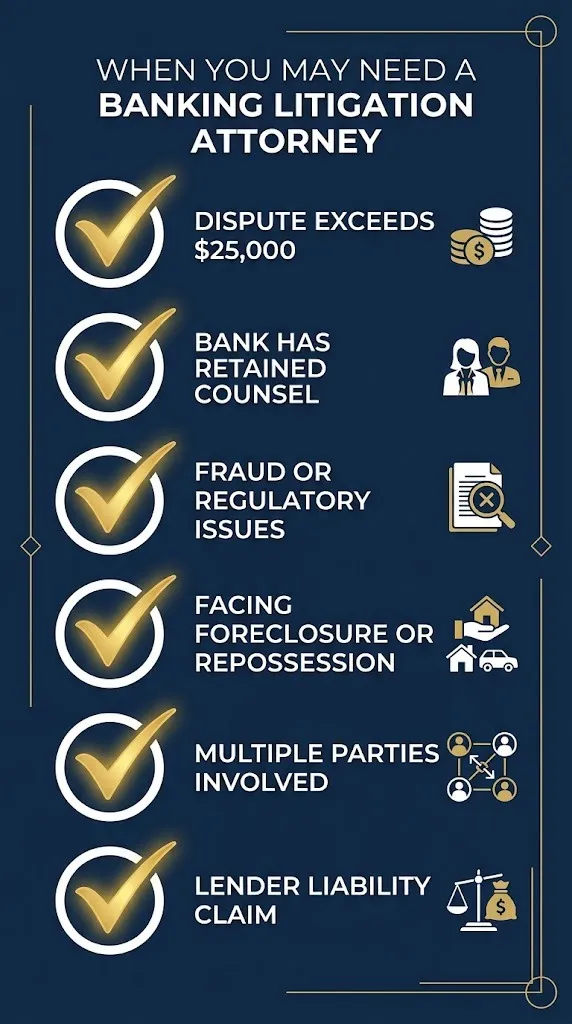
You likely need a banking litigation attorney if the amount in dispute justifies the legal cost and the issues involve complex financial regulations or multiple parties. Simple disputes over small fees rarely warrant hiring a litigator.
Consider hiring an attorney when:
- The disputed amount exceeds $25,000 (roughly the threshold where hourly fees start making sense)
- The bank has already retained counsel
- The dispute involves fraud, regulatory violations, or lender liability
- You’re facing foreclosure, repossession, or a lawsuit
- Multiple parties or transactions are involved
For smaller disputes, start with the bank’s internal complaint process, the CFPB complaint portal, or your state attorney general’s consumer protection division. These are free and can resolve many issues without litigation.
What happens next
Ongoing: FDIC’s case against 17 former SVB executives and directors proceeds through federal court .
Ongoing: Banking litigation employment demand remains steady, with major banks actively hiring in-house counsel .
TBD: Any settlement or judgment in the SVB executive liability case.
Ongoing: Consumer banking disputes continue flowing through CFPB complaint processes and private litigation.
Frequently Asked Questions
What does a banking litigation attorney do?
They represent banks or their customers in disputes over loans, fraud, regulatory compliance, and lender liability, handling cases from demand letters through trial and appeals.
How much does a banking litigation attorney cost?
Hourly rates range from $565 for junior associates to $1,465 or more for senior partners at large firms. Some collection matters use contingency fees around 17% of recovered debt.
When should you hire a banking litigation attorney?
When the disputed amount exceeds roughly $25,000, the bank has retained counsel, or the case involves fraud or regulatory violations.
What is lender liability?
A legal theory that holds banks accountable for bad faith, breach of contract, or fraud in their dealings with borrowers.
How long does banking litigation take?
Most cases take one to three years from filing to resolution if they go to trial. Settlements often happen sooner.
Can you sue a bank without a lawyer?
You can, but banking regulations and procedures are complex. Pro se litigants face significant disadvantages against represented banks.
What is the SVB litigation about?
A $1.71 billion dispute between SVB’s former parent and the FDIC over the bank’s 2023 collapse, which a judge rejected in August 2026 .
Do banks have in-house litigation attorneys?
Yes. Large banks like JPMorgan Chase and Fifth Third employ in-house litigation counsel who manage cases and oversee outside firms .
Banking litigation attorneys handle high-stakes disputes where the cost of legal representation must be weighed against the potential recovery. For consumers facing a bank lawsuit, the first call should be to a consumer protection attorney or legal aid, not a $1,000-per-hour litigator. Know the stakes before you hire.