Insurance Litigation Lawyer 2026: Costs, Process, and How to Choose the Right One
Quick Answer
- Is it legit? Yes, insurance litigation lawyers represent policyholders or insurers in coverage disputes and bad faith claims.
- How much? Many work on contingency (you pay nothing unless they win); hourly rates run $250-$450.
- Key deadline? Deadlines vary by state and policy; check your policy for suit limitations, often one to two years.
Insurance litigation lawyers handle disputes between policyholders and insurance companies when claims are denied, delayed, or underpaid. They read policy language the way a tax auditor reads receipts: for what’s covered, what’s excluded, and where the insurer cut corners.
The stakes are real. A California appellate court recently affirmed a nearly $6.8 million judgment against an insurer that denied a Tubbs Fire business interruption claim, including $3.8 million in punitive damages . In another case, the Eighth Circuit examined whether USAA acted in bad faith after a $7 million verdict exceeded its insured’s $100,000 policy limit .
This guide covers what insurance litigation lawyers actually do, what they cost, how to pick one, and what the 2026 landscape looks like for policyholders fighting for coverage.
The Facts
| Case Type | Insurance coverage disputes, bad faith claims, denied/delayed/underpaid claims |
|---|---|
| Typical Timeline | One to two years from filing to resolution, longer with appeals |
| Hourly Rate Range | $250 to $450 per hour |
| Common Fee Models | Contingency, hourly, or flat fee |
| Key Legal Claims | Breach of contract, bad faith, violation of state unfair claims practices acts |
| Recent Verdict Example | $6.8 million affirmed in California Tubbs Fire bad faith appeal |
| Key Agencies | State departments of insurance, Financial Ombudsman Service (UK) |
What Does an Insurance Litigation Lawyer Actually Do?
An insurance litigation lawyer represents policyholders or insurers in disputes over coverage, claim denials, and bad faith conduct. The job is not just filing lawsuits. Most of the work involves interpreting policy language, gathering evidence, and negotiating before trial.
For policyholders, the lawyer’s job is proving two things: that the loss falls within the policy’s coverage, and that the insurer’s denial or underpayment was wrong. For insurers, the job is defending against those claims by showing the policy excludes the loss or that their conduct was reasonable.
The work spans several stages. Reviewing the policy and claim file comes first. Then comes demand letters and negotiations. If those fail, the lawyer files suit, conducts discovery, and either settles or goes to trial. Appeals follow if either side challenges the outcome.
Insurance disputes commonly involve denied homeowner’s claims, business interruption coverage, auto coverage disputes, life insurance benefits, and health insurance denials . Each type has its own rules and case law.
Key Takeaway: Insurance litigation lawyers spend most of their time interpreting policy language and building evidence, not arguing in court, and the early investigation often decides the case.
How Much Does an Insurance Litigation Lawyer Cost in 2026?
Insurance litigation lawyer costs depend on the fee structure and case complexity, but you often pay nothing up front when an attorney works on contingency. Hourly rates typically run $250 to $450 per hour, while contingency arrangements take a percentage of your recovery .
The fee model matters enormously. Contingency means the lawyer gets paid only if you win. Hourly billing adds up on long cases, and flat fees work for defined tasks. Some firms offer staged billing or conditional fee arrangements for certain disputes .
Several factors drive costs higher. Complex coverage disputes involving multiple policies take more time. Cases requiring expert witnesses (engineers, fire investigators, accountants) add expenses. If the insurer fights hard and the case goes to trial, costs climb further .
For smaller disputes, the math can be tough. If your claim is worth $20,000 and hourly fees could eat half of it, contingency may be the only viable path. That’s why many policyholders start with a demand letter and negotiation before committing to full litigation.
Key Takeaway: Contingency fee arrangements make insurance litigation accessible, but hourly billing remains common for complex commercial disputes where the claim value justifies the cost.
How Do You Choose an Insurance Litigation Attorney?
Choose an insurance litigation attorney with specific experience in your type of dispute and a track record of results. Insurance law is not a general practice skill. Policy language, state regulations, and bad faith standards vary widely.
Look for lawyers who have handled cases involving your kind of loss. A lawyer who litigates commercial property claims may not be the right fit for a life insurance dispute. The key factors include whether the lawyer shares your view on strategy and whether they communicate clearly about costs and risks .
Ask about their experience with your specific insurer. Some carriers have patterns of denying certain claims or making lowball offers. A lawyer who has faced that insurer before knows their playbook.
The right lawyer gives realistic assessments, not inflated promises. They explain the strengths and weaknesses of your case in plain language. They also know when negotiation is smarter than litigation .
Key Takeaway: Match the lawyer to your type of insurance dispute and your jurisdiction, and expect honest answers about case strengths and weaknesses, not sales pitches.
Insurance Litigation Attorneys and Bad Faith Claims: What’s Different?
Insurance litigation attorneys who handle bad faith claims pursue extra damages beyond the policy benefits when an insurer unreasonably denies or delays coverage. Bad faith can lead to punitive damages and attorney fee awards.
A California case shows how this works. After an insurer denied less than $2 million in lost business income from the Tubbs Fire, a jury awarded the policyholder nearly $9.5 million, including $6.5 million in punitive damages. On appeal, the court reduced punitive damages to approximately $3.8 million but affirmed the judgment of nearly $6.8 million .
Bad faith standards vary by state. Some states require “outrageous” conduct, while others apply a reasonableness standard. The Eighth Circuit recently affirmed summary judgment for USAA in a Kentucky bad faith case, finding no evidence the insurer acted outrageously when it offered its policy limit after a $7 million verdict .
The lesson for policyholders: bad faith claims are hard to win, but when the evidence supports them, the damages can be substantial.
How Long Does an Insurance Lawsuit Take in 2026?
An insurance lawsuit typically takes one to two years from filing to resolution, not including appeals . The timeline depends on case complexity, court docket, and whether the parties settle or go to trial.
The process moves through several stages. Filing the complaint and serving the insurer comes first. The insurer then files an answer, and preliminary motions may follow. Discovery is the most time-intensive phase, often taking several months to over a year if experts are involved .
Mediation and pre-trial motions follow. Settlement negotiations can resolve cases faster, but if they fail, pre-trial motions add weeks or months. Trial itself may last days to weeks. Appeals can extend the timeline by additional months or years .
A delayed tax refund is a rough comparison. You file, you wait, and the timeline depends on complications. Insurance lawsuits work similarly, except the “refund” is your coverage and the “audit” is the insurer’s defense team.
Key Takeaway: Most insurance disputes resolve in one to two years, but complex cases with experts and appeals can stretch much longer.
What Types of Insurance Disputes Lead to Litigation?
Insurance disputes that lead to litigation typically involve denied, delayed, or underpaid claims where the policyholder and insurer disagree on coverage. Common triggers include policy exclusions, valuation disagreements, and suspected bad faith.
The most frequent disputes include denied homeowner’s claims, commercial property damage disputes, business interruption claims, auto coverage fights, life insurance benefit disputes, health insurance denials, and delayed claim investigations .
Coverage disputes often turn on policy exclusions. An insurer may deny a claim by citing an exclusion, and the policyholder argues the exclusion doesn’t apply. Courts interpret these disputes based on policy language, state law, and prior rulings.
Valuation fights are another common trigger. The insurer may agree the loss is covered but dispute the amount. These cases often involve expert witnesses and detailed documentation.
Key Takeaway: Coverage disputes and valuation disagreements drive most insurance litigation, and policy exclusions are often the battleground.
What Damages Can You Recover in an Insurance Lawsuit?
You can recover several categories of damages in an insurance lawsuit, depending on the type of claim and state law. Policy benefits, consequential damages, bad faith damages, and attorney fees are the main categories.
Policy benefits are the core recovery. If your claim was wrongly denied, you recover what the policy should have paid. Consequential damages cover losses caused by the denial, like additional living expenses or lost business income.
Bad faith damages apply when the insurer’s conduct was unreasonable. These can include emotional distress damages and, in egregious cases, punitive damages. A recent California case affirmed $3.8 million in punitive damages against an insurer .
Attorney fees are recoverable in some states and some bad faith cases. The rules vary widely, so you should ask your lawyer about fee recovery in your jurisdiction .
Reality Check: No one from an insurance company will call and offer you a fair settlement first. Their adjusters are trained to minimize payouts. Anything you say before talking to a lawyer can be used to reduce your recovery.
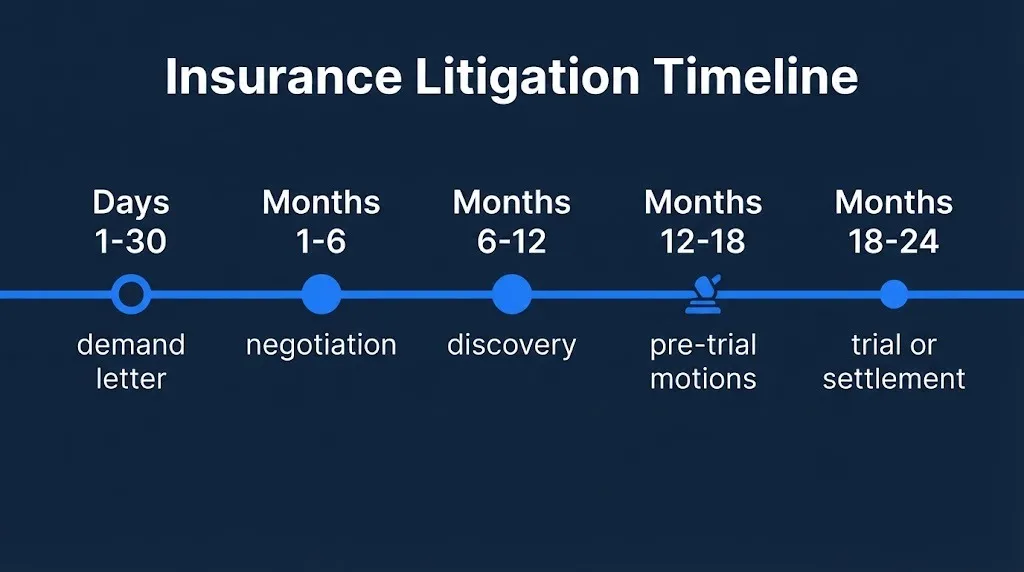
What Happens Next: Insurance Litigation Timeline
Immediate (Days 1-30): Demand letter sent; claim file reviewed; evidence preserved.
Months 1-6: Negotiation and mediation attempts; lawsuit filed if no fair resolution.
Months 6-12: Discovery; depositions; expert reports exchanged.
Months 12-18: Pre-trial motions; summary judgment briefing.
Months 18-24: Trial or settlement; post-trial motions if needed.
Frequently Asked Questions
How much does an insurance litigation lawyer cost?
Many work on contingency, taking a percentage of your recovery with no upfront cost. Hourly rates typically run $250 to $450 .
How long do insurance lawsuits take?
Typically one to two years from filing to resolution, longer if appeals follow .
Can I sue my insurance company for denying my claim?
Yes, if the denial was wrongful. You can sue for breach of contract and, in some cases, bad faith.
What is a bad faith insurance claim?
A claim that the insurer unreasonably denied, delayed, or underpaid coverage. Bad faith can lead to extra damages beyond policy benefits.
Do I need a lawyer for an insurance dispute?
Not always, but complex or high-value disputes often justify legal representation. A lawyer can negotiate better outcomes .
Can I recover attorney fees in an insurance lawsuit?
Sometimes, depending on your state’s laws and whether bad faith is proven. Ask a lawyer about fee recovery in your jurisdiction .
What should I do if my insurance claim was denied?
Keep all communications, request a written explanation, and consult an attorney before signing anything .
Can an insurance lawyer help if my claim was underpaid?
Yes. Lawyers can challenge lowball offers and negotiate for the full value of your claim.