Marital Settlement Agreement 2026: What It Is, What It Costs, and How to Get One Right
Quick Answer
- A marital settlement agreement is a legally binding contract that divides property, debt, and support terms before a divorce is finalized.
- Cost ranges widely: free templates exist, but attorney-drafted agreements typically run into the thousands depending on complexity.
- California’s SB 1427 now lets couples file a joint divorce petition using Form FL-700 instead of one spouse serving the other.
If you’re staring down a divorce and just heard the term “marital settlement agreement” for the first time, you’re not alone. Nearly every uncontested divorce in the country runs through one, whether the couple calls it a settlement agreement, a separation agreement, or a property settlement agreement.
This document decides who gets the house, who pays support, and how retirement accounts split, before a judge ever signs off on your divorce. Get a term wrong or skip a required disclosure, and a court can reject the agreement or, worse, someone can challenge it years later.
This guide covers what a marital settlement agreement actually does, how it differs from a divorce decree, what it typically costs, and how California’s 2026 filing changes affect the process. One detail that surprises a lot of people: signing this agreement does not mean you’re divorced yet. A judge still has to review it.
The Facts
| What It Is | A written contract dividing property, debt, custody, and support terms in a divorce |
| Legally Binding | Yes, once signed, though it needs a judge’s approval to become part of a divorce decree |
| Required For | Most uncontested (no-fault) divorces where spouses agree on terms |
| Typical Cost | Free (self-prepared) to several thousand dollars (attorney-drafted), depending on complexity |
| California Filing Update | SB 1427 allows joint petitions via Form FL-700, effective January 1, 2026 |
| Notarization | Often required depending on the state; California generally requires signatures, not always notarization for the MSA itself |
| Waiting Period (CA) | Divorce cannot finalize sooner than 6 months after service, under Family Code 2339 |
What Is a Marital Settlement Agreement?
A marital settlement agreement (MSA) is a written contract that spells out how divorcing spouses will divide property, debt, custody, and support. It’s the document that turns verbal agreements into something a court can enforce.
Courts sometimes call it a property settlement agreement, separation agreement, or divorce settlement agreement depending on the state. The names vary, but the function is the same: it captures every decision a couple has made so the case doesn’t need a trial.
A typical marital settlement agreement addresses:
- Division of real estate, vehicles, and bank accounts
- Retirement account splits, sometimes requiring a separate Qualified Domestic Relations Order
- Child custody and visitation schedules, if applicable
- Child support and spousal support amounts
- Division of debts and liabilities
- Tax filing status and dependency claims
Think of the MSA as the blueprint. The divorce decree is the finished building the court signs off on afterward.
Is a Marital Settlement Agreement Legally Binding?
Yes, a marital settlement agreement is a legally binding contract once both spouses sign it, but it does not finalize a divorce on its own. A judge must still review and incorporate it into a divorce decree before it carries full court authority.
Once signed, the agreement functions like any other contract between two parties. Breaching its terms, such as refusing to transfer a promised asset, can expose a spouse to a breach of contract claim even before the divorce is final.
What makes an MSA enforceable:
- Both spouses sign and date the document.
- Each side had a genuine opportunity to review it, ideally with independent counsel.
- The agreement was entered voluntarily, without duress or fraud.
- Full financial disclosure was made by both spouses before signing.
- A judge later incorporates the agreement into the divorce decree.
Key Takeaway: Signing a marital settlement agreement creates real legal obligations right away, even though your divorce isn’t official until a judge issues the decree.
Marital Settlement Agreement vs Divorce Decree: What’s the Difference?
A marital settlement agreement is the private contract spouses negotiate, while a divorce decree is the court order a judge signs that legally ends the marriage. They work together, but they are not the same document.
The MSA is essentially a draft of how the couple wants their post-divorce life to look. The decree is what makes that plan official and enforceable by the court, complete with a case number, judge’s signature, and public record status.
| Marital Settlement Agreement | Divorce Decree | |
|---|---|---|
| Created by | Both spouses (often with attorneys or a mediator) | The court, based on the MSA |
| Legal status | Private contract | Public court order |
| Ends the marriage | No | Yes |
| Enforceability | Contract law | Full court authority, enforceable by contempt |
You need the MSA in most cases to get to the decree, but the decree is what actually makes you legally single again.
What Does a Marital Settlement Agreement Cost?
Cost is not yet standardized nationally and depends heavily on complexity, but options range from free self-prepared templates to several thousand dollars for attorney-drafted agreements. There is no single fixed government fee for the document itself, separate from court filing fees.
Rough cost ranges reported across legal service providers:
- Free to low-cost: state or county court-provided templates, or basic online forms
- Moderate cost: flat-fee online divorce services that generate a customized MSA
- Higher cost: attorney-drafted agreements for cases involving businesses, complex retirement accounts, or contested custody
Not yet determined for your case specifically: exact attorney fees vary by firm, region, and how much negotiation is required, so treat any number online as a rough estimate rather than a quote.
Separately, court filing fees for the divorce petition itself apply in every state and are set by the local court, not by the MSA.
Reality Check: No court, attorney, or online service should ever ask you to pay to “unlock” your own signed settlement agreement or rush a judge’s approval. Filing fees go to the court clerk directly, and legitimate document services list their pricing upfront rather than pressuring you after you’ve started.
How to Create a Property Settlement Agreement After Divorce Terms Are Negotiated
You can create a property settlement agreement by negotiating terms with your spouse, documenting them in writing, and having both parties sign before submitting it to the court. The process typically follows a consistent sequence regardless of state.
Steps to prepare a marital settlement agreement:
- Complete full financial disclosure with your spouse, listing assets, debts, and income.
- Negotiate terms directly, through mediation, or through attorneys.
- Draft the agreement covering property, support, and custody if applicable.
- Review the draft carefully, ideally with independent legal counsel for each spouse.
- Sign and date the agreement, with notarization if your state requires it.
- File the agreement with your divorce petition or as an attachment to the case.
- Attend any required hearing so a judge can review and approve the terms.
- Wait for the judge to incorporate the agreement into the final divorce decree.
Mediators can help facilitate negotiation but cannot give legal advice or represent either spouse in court. If mediation stalls, some couples move to arbitration or hire separate attorneys to negotiate on their behalf.
Where to Get a Marital Settlement Agreement Template for California
California courts and several legal document providers publish marital settlement agreement templates, but no single official state form covers every situation. Templates work best for simple, uncontested cases with no business assets or complex custody disputes.
Where templates commonly come from:
- California court self-help centers, which provide general divorce forms
- Legal document services offering downloadable MSA templates for a fee or free
- Family law attorneys, who often customize a base template for your case
A generic template can work if your case is simple: no children, no real property, no retirement accounts to divide. Anything more complex increases the risk that a template misses a required disclosure or mishandles an asset like a pension.
Key Takeaway: A free template can work for a genuinely simple divorce, but complex assets or custody disputes usually justify attorney review before you sign anything.
Is a Simple Divorce Settlement Agreement PDF Safe to Use?
A simple divorce settlement agreement PDF can be safe to use if your situation is genuinely uncomplicated and the template matches your state’s legal requirements. The risk isn’t the PDF format itself, it’s whether the template accounts for your state’s specific rules.
Before using a free or generic PDF template, check that it:
- Matches your state’s required disclosures and terminology
- Includes a full financial disclosure section, not just a fill-in-the-blank property list
- Addresses retirement accounts correctly if you have any (these often need separate court orders)
- Has a clear signature and notarization section matching your state’s rules
Generic templates found through a general web search often carry disclaimers stating they’re for informational purposes only and not a substitute for legal review. Take those disclaimers seriously. A template built for one state’s family code may miss requirements specific to yours.
How to File a Property Settlement Agreement in a California Divorce
California divorces require the marital settlement agreement to accompany or attach to a Petition for Dissolution of Marriage, and as of January 1, 2026, couples who agree on all terms can file jointly using Form FL-700 under Senate Bill 1427. This changed the filing process for uncontested cases.
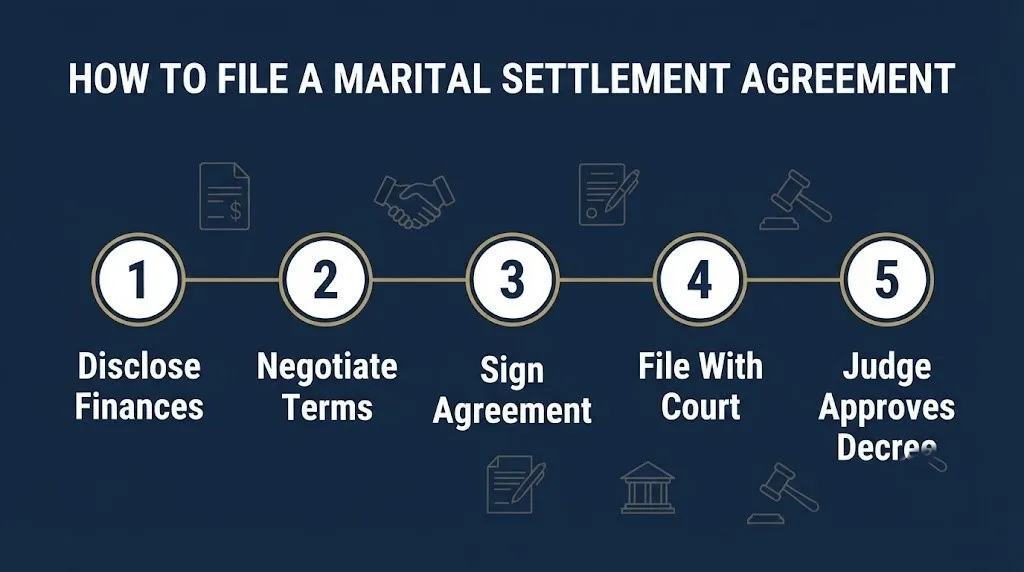
Before SB 1427, one spouse had to file as Petitioner and formally serve the other, creating an adversarial starting point even in fully agreed cases. Under the new law, both spouses file together as equal petitioners, and the filing itself counts as service on both sides.
Steps to file in California:
- Confirm both spouses agree on every divorce term (property, support, custody).
- Complete mandatory financial disclosures for both spouses.
- Prepare the marital settlement agreement covering all agreed terms.
- File jointly using Form FL-700 if using the new joint petition option, or file individually with formal service under the traditional process.
- Submit the signed MSA along with the petition.
- Wait out California’s mandatory six-month waiting period from service, under Family Code 2339, before the divorce can finalize.
- Attend any hearing the court schedules to finalize the judgment.
The six-month waiting period applies regardless of how quickly you and your spouse agree on terms. You can negotiate, sign, and submit your MSA well before that mark, but the court will not terminate marital status any sooner.
What Does a Divorce Financial Settlement Typically Include?
A divorce financial settlement typically includes division of property and debt, spousal support terms if applicable, and child support calculations based on state guidelines. The specific mix depends on what assets and obligations the couple actually has.
Common elements in a financial settlement:
- Division of real property, including the marital home
- Division of bank accounts, investments, and retirement assets
- Allocation of marital debts, including credit cards and loans
- Spousal support (alimony) amount and duration, if awarded
- Child support calculated under state guidelines
- Tax filing status and who claims dependents
Under current federal tax rules, spousal support payments in agreements executed after December 31, 2018 are not tax-deductible for the payer and not taxable income for the recipient. Child support has never been taxable to either party.
Reality Check: No online calculator or template can tell you exactly what your settlement should look like, because support and property division depend on your state’s specific formulas and your actual financial disclosures.
Do You Need a Lawyer to Prepare a Marital Settlement Agreement?
No, you are not legally required to hire a lawyer to prepare a marital settlement agreement, but complex cases carry real risk without one. Simple, low-asset divorces with no children are the cases where self-preparation is most commonly used successfully.
Situations where legal review matters more:
- Ownership of a business or professional practice
- Retirement accounts requiring a Qualified Domestic Relations Order
- Contested custody or support disputes
- Significant income or asset disparity between spouses
- Concerns about hidden assets or incomplete disclosure
Even when both spouses agree on every term, some family law attorneys recommend at least a one-time consultation to review a self-prepared agreement before signing. It’s a small cost compared to discovering a missed provision after the divorce is final.
Can a Marital Settlement Agreement Be Changed or Set Aside Later?
Yes, a marital settlement agreement can sometimes be modified or set aside after the fact, but the rules for doing so are narrow and vary by state. Courts generally favor finality once an agreement is incorporated into a divorce decree.
Common grounds courts consider for setting aside an MSA:
- Fraud or intentional concealment of assets
- Duress or coercion at the time of signing
- Mistake, such as a major miscalculation of asset value
- Failure to complete required financial disclosures
Support terms, particularly child support and sometimes spousal support, are more commonly modifiable later if circumstances change significantly, such as a job loss or a substantial change in income. Property division terms are generally much harder to reopen once finalized.
Key Takeaway: Property divisions in a finalized MSA are difficult to unwind later, which is exactly why disclosure accuracy matters more than speed when you’re negotiating one.
Community Property vs Equitable Distribution: Why It Affects Your Settlement
Whether your state follows community property or equitable distribution rules directly shapes what a fair marital settlement agreement looks like. California is a community property state, meaning most assets and debts acquired during the marriage are generally split 50/50.
Most other states follow equitable distribution instead, where courts divide property based on what’s fair, not necessarily equal. That difference alone can change negotiation strategy significantly depending on where you live.
Quick comparison:
- Community property states (including California): marital assets and debts generally split equally
- Equitable distribution states: division is based on fairness factors like income, contribution, and length of marriage
This is a useful comparison point the way a warranty claim differs by manufacturer: the general concept (something owed to you) stays the same, but the specific formula for calculating it depends entirely on which set of rules applies to your situation.
What Happens After You Sign a Marital Settlement Agreement?
After both spouses sign, the agreement gets filed with the court, and a judge reviews it before incorporating it into the final divorce decree. Signing does not immediately change anyone’s legal marital status.
In California specifically, the mandatory six-month waiting period under Family Code 2339 still applies from the date of service, regardless of how quickly the MSA itself was negotiated and signed. Other states have their own separate waiting periods or none at all.
What typically happens next:
- The signed MSA is filed with or attached to the divorce petition.
- The court reviews the agreement for completeness and fairness.
- Any required waiting period runs its course.
- A judge signs the final divorce decree, incorporating the MSA’s terms.
- The decree becomes the enforceable court order; the marriage is legally over.
Until the judge signs the decree, both spouses remain legally married, even with a fully signed settlement agreement on file.
What Happens Next
January 1, 2026: California’s SB 1427 joint-filing option using Form FL-700 became available statewide for couples who agree on all divorce terms.
Ongoing: Financial disclosure and negotiation remain required steps before any marital settlement agreement can be finalized in any state.
At filing: Courts review the MSA for completeness and voluntary consent before attaching it to a divorce case.
At minimum 6 months post-service (California specifically): The earliest a California divorce decree can be finalized, per Family Code 2339, regardless of MSA signing date.
At judge’s signature: The divorce decree becomes final, legally ending the marriage and making the MSA’s terms enforceable as a court order.
Frequently Asked Questions
What is a marital settlement agreement?
It’s a written, legally binding contract that divides property, debt, custody, and support terms between divorcing spouses.
Courts use it to finalize an uncontested divorce without a trial.
Is a marital settlement agreement the same as a divorce decree?
No, the MSA is the private contract spouses negotiate, while the divorce decree is the court order that legally ends the marriage.
A judge must approve the MSA before it becomes part of the decree.
How much does a marital settlement agreement cost?
Cost ranges from free self-prepared templates to several thousand dollars for attorney-drafted agreements.
The exact price depends on your case’s complexity and whether you hire legal counsel.
Do I need a lawyer to file a property settlement agreement?
No, a lawyer isn’t legally required, but complex assets, custody disputes, or retirement accounts make legal review advisable.
Simple, low-asset divorces are the cases most commonly handled without an attorney.
How does California’s new joint divorce filing law work?
Under SB 1427, effective January 1, 2026, couples who agree on all terms can file a joint petition together using Form FL-700.
This replaces the old process where one spouse had to formally serve the other.
Can a marital settlement agreement be changed after signing?
Sometimes, particularly for support terms if circumstances change significantly, but property division is much harder to reopen.
Courts generally require proof of fraud, duress, or major disclosure failures to set aside a finalized agreement.
Is a marital settlement agreement legally binding before the divorce is final?
Yes, once both spouses sign it, the MSA functions as an enforceable contract, even before a judge issues the divorce decree.
Full legal status change to “divorced” still requires the judge’s final approval.
Do I need to notarize a marital settlement agreement?
Notarization requirements vary by state, so check your specific state’s rules before signing.
Some states require it for enforceability, while others only require both spouses’ signatures.
Bottom Line
A marital settlement agreement is the document that turns your divorce negotiations into something a court can enforce, but it’s not the finish line on its own. Check your state’s specific filing requirements, and in California, calendar the six-month waiting period under Family Code 2339 before expecting a final decree.
If you’re in California and considering the new joint filing option, review Form FL-700’s requirements directly through the court system before assuming it fits your situation.