Is an emotional distress lawsuit legit or a scam? (VERIFY)
Quick Answer
- An emotional distress lawsuit is real and legal in every state, filed individually or added to a personal injury, employment, or medical malpractice case.
- Payouts vary case by case since there is no fixed fund; awards depend on proof of severe, documented psychological harm.
- Deadlines run out fast: many states give as little as one to two years from the incident to file, so acting quickly protects your claim.
Yes, you can sue someone for emotional distress if their intentional or careless conduct caused you real, documented psychological harm. This isn’t a class action settlement with one payout pool. It’s a type of civil claim you can bring on your own, or add to a bigger lawsuit like a car accident or workplace discrimination case.
Anyone who suffered severe anxiety, depression, PTSD, or a similar diagnosed condition after someone else’s actions may have grounds to sue. The deadline that matters most is your state’s statute of limitations, and in places like Tennessee and New York that clock can run out in as little as one year.
This article walks through what counts as emotional distress in court, what proof judges actually want, how compensation gets calculated, and the filing steps. One detail most guides skip: you can win compensation without ever proving a physical injury.
The Facts
| Case Type | Individual civil tort claim (not a class action) |
| Status | Ongoing legal option, available in all 50 states in 2026 |
| Fund Size | Not applicable, no shared settlement pool exists |
| Est. Per Person | Not yet determined, depends entirely on your evidence and state |
| Claim Deadline | Varies by state, often 1 to 3 years from the incident |
| Administrator | Not applicable, you or your attorney file directly with a civil court |
| Proof Needed | Medical or therapy records showing a diagnosed psychological condition |
Not yet confirmed means something specific in a settlement article. Here it means something different: your compensation isn’t confirmed by anyone until a court or the other side agrees to it, because every emotional distress case is its own lawsuit.
Is an emotional distress lawsuit legit or a scam? (VERIFY)
An emotional distress lawsuit is a legitimate, well-established legal claim recognized in every U.S. state. It falls under tort law, the branch of civil law covering harm one person causes another outside of a contract.
Courts have allowed these claims for decades, going back to early 20th-century cases involving intentional cruelty and negligence. Judges take them seriously, but they don’t hand out money for hurt feelings alone.
The catch that trips people up: courts require proof the distress was severe, not just unpleasant. A rude coworker or an annoying neighbor almost never clears that bar on its own.
Key Takeaway: Emotional distress lawsuits are a real, recognized legal option in 2026, but courts require documented, severe psychological harm before any money changes hands.
Can I sue for emotional distress without a physical injury? (VERIFY)
Yes, most states allow emotional distress claims without any physical injury, especially under intentional infliction of emotional distress (IIED).
IIED claims focus on the defendant’s outrageous conduct, not on whether you were physically touched or hurt. Negligent infliction of emotional distress (NIED) claims are stricter in some states and sometimes still require a physical symptom or a close family relationship to the person harmed.
- California: physical injury not required for IIED, but distress must be severe and long-lasting.
- New Jersey: physical injury not required, but the conduct must go beyond insults or annoyances.
- Some NIED claims still ask for a “physical manifestation” like insomnia, ulcers, or panic attacks tied to a diagnosis.
Reality Check: No court, lawyer, or text message can promise you a guaranteed payout before reviewing your medical records and the facts of your case. If a stranger contacts you online offering to “process” an emotional distress claim for a fee before any attorney has reviewed your evidence, that’s a red flag, not a shortcut.
How much can you get for an emotional distress lawsuit? (MONEY)
There’s no fixed payout for emotional distress because there’s no settlement fund behind this claim type. Every award depends on your specific facts, your state, and your proof.
Compensation typically falls into two buckets. Economic damages cover costs you can put a receipt on. Non-economic damages cover the suffering itself, which is harder to price but still compensable.
| Damage Type | What It Covers |
|---|---|
| Economic | Therapy and psychiatric bills, lost wages, medication costs |
| Non-economic | Pain and suffering, loss of enjoyment of life, anxiety, sleeplessness |
| Punitive (rare) | Extra damages meant to punish especially outrageous conduct |
Juries and judges weigh the severity of your diagnosis, how long it lasted, and how directly the defendant’s conduct caused it. A short-lived stressful incident with no treatment records rarely results in a large award. A documented, treated condition lasting months or years carries more weight.
Not yet determined is the honest answer for what your case is worth, and any article claiming a set dollar figure without knowing your facts is guessing.
What proof do you need for an emotional distress claim? (ACTION)
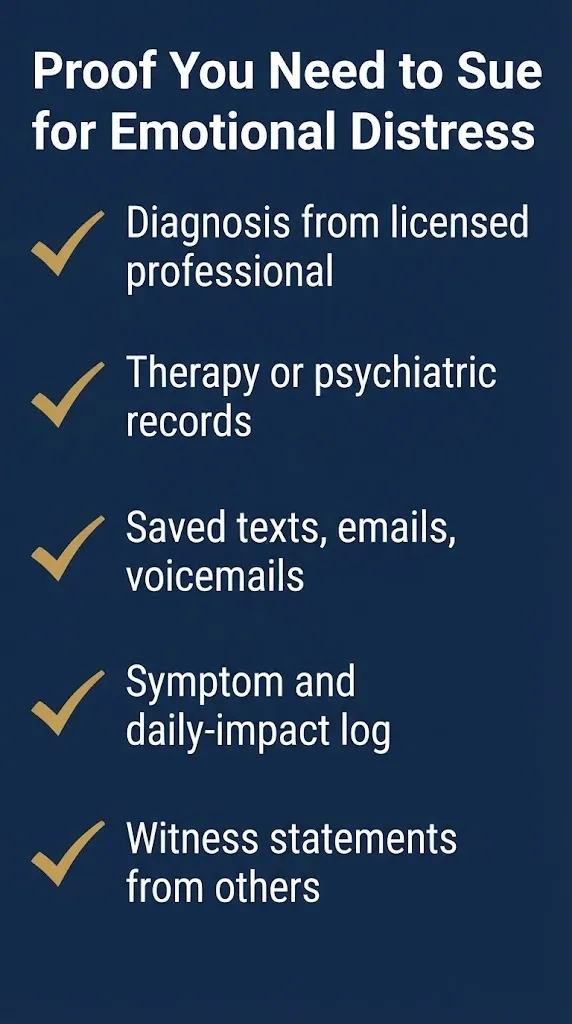
You need documented evidence connecting the defendant’s conduct directly to a real, diagnosed psychological condition. Courts do not accept your word alone.
- Get a diagnosis from a licensed therapist, psychiatrist, or medical doctor.
- Keep every therapy, counseling, or psychiatric record tied to the incident.
- Save texts, emails, voicemails, or photos showing the defendant’s conduct.
- Log dates, symptoms, and how the distress affected your daily life.
- Collect witness statements from people who saw the effects on you.
- Track lost wages or missed work tied to your symptoms.
- Avoid discussing your case publicly on social media before filing.
Key Takeaway: A diagnosis from a licensed professional, backed by dated records, is the single most important piece of evidence in any emotional distress lawsuit.
What is the difference between IIED and NIED? (BACKGROUND)
IIED means the defendant acted intentionally or recklessly. NIED means the defendant was careless, not intentional, and their carelessness still caused you severe distress.
Courts generally set a higher bar for IIED because it requires proving the conduct was “extreme and outrageous,” a legal phrase that excludes ordinary rudeness or workplace conflict. NIED claims often arise from accidents, like witnessing a loved one get seriously injured through someone else’s negligence.
- IIED example: a person makes repeated, targeted threats designed to terrify you.
- NIED example: a driver’s careless crash causes you to develop lasting anxiety, even without physical injury to you.
- Both require a real diagnosed condition, not just temporary upset.
How long do you have to file an emotional distress lawsuit? (ACTION)
Your deadline depends on your state and the type of claim, and in some states it can be as short as one year from the incident.
Tennessee sets a one-year statute of limitations for intentional torts like IIED. New York also generally allows just one year for intentional infliction claims. California and New Jersey give two years. Texas allows two years as well, generally from the date of the incident.
| State | General IIED Deadline |
|---|---|
| California | 2 years |
| New Jersey | 2 years |
| Texas | 2 years |
| Tennessee | 1 year |
| New York | 1 year (intentional torts) |
These figures come from state law overviews current as of 2026 and can shift based on whether a “discovery rule” applies, meaning the clock may start later if you didn’t immediately realize the harm. Confirm your exact deadline with a licensed attorney in your state before assuming any date above applies to your situation.
Key Takeaway: Waiting even a few months past your state’s deadline can permanently bar an otherwise strong emotional distress claim.
Can you sue your employer for emotional distress? (VERIFY)
Yes, you can sue an employer for emotional distress tied to workplace discrimination, harassment, or retaliation, usually alongside a broader employment claim.
In California, emotional distress damages are a recognized part of FEHA (Fair Employment and Housing Act) claims covering discriminatory firing, harassment, and retaliation. Under state laws like California’s SB 497, retaliation within a short window after you report harassment or request an accommodation can strengthen a claim.
- You typically must file with a state or federal agency first, like the EEOC or a state civil rights department.
- Once that agency issues a “right to sue” notice, a separate clock starts for filing in court.
- Missing either the agency deadline or the court deadline can end your case early.
Can you sue for emotional distress after a car accident? (BACKGROUND)
Yes, emotional distress is a recognized category of damages in many car accident lawsuits, even when it’s added to a broader personal injury claim.
Survivors of serious crashes sometimes develop anxiety, PTSD, or a fear of driving that outlasts their physical injuries. Courts treat this similarly to a warranty claim where the paperwork matters as much as the story: your therapy records and diagnosis carry more weight than your own account alone.
Most emotional distress claims tied to accidents get folded into the main personal injury lawsuit rather than filed separately, since it’s more efficient to resolve both together.
Can you sue a city or government employee for emotional distress? (BACKGROUND)
You can sue a city employee for intentional infliction of emotional distress, but suing the city itself is harder because of tort immunity laws.
Most states protect local governments and employees acting in their official capacity from negligence claims. There are exceptions depending on the specific conduct and state law. Small claims courts, which some people use for lower-value emotional distress disputes, also cap how much you can recover, and those limits vary widely by state, from $2,500 in Kentucky up to $20,000 or more in states like Texas and Delaware.
How is emotional distress calculated in a settlement? (MONEY)
There’s no universal formula, but attorneys and insurers often use two common approaches to estimate non-economic damages like emotional distress.
The “multiplier method” takes your economic damages, like medical bills, and multiplies them by a number reflecting severity, often between 1.5 and 5. The “per diem method” assigns a daily dollar value to your suffering and multiplies it by how long the distress lasted or is expected to last.
Neither method guarantees an outcome. Insurance adjusters, juries, and judges all weigh severity, duration, and documentation differently, which is why no article can responsibly promise a set number without reviewing your case.
What happens if you win an emotional distress case? (STATUS)
If you win, the court or a settlement agreement orders the defendant, or their insurer, to pay the damages awarded, which can include your therapy costs, lost wages, and pain and suffering.
Most cases settle before trial, similar to how most disputes end with a negotiated agreement rather than a courtroom verdict. If your case does go to trial and you win, the defendant can sometimes appeal, which can delay payment.
What Happens Next
Filed: you or your attorney file a complaint in civil court naming the defendant and describing their conduct.
Discovery: both sides exchange evidence, records, and witness statements, a process that can take several months to over a year.
Negotiation or trial: most cases settle during this stage; unresolved cases proceed to trial.
Judgment or settlement: the court or a negotiated agreement sets the compensation amount.
Expected 2026 to 2027: timelines vary enormously by court backlog and case complexity, so there is no fixed schedule for an individual lawsuit the way there is for a class settlement.
Frequently Asked Questions
Can you sue someone for emotional distress with no evidence?
No, courts require documented proof, usually a diagnosis from a licensed mental health professional.
Testimony alone is rarely enough to win a contested case.
Is intentional infliction of emotional distress hard to prove?
Yes, courts set a high bar requiring conduct that is “extreme and outrageous,” beyond ordinary rudeness.
Most everyday conflicts, even upsetting ones, don’t meet this legal standard.
Do you need a lawyer to file an emotional distress lawsuit?
You aren’t legally required to have one, but these cases are fact-heavy and hard to win alone.
Most personal injury and employment attorneys handling these cases work on contingency, meaning no upfront fee.
What is the average settlement for emotional distress?
There is no average figure because every case depends on its own facts, state, and evidence.
Treat any website promising a specific dollar amount without reviewing your case with skepticism.
Can emotional distress be added to a personal injury claim?
Yes, it’s commonly included as a non-economic damage within a larger personal injury or malpractice lawsuit.
This is more common than filing emotional distress as its own standalone case.
How long does an emotional distress lawsuit take?
It depends on your court’s caseload and whether the case settles or goes to trial.
Discovery alone can take several months to over a year before any resolution.
Can you sue for emotional distress from workplace harassment?
Yes, emotional distress damages are a recognized part of many workplace discrimination and harassment claims.
You typically must file with a state or federal agency before suing in court.
Is there a class action for emotional distress lawsuits?
No, emotional distress is filed as an individual claim tied to your specific facts, not a shared class fund.
Any site describing a mass “emotional distress settlement” for the general public should be checked against a real court docket.
If you believe you have grounds for an emotional distress claim, the clock is already running. Start gathering your medical records and consult a licensed attorney in your state before your statute of limitations closes, sometimes in as little as one year.
There is no settlement website to check here, because this isn’t one case, it’s a legal option available to individuals nationwide in 2026.