Class Action Lawsuit Definition 2026: What It Means, How It Works, and Why You Got That Notice
Quick Answer:
- A class action lawsuit lets one or a few people sue on behalf of a much larger group with the same legal injury.
- Payouts range from a few dollars to thousands per person depending on the fund size and number of valid claims filed.
- The most critical step when you receive a notice is checking the claim deadline, missing it means you get nothing.
You searched this because you got a postcard or an email saying you are part of a class action, or because you saw a headline about a massive settlement and wondered if there is money waiting for you. You want the straight answer: what is this thing, is it real, do I get paid, and what do I have to do. This article gives you that answer without the legal jargon or the hype.
Class actions touch nearly every consumer in America. If you bought a product, used an app, worked a job, took a medication, or owned a stock, you have probably been a class member at some point. The system processes billions in claims each year. Yet most people ignore settlement notices, leaving money unclaimed. That is the system’s dirty secret. It only works if you participate.
This article explains what a class action lawsuit is in plain terms, how the process works from filing to payment, what your rights are when you receive a notice, how much money you can realistically expect, and how to spot real settlements versus scams. One fact that might surprise you: in many class actions, fewer than 10 percent of eligible claimants file claims, which means the people who do file often get more than the initial per-person estimates.
The Facts
| Detail | Information |
|---|---|
| Governing Rule | Federal Rule of Civil Procedure 23 (federal); analogous state rules |
| Annual Filings | Over 12,000 class actions filed in U.S. federal and state courts annually |
| Typical Duration | 1 to 4 years from filing to settlement |
| Average Settlement | Consumer class actions: $2 million to $50 million. Securities and antitrust: often $100 million+ |
| Per-Person Payout | Typically $5 to $500 for consumer cases. Can be thousands for employment or injury cases |
| Claim Filing Fee | Always zero dollars. Filing a claim in a class action settlement is free |
| Opt-Out Right | Every class member has the right to exclude themselves and preserve the right to sue individually |
What Is a Class Action Lawsuit in Simple Terms?
A class action lawsuit is a legal case where one person or a small group of people sues on behalf of a much larger group who all suffered the same harm. Instead of 100,000 people each filing their own identical lawsuit, one case represents everyone. The court consolidates the claims, resolves them in one proceeding, and if the case wins or settles, distributes the proceeds to the group, called the class.
The harm has to be common. Everyone in the class must have experienced the same or substantially similar injury from the same conduct. A data breach that exposed 10 million customers’ personal information. A defective product sold to 2 million people. An employer that systematically underpaid 50,000 workers. These are classic class action scenarios. The common injury ties everyone together and makes individual lawsuits wasteful.
The remedy is also shared. If the case settles for $50 million, that money is divided among everyone in the class who files a valid claim. The division is rarely equal. It usually follows a formula: how long you were affected, how much you lost, what documentation you have. But the principle is collective. The class wins or loses together.
Key Takeaway: A class action aggregates many small claims into one big case, making it economically viable to sue over harms that would cost more to litigate individually than they are worth.
What Does Class Action Litigation Mean?
Class action litigation means the entire legal process of suing as a group, from the initial complaint through class certification, discovery, trial or settlement, and distribution of the award. It is a specialized form of civil litigation with its own procedural rules. Federal Rule of Civil Procedure 23 governs class actions in federal courts. Each state has its own analogue, often modeled on Rule 23 but with variations that can change the outcome of a case depending on where it is filed.
The defining feature of class action litigation is class certification. A lawsuit is not a class action just because a lawyer puts “class action” in the complaint title. The judge must formally certify the class after finding that the plaintiffs satisfy Rule 23’s requirements: numerosity (too many people to join individually), commonality (shared legal questions), typicality (the named plaintiffs’ claims resemble the class’s), and adequacy (the lawyers and plaintiffs will fairly represent the class). Without certification, the case proceeds as an individual lawsuit.
Class action litigation is expensive and slow. Discovery alone can take years and cost millions. Defendants fight certification aggressively because losing that motion transforms a one-person dispute into a bet-the-company case. Plaintiffs’ lawyers advance millions in costs with no guarantee of recovery. This is why class action settlements, when they happen, are hard-fought and why the fee awards to class counsel, typically 20 to 33 percent of the fund, reflect the risk they took.
How Does a Class Action Lawsuit Work Step by Step?
A class action lawsuit follows a structured process that takes years from start to finish. Understanding the steps helps you understand what that settlement notice in your mailbox actually represents and where your case is in the pipeline. Here is how it works, from complaint to check.
- A plaintiff files a complaint alleging the defendant harmed a group of people in the same way.
- The plaintiff moves for class certification, asking the judge to let the case proceed as a class action.
- The judge grants or denies certification. If denied, the case continues as an individual suit or dies.
- If certified, both sides engage in discovery, exchanging documents, taking depositions, and hiring experts.
- The defendant may move for summary judgment to end the case without trial. The judge rules.
- If the case survives, the parties typically negotiate a settlement rather than risk trial.
- The proposed settlement is filed with the court. The judge grants preliminary approval.
- Notice goes to the class. This is the postcard or email you receive.
- A fairness hearing is held. Objectors can speak. The judge grants or denies final approval.
- If approved and appeals resolve, the claims administrator processes claims and distributes payments.
This is like a group tax refund that requires a judge to approve the distribution formula. You do not get paid until every step is complete, and the process can take years after you file your claim. The notice you receive at step 8 is the moment you learn the case exists, not the moment you get paid.
Key Takeaway: The settlement notice is the start of your involvement, not the end. You still need to file a claim, and you still need to wait months or years for payment.
What Is the Meaning of a Class Action Suit?
A class action suit means a lawsuit designed to resolve a common dispute for an entire group in one proceeding. The phrase “class action suit” is interchangeable with “class action lawsuit.” The defining feature is collective representation. You do not hire a lawyer. You do not pay a filing fee. You do not attend court. The named plaintiffs and class counsel do the work. You are a passive beneficiary unless you choose to opt out and pursue your own case.
The meaning extends beyond the legal definition. Class actions serve a regulatory function. They deter corporate misconduct that causes small-dollar harm to large populations, harm that no individual would sue over. A bank that illegally charges $20 fees to 5 million customers steals $100 million. No single customer sues over $20. A class action can recover that $100 million. This is the economic logic of the device. It turns unenforceable rights into enforceable ones.
Class actions also redistribute power. The defendant, typically a corporation with deep pockets, faces plaintiffs who individually lack resources. Aggregation levels the field. The plaintiffs’ lawyer, working on contingency, invests millions to match the defendant’s legal spend. When it works, the class gets compensation and the defendant stops the behavior. When it fails, the plaintiffs’ lawyer loses the investment and the class gets nothing.
How Is a Class Action Different From a Regular Lawsuit?
A class action differs from a regular lawsuit in scope, procedure, and control. In a regular lawsuit, one plaintiff sues one defendant for one injury. The plaintiff hires the lawyer, makes the decisions, and keeps the recovery. In a class action, the named plaintiff represents thousands or millions of absent class members who did not choose the lawyer and may not even know the case exists until they receive a settlement notice.
The procedural differences are substantial. A regular lawsuit starts when the complaint is filed. A class action does not truly begin as a class case until the judge certifies the class, which can take years. Settlement in a regular case requires agreement between the two parties. Settlement in a class action requires that plus court approval after notice to the class and a fairness hearing. The judge acts as a fiduciary for absent class members, reviewing the settlement for fairness, reasonableness, and adequacy.
The opt-out right is unique to class actions. In a regular lawsuit, you are either a party or you are not. In a class action, you are automatically included unless you affirmatively exclude yourself. Opting out preserves your right to sue individually. Staying in means you are bound by the outcome and cannot sue later over the same conduct. This is the single most important strategic decision a class member makes, and most people never make it because they throw the notice away without reading it.
| Feature | Regular Lawsuit | Class Action |
|---|---|---|
| Who sues | One plaintiff | One or more named plaintiffs for a group |
| Who controls | The plaintiff | Class counsel, subject to court oversight |
| Who pays legal fees | The plaintiff | Contingency fee from the settlement fund |
| Settlement approval | Private agreement between parties | Court must approve after fairness hearing |
| Opt-out right | None | Every class member can exclude themselves |
| Typical payout | Full damages for one person | Pro rata share of settlement fund |
Who Can Be Part of a Class Action Lawsuit?
You can be part of a class action lawsuit if you fit the class definition in the settlement notice or court order. The class definition is a precise description of who is included. It typically specifies a time period (the class period), a geographic scope, and the conduct or product at issue. If you purchased a specific product between certain dates, or worked for a company in a certain role during a certain window, or had your data exposed in a specific breach, you are probably in the class.
You do not need to do anything to become a class member. Membership is automatic if you satisfy the class definition. This is called passive inclusion. You are in unless you opt out. You may not even know you are in until a notice arrives. Your rights as a class member include filing a claim for your share of the settlement, objecting to the settlement if you think it is unfair, or opting out entirely to preserve your right to sue individually.
The class definition is binding. If you are close but do not quite fit, you are not in the class and cannot claim settlement money. If you bought the product one day outside the class period, you are not a class member. If you lived in a state not covered by the settlement, you are not a class member. The lines are bright and courts enforce them strictly.
Key Takeaway: You become a class member automatically if you fit the definition. You get paid only if you file a claim. Being in the class is not the same as getting a check.
How Much Money Do You Get From a Class Action?
Class action payouts range from pocket change to five figures depending on the type of case, the size of the settlement fund, and how many people file valid claims. Consumer class actions involving small overcharges or privacy violations typically pay $5 to $75 per person. Employment class actions for unpaid wages can pay thousands. Securities class actions can pay significant sums to large shareholders but pennies to retail investors. Antitrust class actions against drug companies or tech firms have generated per-person payouts in the hundreds or low thousands for consumers who overpaid.
The math is simple and unforgiving. Take the settlement fund. Subtract attorney fees, usually 20 to 33 percent. Subtract administrative costs. Subtract any service awards to the named plaintiffs. What remains is the net fund available to the class. Divide that by the number of valid claims. That is your check. If the fund is $10 million, fees are $3 million, costs are $500,000, and 200,000 people file claims, the per-person payout is $32.50. If only 50,000 file, it jumps to $130. Lower claim rates mean higher payouts for the people who bother to file.
| Case Type | Typical Payout Range | Example Cases (2024 to 2026) |
|---|---|---|
| Consumer Overcharge | $5 to $100 | TurboTax, chicken price-fixing |
| Data Breach | $25 to $500 | Equifax, T-Mobile |
| Employment (Wage & Hour) | $500 to $10,000 | Google, Amazon misclassification |
| Securities Fraud | Pennies to thousands | Various shareholder suits |
| Antitrust | $50 to $1,000 | Generic drug pricing, tech platform suits |
| Product Defect | $20 to $500 | Medical devices, auto parts |
Reality Check: Most class action checks are not life-changing. They are modest compensation for modest harms. Anyone promising you thousands from a consumer class action is selling you a fantasy. File the claim because the money is rightfully yours, not because you expect it to pay the rent.
How Do I File a Class Action Claim?
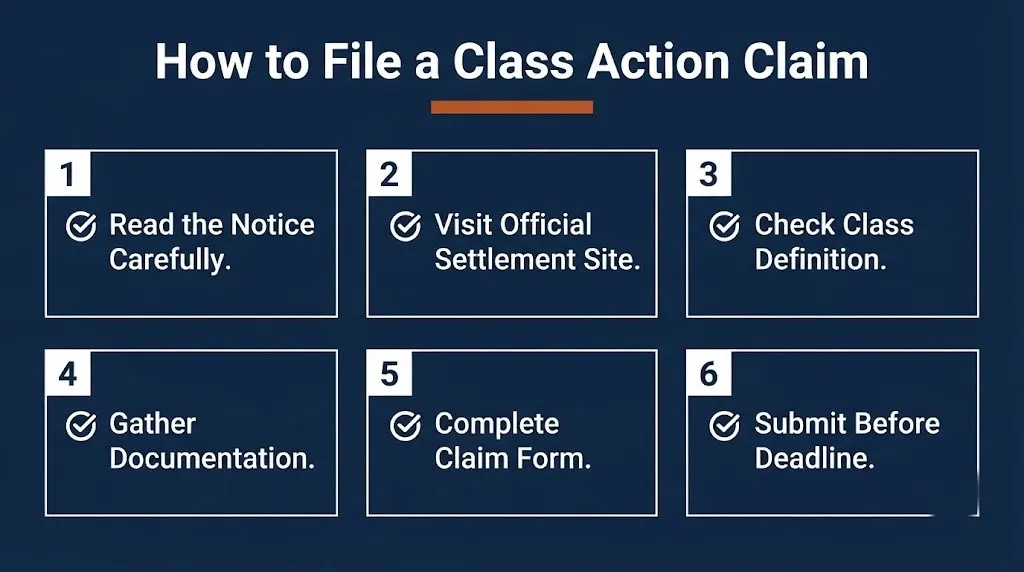
Filing a class action claim is free and generally straightforward. You do not need a lawyer. You do not pay a filing fee. The claim form is on the official settlement website. The process is designed to be completed in under 15 minutes for most consumer cases. Here is how it works:
- Read the settlement notice carefully. Identify the official settlement website and the claim deadline.
- Visit the official settlement website, never a third-party site that appears in a search ad.
- Check that you fit the class definition before filling anything out.
- Gather documentation if required: receipts, account numbers, employment records, medical records.
- Complete the online claim form or download and mail the paper version.
- Submit before the deadline and save the confirmation number or take a screenshot.
- Wait. Processing takes months. The website will have a claim-status lookup tool.
The administrator verifies claims by cross-referencing with the defendant’s records or reviewing uploaded documentation. If your claim is rejected, you will be notified and given a chance to correct deficiencies. This is not the same as a denial of benefits. It usually means your documentation was incomplete. Fix it and resubmit if the deadline has not passed.
What Is a Class Action Settlement Notice?
A class action settlement notice is a court-ordered communication informing you that you are a member of a class in a case that has settled. It is not junk mail. It is not a scam, though scammers have learned to imitate these notices. A legitimate notice comes from a court-appointed claims administrator like Epiq, Kroll, JND Legal Administration, or Rust Consulting. It includes the case name, the court, the settlement fund amount, the claim deadline, and instructions for filing a claim, objecting, or opting out.
The notice arrives because the defendant’s records show you may be a class member. The judge ordered notice to be sent to everyone reasonably identifiable. If you receive one, read it. The deadline on that notice is real and will not be extended. Tossing it in the trash is the equivalent of throwing away a check, though the check requires you to fill out a form first.
If you did not receive a notice but believe you are a class member, you can still file a claim. Search the case name on the settlement administrator’s website. If you fit the class definition, you are entitled to file even if the notice went to an old address or got lost in the mail. The class definition, not the mailing list, controls eligibility.
Can You Opt Out of a Class Action and Why Would You?
Yes, you can opt out of a class action. Opting out means you exclude yourself from the settlement. You do not get any settlement money. You do not release your claims. You preserve the right to sue the defendant on your own. The opt-out deadline is listed in the settlement notice. It is usually earlier than the claim deadline. If you miss it, you are stuck in the class.
You would opt out if your individual damages are substantially higher than what the class settlement offers and you want to pursue your own case. If you suffered a serious injury from a product that generated a class action over minor economic losses, the class settlement might give you $50. Your individual case could be worth six figures. Opting out lets you pursue that. You need your own lawyer. You need evidence. You need the resources to litigate. Most people do not opt out because most class member injuries are small and individual litigation makes no economic sense.
Opting out is irreversible. Once the deadline passes, you are a class member bound by the settlement. You cannot later change your mind and sue. This is a one-way door. Make the decision deliberately, ideally after consulting a lawyer if your individual damages are significant.
Key Takeaway: Opt out if your individual claim is worth far more than the settlement payout. Stay in if the settlement payout is the only realistic way you will ever be compensated. Most people should stay in.
How Long Does a Class Action Take to Pay Out?
A class action takes 12 to 36 months after settlement approval to pay out, and the full case can take 3 to 6 years from filing to final distribution. The timeline is long because each step requires court time, notice periods, and administrative processing. Appeals can add a year or more. A case filed in 2022 might not pay until 2026. A case filed in 2024 might not pay until 2028.
The post-settlement timeline works like this. After the judge grants final approval, there is a 30-day appeal window (longer in some jurisdictions). If no one appeals, the settlement becomes final. The administrator then processes claims, which can take 3 to 9 months depending on volume and complexity. If claims exceed expectations, the administrator must verify each one, reject invalid claims, and calculate pro rata shares. After that, payments are issued. This whole sequence rarely takes less than 6 months and often takes a year or more after final approval.
If an appeal is filed, the timeline extends by 12 to 24 months while the appellate court reviews the settlement. Objectors with frivolous appeals can delay payment for the entire class, which is a controversial feature of the system that Congress and the courts have debated reforming but have not yet fixed as of 2026.
What Are the Pros and Cons of Class Actions?
Class actions have significant advantages and real limitations. Understanding both helps you evaluate whether a settlement is fair and whether you should participate. The system is imperfect. It compensates some people, enriches some lawyers, deters some misconduct, and leaves money on the table when claim rates are low. Here is the honest balance sheet.
Pros:
- They make small claims viable. A $20 overcharge multiplied by 5 million people is a $100 million case.
- They deter corporate misconduct. The threat of aggregation forces companies to comply with the law.
- They require no upfront cost from class members. Filing a claim is free.
- They create binding precedent and behavioral change, sometimes more effectively than regulation.
Cons:
- Per-person payouts are modest. Most consumer class action checks are under $100.
- The process is slow. Years pass between injury and payment.
- Attorneys take a significant cut. A 25 percent fee on a $100 million settlement means $25 million goes to lawyers.
- Claim rates are low, typically 1 to 10 percent, meaning most class members never get compensated.
- Cy pres distributions, where unclaimed money goes to charity rather than class members, are controversial.
How Has Class Action Law Changed in 2026?
Class action practice in 2026 has been shaped by recent Supreme Court decisions, changes to federal rules, and the growing role of artificial intelligence in claims processing. The most significant development is the Supreme Court’s continued refinement of standing requirements, making it harder to certify classes where some members suffered no concrete injury. Courts now scrutinize class definitions more carefully, requiring plaintiffs to show that every class member, or at least the vast majority, has Article III standing to sue.
Claims administration has become more digital and more fraud-resistant. Administrators now use AI-driven document review to verify claims faster and catch duplicate or fraudulent submissions. Some settlements offer digital payment through PayPal, Venmo, Zelle, or ACH direct deposit, reducing the number of uncashed paper checks. The shift to digital notice, primarily through email and targeted online ads, has continued, though mailed postcards remain the primary method for reaching class members without reliable digital contact information.
Cy pres reform remains debated but unresolved. Several bills introduced in Congress in 2025 and 2026 would require unclaimed settlement funds to be redistributed to class members or revert to the defendant rather than being donated to third-party organizations. None have passed as of mid-2026. The current system, where judges approve cy pres recipients that often include organizations with connections to class counsel or the judiciary, continues to draw criticism.
Key Takeaway: Class actions in 2026 are harder to certify, more digital in administration, and still plagued by the unresolved cy pres debate. The fundamental structure, aggregation of small claims for collective resolution, remains intact.
What Happens Next
Class action law in the remainder of 2026 and into 2027 will be shaped by several pending developments. Here is what to watch:
Ongoing 2026: Supreme Court continues to refine standing and class certification standards through cases on its docket.
Late 2026 to 2027: Possible legislative action on cy pres reform, driven by bipartisan concern about unclaimed settlement funds going to affiliated charities rather than class members.
2027: Continued adoption of AI claims processing by major administrators, potentially reducing processing times from 9 months to 4 to 6 months.
Watch for: Any Supreme Court decision that significantly narrows class certification under Rule 23(b)(3), which governs the most common type of class action, the damages class. A restrictive ruling could reshape the entire field.
Frequently Asked Questions
What Is a Class Action Lawsuit?
A class action lawsuit is a legal case where one or more plaintiffs sue on behalf of a larger group with the same injury.
The group, called the class, shares in any settlement or judgment.
Class actions make it possible to sue over small-dollar harms that would be uneconomical to litigate individually.
How Do I Know If I Am Part of a Class Action?
You are a class member if you fit the class definition in the settlement notice or court order.
The notice typically specifies dates, locations, and the product or conduct at issue.
You can also search the case name on the settlement administrator’s website to check eligibility.
How Much Will I Get From a Class Action Settlement?
Most consumer class actions pay between $5 and $500 per person depending on the fund size and claim volume.
Employment and injury cases can pay thousands.
The exact amount is the net fund divided by the number of valid claims, so final amounts are not known until after the claim deadline.
Do I Need a Lawyer to File a Class Action Claim?
No. Filing a claim in an existing class action settlement is free and does not require a lawyer.
The claim form is on the official settlement website.
You only need a lawyer if you want to opt out and file your own separate lawsuit.
What Happens If I Do Nothing When I Get a Class Action Notice?
If you do nothing, you remain in the class but you receive no money.
You also give up the right to sue the defendant separately over the same conduct.
To get paid, you must file a claim before the deadline.
Can I File Multiple Class Action Claims?
Yes. Each class action is independent. Filing a claim in one does not affect your eligibility for another.
You can participate in as many settlements as you qualify for.
There is no limit on how many class action claims you can file.
How Long Does It Take to Get a Class Action Settlement Check?
Most settlements pay within 6 to 18 months after the claim deadline passes.
Appeals can extend the timeline by a year or more.
The settlement website will have a claim-status tool and estimated payment dates once available.
Is a Class Action Settlement Notice a Scam?
A legitimate notice comes from a court-appointed administrator, lists a real court and case name, and never asks for payment.
Scam notices pressure you, ask for bank passwords or upfront fees, and have short or fake deadlines.
When in doubt, search the case name independently rather than clicking links in the notice.
Your next step depends on where you are in the process. If a settlement notice is sitting on your counter, read it today. Identify the deadline. If you qualify, file the claim now. It takes minutes and costs nothing. If you are waiting for payment on a claim you already filed, use the claim-lookup tool on the settlement website rather than calling a lawyer. The administrator has the most current information about your payment status.
The class action system works, but only for people who participate. Tossing the notice and doing nothing is the most common choice. It is also the choice that leaves money in the fund for everyone else.