Compensation Synonym 2026: Legal Terms, Settlement Language, and What Words Actually Mean in Your Claim
Quick Answer:
- Common synonyms for compensation in legal contexts include damages, restitution, recompense, indemnification, and remuneration, but each carries a distinct legal meaning.
- The word used in your settlement agreement determines tax treatment, payment structure, and your rights if payment is late.
- In class actions and injury claims, “compensation” almost always means a cash payment, but how it is categorized changes everything about your payout.
You searched this because you are reading a settlement notice, a legal document, or a demand letter and you want to know what the words actually mean. Or you are writing something yourself, a claim, a complaint, a negotiation, and you need the right term. Compensation sounds simple. It is not. The word you choose determines whether your payment is taxed as income, whether it is protected in bankruptcy, and whether accepting it bars you from suing again.
This matters for anyone dealing with a legal claim, an insurance settlement, an employment dispute, or a class action notice. The difference between “damages” and “restitution” can be thousands of dollars in taxes. The difference between “indemnification” and “settlement” can determine whether you sign away your right to pursue other claims. Words are the architecture of legal agreements, and picking the wrong one is like framing a house with the wrong blueprint.
This article covers every major synonym for compensation used in legal, employment, and insurance contexts in 2026, what each word specifically means, when to use which one, and the practical consequences of each term. One fact that surprises most people: in many class action settlements, what you receive is technically not “compensation” at all under the tax code, a distinction that can save you from owing the IRS a portion of your settlement check.
The Facts
| Detail | Information |
|---|---|
| Topic | Synonyms and antonyms for compensation in legal, employment, and settlement contexts |
| Primary Terms | Damages, restitution, recompense, indemnification, remuneration, redress, reimbursement, settlement, award |
| Antonyms | Forfeiture, penalty, deprivation, loss, nonpayment, denial |
| Tax Distinction | Compensatory damages for physical injury are typically not taxable. Punitive damages and emotional distress damages are taxable |
| Context Dependency | The same word can have different meanings in workers compensation, class actions, personal injury, and employment law |
| Most Precisely Used In | Settlement agreements, court orders, demand letters, insurance policies, employment contracts |
What Is Another Word for Compensation?
The most common and legally precise another word for compensation is damages. Damages refers to money awarded by a court or agreed to in a settlement that is intended to make the injured party whole. It is the standard term in personal injury, breach of contract, and most civil litigation. When a judge orders a defendant to pay the plaintiff $100,000, the order says “damages,” not “compensation,” though the two words are functionally interchangeable in everyday use.
The distinction matters because “damages” carries a specific legal history. Damages are compensatory when they reimburse actual losses. They are punitive when they punish the wrongdoer. They are nominal when the plaintiff wins but suffered minimal harm, think $1 verdicts. Each subtype has different tax treatment, different insurability, and different implications for future litigation. Calling everything “compensation” erases those distinctions.
Other precise synonyms include restitution, recompense, and indemnification. Restitution means giving back what was taken, returning the plaintiff to the position they occupied before the harm. Recompense is the broadest term, covering any payment made in return for loss or suffering. Indemnification is a contractual promise to cover someone else’s losses, common in insurance and business agreements. Each word opens a different legal door.
Key Takeaway: In legal documents, use “damages” for court-awarded money, “restitution” for returning what was taken, and “indemnification” for contractual reimbursement. Using the wrong synonym can change your legal rights.
Which Word Is a Synonym of Compensation?
At least a dozen words function as synonyms of compensation in different legal and professional contexts. The most common are damages, restitution, recompense, remuneration, indemnification, redress, reimbursement, settlement, award, reparation, amends, and consideration. Each has a slightly different meaning and a different appropriate context. The word you should use depends entirely on what you are trying to communicate.
Remuneration is the standard term in employment law. It covers salary, wages, bonuses, commissions, and benefits. A worker’s total remuneration is everything they receive in exchange for labor. Reimbursement means repayment for money spent, usually out of pocket. If you buy a plane ticket for a work trip and the company pays you back, that is reimbursement, not compensation. The distinction avoids confusion between income and expense recovery, which matters for tax purposes and for calculating damages in wrongful termination cases.
Redress and reparation are broader, more formal terms. Redress means setting something right, often through a combination of money and changed behavior. Reparation carries historical weight, describing payments by governments to groups harmed by systemic wrongs, such as reparations for slavery or wartime atrocities. These words appear more in human rights law and international tribunals than in a typical car accident settlement.
What Are the Legal Synonyms for Compensation in Settlement Agreements?
In settlement agreements, the most legally significant synonyms for compensation are settlement payment, settlement consideration, release payment, and compromise amount. These terms do specific legal work. A settlement payment is the money changing hands. Settlement consideration is the legal term for what each side gives up to make the agreement binding. The plaintiff gives up the right to sue. The defendant gives up money. That exchange of promises and value is consideration, and it is what makes the contract enforceable.
The term “release payment” signals that the money is paid in exchange for a release of claims, a signed document in which the plaintiff gives up the right to sue on the facts giving rise to the settlement. This is the single most important document in any settlement. The release is what the defendant is buying. The payment is the price. Calling it a compensation payment is accurate but incomplete. Calling it a release payment tells everyone exactly what the deal is.
Understanding these terms helps you read a settlement notice or agreement and know what is being asked of you. If the document says “in consideration of the settlement payment, claimant releases all claims,” it means the money is the only thing you get, and you give up the right to sue over this matter ever again. The words are not boilerplate. They are the mechanism.
What Are the Antonyms of Compensation?
The antonyms of compensation in legal and financial contexts include forfeiture, penalty, deprivation, loss, nonpayment, denial, and disgorgement. Forfeiture means losing money or property as a consequence of wrongdoing, the opposite of receiving compensation. The government seizes assets. You get nothing. Penalty is a punitive payment imposed by a court or regulator, flowing from the wrongdoer to the state, not from the wrongdoer to the victim.
Deprivation and loss describe the state of being harmed without remedy. If you suffer an injury but the statute of limitations expires before you file, you experience loss without compensation. Denial is what happens when an insurer or court rejects your claim. Nonpayment is when a defendant owes but does not pay, a practical antonym that is common enough to support an entire legal practice area, judgment enforcement.
Disgorgement is a term of art in securities and antitrust law. It means giving up profits obtained through illegal conduct. Disgorgement is not compensation to victims, though the money may later be distributed to them. It is the wrongdoer surrendering the fruits of the violation. Understanding these antonyms helps you understand what compensation is not. It is not a fine. It is not a penalty. It is not a windfall. It is money meant to make the injured party whole.
| Term | Definition | Context |
|---|---|---|
| Forfeiture | Loss of money or property as a legal consequence | Criminal law, regulatory enforcement |
| Penalty | Punitive payment to the government | Civil fines, regulatory actions |
| Deprivation | Harm without legal remedy | Expired claims, sovereign immunity |
| Denial | Rejection of a claim for benefits or payment | Insurance, workers compensation |
| Nonpayment | Failure to pay an acknowledged obligation | Judgment enforcement, collections |
| Disgorgement | Surrender of illegal profits | Securities fraud, antitrust |
How Are Compensation Synonyms Used in Workers Compensation Claims?
In workers compensation claims, the terminology is specific and statutorily defined. The system uses “benefits,” not “compensation” or “damages.” A workers compensation benefit is a statutory entitlement, not a negotiated settlement. The worker receives wage-loss benefits, medical benefits, specific loss benefits, and death benefits. Each category has a precise statutory definition and a fixed calculation method. Calling your workers comp payment “damages” is technically incorrect and can create confusion about your rights.
The distinction matters because workers compensation benefits are not damages in the tort sense. You do not prove fault. You do not recover pain and suffering. The system is designed to replace the tort system with a no-fault administrative framework. Using the wrong word can blur that boundary. Injured workers sometimes believe they can settle for “compensation” and then sue for “damages.” They cannot. The workers comp settlement, called a Compromise and Release in many states, is the exclusive remedy.
Understanding this terminology protects you when you negotiate a settlement or read a workers compensation judge’s decision. The terms are not interchangeable. Your “average weekly wage” determines your “compensation rate,” which produces your “weekly benefit.” You are not receiving “pay.” You are not receiving “damages.” You are receiving a statutory benefit calculated under a specific formula. Using the right words shows you understand the system and may help you avoid agreeing to a settlement that undervalues your claim.
What Is the Difference Between Compensation and Restitution?
Compensation and restitution differ in purpose and calculation. Compensation aims to make the injured party whole by paying for the harm suffered, including losses that are difficult to quantify like pain and suffering. Restitution aims to return the parties to the position they were in before the wrongful act by requiring the wrongdoer to give back what was taken. Compensation looks forward to the plaintiff’s loss. Restitution looks backward to the defendant’s gain.
If someone steals $10,000 from you, restitution requires them to return $10,000. Compensation might be higher if the theft caused additional losses, like overdraft fees, damage to your credit, or emotional distress. Restitution is measured by the wrongdoer’s gain. Compensation is measured by the victim’s loss. In many cases the amounts are similar. In some they diverge sharply. A defendant who profited enormously from a small harm to each of millions of plaintiffs may pay restitution of millions to each plaintiff, or the restitution may go to the government while the plaintiffs receive compensation through a separate class action.
This distinction has practical consequences in settlement negotiations. A defendant may be more willing to agree to restitution than to compensation because restitution sounds fair and is often smaller. Plaintiffs who understand the difference can push for full compensation rather than settling for restitution alone. In tax terms, restitution payments are generally not taxable if they return property that was yours. Compensation for lost income is taxable. The words you use in the settlement agreement determine the IRS treatment.
Is a Settlement the Same as Compensation?
A settlement is not the same as compensation. A settlement is an agreement to resolve a dispute. Compensation is one possible outcome of that agreement. The settlement is the process and the contract. The compensation is the payment. You can have a settlement with no compensation at all, such as when a defendant agrees to change a business practice in exchange for the plaintiff dropping the case. You can have compensation with no settlement, such as when a court orders payment after trial.
This distinction matters because treating settlement and compensation as synonyms leads people to misunderstand what they are signing. A settlement agreement includes much more than a payment amount. It includes release language, confidentiality clauses, non-disparagement provisions, tax allocation language, and representations about Medicare liens and other third-party interests. The compensation is one term among many. Focusing only on the dollar amount while ignoring the rest of the settlement is how people accidentally sign away rights they intended to keep.
When you read a class action settlement notice, you are reading a description of a proposed settlement, not a guarantee of compensation. The compensation arrives only if you file a claim, only if the claim is approved, and only after the settlement is finalized and all appeals are resolved. The settlement is the framework. The compensation is what you hope flows from it. The two are not synonyms. They are not even sequential steps. They are distinct legal concepts that interact but do not overlap.
Key Takeaway: A settlement is an agreement. Compensation is a payment. You can have one without the other. Understanding the difference is essential to understanding what you are signing and what you are giving up.
What Words Should You Use in a Demand Letter Instead of Compensation?
In a demand letter, you should use specific, legally recognized terms that match the nature of your claim. For a personal injury claim, use “damages” and specify the categories: economic damages for medical bills and lost wages, non-economic damages for pain and suffering. For a breach of contract claim, use “expectation damages” or “reliance damages” depending on your theory. For an employment claim, use “lost wages,” “back pay,” “front pay,” and “emotional distress damages” as appropriate.
General words like “compensation” or “fair payment” signal that you do not understand the legal basis for your claim and may result in a lower settlement offer. The adjuster or defense attorney reading your letter has seen thousands of demand letters. The ones that use precise legal terminology get taken more seriously because they suggest the writer knows what the claim is worth and how to prove it. The ones that ask for “compensation for my troubles” get lowball offers.
Here are the terms to use, organized by claim type:
- Personal injury: economic damages, non-economic damages, medical expenses, lost earnings, loss of earning capacity, pain and suffering, loss of consortium
- Employment: back pay, front pay, compensatory damages, liquidated damages, emotional distress damages, punitive damages
- Breach of contract: expectation damages, reliance damages, restitution, consequential damages, incidental damages
- Property damage: repair costs, replacement value, diminished value, loss of use
- Insurance claim: policy benefits, replacement cost, actual cash value, coverage amount
Reality Check: Insurance adjusters and defense attorneys read demand letters all day. They respond to numbers and legal theories, not adjectives. A letter that says “I want $50,000 in economic damages and $100,000 in non-economic damages supported by the attached medical records and wage statements” will get a serious response. A letter that says “I demand fair compensation for everything I went through” will not.
What Are Synonyms for Compensation in Business and Employment?
In business and employment contexts, the standard synonyms for compensation are remuneration, total rewards, pay package, and earnings. Remuneration is the most precise term, covering salary, wages, bonuses, commissions, overtime, profit sharing, stock options, and benefits. A total rewards statement from a human resources department is a compensation summary by another name, emphasizing that health insurance, retirement contributions, and paid leave are part of the employee’s economic arrangement.
In executive employment, “compensation package” is the standard term. The Securities and Exchange Commission requires public companies to disclose named executive officer compensation annually. The word “compensation” in this context has a regulatory definition that includes base salary, annual bonus, long-term incentive awards, stock options, pension value, and perquisites. Using “pay” or “salary” to describe an executive’s total compensation would be inaccurate under SEC rules.
For independent contractors and freelancers, the language shifts. Contractors receive payment, fees, or project-based compensation, not salary or wages. The distinction matters for tax purposes, for workers compensation coverage, and for determining whether the worker is properly classified. An independent contractor who describes their earnings as “salary” is using language that suggests employment, which can create misclassification risk for the hiring entity.
How Do Compensation Synonyms Differ Across Legal Practice Areas?
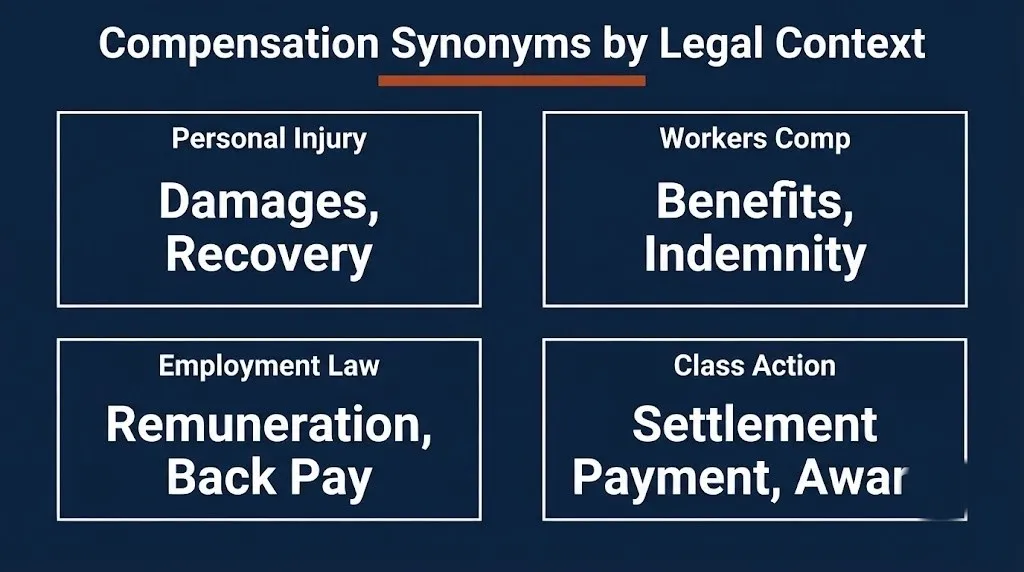
Compensation synonyms differ systematically across legal practice areas, and using the wrong term can confuse your claim or weaken your position. Here is how the terminology maps across the major areas of litigation and claims in 2026:
| Practice Area | Preferred Term | Secondary Terms | Never Use |
|---|---|---|---|
| Personal Injury | Damages | Compensation, recovery | Benefits, award |
| Workers Compensation | Benefits | Compensation rate, indemnity | Damages, settlement (until final) |
| Employment Law | Damages, back pay | Remuneration, lost wages | Benefits (confuses with workers comp) |
| Class Actions | Settlement payment, award | Recovery, compensation | Damages (rare in consumer class actions) |
| Insurance Claims | Policy benefits, coverage | Indemnification, reimbursement | Damages (suggests litigation) |
| Contract Disputes | Damages, expectation damages | Restitution, reliance damages | Benefits, compensation |
| Securities Fraud | Disgorgement, damages | Civil penalties, restitution | Settlement (until agreement reached) |
| International Law | Reparation, compensation | Restitution, satisfaction | Damages |
The table reveals a simple rule: use the term that matches your forum. A workers compensation judge decides benefits. A civil court jury awards damages. An arbitrator issues an award. A settling party makes a settlement payment. Using the wrong term in the wrong forum does not invalidate your claim, but it marks you as someone who does not know the system, and that perception affects everything from settlement negotiations to how carefully the court reviews your filings.
What Happens Next
The language of legal compensation continues to evolve in 2026, shaped by tax law changes, court decisions on settlement characterization, and the increasing use of AI in claims processing. Here is what to watch:
Ongoing 2026: IRS continues to scrutinize settlement allocations, particularly the characterization of payments as non-taxable physical injury damages versus taxable emotional distress damages.
Late 2026 to 2027: Several states considering legislation that would standardize terminology in class action settlement notices to improve consumer understanding.
Watch for: Supreme Court cases addressing the tax treatment of attorney fees in settlements, which could change the practical meaning of “compensation” for plaintiffs who have contingency fee arrangements.
Frequently Asked Questions
What Is the Best Synonym for Compensation?
There is no single best synonym. “Damages” is best for litigation. “Benefits” is best for workers compensation. “Remuneration” is best for employment.
The best word depends entirely on the context in which you are using it.
Using the wrong synonym can change the legal meaning of your document.
What Is the Opposite of Compensation?
The opposite of compensation is forfeiture, penalty, deprivation, or loss.
In legal terms, forfeiture means giving up money or property rather than receiving it.
In practical terms, nonpayment is the most common opposite, when compensation is owed but not delivered.
Is Reimbursement a Synonym for Compensation?
No. Reimbursement is repayment for money you spent. Compensation is payment for harm you suffered.
If your employer pays you back for a work expense, that is reimbursement, not taxable income.
If your employer pays you for lost wages after wrongful termination, that is compensation, and it is taxable.
What Does Compensation Mean in Legal Terms?
In legal terms, compensation means money paid to make an injured party whole.
It can take the form of damages in court, benefits in workers compensation, or a settlement payment outside court.
The legal definition is consistent across contexts, but the tax treatment and procedural rules vary dramatically.
Can I Use Compensation and Damages Interchangeably?
In everyday language, yes. In legal documents, no.
Damages is a term of art with specific subcategories: compensatory, punitive, nominal, liquidated.
Using the wrong term in a contract or settlement agreement can produce unintended consequences.
What Is Compensation Called in a Class Action?
In a class action, compensation is typically called a settlement payment, award, or recovery.
Class action notices rarely use “damages” because the case settled before trial.
The payment you receive is your share of the settlement fund.
How Do I Describe Compensation in a Demand Letter?
Use specific damage categories: economic damages, non-economic damages, lost wages, medical expenses, pain and suffering.
Avoid general terms like “compensation” or “fair payment.”
A precise demand letter gets a more serious response than a vague one.
What Is the IRS Definition of Compensation?
The IRS defines compensation broadly as any payment for services rendered or in settlement of a claim.
Settlement payments for physical injury are generally excluded from taxable compensation.
Punitive damages and interest on settlements are taxable regardless of the underlying claim type.
Your next move depends on what you are writing. If you are drafting a demand letter, use the precise terms for your claim type. If you are reading a settlement notice, understand that “settlement” means the agreement and “compensation” means the payment. If you are negotiating a severance or settlement, consult a tax professional about how the characterization of the payment affects what you keep. The words in your agreement are not just words. They are the difference between a check that clears and a check that goes partly to the IRS, or between a release that protects your rights and one that waives them.
Words are tools. Compensation is one tool among many for describing what you are owed. Use the right one.